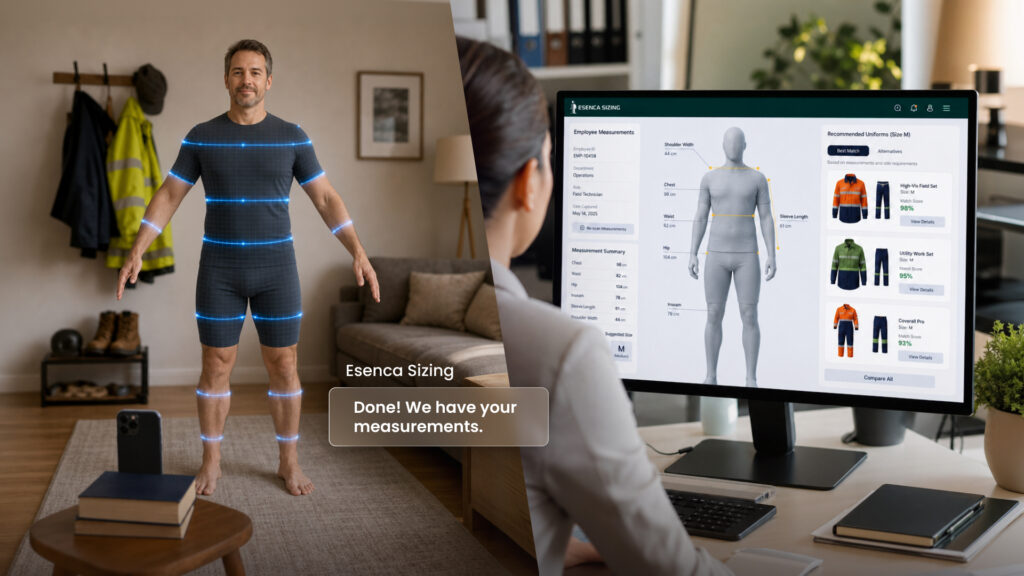



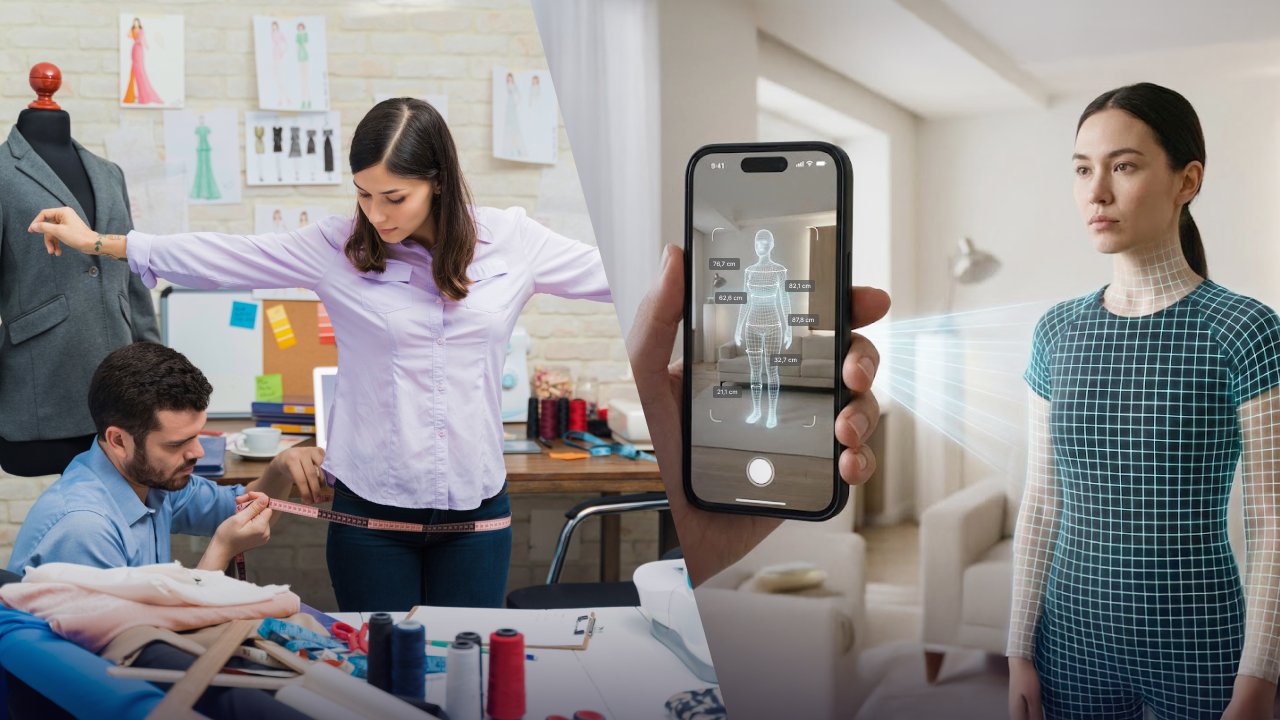
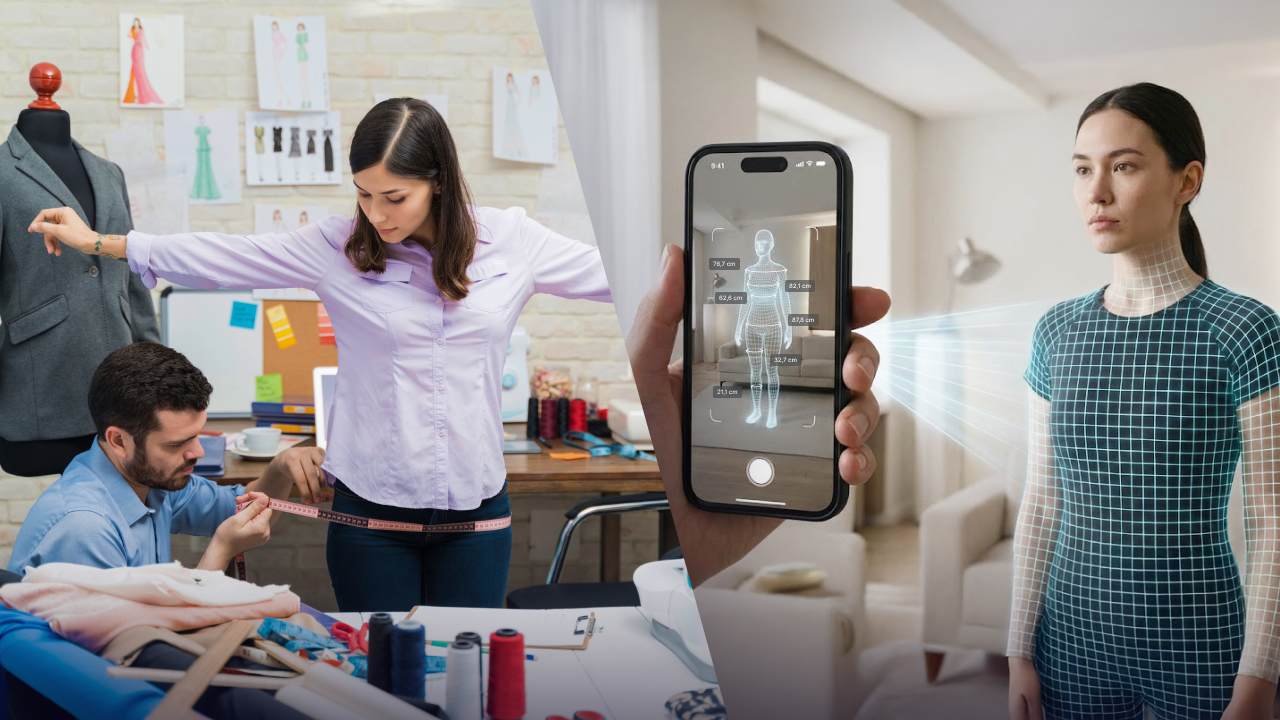
Digital body measurement has transformed from science fiction to everyday reality. What once required expensive 3D scanners, controlled studio environments, and specialised technicians can now be accomplished with a smartphone camera in under 60 seconds.
But how does this technology actually work? What happens between the moment someone takes two photos and the instant they receive precise body measurements?
This article explains the science, technology, and processes behind modern intelligent body measurement systems, breaking down complex concepts into understandable steps.
The Evolution of Body Measurement Technology
Understanding where we are requires context on where we’ve been.
Traditional Manual Measurement
For centuries, body measurements relied on physical tools—measuring tapes, callipers, and trained measurers following standardised protocols. Tailors, medical professionals, and clothing manufacturers developed elaborate systems for capturing human dimensions.
The method works but has inherent limitations: measurements vary between different measurers when they measure the same person, the process is time-consuming, it requires physical contact, and scaling to measure thousands of people presents logistical challenges.
First-Generation 3D Body Scanners
The 1990s and early 2000s brought dedicated 3D body scanning technology. These systems used various approaches:
Laser Scanning: Multiple laser beams sweep across the body, measuring distance at thousands of points to create a three-dimensional model.
Structured Light: Projectors cast light patterns onto the body while cameras capture how those patterns deform, revealing body contours.
Multi-Camera Photogrammetry: Arrays of synchronized cameras capture the body from multiple angles simultaneously, with software reconstructing 3D shape from the 2D images.
These systems delivered excellent accuracy but required significant infrastructure—dedicated rooms, expensive equipment, controlled lighting, and technical expertise. Costs ranged from tens of thousands to hundreds of thousands of dollars per installation.
The Smartphone Revolution
Mobile computing power changed everything. Modern smartphones contain high-resolution cameras, powerful processors capable of running advanced algorithms, and sophisticated sensors. This convergence of technologies has made it possible to move sophisticated body measurements from specialised facilities to everyone’s pockets.
Today’s intelligent measurement systems, operating on standard smartphones, either match or surpass the accuracy of first-generation dedicated scanners, all at a significantly lower cost and with significantly increased accessibility.
Core Technologies Behind Digital Body Measurement
Several technological disciplines converge to enable modern body measurement systems.
Computer Vision
Computer vision allows machines to extract meaningful information from visual data. In body measurement applications, computer vision algorithms perform several critical functions:
Body Landmark Detection: Identifying specific points on the human body—shoulder joints, waist position, hip points, ankle location, and dozens of other anatomical landmarks. The system must recognise these features, regardless of variations in body shape, skin tone, clothing colour, or background.
Semantic Segmentation: Determining the boundaries of the body against the background. This segmentation process separates the individual from everything else in the image, creating a clear silhouette that can be analysed for measurements.
Pose Estimation: Understanding the pose and orientation of the body in three-dimensional space based on two-dimensional images. The system must determine whether someone is standing straight, how their arms are positioned, and the angle of the camera relative to the subject.
Modern computer vision systems use deep learning neural networks trained on millions of images to perform these tasks with remarkable accuracy across diverse conditions.
Deep Learning and Neural Networks
Deep learning is currently at the forefront of machine intelligence for visual tasks. Unlike traditional programmed algorithms that follow explicit rules, neural networks learn patterns from data.
Training Process: Body measurement neural networks are trained on extensive datasets containing:
- Thousands to millions of body images from diverse populations
- Corresponding manual measurements taken by professionals
- 3D body scans providing ground truth data
- Images captured in varied conditions (different lighting, backgrounds, and clothing).
During training, the network learns to recognise patterns that correlate image characteristics with body dimensions. It discovers that certain visual features indicate specific measurements, even when those relationships are too complex for humans to articulate as explicit rules.
Model Architecture: Modern systems typically use convolutional neural networks specifically designed for image analysis. These networks process images through multiple layers, with the early layers detecting simple features like edges and colours and the deeper layers recognising complex patterns like body proportions and anatomical structures.
Continuous Improvement: As more people use the system, additional data can be collected (with appropriate consent) to further refine the models, improving accuracy over time.
3D Reconstruction
Perhaps the most impressive aspect of modern body measurement is creating three-dimensional models from two-dimensional photographs.
Depth Estimation: Using a single image or pair of images, algorithms estimate the distance from the camera to each point on the body’s surface. This creates a depth map—essentially a greyscale image where brightness represents distance.
Several techniques enable this:
- Monocular Depth Estimation: Neural networks trained to infer depth from single images by recognising visual cues like size, occlusion, texture gradients, and perspective that humans use unconsciously to perceive depth.
- Stereo Vision: When multiple images are available from slightly different angles, the system can triangulate depth similarly to how human binocular vision works, comparing differences between the images to calculate distance.
Mesh Generation: Once depth information is available, the system constructs a 3D mesh—a network of connected points representing the body’s surface. This mesh can be rotated and viewed from any angle, and it can be analysed to extract measurements.
Surface Normals: Advanced systems also calculate surface orientation at each point, understanding not just where the surface is but which direction it’s facing. This improves accuracy when extracting measurements like circumferences.
Measurement Extraction
With a 3D body model constructed, the system must extract specific measurements according to standardised definitions.
Anatomical Landmark Detection: The system identifies precise locations corresponding to measurement points defined in standards like ISO 8559-1:2017(E). For example:
- Waist circumference is measured at the waist level, defined as midway between the lowest rib point and the highest point of the hip bone at the side of the body
- Hip circumference is measured at the level of the greatest projection at the back of the body (buttocks)
- Back Shoulder breadth width is measured between the most lateral point of the lateral edge of the spine (acromial process) of the scapula, projected vertically to the surface of the skin”
Circumference computation: For circumference measurements, the system must determine the correct path around the body. This isn’t always a simple circle, ellipse or other regular geometric shape body contours are complex, a
Distance Computation: Linear measurements like inseam, or arm length require calculating distances along or between specific body landmarks, accounting for body curves and contours.
Validation: Quality systems include error checking to identify measurements that fall outside expected ranges, flagging potential issues for review or prompting users to retake photos if needed.
Step-by-Step: What Happens When You Take a Measurement
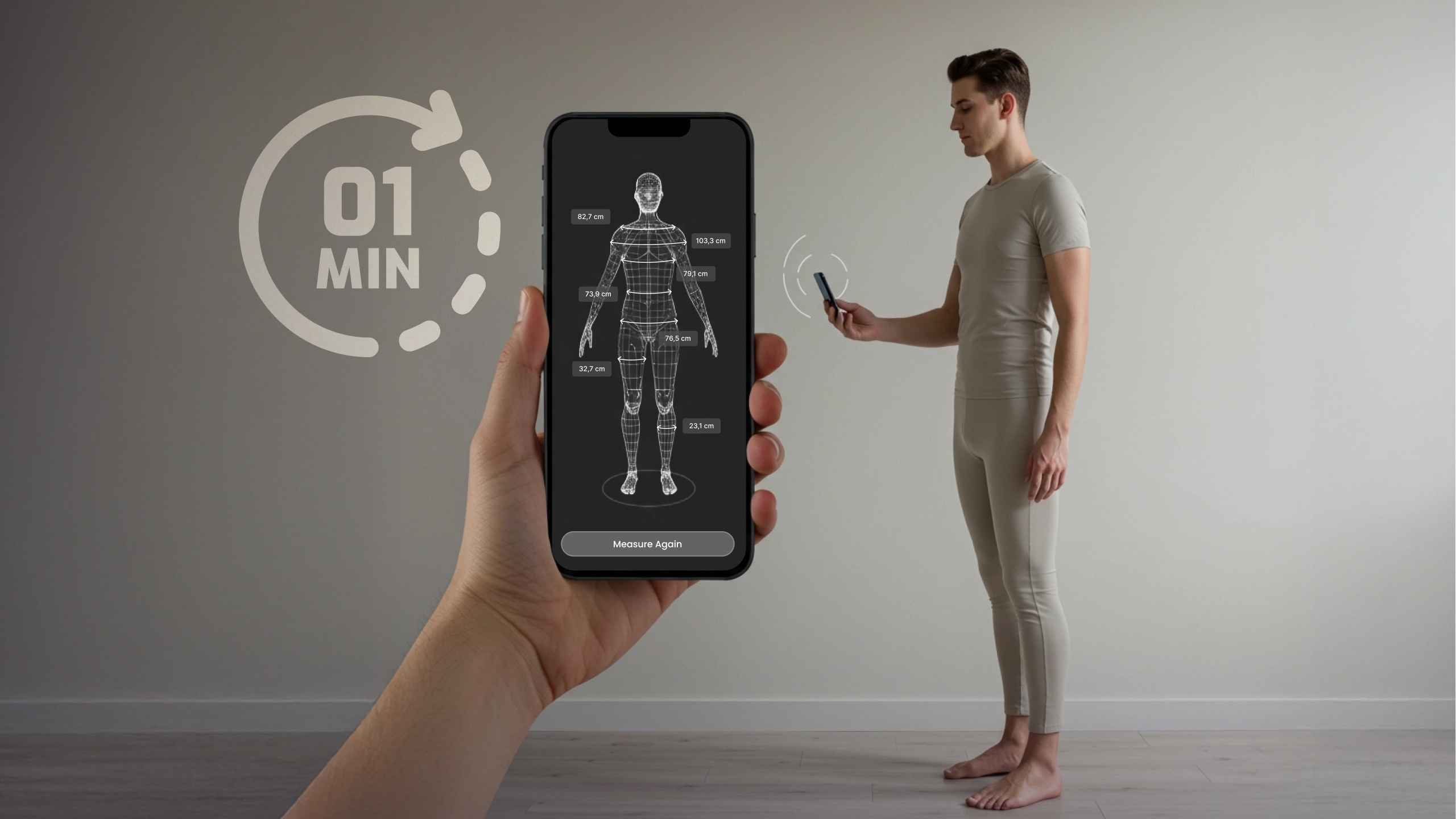
Let’s walk through the actual process from a user’s perspective and what’s happening behind the scenes.
Step 1: Image Capture
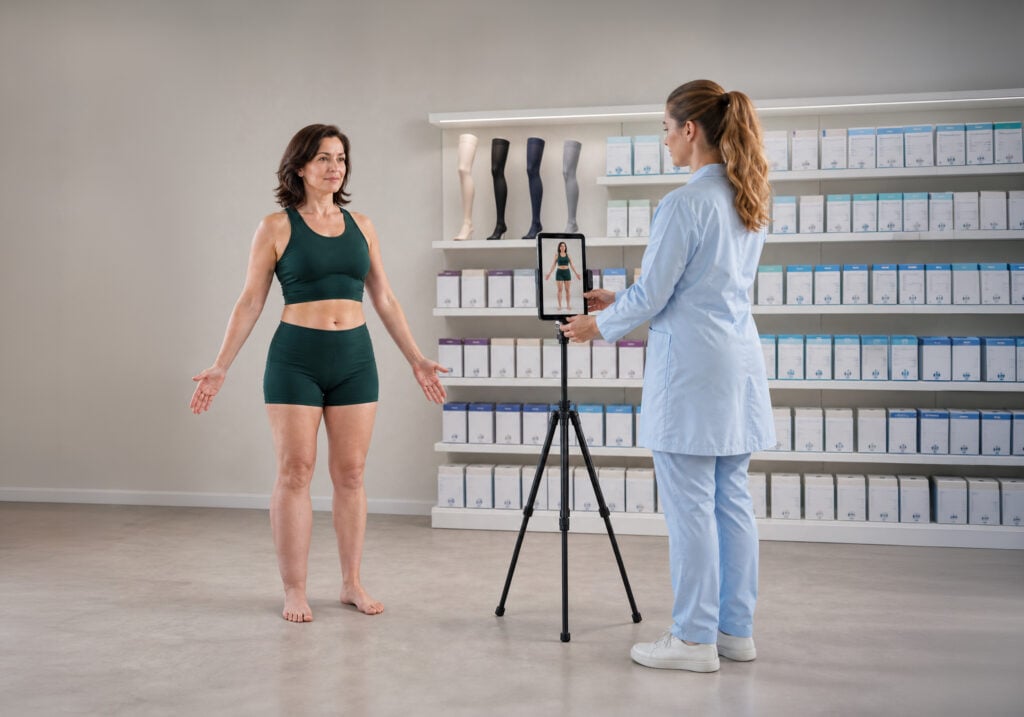
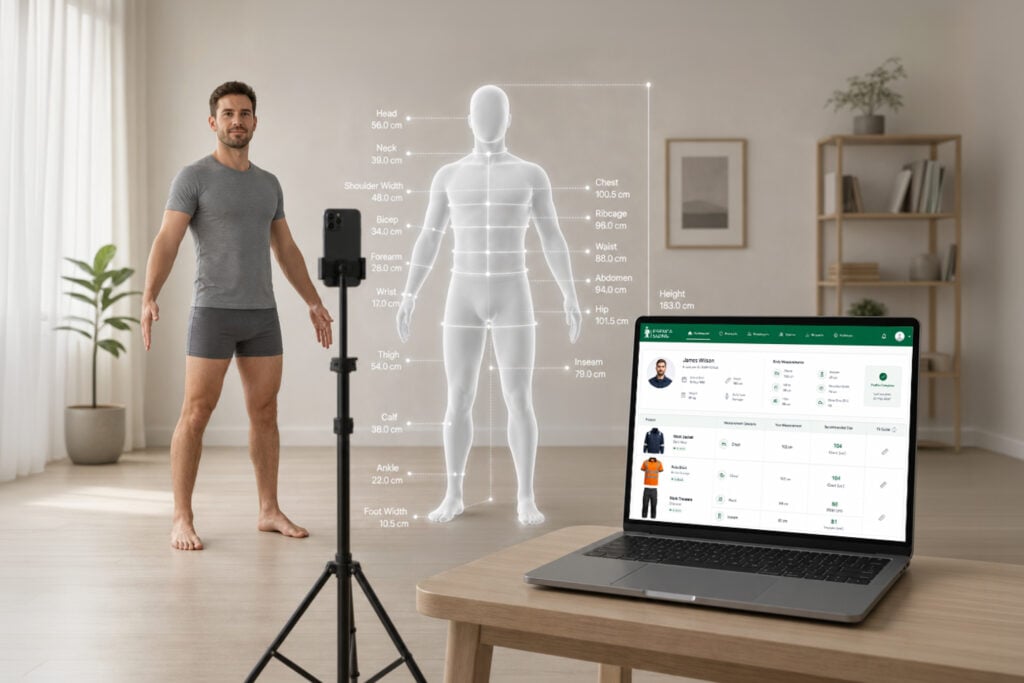
User Experience: The application provides clear instructions—typically requesting a front-facing photo and a side-facing photo. Visual guides show the correct pose (standing straight, arms slightly away from the body) and camera position (hip height, 2-3 metres away).
Behind the Scenes: Even before the photo is taken, the system may provide real-time feedback:
- Checking that lighting is adequate
- Verifying that a person is detected in the frame
- Confirming the person is at an appropriate distance
- Ensuring the pose is correct
When when the image is automatically captured by the solution, the system immediately begins quality checks:
- Is the entire body visible?
- Is the image in focus?
- Are there obstructions or occlusions?
- Is the background sufficiently clear?
If the system detects issues, it immediately provides the user with feedback to retake the photo. This prevents wasted time processing inadequate images.
Step 2: Image Preprocessing
Normalisation: Images are standardised, adjusted for brightness, contrast, and colour balance to ensure consistent input for the intelligent models, regardless of camera type or lighting conditions.
Background Segmentation: The person is separated from the background using segmentation algorithms. This creates a mask that isolates the body, eliminating visual clutter that could confuse subsequent processing.
Modern systems use sophisticated segmentation that can handle challenging scenarios:
- Complex backgrounds with multiple objects
- Backgrounds with similar colors to clothing
- Variable lighting creating shadows
- Reflective surfaces or mirrors in the background
Pose Normalisation: The system detects the body’s pose and orientation and calculates any rotation or tilt. This information is used to normalise the body to a standard reference pose, enabling consistent measurements regardless of minor variations in how the person is standing.
Step 3: Feature Detection and Landmark Identification
Anatomical Landmark Detection: Computer vision models analyse the segmented body image to identify dozens of specific anatomical points:
- Top of head
- Chin point
- Neck base
- Shoulder points (left and right)
- Armpit points
- Elbow positions
- Wrist locations
- Waist position (natural waist and hip height)
- Crotch point
- Knee centers
- Ankle positions
- Foot outlines
Advanced systems identify 50-100+ landmarks, creating a detailed skeletal structure understanding of the body.
Confidence Scoring: For each detected landmark, the system assigns a confidence score. High-confidence detections are used directly, while lower-confidence detections may trigger additional analysis or flag the measurement for quality review.
Symmetry Checks: The system verifies that left-right symmetry is reasonable. Significant asymmetries might indicate detection errors (or in medical contexts, might be clinically relevant information).
Step 4: 3D Body Model Construction
Depth Map Generation: Using a computer vision deep learning model, the system directly infers a dense depth map from the input image, estimating the distance from the camera to each point on the body surface and the rest of the scene.
3D Mesh Building: Points are connected into a three-dimensional mesh representing the body’s surface. This mesh typically contains thousands of polygons, creating a smooth representation of body contours.
Multi-View Integration: When multiple images are available (front and side views), the system integrates information from both perspectives to refine measurements estimation, improving accuracy, particularly for measurements where body depth matters significantly.
Model Smoothing: The raw 3D reconstruction may contain noise or irregularities. Smoothing algorithms refine the surface while preserving important features.
Step 5: Measurement Extraction
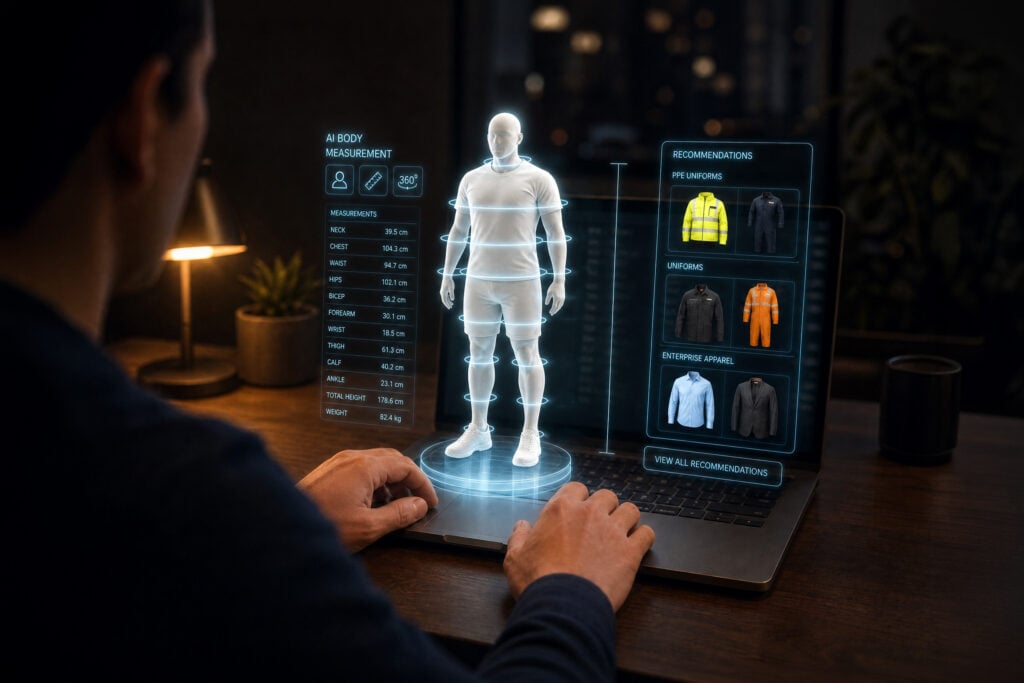
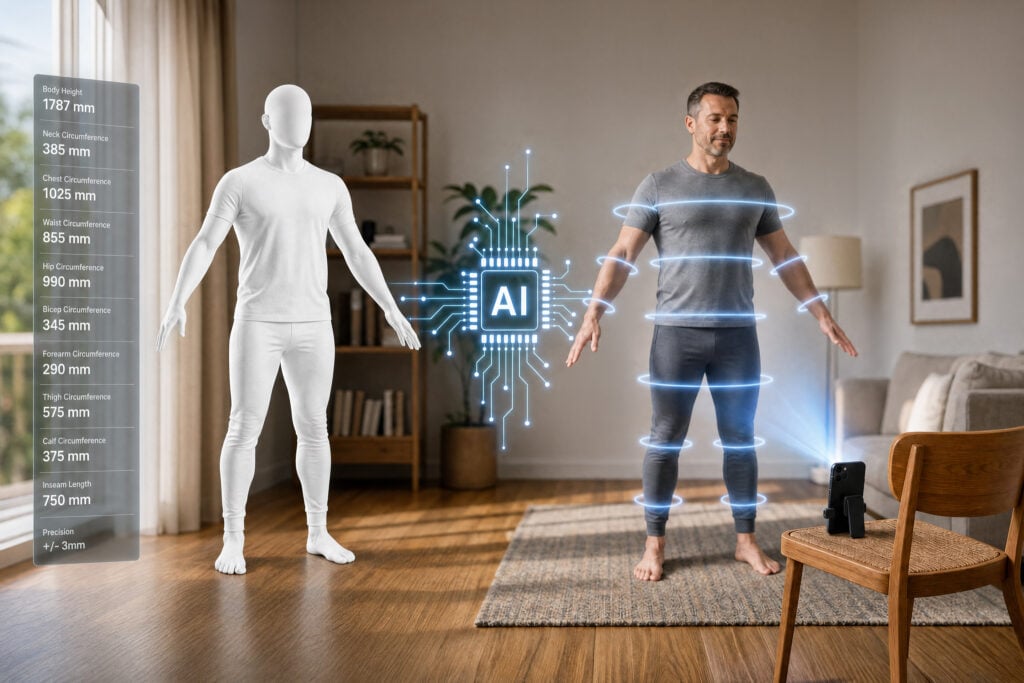
Standardised Measurement Protocol: Following international standards like ISO 8559-1:2017(E), the system extracts specific measurements:
Circumference
- Waist: Horizontal girth of torso measured at axilla
- Hip: At the level of the greatest projection at the back of the body (buttocks)
- Thigh: Maximum horizontal girth of the thigh below the gluteal fold
- Knee, calf, ankle, wrist, arm circumferences
Lengths:
- Inseam (crotch to ankle)
- Outseam (waist to ankle)
- Arm length (shoulder to wrist)
- Torso length (shoulder to crotch)
- Back length (neck to waist)
Widths and Breadths:
- Shoulder width
- Chest width
- Hip width
Premium systems extract 100+ distinct measurements, providing comprehensive data for virtually any sizing application.
Measurement Validation: Each extracted measurement undergoes validation:
- Is it within physiologically plausible ranges?
- Is it proportionate to related measurements?
- Does it match expected relationships
- Measurements failing validation checks may trigger a review or request for image retakes.
Step 6: Size Recommendation
Size Chart Mapping: The extracted measurements are compared against the size charts for specific garments or products. This isn’t a simple lookup—it’s a sophisticated matching algorithm.
Calibration Application: This is where properly calibrated systems dramatically outperform generic solutions. Calibration adjustments learnt from actual fitting sessions are applied:
- Material stretch factors for different fabrics
- Brand-specific cutting patterns and fit preferences
- Product-category adjustments (formal wear vs. workwear vs. activewear)
- Regional or demographic fit variations
Fit Preference: Systems may account for user preferences:
- Slim fit vs. regular vs. relaxed
- Compression level for medical garments
- Safety margin for protective equipment
Multi-Size Recommendations: Rather than providing only a single size, sophisticated systems may offer:
- Primary recommendation with confidence level
- Alternative sizes with explanations (e.g., “Size M for regular fit, Size L for relaxed fit”)
- Specific guidance for edge cases where measurements fall between sizes
Uncertainty Communication: When confidence is lower or measurements are borderline between sizes, the system communicates this uncertainty rather than making overconfident recommendations.
Step 7: Data Storage and Privacy
Immediate Image Deletion: Leading systems remove photographs immediately after processing. Only numerical measurement data and depth maps and segmentation maps are retained—no visual information that could identify the individual.
Data Encryption: Measurement data is encrypted both in transit (during transmission) and at rest (when stored), protecting privacy.
User Control: Businesses should have control over their data:
- Ability to view stored measurements
- Option to delete their measurement profile
- Transparency about data usage
Compliance: Systems must comply with relevant privacy regulations:
- GDPR in Europe (consent, right to deletion, data minimization)
- CCPA in California
- Industry-specific regulations (HIPAA for medical applications)
Step 8: Results Presentation
User Interface: Results are presented clearly:
- Visual representation (avatar showing body shape)
- Numerical measurements in user’s preferred units
- Size recommendations with explanations
- Fit visualization if available
Measurement History: Users can typically access historical measurements to track changes over time, which is useful for fitness tracking, pregnancy, medical monitoring, or seasonal clothing purchases.
Export Options: Data may be exportable for use with other applications or for sharing with healthcare providers, personal trainers, or custom clothing manufacturers.
If you want the product-level view rather than the mechanics, see it in three steps.
Accuracy Factors: What Affects Measurement Precision
Multiple factors influence how accurately digital systems measure bodies.
Image Quality
Lighting Conditions: Adequate, even lighting is crucial. Harsh shadows or extreme backlighting can obscure body contours, reducing accuracy. However, modern systems are increasingly robust to lighting variations.
Camera Resolution: Higher resolution cameras capture more detail, enabling more precise landmark detection. However, algorithmic improvements have made systems effective even with moderate-resolution smartphone cameras (8+ megapixels).
Focus and Blur: Sharp, in-focus images are essential. Motion blur or defocused images reduce measurement accuracy significantly.
Compression Artifacts: Heavy image compression can introduce artifacts that interfere with measurement. High-quality image capture and transmission are important.
User Factors
Pose Correctness: The Standing position affects measurements. Users should:
- Stand naturally upright
- Keep the arms slightly away from the body (to allow a clear torso outline)
- Distribute weight evenly on both feet
- Face the camera squarely
Deviations from correct pose introduce measurement errors.
Clothing Choice: Tight-fitting clothing provides clearer body contours than loose garments.
Background Complexity: Simple, contrasting backgrounds make body segmentation more reliable.
Technical Factors
Algorithm Sophistication: More advanced neural network architectures trained on larger, more diverse datasets produce more accurate results.
Calibration: Generic algorithms in best scenarios achieve 40-60% correct size recommendations. Proper calibration to specific garments improves this to 90-95%+.
Processing Power: More computational resources enable more sophisticated algorithms, though mobile optimisation has made powerful processing possible on smartphones.
Measurement-Specific Factors
Body Dimension Type: Some measurements are inherently easier to extract accurately:
- Highly Accurate (±0.5-1.5 cm): Shoulder width, arm length, head circumference, calf, ankle
- Very Good (±1.5-3 cm): Chest, waist, hip circumferences
Smaller, more subtle measurements naturally have higher relative error percentages even when absolute errors remain small.
Body Shape Variations: Unusual proportions or body shapes may be under-represented in training data, potentially reducing accuracy for those individuals. Diverse training datasets help minimise this issue.
Real-World Performance: Accuracy Benchmarks
Understanding theoretical capabilities is useful, but real-world performance matters more.
Comparison Against Manual Measurements
Studies comparing digital measurement systems to professional manual tape measurements show:
Major Body Dimensions: Mean absolute error of 1.5-3 cm for measurements like chest, waist, and hip circumferences. This rivals inter-measurer variability in manual measurements—different professionals measuring the same person often show 1-2 cm differences.
Smaller Dimensions: Mean absolute error of 0.7-1.5 cm for measurements like ankle or wrist circumference, with some systems achieving ±3 mm consistency.
Comparison Against 3D Body Scanners
When digital smartphone measurements are compared to dedicated 3D body scanners:
Comparable Performance: For most common measurements, smartphone-based systems match dedicated scanner accuracy, with differences typically under 1 cm.
Scanner Advantages: Dedicated scanners may provide more detailed surface topology data useful for custom pattern making or specialized medical applications.
Practical Advantage: Smartphone systems’ accessibility, speed, and cost-effectiveness make them practical for applications where dedicated scanners would be impractical.
Size Recommendation Accuracy
The ultimate test is whether recommended sizes actually fit:
Before Calibration: Generic sizing algorithms achieve 40-60% correct size recommendations across diverse product catalogs.
After Calibration: Properly calibrated systems achieve 90-95% accuracy, with some implementations reaching 93-98% for specific product lines.
Real-World Validation: Testing with actual employees receiving and trying on recommended sizes confirms these accuracy rates in practical deployment scenarios, not just laboratory conditions.
Limitations and Challenges
No technology is perfect. Understanding limitations helps set appropriate expectations.
Current Limitations
Extreme Poses: Unusual body positions—sitting, bending, and asymmetric stances—can reduce accuracy or prevent measurement entirely.
Occlusions: If parts of the body are blocked from view (by furniture, other people, or the person’s own limbs), measurements of those regions become unreliable.
Non-Standard Body Shapes: While systems handle typical variation well, extreme medical conditions, significant asymmetries, or unusual proportions may challenge algorithms trained primarily on more typical body shapes.
Clothing Effects: Very loose, bulky, or heavily layered clothing makes it difficult to determine true body contours. While systems can estimate under tight clothing, baggy garments introduce significant uncertainty.
Motion Blur: If the subject moves during capture, resulting blur degrades measurement accuracy. Still images work better than those extracted from video in most cases.
Technical Challenges Being Addressed
Diverse Populations: Ensuring accuracy across different ethnicities, ages, body types, and abilities requires extensive training data that is representative of these diverse groups. Ongoing efforts focus on improving representation.
Edge Cases: Pregnant individuals, people with prosthetics, wheelchair users, and others with unique measurement needs require specialised consideration and testing.
Real-Time Processing: While current systems work in under 60 seconds, achieving truly real-time measurement (multiple times per second) remains technically challenging on mobile devices.
Privacy-Preserving Training: Improving algorithms requires data, but collecting body images and measurements raises privacy concerns. Developing privacy-preserving machine learning techniques (federated learning, differential privacy) helps address this tension.
The Future of Digital Body Measurement
Technology continues advancing rapidly. Several trends are emerging:
Enhanced Accuracy
Larger Training Datasets: As more data becomes available (with appropriate privacy protections), models will improve, particularly for under-represented populations and body types.
Better Architectures: Advances in neural network design—transformer models, attention mechanisms, and multi-modal learning—promise further accuracy improvements.
Sensor Fusion: Combining standard camera images with depth sensors (like iPhone LiDAR), thermal imaging, or other modalities could enhance measurement precision.
Expanded Applications
Dynamic Measurement: Capturing body measurements during movement for applications like ergonomics, sports performance analysis, or rehabilitation monitoring.
Detailed Surface Topology: More detailed body surface mapping for custom orthotics, prosthetics, or precision-fitted equipment.
Temporal Tracking: Sophisticated analysis of how bodies change over time for medical monitoring, fitness tracking, or pregnancy monitoring.
Virtual Try-On: Combining accurate body measurements with realistic garment visualization, allowing people to “try on” clothing virtually before purchase.
Improved Accessibility
Reduced Hardware Requirements: Making accurate measurement possible with even lower-end smartphone cameras, expanding accessibility in developing regions.
Offline Processing: Enabling complete on-device processing without requiring internet connectivity or cloud computing.
Assistive Features: Better support for people with disabilities through voice guidance, accessible interfaces, and accommodations for various physical limitations.
Privacy Innovations
Fully On-Device Processing: Eliminating the need to transmit images or data to external servers, with all computation happening on the user’s device.
Federated Learning: Training improved models using data from many users without collecting that data centrally, preserving privacy while enabling improvement.
Privacy-Preserving Computation: Techniques like homomorphic encryption that allow computation on encrypted data, ensuring measurements can be extracted without exposing sensitive visual information.
Practical Implications
Understanding how digital body measurement works helps in several contexts:
For Consumers
Setting Expectations: Knowing that 1-3 cm variation is normal helps users understand that digital measurements aren’t perfectly identical to tape measurements—they’re complementary approaches with similar accuracy.
Optimal Usage: Understanding how systems work helps users provide better inputs—appropriate clothing, good lighting, correct poses—yielding more accurate results.
Privacy Awareness: Knowing that leading systems don’t store photos helps alleviate privacy concerns, while understanding data flows enables informed decisions about which services to use.
For Businesses
Technology Selection: Understanding the underlying technology helps evaluate vendor claims and select appropriate solutions for specific use cases.
Implementation Planning: Knowing that calibration dramatically improves accuracy emphasizes the importance of fitting sessions with actual garments rather than expecting perfect results immediately.
User Communication: Explaining how the technology works (in simpler terms) helps employees or customers feel more comfortable using digital measurement systems.
For Developers and Researchers
Research Directions: Understanding current capabilities and limitations highlights opportunities for innovation and improvement.
Ethical Considerations: Awareness of privacy implications, potential biases, and accessibility challenges informs responsible development practices.
Benchmarking Standards: Knowing what accuracy levels are currently achievable helps set appropriate targets for new systems.
Conclusion
Digital body measurement represents a remarkable convergence of machine intelligence, computer vision, mobile computing, and human-centred design. What appears simple to users—taking two photos and instantly receiving measurements—involves sophisticated technology processing images through multiple stages of analysis.
The technology has matured from experimental research to practical, deployed systems measuring hundreds of thousands of people. Current systems rival manual measurement accuracy for most applications while offering dramatic advantages in speed, scalability, and accessibility.
Yet significant room for improvement remains. Expanding accuracy across more diverse populations, handling edge cases more reliably, enhancing privacy protections, and reducing computational requirements all represent active areas of development.
For organizations considering digital measurement solutions, understanding the underlying technology provides crucial context for evaluating options, setting realistic expectations, and planning successful implementations. The technology works—impressively well in many cases—but works best when users and implementers understand both its capabilities and limitations.
As smartphones become more powerful, intelligent models more sophisticated, and training datasets more comprehensive, digital body measurement will only improve. The technology that seems remarkable today may soon become as commonplace as GPS navigation or facial recognition—invisible infrastructure enabling countless applications we haven’t yet imagined.
Learn more about implementing digital body measurement technology: Explore our comprehensive guide to sizing tools for uniforms, including real-world case studies, accuracy benchmarks, and implementation roadmaps.
Ready to see digital body measurement in action? Contact Esenca Sizing for a demonstration and calibration session customised to your specific measurement requirements.