



When an online fashion retailer processes 10,000 orders monthly and 30% come back due to fit issues, they’re not just handling returns; they’re watching profits evaporate through returns logistics, processing costs, and environmental waste. For every $100 in returned merchandise, retailers lose $10–25 in operational costs alone, before accounting for lost sales, damaged goods, and the carbon footprint of shipping items back and forth.
The e-commerce boom has transformed retail, but it’s brought an uncomfortable truth: online clothing sales generate return rates 3-4 times higher than in-store purchases. The culprit? Poor sizing data. Without the ability to try garments before purchase, customers rely on size charts that don’t account for body shape variations, brand inconsistencies, and garment-specific fit characteristics. The result is a returns crisis costing the fashion industry billions while generating massive environmental waste.
For data-driven fashion directors, e-commerce platform architects, and retail operations leaders, return rates represent more than operational headaches; they’re existential threats to profitability and sustainability goals. Traditional approaches to sizing have failed online retail. Generic size charts achieve 40-60% accuracy at best, leaving customers frustrated and retailers drowning in returns.
This comprehensive guide examines the true cost of e-commerce return rates, why traditional sizing data fails online shoppers, and how modern digital body measurement technology is transforming retail sustainability while dramatically improving profitability.
The E-commerce Returns Crisis
The Scale of the Problem
E-commerce return rates have reached crisis levels across fashion retail. While in-store clothing purchases generate return rates of 8-10%, online fashion returns range from 25% to 40%, depending on the category. Some segments, like dresses and formal wear, experience return rates exceeding 50%.
Volume Impact: For a mid-sized online retailer processing 120,000 orders annually, a 30% return rate means handling 36,000 returned items. Each return requires receiving, inspection, processing, restocking or disposal, and often replacement shipment, multiplying the operational burden far beyond the original order.
Growing Challenge: As e-commerce penetration increases, the absolute volume of returns grows exponentially. A retailer growing online sales by 20% annually while maintaining a 30% return rate sees return volume grow by 20% yearly, a compounding operational challenge.
Category Variations: Return rates vary significantly by product category. Dresses and formal wear (40-50% returns), pants and jeans (35-45%), shoes (30-40%), and shirts and tops (25-35%) all exceed sustainable levels. The common factor? These categories have complex fit requirements that generic sizing data fails to address.
Why Customers Return Online Clothing
Research consistently shows sizing and fit issues dominate return reasons for online fashion purchases:
Size/Fit Problems (60-70%): The overwhelming majority of returns cite “doesn’t fit”, “too small”, “too large”, or similar sizing issues. This isn’t customer capriciousness, it’s a systematic failure of sizing information.
Looks Different Than Expected (15-20%): Photos and descriptions don’t convey how garments will look on specific body types. Without trying on, customers make purchases based on models who may have different proportions.
Quality Issues (10–15%): Returns are caused by clothes that arrive damaged, poorly made, or different from what was described. However, this percentage is insignificant compared to the percentage of returns due to sizing issues.
Changed Mind (5-10%): Pure preference changes, customers ordered multiple sizes intending to return extras or simply decided they didn’t want the item—represent the smallest category.
The dominance of sizing and fit in return reasons reveals that the problem is solvable. These aren’t subjective preference issues or quality problems requiring manufacturing changes. They’re data problems. Customers are making purchase decisions with insufficient or inaccurate sizing information.
The “Bracketing” Phenomenon
Faced with sizing uncertainty, many customers adopt a practice called “bracketing”, ordering multiple sizes of the same item, intending to keep only one and return the rest. From a customer perspective, this reduces risk. From a retailer perspective, it multiplies operational costs.
Prevalence: Studies suggest 20-30% of online fashion customers regularly bracket purchases, and the practice is growing as free returns become standard.
Impact on Return Rates: Bracketing inflates return rates beyond what sizing failures alone would generate. A customer who brackets two sizes returns at least one item (50% return rate on that SKU) even when one fits perfectly.
Retailer Dilemma: Retailers face a catch-22. Offering free returns encourages purchases but enables bracketing. Charging for returns reduces bracketing but suppresses conversion rates. Neither approach solves the underlying problem: customers lack confidence in sizing information.
The True Cost of Fashion Returns
Direct Operational Costs
Return Processing Labour: Each return requires staff time for receiving, inspection, determining restockability, system updates, and processing refunds. This labour typically costs retailers $8–15 per return.
Reverse Logistics: Shipping returned items from customers back to fulfilment centres or distribution points adds costs that often exceed original outbound shipping since return volumes don’t benefit from the same economies of scale as outbound shipments.
Restocking and Inventory Management: Returns must be inspected, cleaned if needed, repackaged, and returned to inventory. Items that can’t be restocked due to wear, damage, or hygiene concerns must be liquidated at steep discounts or discarded entirely.
Replacement Fulfillment: When customers request exchanges rather than refunds, retailers process essentially two transactions for one sale—doubling picking, packing, and shipping costs.
Customer Service: Returns generate support enquiries. Customers need return labels, have questions about refund timing, and want to check replacement status, each interaction consuming service resources.
Hidden Financial Impacts
Lost Sales Revenue: Returns don’t just cost money to process, they represent lost sales. When customers return items, retailers lose the gross margin they would have earned on successful sales.
Inventory Depreciation: Returned items often can’t be resold at full price. Garments that were worn briefly, arrived out of season, or show any wear sell at markdown—10-50% below original retail.
Cash Flow Disruption: Returns create cash flow challenges. Retailers pay suppliers for inventory, ship it to customers, then refund customers weeks later when items return—tying up working capital unproductively.
Opportunity Cost: Warehouse space, staff time, and capital tied up in processing returns represent opportunities to invest in growth, new product development, or customer acquisition.
Brand and Customer Relationship Costs
Customer Lifetime Value Impact: High return rates, while sometimes reflecting initial purchase uncertainty, can damage customer relationships. Processing hassles, refund delays, or restocking fees frustrate customers and reduce repeat purchase likelihood.
Negative Reviews: Sizing disappointments often generate negative reviews mentioning “runs small”, “sizing inconsistent”, or “doesn’t fit as expected”—deterring future customers from purchasing.
Reduced Conversion Rates: Returns data creates a feedback loop. High return rates signal to retailers that certain items or categories are problematic, leading to reduced marketing investment, which suppresses sales.
Environmental Impact: The Sustainability Crisis
Carbon Footprint of Returns
Fashion returns generate substantial environmental costs that rarely appear in sustainability reports but represent significant impacts.
Transportation Emissions: Each return involves multiple shipping legs: the initial outbound shipment from the warehouse to the customer, the subsequent return shipment from the customer to the processing centre, and, frequently, an additional shipment for exchanges. For a garment returned and replaced, transportation emissions triple compared to a successful first-time sale.
Last-Mile Impact: The “last mile” of delivery—from the distribution centre to the customer’s door—is the most carbon-intensive portion of e-commerce logistics. Returns can double or triple the emissions from this most polluting segment.
Air Freight: When customers request rush replacements or retailers use expedited return processing to get items back into inventory quickly, air freight adds 10–50 times the carbon emissions of ground transportation.
Global Scale: With fashion e-commerce generating billions of transactions annually and 25-40% return rates, the aggregate carbon footprint of returns represents millions of tons of CO₂ emissions—equivalent to the annual emissions of medium-sized cities.
Textile Waste From Returns
Not all returned items make it back to retail shelves, creating a massive waste problem.
Unsellable Returns: Items returned worn, damaged, out of season, or with hygiene concerns (underwear, swimwear, activewear) often cannot be restocked. Industry estimates suggest 10-25% of returns are unsellable as new merchandise.
Liquidation and Disposal: Unsellable returns follow several paths, most of them environmentally problematic:
- Liquidation sales: Deep discounts (70-90% off) to liquidators who often export items to developing markets
- Donation: Some items go to charities, though quality and seasonal concerns limit these options
- Incineration: Some retailers burn unsellable returns for energy recovery
- Landfill: The worst outcome, items going directly to waste
Fast Fashion Acceleration: High return rates enable fast fashion’s volume-over-quality model. When customers can easily return items, they’re more willing to purchase trend pieces they’ll wear once. This approach accelerates the cycle of overproduction and waste.
Packaging Waste
Returns double packaging waste. Original outbound shipments use packaging that’s often discarded. Return shipments require additional packaging—poly mailers, boxes, tape, and labels. Multiplied across millions of returns, this represents enormous waste streams.
Resource Consumption
Beyond disposal, returns waste the resources that went into producing garments that ultimately don’t fulfil their purpose:
Water Usage: Textile production is water-intensive. A cotton t-shirt requires 2,700 litres of water to make. When that shirt is returned, worn briefly, and disposed of instead of being resold, 2,700 litres are wasted.
Energy: Manufacturing, dyeing, and finishing textiles consumes significant energy. Returns that end in disposal waste all the energy that went into production.
Raw Materials: Cotton, polyester, dyes, and other materials in garments that are returned and disposed of represent wasted natural and synthetic resources.
Why Traditional Sizing Data Fails Online
The Fundamental Problem
In-store vs. Online Information Gap: Physical retail allows customers to try garments on, assess fit across their unique body shape, and make purchase decisions with complete information. Online retail provides only size charts, product descriptions, and photos of usually very lean individuals that perfectly fit in the medium size of the product, which is not the case for most users indirect proxies for how a garment will actually fit an individual’s body.
Generic Size Charts: Most e-commerce size charts provide ranges: “Size Medium: Chest 38-40 inches, Waist 32-34 inches.” But these ranges don’t account for:
- Body shape variations (athletic, pear-shaped, apple-shaped, rectangular)
- Proportional differences (long torso/short legs, broad shoulders/narrow hips)
- Garment-specific fit (slim fit vs. relaxed, intended ease allowances)
- Material stretch and behavior
Brand Inconsistency: Size standards vary dramatically between brands. A “Medium” from Brand A fits differently than Brand B’s “Medium.” Customers can’t reliably use their size history from one brand to predict fit in another, yet online shopping involves purchasing from multiple brands without this context.
Customer Uncertainty Drives Poor Decisions
Defensive Sizing: Without confidence in sizing information, customers default to “safer” decisions—ordering larger sizes “just in case”, buying multiple sizes (bracketing), or avoiding purchases entirely. All three outcomes hurt retailers.
Incomplete Self-Knowledge: Most customers don’t know their body measurements accurately. When size charts ask for chest, waist, and hip measurements, customers guess, use outdated data, or measure incorrectly, feeding inaccurate information into already-imperfect size charts.
Style Confusion: Product descriptions use terms like “relaxed fit”, “slim fit”, or “true to size” inconsistently. What Brand A calls “relaxed” might be Brand B’s “regular.”. Customers lack the context to interpret these descriptors accurately
Multichannel Complexity
E-commerce platforms selling hundreds of brands face additional challenges:
No standardisation: Each brand uses different size standards, fit philosophies, and measurement approaches. Platforms can’t provide consistent sizing guidance across catalogues.
Limited Data: Platforms often lack detailed garment measurements, manufacturer fit information, or historical return data by size—information needed to provide accurate recommendations.
Scale Impossibility: Manually managing size recommendations for catalogues with 10,000–100,000 SKUs across multiple brands is operationally impossible without technological solutions.
Digital Body Measurement: The Solution

How Digital Sizing Technology Works
Modern digital body measurement technology transforms sizing from guesswork into data-driven precision using smartphone-accessible platforms.
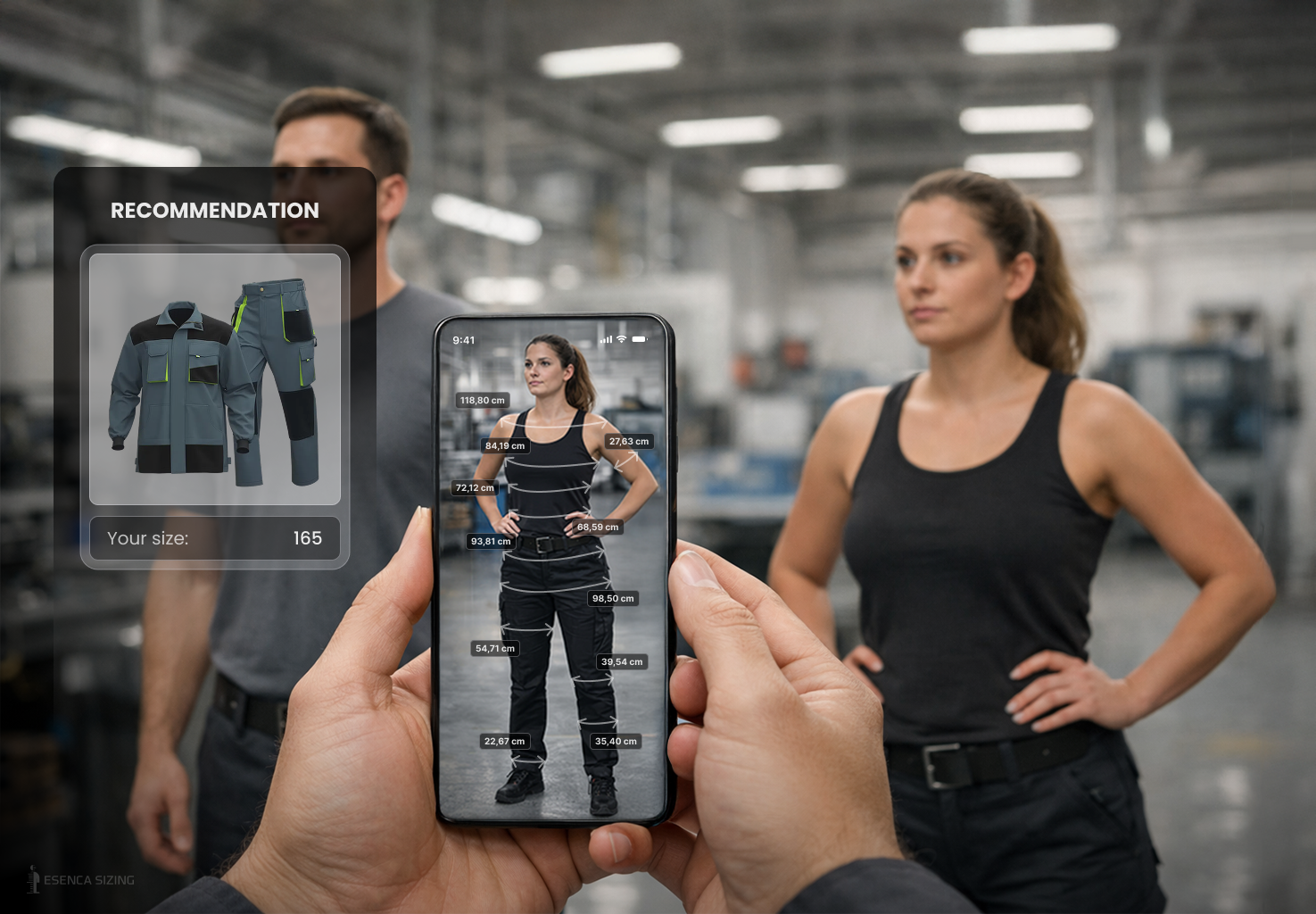
Smartphone-Based Measurement: Customers use their smartphone cameras to capture two photos, front and side views. Advanced computer vision algorithms analysed these images to extract precise body measurements.
3D Body Modeling: From 2D photographs, algorithms reconstruct three-dimensional body models. This 3D representation enables measurement extraction from any angle and accounts for body contours that aren’t directly visible in either photo.
ISO 8559 Standardisation: Systems extract 100+ measurements following international standards (ISO 8559), ensuring consistency and compatibility with garment industry sizing specifications.
Measurement Accuracy: Modern systems achieve 1 – 2 cm mean absolute error for major body dimensions (chest, waist, hips)—better than to professional manual tape measurements. For smaller dimensions, accuracy reaches 0.5-1.2 cm.
Speed and Convenience: The entire process takes under 60 seconds. Customers receive comprehensive body measurements immediately, stored for future purchases across the platform.
Product-Specific Calibration
The transformation from generic 40-60% sizing accuracy to 90-95% accuracy occurs through calibration, adapting algorithms to specific products.
Calibration Process: Retailers or brands conduct fitting sessions where customers are measured digitally, then try on actual garments in multiple sizes. Detailed fit feedback (“Size M fits perfectly”, “Size L is too loose in the waist”) creates ground truth data.
Algorithm Training: This data trains recommendation engines to understand how specific products fit different body types. The system learns that Brand A’s jeans run small in the waist, Brand B’s dresses are cut for taller torsos, and Product C’s material stretches to accommodate a wider range.
Continuous Improvement: Return data provides ongoing feedback. When customers return items citing fit issues, this information refines recommendations, creating a virtuous cycle of improving accuracy.
Multi-Brand Scalability: Once calibrated for a brand’s core products, the system applies learnt patterns to similar items. A platform calibrating 10-20 representative products per brand can achieve high accuracy across that brand’s full catalogue.
Integration With E-commerce Platforms
Widget Embedding: Digital measurement tools embed directly in product pages as simple widgets. Customers are invited to click “Find Your Size”, complete their measurement in just 60 seconds, and promptly receive product-specific size recommendations.
API Connections: Platforms integrate measurement systems via APIs, connecting sizing data to inventory management, order processing, and customer relationship systems seamlessly.
Cross-Platform Consistency: Once measured, customers’ body data follows them across all products and brands on the platform. They measure once and receive accurate recommendations everywhere.
Mobile Optimisation: Systems work identically on smartphones, tablets, and desktop computers, which is critical since mobile commerce represents 50-70% of e-commerce traffic.
Improved Customer Satisfaction: Customers receiving correctly sized garments on the first order are more satisfied, leave better reviews, and become repeat purchasers. Net Promoter Scores (NPS) improve measurably.
Better Inventory Management: Accurate sizing data reveals true demand by size, enabling better inventory planning. Overstocking slow-moving sizes and understocking popular sizes both decrease.
Reduced Customer Service Burden: Fewer sizing problems mean fewer support enquiries about returns, exchanges, and refunds—allowing service teams to focus on higher-value customer interactions.
Implementation and Integration
Getting Started With Digital Sizing
Assessment Phase: Retailers begin by analysing current returns, identifying categories with the highest rates, and calculating the business case based on return reduction potential.
Platform Integration: Technical teams implement Esenca’s API and embed measurement widgets into product pages. Standard integrations typically complete within 2-3 weeks.
Calibration for Accuracy: Brands conduct calibration sessions for their product lines—measuring diverse customers, having them try actual garments, and collecting fit feedback. This ground truth data trains algorithms to achieve 93-98% accuracy.
Soft Launch: Initial deployment to a percentage of traffic allows validation of technical integration and accuracy before full rollout.
Full Deployment: Once validated, measurement tools become available to all customers across all applicable products.
Continuous Optimization: Ongoing monitoring of return rates, accuracy metrics, and customer feedback enables continuous refinement and improvement.
Cross-Platform Opportunities
Marketplace Ecosystems: Multi-brand platforms benefit significantly from digital sizing. Once customers measure themselves, they receive accurate recommendations across all brands and products on the platform—creating exceptional user experiences while dramatically reducing platform-wide return rates.
Brand Partner Enablement: Platforms can offer measurement technology to their brand partners as a value-added service, improving seller success metrics and platform attractiveness.
Data Network Effects: As more customers measure themselves and more products are calibrated, recommendation accuracy improves platform-wide—creating competitive moats that are difficult for competitors to replicate.
Measuring Success
Key Performance Indicators
Organisations implementing digital sizing should track:
Return Rate: The primary metric. Target 70-80% reduction in sizing-related returns.
Return Reasons: Analyse whether the remaining returns are fit-related (suggesting calibration refinement opportunities) or other factors.
Conversion Rate: Measure changes in purchase completion rates. Expect 30% improvement as sizing confidence increases.
Average Order Value: Customers confident in sizing often purchase more items per transaction.
Customer Acquisition Cost: Better reviews and word-of-mouth from satisfied customers can reduce acquisition costs over time.
Net Promoter Score: Customer satisfaction typically improves measurably when sizing problems are eliminated.
Sustainability Metrics: Track CO₂ emissions avoided, garments saved from disposal, and progress toward corporate sustainability goals.
Financial Impact
While specific costs vary by implementation scale, typical impact includes:
Operational Savings: dramatic reduction in return processing labour, reverse logistics, restocking costs, and customer service burdens.
Revenue Protection: Preserved gross margin from sales that would have been returned and liquidated at steep discounts.
Inventory Optimization: Better size distribution data enables inventory planning that reduces overstock and stockouts.
Customer Lifetime Value: Improved satisfaction drives higher repeat purchase rates and customer lifetime value.
Competitive Advantage: Superior sizing accuracy becomes a differentiator in competitive markets, supporting premium positioning and market share growth.
The Path Forward
E-commerce Sustainability Imperative
The fashion industry faces mounting pressure to reduce environmental impact. Regulatory requirements, investor scrutiny, and customer expectations all demand demonstrable sustainability improvements.
Digital sizing technology offers one of the highest-impact opportunities available:
- Immediate Impact: Return rate reductions and associated sustainability benefits occur as soon as systems go live
- Measurable Results: CO₂ reductions, waste prevention, and resource conservation are quantifiable
- Scalable Solution: Technology scales across product catalogs and customer bases without proportional resource increases
- Customer-Positive: Unlike sustainability initiatives requiring customer sacrifice, better sizing improves customer experience while benefiting the environment
Competitive Dynamics
Early adopters of digital sizing technology gain advantages that compound over time:
Customer Retention: Superior sizing accuracy creates customer loyalty. Once measured on Platform A with excellent results, customers have less incentive to try Platform B with inferior sizing.
Data Advantages: More measurements and return data create better algorithms, which attract more customers, generating more data—a virtuous cycle competitors struggle to match.
Cost Structure: Lower return rates translate to better unit economics, enabling competitive pricing, better marketing investment, or higher profitability.
Brand Differentiation: Retailers known for “always getting sizing right” develop powerful brand associations that traditional marketing can’t easily replicate.
The Esenca Sizing Advantage
Esenca Sizing Body offers e-commerce retailers and platforms a proven path to transform return rates and sustainability performance:
Proven Technology: 300.000+ measurements, 93-98% accuracy in real implementations, and case studies across multiple industries validate the technology’s effectiveness.
E-commerce Optimised: Built specifically for online retail with platform-agnostic integration, mobile-first design, and customer-friendly interfaces.
Privacy Leadership: GDPR compliance validated by independent audits, immediate photo removal, and user-first data practices build customer trust.
Sustainability Focus: A measurable impact on return rates, carbon emissions, and waste reduction aligns with corporate sustainability commitments.
Scalable Implementation: Technology handles small boutiques and global marketplaces, adapting to organisational scale and complexity.
Continuous Innovation: Ongoing algorithm improvements, expanded measurement capabilities, and platform enhancements ensure sustained competitive advantage.
Conclusion

E-commerce fashion returns represent a crisis of profitability and sustainability. With 25-40% return rates costing retailers billions while generating massive environmental waste, the status quo is unsustainable.
Traditional sizing approaches—generic size charts, inconsistent brand standards, and customer guesswork—systematically fail online shoppers. Customers lack confidence in the system, retailers lose profits due to returns, and the environment suffers from carbon emissions and textile waste.
Digital body measurement technology offers a proven solution. By providing accurate, personalised sizing data, systems like Esenca Sizing Body transform return rates from 30-40% down to 2-7%—an 85-94% improvement that dramatically impacts both profitability and sustainability.
The technology is proven, the implementation path is clear, and the benefits are immediate. Retailers implementing digital sizing see return rate reductions within weeks, achieving rapid return on investment while making meaningful progress toward sustainability goals.
Early adopters are already capturing advantages that compound over time: customer loyalty from superior experiences, cost structures that enable competitive pricing, and sustainability credentials that resonate with increasingly conscious consumers.
Transform your e-commerce operation from a returns crisis to sustainable profitability. The technology exists. The results are proven. The time to act is now.
Ready to Eliminate Workwear Sizing Challenges?
Discover how Esenca Sizing’s digital measurement technology achieves 90–98% accuracy for industrial workwear programs.
Schedule a Demonstration — See calibration in action and discuss implementation for your specific requirements.
Explore Related Resources
- Complete Guide to Sizing Tools for Uniforms — Comprehensive overview of modern measurement technology
- How Digital Body Measurement Works — Technical explanation of the technology