How Esenca Sizing's Body Measurement Technology Works
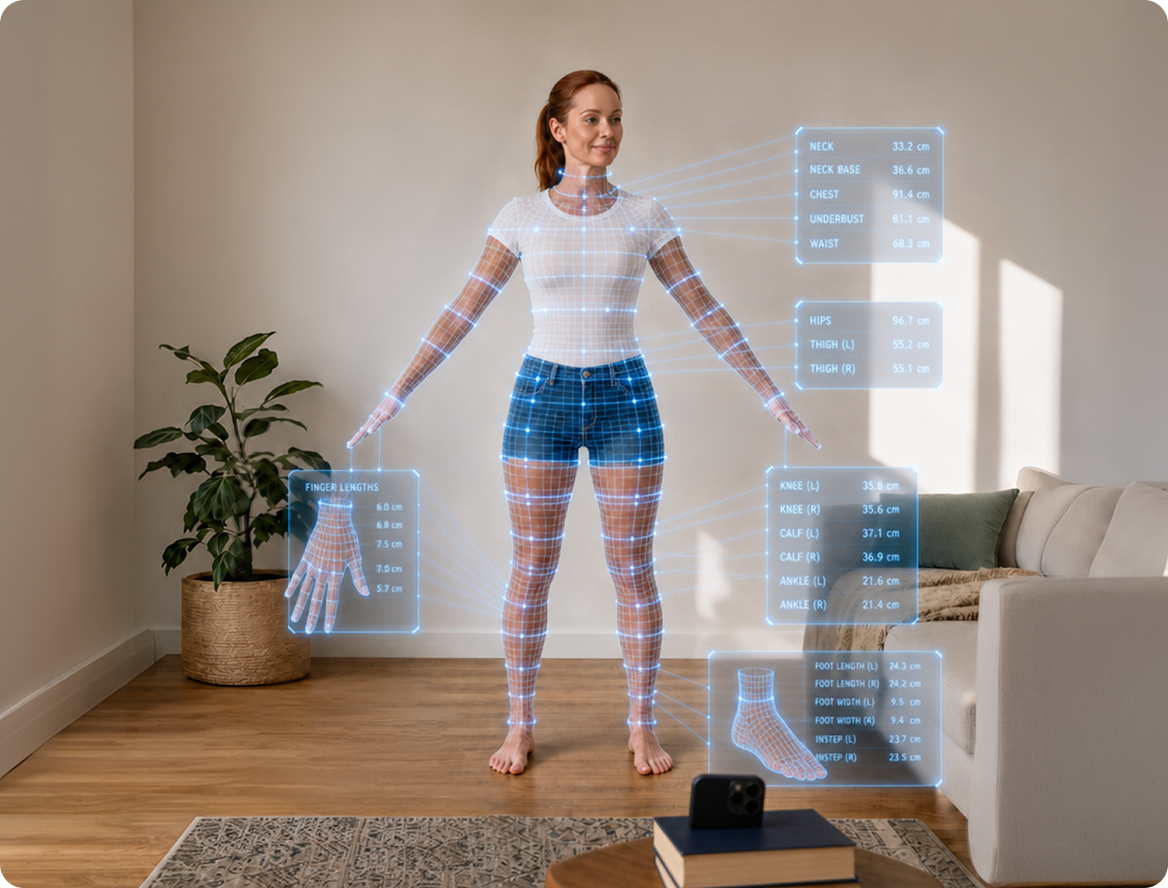
Esenca Sizing uses computer vision and machine learning to capture over 100 body measurements from two smartphone photos in under 30 seconds, achieving 91-97% accuracy across measurement types.
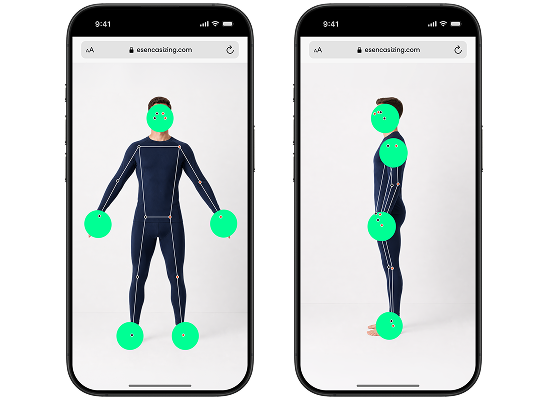
The system applies pose estimation to identify body keypoints and silhouette segmentation to separate the body from its background.
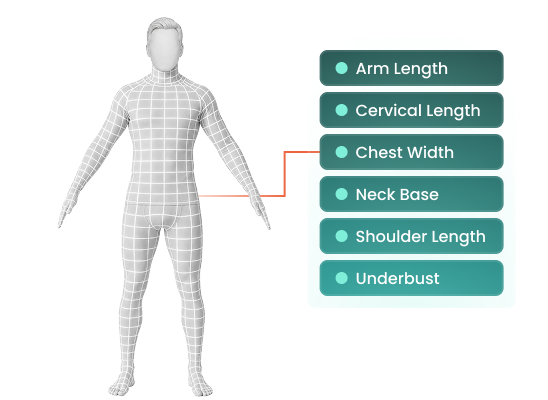
From these inputs, it extracts measurements and reconstructs a 3D body representation. The output can be matched against any sizing chart or garment specification.
This page describes how the technology works, how it is trained and validated, and what accuracy it achieves in independently benchmarked production deployments.This page describes how the technology works, how it is trained and validated, and what accuracy it achieves in independently benchmarked production deployments.
How the Measurement Process Works
From the user’s perspective, the measurement process has three steps and takes under one minute from start to finish.From the user’s perspective, the measurement process has three steps and takes under one minute from start to finish.
Access
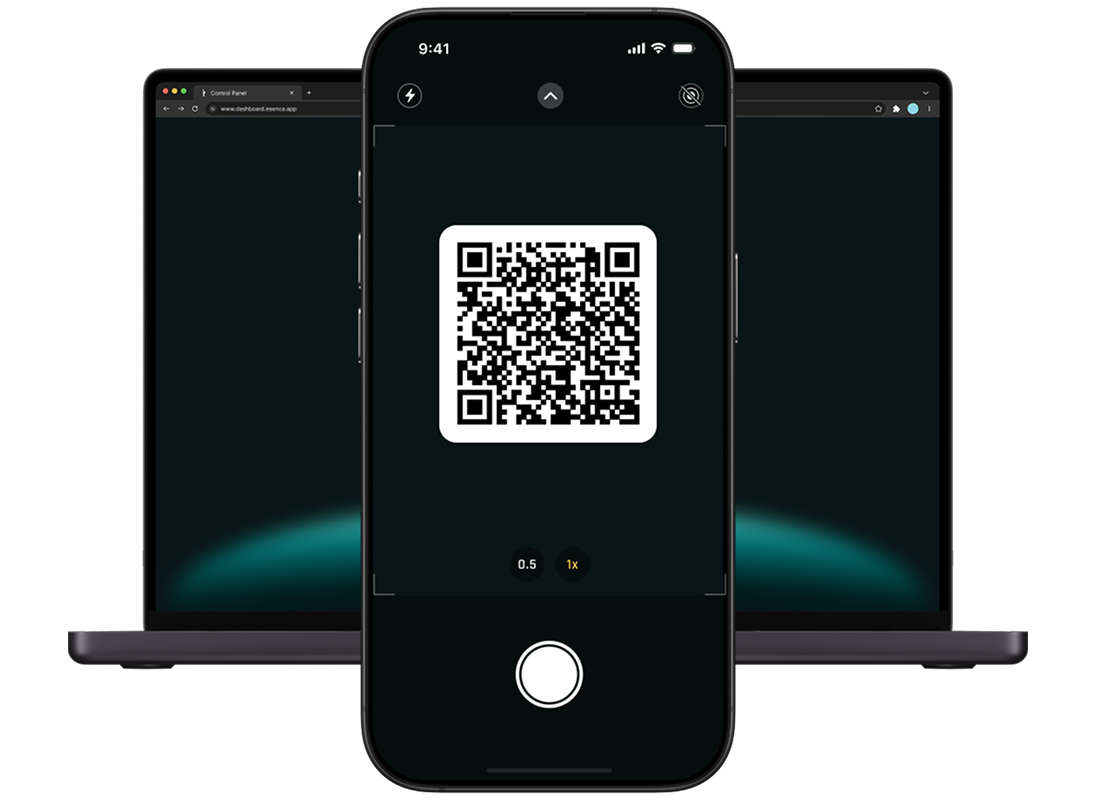
The user opens Esenca Sizing through a QR code, a direct link, or an embedded widget on a partner platform. No app download is required. The interface launches in any modern smartphone browser.The user opens Esenca Sizing through a QR code, a direct link, or an embedded widget on a partner platform. No app download is required. The interface launches in any modern smartphone browser.

Photo capture with on-screen guidance
An interactive tutorial guides the user through capturing two photographs, one front-facing and one side-facing against a plain background. Real-time feedback ensures correct posture and framing before each photo is accepted. The tutorial is available in 18 languages and supports both self-measurement and operator-led capture.
Processing and results
The system processes the two images and returns over 100 body measurements in under 30 seconds, along with a 3D body model. The measurements are matched against the partner’s sizing chart or garment specification to generate a size recommendation. Results are delivered to the user, the operator, or the integrated ordering system.
The Computer Vision Pipeline
Esenca Sizing’s measurement model combines four computer vision techniques, each addressing a specific part of the problem of extracting accurate body measurements from 2D image data. The techniques run sequentially during the under-30-second processing window.
Keypoint detection
The user opens Esenca Sizing through a QR code, a direct link, or an embedded widget on a partner platform. No app download is required. The interface launches in any modern smartphone browser.The user opens Esenca Sizing through a QR code, a direct link, or an embedded widget on a partner platform. No app download is required. The interface launches in any modern smartphone browser.
Silhouette segmentation
Silhouette segmentation separates the body from the background in each image. This is performed by a convolutional neural network that classifies each pixel as either body or non-body, producing a precise outline of the human form. Accurate segmentation is essential for circumference measurements: the system measures the distance across the body at specific anatomical levels, and any body pixels misclassified as background would shrink them. The model is trained to handle a wide range of clothing, backgrounds, and lighting conditions.
3D body reconstruction
From the pose keypoints, segmented silhouettes, and detected landmarks across both views, the system reconstructs a 3D representation of the body. The reconstruction is generated from the body measurements extracted by Esenca Sizing together with the segmented silhouettes, combining parametric body modelling with these image-derived inputs to produce a 3D mesh that matches the individual’s proportions.
Landmark detection
Anthropometric landmark detection extends the process to a specialised set of points required for precise body measurement that fall outside the standard pose keypoint set: the seventh cervical vertebra (C7), the natural waistline, the fullest point of the hip, the wrist crease, and the lateral malleolus. While both tasks share the same underlying formulation — localising semantically defined points, typically via heatmap or coordinate regression — anthropometric landmarks cannot be recovered from a generic pose model. They are defined by anatomical and measurement conventions rather than by skeletal joints, so they require purpose-built models trained on annotated anthropometric data.
Landmark accuracy is the single largest determinant of measurement accuracy. Esenca Sizing’s landmark detection has been refined through multiple iterations against benchmark datasets, including data provided by partners such as Essity for clinical validation.
Training Data and Model Development
Esenca Sizing’s measurement model has been developed continuously since 2020. The original research originated in collaboration with academic institutions and was first published at the Romanian Conference on Human-Computer Interaction (RoCHI) in 2022. The technology is patent-pending and developed entirely in-house, with no dependency on third-party measurement modules.
The model is trained on multiple proprietary and open-source datasets of human body images annotated with reference measurements obtained from 3D body scanners. The datasets covers a wide range of body shapes, sizes, ages, ethnicities, and clothing conditions. Diversity is essential for a measurement system intended for global deployment across workwear, PPE, medical, and fashion applications.
The model is refined iteratively through structured studies conducted in collaboration with deployment partners. When a partner identifies measurement scenarios that fall outside the system’s existing accuracy envelope — for example, the high-precision leg-only measurements required by Essity for compression therapy products — Esenca Sizing develops targeted improvements to the segmentation, landmark detection, and circumference estimation algorithms. These improvements are validated against benchmark datasets supplied by the partner for the study before being released into production.
These collaborative studies, run with partner agreement across European deployments, where Esenca Sizing has processed over 500,000 measurements, provide a continuous source of operational insight that informs further model refinement.
Accuracy Methodology
Esenca Sizing's accuracy is validated using three complementary metrics:
Mean Absolute Error (MAE)
The average difference between the measured value and a reference value obtained from a high-precision 3D scanner or controlled manual measurement. Lower MAE indicates higher accuracy.
Repeatability
How consistent the system is when measuring the same person multiple times. This metric isolates measurement stability from absolute accuracy.
Production fit success
The percentage of measurements that result in a correctly fitted garment in real-world deployment, calculated based on actual return data.
Validated results from production deployments and controlled trials:
97% accuracy across measurement types, validated against 3D scanner reference data
±3mm average repeatability when the same person is measured multiple times (validation of Essity’s compression therapy)
91% size recommendation accuracy in PPE workwear deployment, validated on a 150-worker cohort
±3% error on major circumference measurements
±3mm precision on all measurements
For context, the same Essity benchmark study found that five trained professional human measurers, working independently on the same participants in controlled conditions, produced differences of up to 3-4 cm between themselves on the same anatomical points. Esenca Sizing’s repeatability of ±3 mm represents a step change in measurement consistency relative to manual methods.
What the Technology Captures
Esenca Sizing’s measurement platform covers three anatomical domains, each delivered through a dedicated module:
| Module | Measurements captured | Time | Use cases |
|---|---|---|---|
| Body | 100+ body measurements(circumferences, lengths, shape) | Under 1 Minute | Workwear, uniforms, PPE coveralls, fashion apparel |
| Hand | 30+ hand measurements(palm, fingers, full hand) | Under 30 sec | Protective gloves, work gloves, rings, accessories |
| Foot | 10+ foot measurements(length, width, arch, instep) | Under 30 sec | Safety footwear, work boots, orthotics, fashion shoes |
All three modules use the same underlying computer vision pipeline, adapted for the specific anatomical domain. Hand measurement uses a different image-capture protocol; the user places their hand on a white sheet of paper as a reference scale but applies the same landmark detection and segmentation principles.
Hardware and Deployment Requirements
Esenca Sizing is designed to run on hardware that most organisations and individuals already own. The minimum requirements for body measurement are a smartphone or tablet with a working front and rear camera, a plain background, and adequate lighting.
No app installation is required. The system runs in a standard smartphone browser. No special hardware is needed: no scanning booths, no depth sensor arrays, no infrared cameras, no fixed installation.No app installation is required. The system runs in a standard smartphone browser. No special hardware is needed: no scanning booths, no depth sensor arrays, no infrared cameras, no fixed installation.
Esenca Sizing also supports offline measurement for environments without reliable internet access. The iOS offline solution is a proprietary deployment model developed for clients with on-site measurement requirements at locations where cloud connectivity cannot be guaranteed.
Self-measurement
The user measures themselves remotely using their smartphone. This solution is suitable for distributed workforces, international teams, and high-turnover environments where workers may not be available for on-site fittings.
Operator-led on-site
A field representative or HR operator captures measurements using a single device for multiple workers. A single device can process up to 300 people scans per day in this mode.
Multi-device on-site
Multiple devices run in parallel for large-scale events such as new client onboarding or annual workforce measurement. Capacity scales linearly with device count.
Booth-based
An optional fixed installation (“Magic Mirror”) for retail or pharmacy environments where consistent capture conditions and high throughput are priorities.
Standards and Validation
Esenca Sizing’s body measurement outputs align with ISO 8559, the international standard defining body dimensions for garment construction and anthropometric surveys.
Data privacy and security
Esenca Sizing operates under full GDPR compliance. Photos used for measurement are processed in the RAM memory and discarded; no images are stored beyond the processing window. All measurement data is encrypted in transit and at rest. A Data Processing Agreement is available for partners who require formal documentation.
Workers retain the right to request access to or deletion of their measurement data at any time. Esenca Sizing does not share measurement data with third parties beyond the contracted partner.
FAQ
What technology does Esenca Sizing use to measure the body?
Esenca Sizing uses computer vision and machine learning to extract body measurements from two smartphone photos. The model combines keypoint detection to identify body keypoints, silhouette segmentation to separate the body from the background, and custom anthropometric landmark detection to locate specific anatomical points. From these inputs, the system extracts over 100 measurements and then reconstructs a 3D body representation in under 30 seconds.
How accurate is smartphone body measurement?
Esenca Sizing achieves 91–97% accuracy in size recommendations. Production deployments report a 97% fit success rate in workwear (Mewa, validated through actual garment return data across one of Europe’s largest workwear rental programmes) and a 91% sizing accuracy (Lavans, validated across its Dutch workforce programme).
For Medical Applications, independent benchmarks include 97% accuracy on major circumference measurements (Essity, compression therapy validation) and ±3mm average repeatability when the same person is measured multiple times.
What computer vision techniques does Esenca Sizing use?
Esenca Sizing’s measurement pipeline combines at least four computer vision techniques: pose estimation (to identify body keypoints such as shoulders, hips, and knees), silhouette segmentation (to separate the body from the background using semantic segmentation algorithms), anthropometric landmark detection (to locate specific anatomical points required for precise measurement), and 3D body reconstruction (to generate a 3D mesh from the two 2D input images). The techniques run sequentially during processing.
How is Esenca Sizing's measurement model trained?
The model is trained on multiple proprietary datasets of human body images annotated with reference measurements obtained from 3D body scanners. The training data covers a wide range of body shapes, sizes, ages, ethnicities, and clothing conditions. Esenca Sizing’s research originated in academic collaboration in 2020 and was first published at the Romanian Conference on Human-Computer Interaction (RoCHI) in 2022. The model is refined continuously based on real-world data from periodic scientific studies organised by Esenca Sizing in collaboration with its partners.
Does Esenca Sizing's measurement work without the internet?
Yes. Esenca Sizing offers an iOS offline measurement solution for environments without reliable internet access. The offline solution is a proprietary deployment model that runs the full measurement pipeline locally on an iOS device, with measurement data synchronised to the cloud when connectivity is restored. The standard cloud-based solution requires only a basic mobile or Wi-Fi connection.
How is Esenca Sizing's accuracy validated?
Esenca Sizing’s accuracy is validated through three methods: benchmarking against high-precision 3D scanners operating to ISO 20685 reference standards, controlled trials against trained manual measurers, and production data from deployments at clients including Essity (compression therapy), Lavans (workwear, Netherlands), and Mewa (97% fit success rate, validated through garment return data across European locations). Validation data is reviewed continuously and informs ongoing model refinement.
Ready to Transform Your Workwear & PPE Program?
Join leading organisations that have eliminated sizing guesswork and improved worker safety with Esenca’s digital measurement platform.