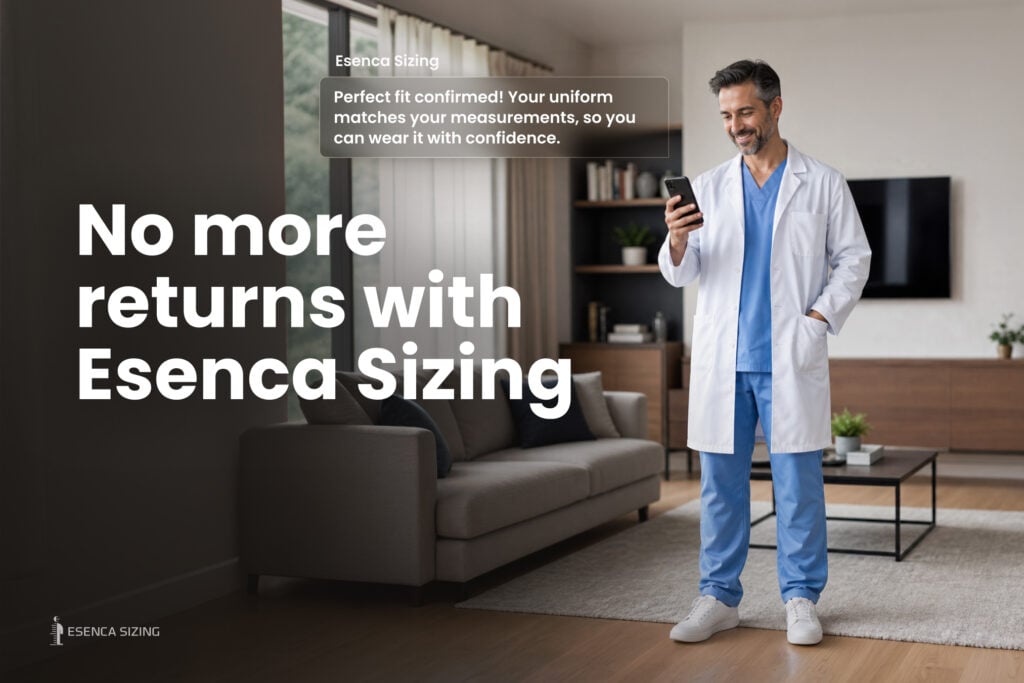





Uniform sizing has long been one of the most challenging aspects of workforce management. Whether you’re outfitting healthcare workers, industrial teams, or corporate staff, getting the right fit for hundreds or thousands of employees is complex, time-consuming, and costly when done incorrectly.
The emergence of digital sizing tools has transformed this process, but many organizations still struggle with high return rates, inefficient measurement workflows, and the substantial costs of traditional sizing methods.
This comprehensive guide explores modern sizing tools for uniforms, helping you understand available technologies, their benefits, and how to choose the right solution for your organisation.
The True Cost of Poor Uniform Sizing
Before diving into solutions, it’s important to understand what’s at stake. Inadequate uniform sizing creates multiple problems that impact your bottom line and workforce satisfaction:
Financial Impact: Return rates for ill-fitting uniforms can reach 20–30% in some industries, creating a cycle of shipping, processing, and restocking costs. Each return typically costs between $10 and $25 in processing expenses alone, not including the environmental impact of reverse logistics.
Safety Concerns: In industrial and healthcare settings, poorly fitted uniforms aren’t just uncomfortable—they’re dangerous. Loose-fitting protective workwear can catch on machinery, while tight-fitting medical scrubs restrict movement during critical procedures. The Occupational Safety and Health Administration has documented numerous incidents where improper clothing fit contributed to workplace accidents.
Time Investment: Traditional on-site measurement sessions require significant time commitment. Measuring 100 employees manually can take 3-5 full working days, pulling staff away from productive activities. When you factor in scheduling coordination and employee downtime, the true cost becomes even more substantial.
Employee Satisfaction: Workers who receive poorly fitting uniforms experience lower job satisfaction and may perceive it as a lack of care from their employer. In competitive labour markets, these details matter for retention.
Inventory Management: Without accurate sizing data, procurement teams often over-order certain sizes while running short on others, leading to excess inventory costs and stockouts that delay uniform distribution.
Traditional Uniform Sizing Methods and Their Limitations
Manual Tape Measurements
The conventional approach involves trained personnel using measuring tapes to capture body dimensions. While this method can be accurate when performed by experienced measurers, it faces several challenges:
- Consistency issues: Different measurers may use slightly different techniques, leading to variability in results
- Time-intensive: Each person requires 5-10 minutes for a complete measurement session
- Privacy concerns: Some employees feel uncomfortable with close physical contact during measurements
- Scalability problems: Measuring large workforces requires either multiple trained staff or extended timeframes
- Travel costs: For organizations with multiple locations, sending measurement teams on-site generates significant travel expenses
Standard Size Charts
Many organisations rely on generic size charts, asking employees to self-select based on their usual clothing sizes. This approach is quick but notoriously inaccurate:
- Sizing standards vary significantly between manufacturers and regions
- Employees often misjudge their size, leading to 40-60% incorrect selections
- Body shape variations mean two people with the same chest measurement may need different sizes
- No accountability for special requirements or preferences
In-Person Fitting Sessions
Some organisations opt for comprehensive fitting sessions, where employees try on sample uniforms. While this improves accuracy, it presents its challenges:
- Requires maintaining an extensive sample inventory across all sizes
- Demands significant space for fitting rooms and storage
- Involves substantial staff time to coordinate and conduct sessions
- Difficult to manage for remote or distributed workforces
Hybrid Approaches
Many organisations combine methods—for instance, using size charts for initial orders and handling exceptions individually. However, this still results in high initial error rates and doesn’t solve the fundamental efficiency problem.
Modern Sizing Tools for Uniforms: Technology Overview
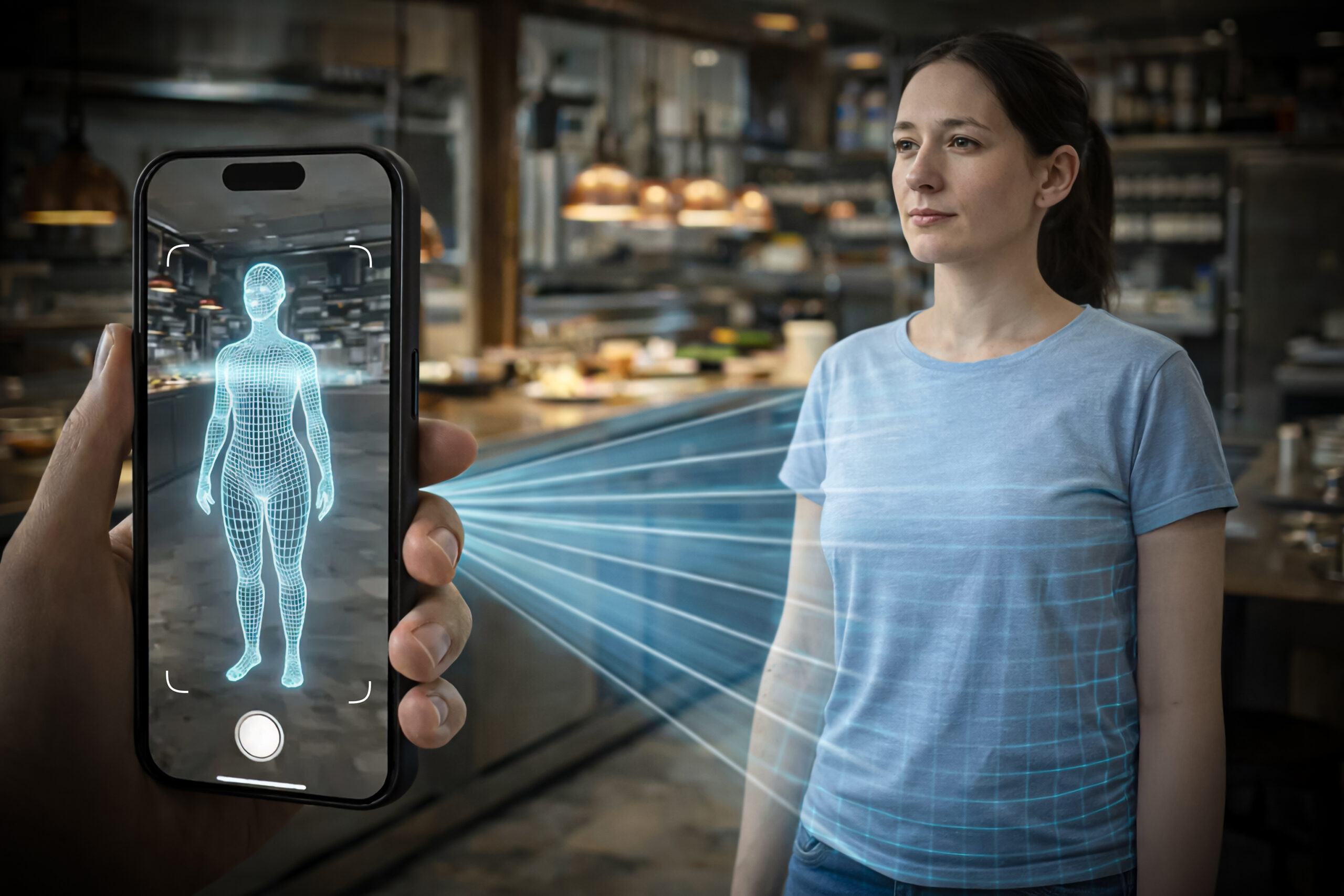
The past five years have seen remarkable advances in body measurement technology. Modern sizing tools leverage artificial intelligence, computer vision, and mobile technology to deliver accurate measurements without traditional drawbacks.
Machine learning-powered Body Measurement
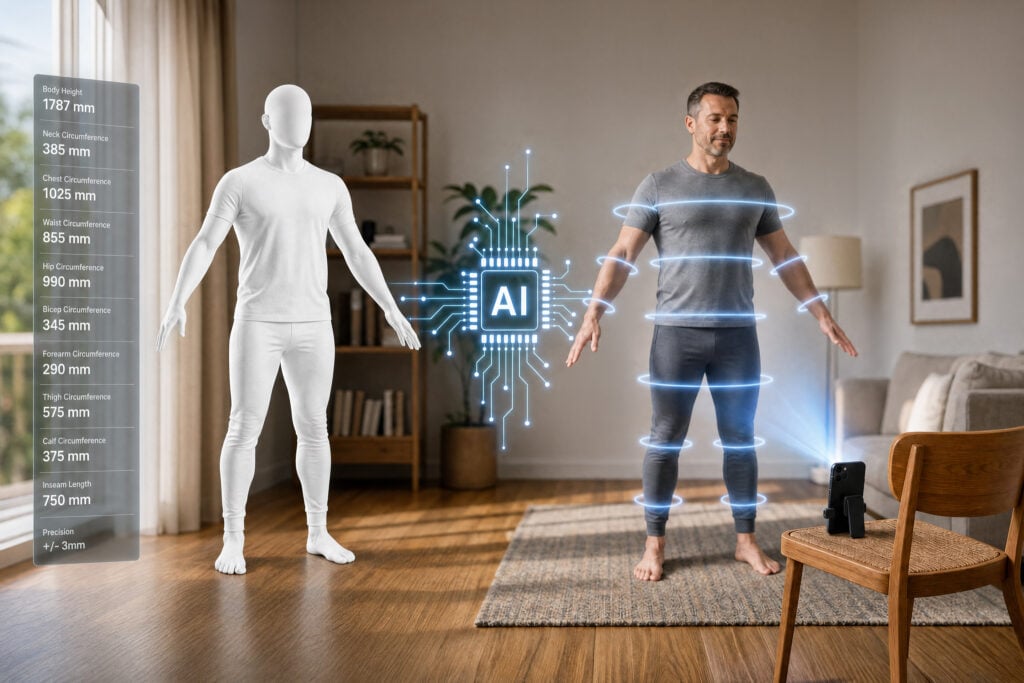
Advanced sizing platforms use machine learning to analyse photos and extract precise body measurements. The technology typically works by:
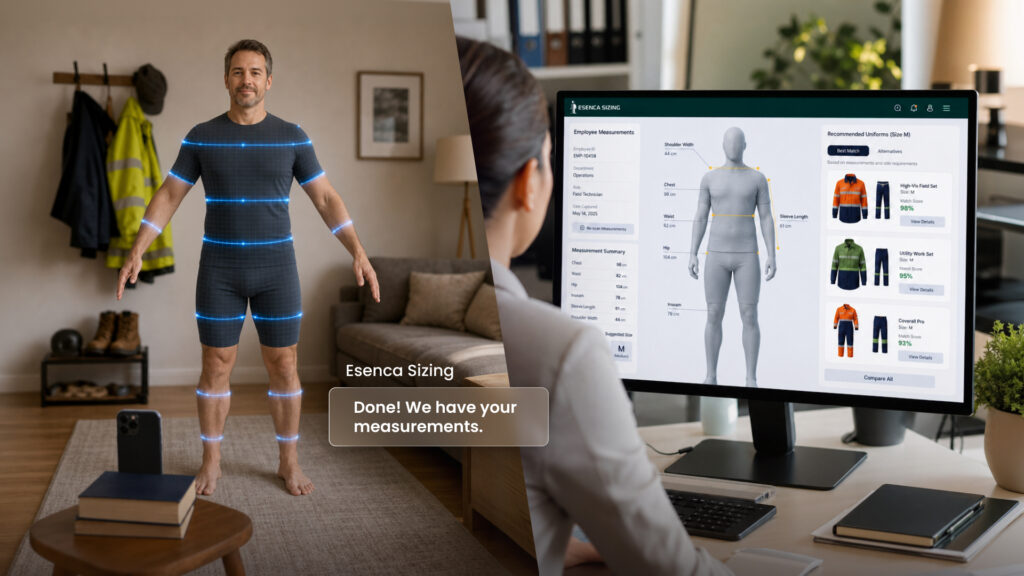
- Image Capture: Users take photos using a smartphone camera, usually front and side views
- Computer Vision Processing: algorithms identify key body landmarks and anatomical points
- 3D Reconstruction: The system builds a three-dimensional body model from two-dimensional images
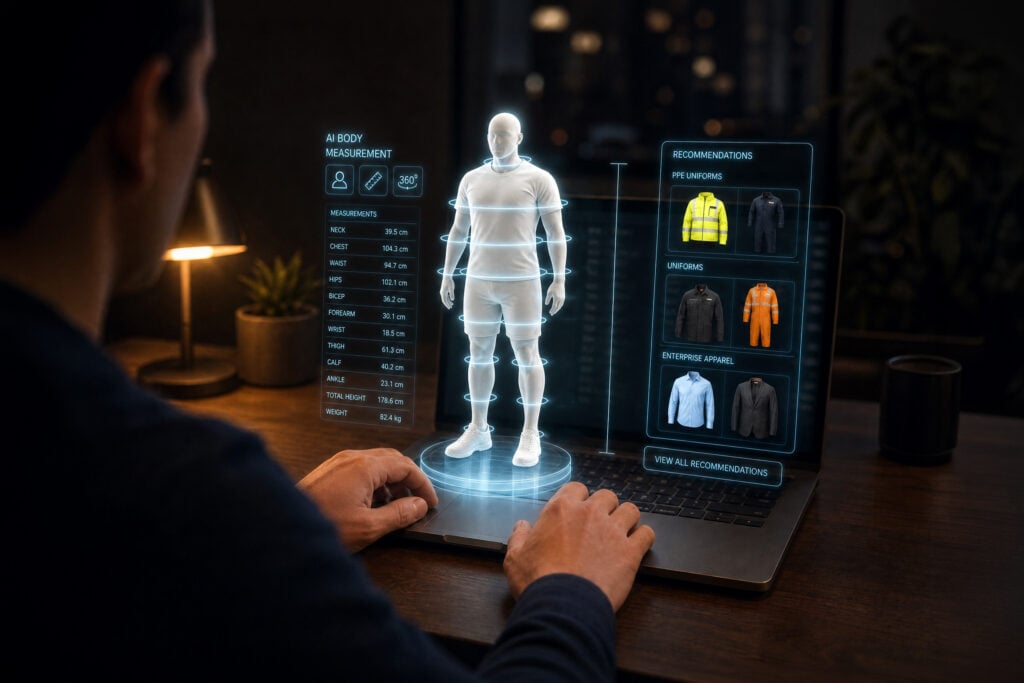
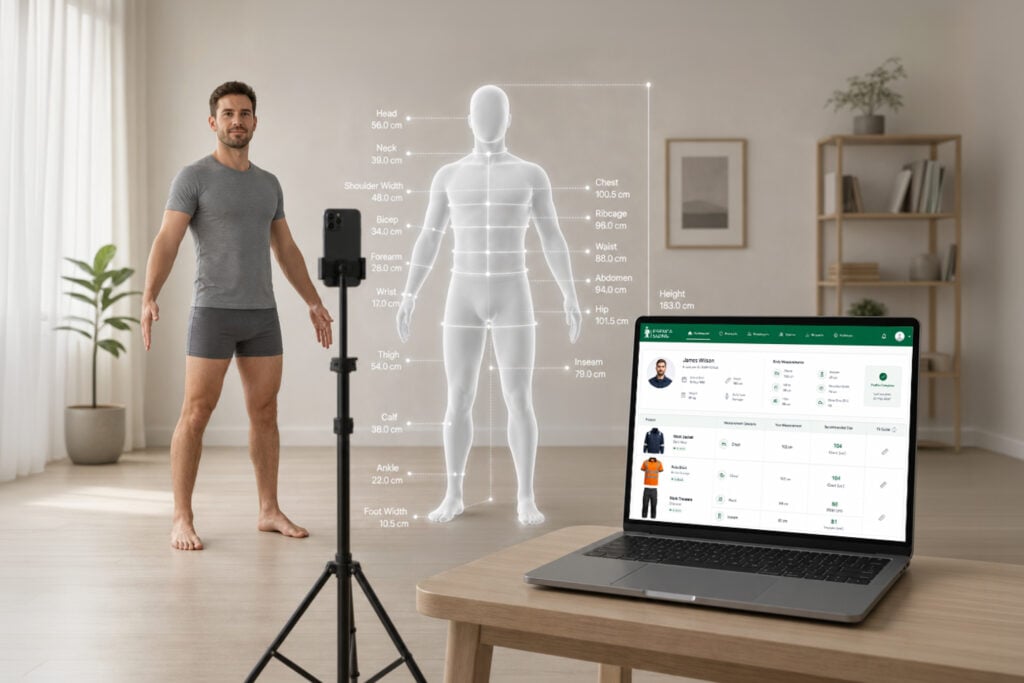
- Measurement Extraction: Over 100 measurements are calculated from the 3D model
- Size Recommendation: The system maps measurements to specific uniform size charts
Leading solutions can complete this entire process in under 60 seconds, with the actual measurement phase taking only a few seconds.
Key Technologies Behind Modern Sizing Tools
Computer Vision: This technology enables machines to identify and understand visual information. For sizing applications, computer vision algorithms detect body contours, joint locations, and anatomical landmarks with millimetre-level precision.
Machine Learning: models are trained on vast datasets of body measurements and actual fit outcomes. This training allows the system to account for body shape variations and predict which size will fit best for each individual.
3D Body Reconstruction: Advanced algorithms reconstruct three-dimensional body shapes from standard photographs, eliminating the need for specialised scanning equipment.
Pattern Recognition: Systems learn to work in real-world conditions—variable lighting, non-ideal backgrounds, and different clothing types—rather than requiring controlled studio environments.
Mobile-First Solutions
The most practical sizing tools are built for smartphones, allowing employees to measure themselves anywhere:
- No special equipment required beyond a standard smartphone
- Works in any location with adequate lighting
- Can function offline for privacy-sensitive environments
- Accessible to distributed workforces without requiring on-site visits
Key Features to Look for in Uniform Sizing Tools
When evaluating sizing solutions for your uniform program, certain capabilities distinguish effective tools from inadequate ones.
Measurement Accuracy
Accuracy is paramount, but understanding how it’s measured matters. Look for solutions that report:
- Mean absolute error: The average difference between digital measurements and manual tape measurements, typically 1.5-3 cm for major body dimensions
- Smaller measurement precision: For critical dimensions like ankle or wrist circumference, expect 0.7-1.5 cm mean error
- Real-world performance: Accuracy metrics based on actual conditions, not laboratory settings
Be wary of vendors claiming perfect accuracy. Real-world conditions introduce variability that even the best systems must manage.
Size Recommendation Accuracy
Measuring the body is only half the equation—the system must also recommend the correct size. This is where calibration becomes critical:
- Calibration process: Quality vendors conduct fitting sessions with real garments to tune their algorithms to your specific uniform collection
- Ground truth validation: The system should be tested with actual employees trying on recommended sizes
- Performance metrics: Look for 90-97% correct size recommendations after proper calibration
Without calibration, even excellent measurement technology may only achieve 40-60% correct recommendations due to variations in how different manufacturers cut their garments.
Scalability
Your sizing solution must accommodate both small teams and large-scale organisation-wide deployments.
- Concurrent users: Can the system handle hundreds of employees measuring themselves simultaneously?
- Data processing speed: Are results delivered in seconds or minutes?
- Infrastructure requirements: Does it require specialised hardware or complex IT infrastructure?
- Multi-location support: Can you deploy across different sites without additional hardware?
Integration Capabilities
Sizing tools should connect seamlessly with your existing systems:
- API availability: Standard REST APIs allow connection to HR systems, uniform ordering platforms, and inventory management
- Data export: Can you extract measurement data in standard formats?
- Platform compatibility: Does it work with your eCommerce or uniform ordering system?
- Widget integration: Can employees access sizing directly from your internal portal?
Privacy and Compliance
Body measurement data is personal information requiring careful handling:
- GDPR compliance: For European operations, full compliance with data protection regulations is mandatory
- Data minimization: Systems should capture only necessary information and delete raw images immediately after processing
- No photo storage: Leading solutions process images in real-time without storing photographs
- Encryption: All data transmission should use industry-standard encryption
- Third-party restrictions: Verify that data isn’t shared with external parties
Offline Functionality
Some environments require measurement capability without internet connectivity:
- Industrial facilities may face restrictions or unreliability in network access.
- Security-sensitive locations: Where internet-connected devices face limitations
- Remote sites: With limited connectivity infrastructure
Offline-capable solutions store measurement processing locally and sync data when connectivity is restored.
User Experience
Employee adoption depends on how easy the tool is to use:
- Clear instructions: Video and audio guidance through the measurement process
- Error prevention: Real-time feedback if photos aren’t captured correctly
- Speed: Complete measurements in under 60 seconds
- Accessibility: Support for multiple languages and accessibility features
- Multiple access methods: QR codes, direct links, embedded widgets
Industry-Specific Applications
Different sectors have unique uniform sizing requirements that specialised tools can address.
Workwear and Industrial Uniforms
Industrial environments present specific challenges for uniform sizing:
Safety requirements: Protective workwear must fit properly to function correctly. Loose garments can catch in machinery, while tight clothing restricts movement and may tear under stress.
Diverse body types: Industrial workers often span a wide range of body shapes and sizes, making standardised approaches less effective.
High volumes: Large manufacturing facilities may outfit hundreds or thousands of workers simultaneously during onboarding or seasonal hiring.
Real-world conditions: Measurement often occurs in busy facilities with variable lighting and backgrounds, requiring robust technology that works outside controlled environments.
Healthcare Uniforms
Medical facilities have distinct uniform requirements:
Hygiene standards: Measurement processes must not compromise infection control protocols, making contactless digital solutions particularly valuable.
Shift work coordination: Healthcare staff work varied schedules, making it difficult to coordinate in-person measurement sessions. Self-service digital tools allow staff to measure themselves on their own time.
Specialised garments: From scrubs to lab coats to compression garments, healthcare workers require multiple uniform types, each with different fit requirements.
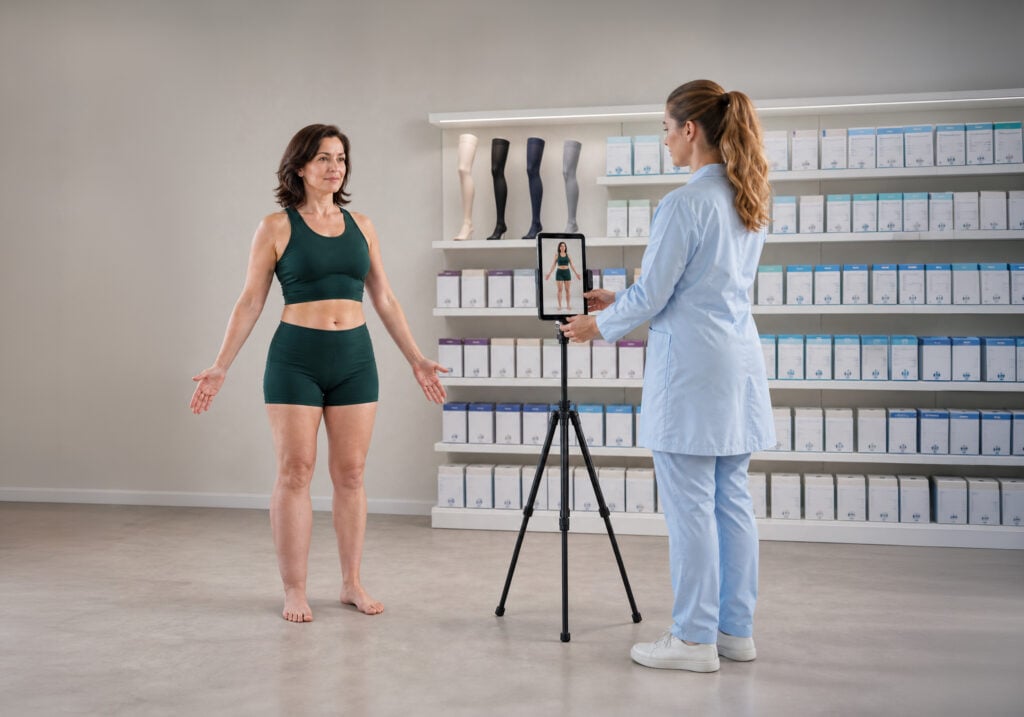
Compression wear accuracy: For compression stockings and similar medical garments, measurement precision is critical. The smallest circumference around the ankle, for example, requires accuracy within 3-5 millimeters for effective therapeutic compression.
Corporate and Hospitality Uniforms
Professional service environments prioritize appearance and brand consistency:
Brand image: Employees represent the company, making well-fitted, professional-looking uniforms essential for brand perception.
Employee satisfaction: In customer-facing roles, staff confidence in their appearance directly impacts service quality and employee morale.
Rapid onboarding: Hotels, restaurants, and retail environments often hire in waves, requiring efficient sizing processes that don’t delay employee start dates.
Distributed locations: Multi-location operations benefit from centralized digital sizing that eliminates the need to send measurement teams to each site.
Military and Public Service Uniforms
Government and military organizations face unique constraints:
Standardization requirements: Uniforms must meet specific regulations and standards, often with minimal tolerance for variations.
Large-scale deployments: Military branches and large public service organizations may outfit tens of thousands of personnel.
Budget accountability: Public sector procurement requires documented cost-effectiveness and efficiency.
Security considerations: Measurement processes must comply with security protocols, potentially requiring offline functionality in certain facilities.
ROI and Business Impact
Implementing modern sizing tools delivers measurable returns across multiple dimensions.
Return Rate Reduction
Return rates represent one of the most significant costs associated with uniform programs. Traditional sizing methods often result in 20-30% return rates, while properly implemented digital sizing tools can reduce this to 5-10%:
- Direct cost savings: Each avoided return saves $10-25 in processing costs
- Inventory efficiency: Lower return rates reduce the need for safety stock
- Employee productivity: Fewer returns mean less time spent on exchanges and reorders
For an organisation outfitting 1,000 employees annually with an average uniform cost of $200, reducing returns from 25% to 8% saves approximately $34,000 per year in processing costs alone.
Time Savings
Digital sizing eliminates the need for travel time, scheduling coordination, and manual measurement sessions.
- Employee time: Self-service measurements take less than 1 minutes versus 10-15 minutes for manual sessions
- Coordination effort: No need to schedule and manage in-person measurement appointments
- Scalability: Systems can handle thousands of concurrent users without additional staff time
An organisation measuring 500 employees can complete the process in 1 day rather than weeks, accelerating uniform deployment and reducing the time to productivity for new hires.
Travel Cost Elimination
For multi-location organisations, on-site measurement sessions generate substantial travel expenses:
- Transportation: Airfare, mileage, vehicle rental
- Accommodation: Hotel costs for measurement teams
- Per diem: Meal and incidental expenses
- Staff time: Travel hours that could be spent on productive activities
A company with 10 locations might spend $15,000-30,000 annually on measurement-related travel. Digital tools eliminate these costs entirely.
Improved Employee Satisfaction
Well-fitted uniforms contribute to workplace satisfaction:
- Employees feel valued when their employer invests in proper fit
- Comfortable clothing improves focus and productivity
- Professional appearance boosts confidence in customer-facing roles
- Reduced friction in the uniform ordering process creates a better employee experience
Data-Driven Inventory Management
Accurate sizing data enables better procurement decisions:
- Demand forecasting: Historical measurement data reveals actual size distribution in your workforce
- Inventory optimization: Stock levels can match real demand rather than assumptions
- Reduced waste: Less overstock of unpopular sizes and fewer stockouts of common sizes
- Trend analysis: Track how workforce demographics shift over time
Challenge: Privacy Concerns
Employees may worry about how their body measurement data will be used or stored.
Solution: Choose vendors with strong privacy practices including immediate image deletion, no photo storage, and GDPR compliance. Communicate privacy protections clearly to employees. Provide transparency about what data is collected, how it’s used, and who has access.
Frequently Asked Questions
How accurate are digital sizing tools compared to manual measurements?
Modern machine learning-powered sizing tools typically achieve 1.5-3 cm mean absolute error for major body dimensions compared to manual tape measurements. For critical smaller measurements, expect 0.7-1.5 cm accuracy. After proper calibration for your specific garments, size recommendation accuracy reaches 90–95% in real-world conditions.
Do employees need special equipment to use digital sizing?
No. Leading solutions work with standard smartphones—no specialised scanners, sensors, or additional equipment is required. This feature makes the technology accessible to distributed workforces and eliminates hardware costs.
How long does it take to measure an employee?
The actual measurement process takes just a few seconds. Including instruction review and photo capture, most employees complete the entire process in under 60 seconds.
What happens to employee photos after measurement?
Reputable sizing platforms process images in real time and remove them immediately afterward. Only numerical measurement data is retained—no photographs are stored. This approach protects privacy while maintaining measurement accuracy.
Can digital sizing work for all body types?
Yes. Advanced systems are trained on diverse datasets representing wide ranges of body shapes, sizes, and proportions. The technology typically works effectively for very small to very large individuals, though vendors should demonstrate performance across your actual employee population during pilot testing.
How much do digital sizing tools cost?
Pricing varies based on features, user volume, and integration requirements. Expect costs ranging from a few dollars per measurement to subscription-based models for enterprise deployments. Calculate ROI based on return rate reduction, time savings, and eliminated travel costs to evaluate cost-effectiveness.
Do sizing tools work offline?
Some advanced platforms offer offline functionality, processing measurements on-device without internet connectivity. This capability is valuable in industrial facilities, security-sensitive locations, or areas with limited network access.
How often should employees be re-measured?
Body measurements change over time due to weight fluctuations, pregnancy, aging, and other factors. Organizations typically re-measure employees every 12-24 months, or when employees report fit issues with current uniform sizes.
What if an employee’s recommended size doesn’t fit?
Even the best sizing systems aren’t 100% perfect. Establish a clear exception process for the 5-10% of cases where recommended sizes need adjustment. Track these cases—they often reveal opportunities for further calibration refinement.
Can sizing tools handle different uniform manufacturers?
Yes, through calibration. Since manufacturers use different size standards and cutting patterns, quality sizing tools calibrate to each uniform line in your catalog, ensuring accurate recommendations regardless of who manufactures the garment.
The Future of Uniform Sizing
Sizing technology continues to evolve rapidly. Emerging trends include:
Enhanced AI models: Ongoing improvements in computer vision and machine learning will further improve accuracy and reduce sensitivity to measurement conditions.
Virtual try-on: Integration of sizing with augmented reality could allow employees to visualize how uniforms will look before ordering.
Predictive sizing: As systems accumulate data, they may predict size changes based on lifestyle factors, seasons, or demographic trends.
Sustainability integration: Better sizing reduces returns and waste, contributing to environmental goals. Future tools may explicitly track and report sustainability metrics.
Broader applications: Technologies developed for uniform sizing are expanding into personal protective equipment, footwear, accessories, and medical devices.
Ready to modernize your uniform sizing process?
Explore how Esenca Sizing’s machine-powered body measurement technology can deliver 90-97% size recommendation accuracy for your uniform programme.
Contact us to schedule a demonstration.