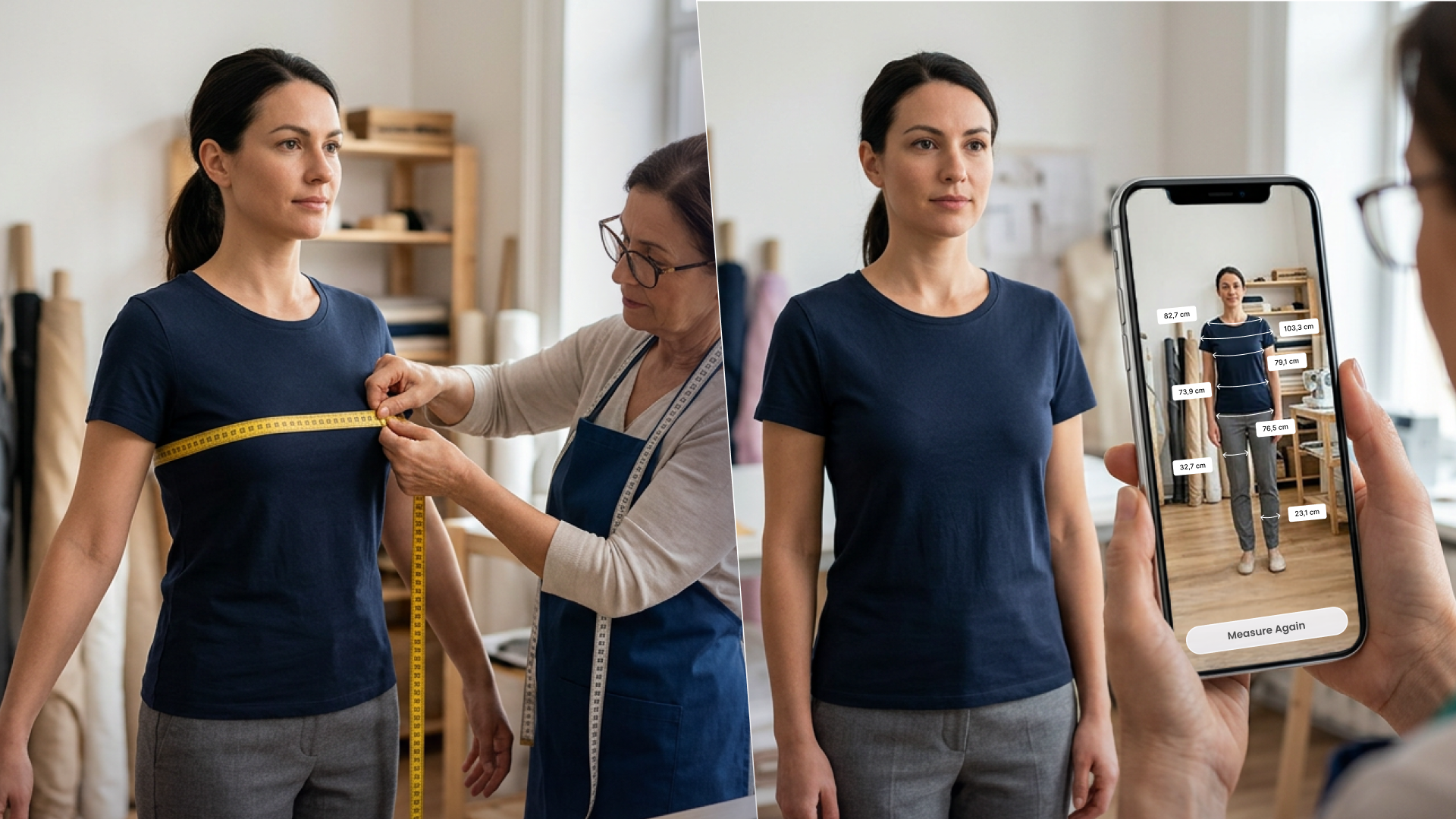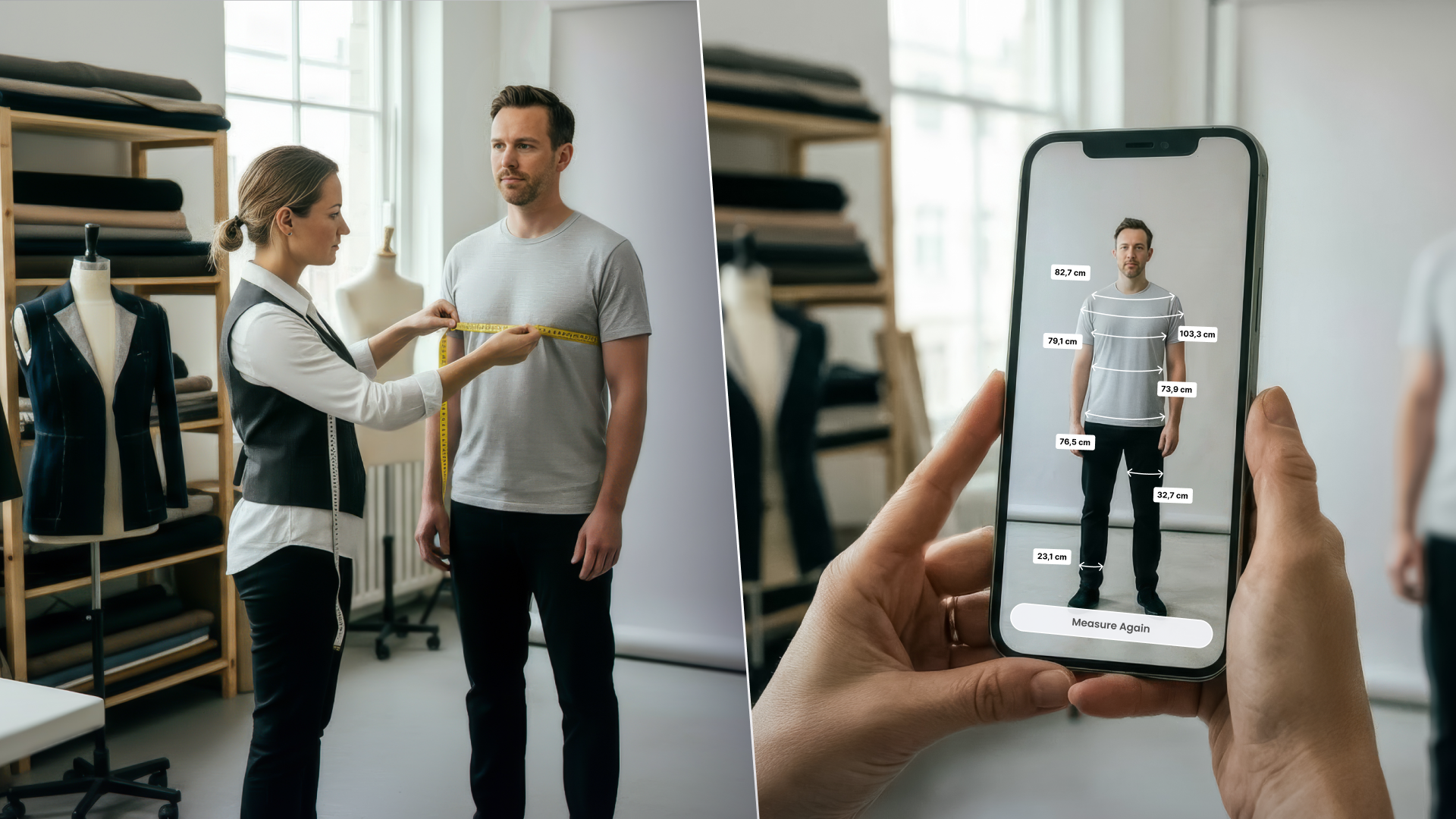
If you run a custom clothing business, you already know the tension: your reputation depends on a perfect fit, but every new client needs a measuring appointment. That appointment takes 30–45 minutes, limits how many clients you can serve, and confines your business to customers who can travel to you.
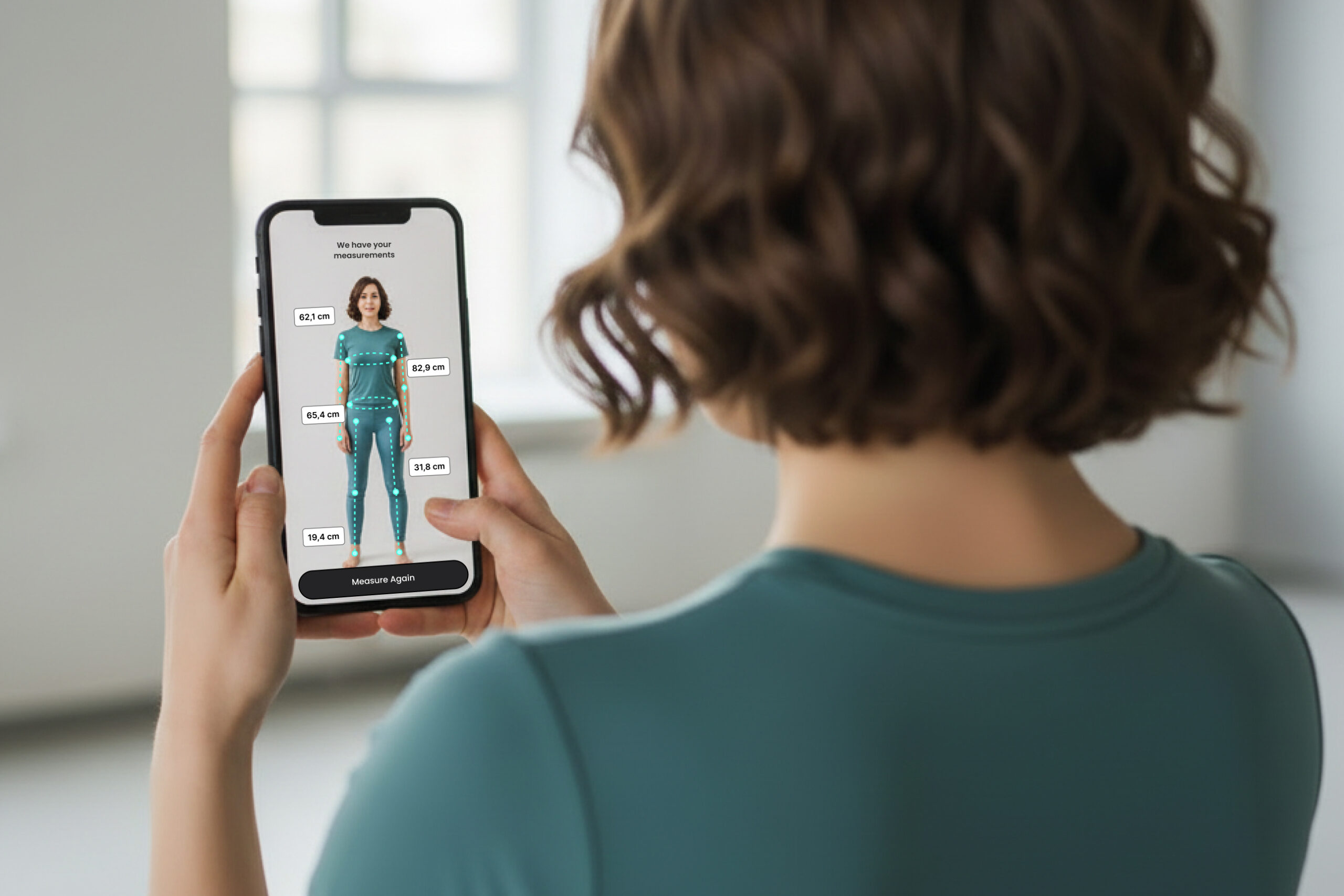
Digital body measurement for custom clothing solves this. Using a smartphone camera and machine learning computer vision, your clients can capture 100+ precise measurements in under a minute — from anywhere in the world — with no special equipment required.
This guide explains how body measurement technology works, what it costs your business to ignore it, and why Esenca Sizing is the platform we recommend for custom tailors and made-to-measure brands looking to grow without compromising on fit quality.
| Market Snapshot: Custom Clothing in 2026 | |
|---|---|
| $59.75B | Global custom clothing market value in 2025 Source: Business Research Insights |
| 9.58% CAGR | Projected annual growth rate through 2035 |
| 58% | Of custom clothing brands now using 3D body-scanning tools Source: Market Reports World |
| 62% | Of new custom clothing orders placed through digital tailoring platforms |
| 19% | Decline in US tailoring professionals 2018–2023, tightening the skilled labour pool |
| 28% | Reduction in return rates when virtual fitting technology is deployed |
WHAT THIS GUIDE COVERS
The Hidden Business Cost of Manual Measuring Appointments
Manual measurement feels like a natural part of the custom clothing process — but when you calculate its real impact on your business, the picture changes.
Time: your scarcest resource
A proper measuring appointment rarely takes only the time you spend with a tape measure. Factor in scheduling, handling no-shows, the session itself, and entering data into your system, and you’re investing 30–45 minutes per new client. That time directly caps your capacity: if you fit eight measuring appointments per day, that’s your ceiling for new client intake — regardless of demand.
Geographic constraints that limit your market
Every client has to travel to you. This limits your addressable market to people within a reasonable radius who are willing to make the journey. Premium custom clothing attracts motivated buyers, but distance still shrinks your pool. Expanding to a new city means opening a new location or building a network of measuring partners — both requiring significant investment before a single new order comes in.
Meanwhile, modern made-to-measure brands are serving customers in any city, any country, without a single additional square foot of real estate.
Skilled labour: a shrinking and fragile resource
Taking accurate, consistent body measurements is a genuine skill. It takes years of practice to master, and even experienced measurers produce significant variations based on technique, tape tension, and body type and size. According to the US Bureau of Labor Statistics, the number of professional tailors in the US fell by 19% between 2018 and 2023. Finding, training and retaining good measurers gets harder every year.
When a skilled fitter leaves, they take that institutional knowledge with them. New hires need months of supervised practice before they can hold your quality standard independently.
Measurement variability: the silent quality problem
No two people measure identically. Across multiple staff members and hundreds of clients, those small variations accumulate into inconsistency. A client who orders twice over two years may receive different fit outcomes if different people took their measurements. Remake rates increase. Customer satisfaction drops. Your quality reputation the thing you charge a premium for depends on consistency, which you cannot fully guarantee with manual methods.
The scalability ceiling
Manual measurement creates a hard growth ceiling. Doubling revenue requires more than doubling measurement capacity: more staff, more space, more scheduling complexity. This is the opposite of how digital businesses scale, where marginal costs fall as volume increases. Around 45% of custom clothing brands already report struggling to scale operations without compromising quality (Market Reports World, 2025). Digital body measurement is how leading brands are breaking through that ceiling.
How Digital Body Measurement Technology Works
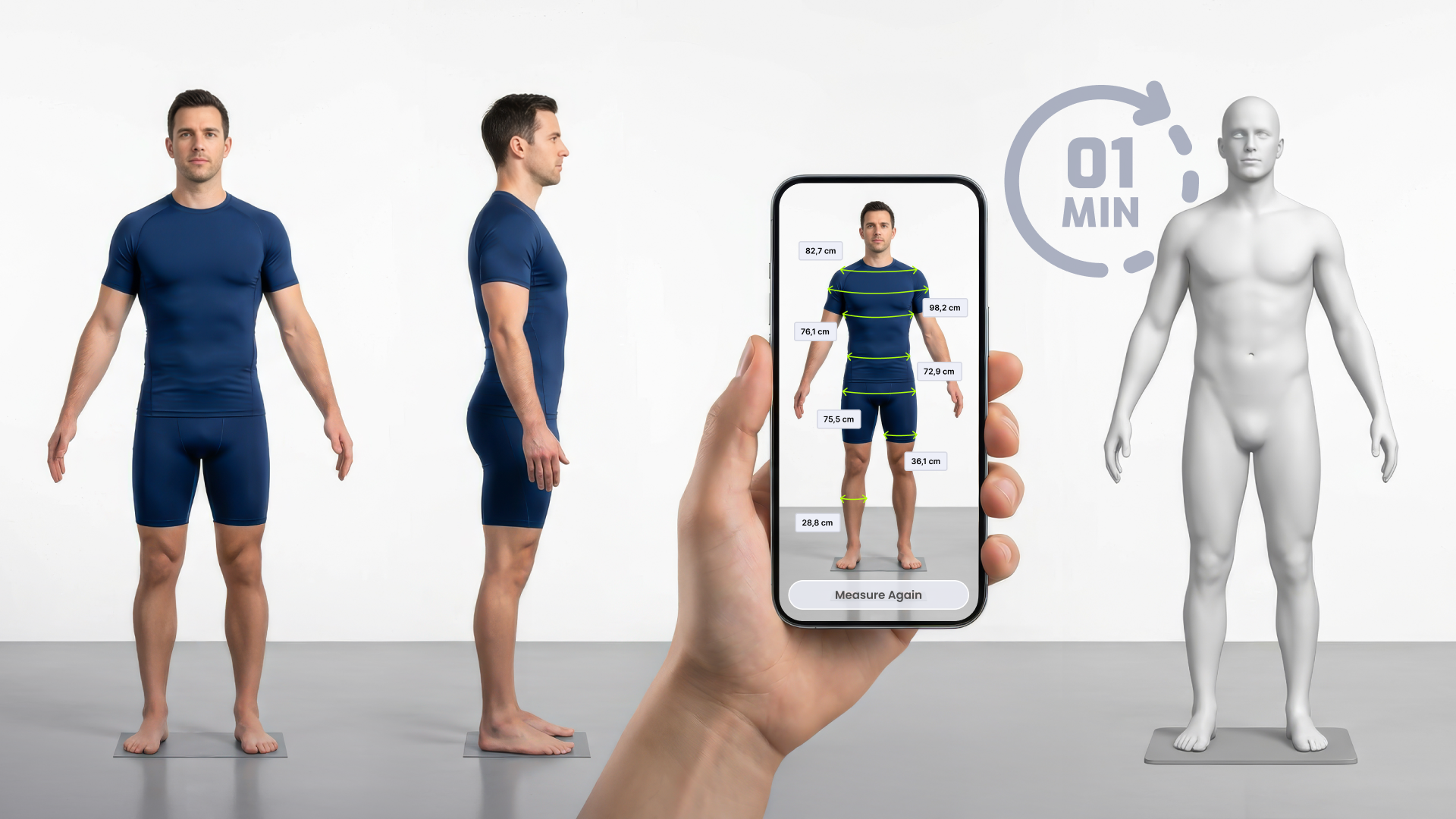
Modern body measurement software is a long way from the early attempts that produced unreliable results. Today’s best platforms combine smartphone cameras, computer vision, and machine learning to capture measurements with accuracy bettter to — and in consistency terms, better than — skilled manual measuring.
The scanning process, step by step
- The client opens a link or scans a QR code on their smartphone — no app download required on the best platforms.
- They take two standard photos (front and side) in normal clothing, following simple on-screen prompts.
- Computer vision algorithms identify body landmarks: shoulders, chest, waist, hips, inseam, and more.
- Machine learning models trained on millions of body scans extract 100+ measurements.
- A 3D body model is constructed from the two views, accounting for posture and camera angle.
- Results are transmitted directly to your order management or pattern-making system via API.
The entire process takes under 60 seconds from the client’s perspective. Compare that to a 30–45 minute appointment.
Accuracy: how close does it get?
The best digital body measurement platforms now achieve sub-5mm accuracy on core garment measurements meeting or exceeding the ISO 8559-1:2017 international standard for body measurement. For most custom garment applications, this is even better than the skilled manual measuring.
Critically, digital measurement provides perfect consistency. The same client scanned twice gets identical results. That consistency, across every client and every order, is something manual processes cannot reliably deliver.
What digital measurement captures that tape measures miss
A tape measure captures point-to-point distances. Advanced digital measurement captures something richer: body proportions, postural asymmetries, and three-dimensional shape data. This enables more precise pattern adjustments—for conditions like uneven shoulders or a prominent shoulder blade that manual measurements often miss or that would be too time-consuming to incorporate systematically.
That data also becomes a permanent, searchable client record. You can track how a client’s body changes over time, automate reorders, and build a measurement library that continuously refines your pattern blocks.
Esenca Sizing: Our Recommended Platform for Custom Clothiers
Of all the digital body measurement platforms available today, Esenca Sizing is the one we recommend for custom clothing businesses. It is purpose-built for fashion, workwear and apparel, ISO-certified for accuracy, and designed to integrate into any existing workflow without specialist hardware or a lengthy IT project.
What Esenca Sizing delivers
Esenca captures over 100 body measurements from just two standard photos, achieving precision within 5mm and complying with ISO 8559-1:2017 — the same international standard underpinning professional tailoring. The process completes in under 60 seconds and runs entirely from a web browser. Your clients need nothing beyond the phone in their pocket.
| ESENCA SIZING: KEY FEATURES FOR TAILORS & MADE-TO-MEASURE BRANDS | |
|---|---|
| 100+ measurements | Captures every data point a custom garment requires, including posture and proportion details manual measuring often misses |
| <5mm precision | ISO 8559-1:2017 certified accuracy — the same standard professional tailoring relies on |
| <60 seconds | Complete client scan time, entirely self-directed with no measuring appointment needed |
| Zero hardware | Browser-based — works on any smartphone, no app download or special scanner required |
| QR code sharing | Send clients a link or QR code and they measure themselves immediately, from anywhere |
| API integration | Connects to any eCommerce platform, order management, or pattern-making software |
| Client history | Stores measurements securely so repeat clients never re-measure; tracks changes over time |
| GDPR compliant | Biometric data handled securely, with full ownership retained by your business, no photos are stored |
| Analytics | Sizing pattern insights across your customer base help you refine blocks and reduce remakes |
| Free trial | Two-week free trial — test with real clients before committing |
Why Esenca is different from retail sizing tools
Most sizing platforms are built for ready-to-wear retail: their goal is recommending an existing size from a chart. Esenca is built for precision. It extracts the granular measurement data that custom garment construction requires — not a size band, but the actual body dimensions that define a perfectly fitted piece.
Esenca has been validated across fashion, workwear, medical device fitting, and protective equipment — categories where imprecise measurement has real consequences. That rigour translates directly into confidence for custom clothiers.
What the transition looks like in practice
Getting started with Esenca is straightforward. You generate a measurement link or QR code for a new client and share it by email or message. The client completes their scan independently in under a minute. Their measurements arrive in your system automatically, ready for pattern making.
For your existing clients: they no longer need an appointment just to re-order. For clients in other cities or countries: you can now serve them. For your business: you can take orders 24 hours a day without adding a single measuring appointment to your calendar.
Explore Esenca Sizing and start a free trial at esencasizing.com.
The Business Case: Revenue, Cost, and Quality
Digital body measurement for custom clothing transforms business economics in three dimensions simultaneously.
Revenue opportunities
- Geographic reach: Serve clients in any city or country without opening new locations. Your addressable market shifts from local to national or global.
- 24/7 ordering: Clients measure themselves when convenient. International clients in different time zones face no barriers. Order capacity decouples from appointment slots.
- Higher volume, same team: Revenue growth no longer requires proportional hiring of skilled measurers. Digital tailoring platforms already account for over 62% of new custom orders industry-wide.
- Subscription and repeat models: With measurements on file, reordering is frictionless. Seasonal subscriptions, fabric-of-the-month programmes, and automatic replenishment all become practical.
Cost reductions
- Eliminate appointment overhead: Scheduling, rescheduling, and conducting measurement sessions consumes hours per week. That time becomes available for higher-value work: consultation, design, and quality control.
- Reduce remake rates: Consistent digital measurements eliminate errors from human variability. Virtual fitting technology has been shown to reduce return and remake rates by up to 28% (Market Reports World).
- Expand your labour pool: You still need skilled craftspeople for construction and finishing. But you reduce dependency on the specific, hard-to-hire skill of accurate manual measuring.
Quality improvements
- Perfect consistency: Every client receives the same measurement quality, regardless of who processes the order or when. Your quality reputation strengthens because it no longer depends on individual variation.
- Richer data: Postural asymmetries and body proportion data enable more sophisticated pattern adjustments than manual tape measuring typically captures.
- Continuous improvement: Aggregate measurement data across hundreds of clients helps you identify common fit issues and refine your blocks systematically – turning individual garment feedback into population-level pattern intelligence.
Keeping the Personal Touch in a Digital Workflow
The most common concern among traditional tailors considering digital measurement is brand positioning: does adopting technology signal that you’re cutting corners? The short answer is no – but the longer answer matters.
Technology is a tool, not a brand identity
What defines premium custom clothing is not the method of capturing measurements. It is the expertise in fabric selection, the understanding of proportion and style, the mastery of construction, and the guidance you offer clients making important purchasing decisions. Digital measurement replaces one technical step – recording dimensions – while leaving every source of genuine value untouched.
High-end fashion houses and luxury made-to-measure brands have already demonstrated that digital measurement and luxury positioning are entirely compatible. Technology signals modernity and customer-centricity, not cost-cutting.
The hybrid model that top tailors are using
Most successful implementations combine digital measurement with continued personal consultation. Clients capture their own measurements independently, then consult with you on fabric, style, and fit preferences. The appointment that used to be about tape measures becomes entirely about the things that actually require your expertise.
For remote clients, video consultations replace in-person meetings without sacrificing the relationship. You provide the same guidance, through a different channel, to a much wider audience.
Better fit through better data
Digital measurement can actually improve fit quality beyond what manual methods achieve. Postural data and asymmetry detection enable pattern adjustments that a rushed manual measuring session routinely misses. And measurement data gathered across your client base lets you refine your standard blocks continuously, based on actual fit feedback, not just the instincts of a single craftsperson.
Implementation: Integrating Digital Measurement into Your Business
Connecting to your existing workflow
Digital measurements need to reach your pattern-making process. Evaluate how a platform’s data exports, what formats it supports, and how it connects with the tools you already use – whether that’s CAD software, a bespoke order management system, or a spreadsheet. Esenca’s robust API is designed to integrate with any eCommerce or production platform without requiring a custom development project.
Introducing clients to the new process
How you introduce digital measurement affects adoption significantly. Position it as a convenience upgrade: clients no longer need to travel for an appointment just to get measured. They can do it from home, in under a minute, on their phone. For clients who want reassurance, offer a guided video walkthrough or keep traditional measuring as an option during the transition period.
Quality control
Good platforms flag potentially problematic scans automatically. Build your own checks on top: review measurements for first-time clients more carefully, cross-reference against your pattern blocks for plausibility, and use fit samples or toiles for high-value first orders while you build confidence in the system. As you accumulate data, your quality checks become faster and more reliable.
Protecting client data
Body measurement data is biometric data. Ensure your chosen platform is GDPR compliant (for European clients), stores data securely, and gives you not the platform ownership of your client records. Esenca Sizing meets all these requirements by design.
How Traditional Tailors Are Making the Transition
Custom clothing businesses across every segment of the market have already adopted digital measurement. Their experiences offer a practical guide to what the transition looks like.
Established bespoke tailors: the hybrid approach
Long-established bespoke houses are maintaining their physical showrooms for fabric selection and consultations while adding digital measurement as an option for clients who prefer convenience or live outside their immediate geography. The result: the same service for loyal local clients, plus access to a much wider market without opening new locations. Digital measurement becomes an added capability rather than a replacement for what made them successful.
Born-digital brands: proof of concept at scale
Made-to-measure brands built around digital measurement from the start have proven that large customer segments will order custom clothing entirely online, without ever visiting a physical location, provided the measurement process is simple and the results reliable. Sene, one such brand, fulfils over 90% of its orders through its digital custom-fit system. These companies have normalised the idea of digital measurement, making it easier for traditional tailors to adopt without any perception of compromising their standards.
Luxury brands: technology as a premium signal
High-end fashion houses now use digital measurement to enhance service rather than reduce it. They offer clients the convenience of remote measurement while maintaining personal consultation and premium materials. The implicit message to clients: we respect your time enough to make this effortless. Technology here signals sophistication, not efficiency-seeking.
Step-by-Step Roadmap: Getting Started with Digital Body Measurement
Step 1: Trial with willing clients (weeks 1–2)
Start a free trial with Esenca Sizing at esencasizing.com. Select three to five existing clients who are open to trying new approaches and ask them to complete a scan. Compare the digital measurements against their existing manual records. Gather their feedback on the experience.
Step 2: Evaluate integration (weeks 2–3)
Test how Esenca’s API connects with your order management or pattern-making system. Assess the data format, the quality of exported measurements, and how much manual intervention (if any) is needed to bridge to your workflow. Most businesses find this is faster than expected.
Step 3: Redesign your client journey (weeks 3–4)
Do not simply bolt digital measurement onto your existing process. Rethink the client journey. If clients can measure from home, the first in-person or video touchpoint becomes entirely about style and fabric. That’s a better use of everyone’s time and a better client experience.
Step 4: Soft-launch to your full client base (month 2)
Introduce digital measurement to your full client base as an option, not a requirement. Frame it as a convenience upgrade. Maintain traditional measuring for clients who strongly prefer it during this period.
Step 5: Open to new geographies (month 3 onward)
Once the system is established with your existing clients, begin marketing to geographies you couldn’t serve before. Update your website, add location-specific landing pages, and expand your addressable market. This is where the business case fully materialises: more clients, no proportional increase in operational cost.
Step-by-Step Roadmap: Getting Started with Digital Body Measurement
These are the questions custom clothiers most commonly ask before adopting digital body measurement technology.
Q: How accurate is digital body measurement compared to manual measuring?
A: The best platforms achieve sub-5mm accuracy on core garment measurements, meeting the ISO 8559-1:2017 international standard. For most custom clothing applications, this matches skilled manual measuring. The significant additional advantage is perfect consistency: the same client scanned twice gets identical results, which manual measuring cannot guarantee.
Q: Do my clients need to download an app?
A: With Esenca Sizing, no. The process runs entirely from a web browser. You share a link or QR code, the client opens it on their phone, takes two photos, and their measurements are sent to you. No app download, no account creation required on the client side.
Q: Will this affect my brand positioning as a premium tailor?
A: Not negatively. Digital measurement replaces one technical task – recording dimensions – while leaving everything that defines premium custom clothing unchanged: your expertise, your fabric knowledge, your craftsmanship. Luxury brands and high-end bespoke houses have adopted this technology without any damage to their positioning. If anything, clients appreciate the convenience.
Q: What happens to my clients who prefer traditional measuring?
A: Keep traditional measuring available during your transition period. Most clients will adopt digital measurement naturally once they experience how quick and easy it is. For clients who genuinely prefer in-person measuring, you can continue to offer it – digital measurement is an addition to your service, not a forced replacement.
Q: How does the data integrate with my existing pattern-making or order management system?
A: Esenca Sizing connects to any eCommerce platform or production system via API. The integration is designed to be straightforward without a custom development project. Measurement data exports in standard formats compatible with major pattern-making software.
Q: Is client measurement data secure and GDPR compliant?
A: Esenca Sizing is GDPR compliant and stores all biometric data securely. Your business retains ownership of your client records. Body measurement data is sensitive by nature, so verify data handling practices with any platform you consider – Esenca meets the standard you need.
Q: How long does the client scanning process take?
A: Under 60 seconds for the scan itself. Clients need two standard photos taken in tight clothing. The complete process from opening the link to measurements arriving in your system takes under two minutes.
Q: Can I use digital measurement for all garment types?
A: For most custom clothing categories – suits, shirts, trousers, dresses, jackets, coats – digital measurement captures all the data points you need. For highly specialised garments requiring unusual measurements (certain sportswear, theatrical costume, medical garments), you may want to supplement with targeted manual checks on specific dimensions.
Q: What does it cost?
A: Esenca Sizing offers a two-week free trial. Pricing beyond the trial is based on your volume and integration requirements visit esencasizing.com for more details. The business case is straightforward: the time saved on measurement appointments alone typically offsets the subscription cost within the first month for any business doing more than a handful of new client orders per week.
Q: Is digital body measurement suitable for a small boutique tailor or only for larger operations?
A: It is particularly well suited to small and boutique operations. The QR code model means you can begin using it with no IT setup – generate a link, send it to a client, receive measurements. The time saved per client is proportionally more valuable the smaller your team. And the geographic reach it unlocks is arguably more transformative for a boutique that was previously constrained to a small local market than for an already-national brand.
Conclusion: The Future of Custom Clothing Is Already Here
Digital body measurement for custom clothing has crossed the threshold from experimental technology to proven business practice. Over 58% of custom clothing brands have already adopted 3D body-scanning tools. The market is growing at nearly 10% per year. The question is no longer whether this technology works – it does – but whether your business is positioned to benefit from it.
The businesses that will define the next decade of custom tailoring are the ones combining centuries-old craftsmanship with modern accessibility. They are using digital measurement to remove the geographic and logistical barriers that kept their expertise locked inside a small radius. They are serving clients anywhere. They are taking orders any time. They are doing it without compromising a single stitch of the quality that justifies their premium pricing.
Your measuring tape served your industry well. Digital body measurement serves the same essential purpose – capturing the precise dimensions that make a garment fit perfectly – but without the appointments, the travel, the variability, or the growth ceiling.
The starting point is simple: try Esenca Sizing free for two weeks at esencasizing.com. Test it with a few clients. See what your workflow looks like when measuring appointments are no longer the bottleneck. Then decide how far you want to take it.