The $600 Billion Sizing Problem
Fashion e-commerce returns cost retailers over $600 billion annually, with 60-70% of returns attributed directly to poor fit. For business leaders managing online retail operations, uniform programs, or custom clothing services, the sizing question seems straightforward: should you invest in body scanning apps or rely on traditional tape measurements?
The debate between body scanning apps vs traditional measurements has dominated sizing technology discussions for years. Fashion brands have invested millions in scanning technology partnerships. Uniform services have maintained traditional measurement protocols across thousands of employees. Custom manufacturers have experimented with both approaches seeking scalability without quality compromise.
Yet return rates remain stubbornly high. Customer cart abandonment continues. Employee satisfaction with uniform fit disappoints. The measurement method debate misses a fundamental reality: accurate body measurements don’t automatically translate into accurate size recommendations.
This comprehensive analysis examines body scanning apps vs traditional measurements from a business perspective—exploring costs, accuracy, implementation challenges, and ROI reality. More importantly, it reveals why neither approach solves the core fit prediction problem and what sizing solutions actually deliver measurable business results.
The $600 Billion Sizing Problem
Traditional Measurements for Business: Pros & Cons
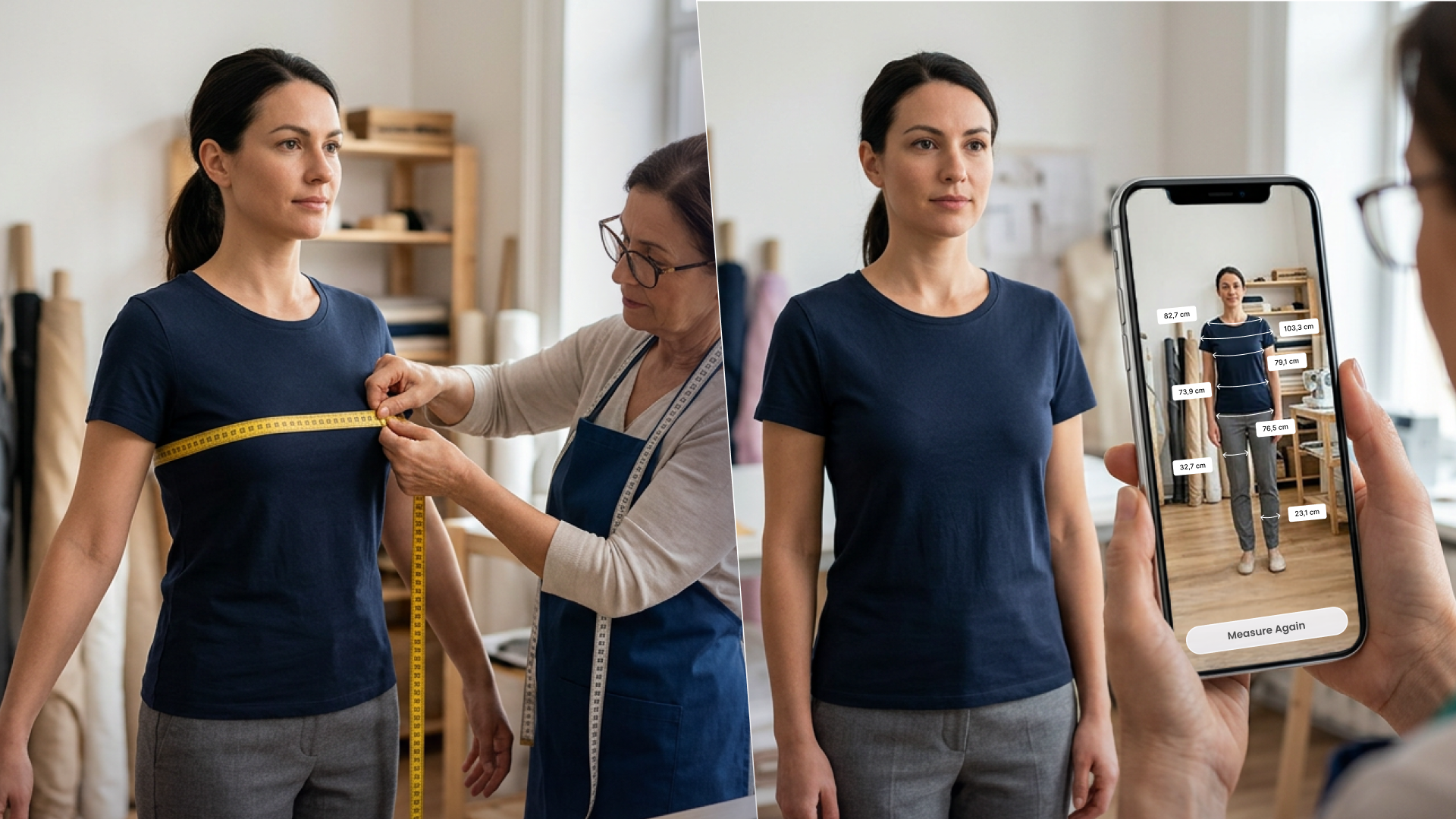
Traditional tape measure methods have served the apparel industry for over 200 years. For many businesses, this approach represents the proven standard requiring no technology investment, no software integration, and no customer education.
The Business Advantages of Traditional Measurements
No Technology Investment Required
Traditional measurement methods eliminate licensing fees, integration costs, and ongoing software maintenance. For businesses evaluating body scanning apps vs traditional measurements purely on upfront cost, tape measures win decisively.
Universal Understanding and Acceptance
Every customer and employee understands traditional measurements. Bust, waist, hip, inseam these dimensions form the common language between manufacturers, retailers, and customers. No training required, no app downloads, no technical barriers preventing participation.
Works with Existing Infrastructure
Most apparel businesses built their sizing systems, production specifications, and quality control processes around traditional measurement standards. Size charts reference standard body dimensions. Manufacturing specs use familiar measurement points. Switching to body scanning apps vs traditional measurements requires rebuilding this infrastructure.
Clear Compliance Documentation
For industrial safety procurement and medical device operations, traditional measurements provide straightforward documentation trails. Recorded tape measurements easily satisfy regulatory compliance requirements for proper PPE fitting. Body scanning apps introduce data format complexity that doesn’t always align with regulatory standards.
The Business Challenges of Traditional Measurements

Scalability Problems Hit Operations Hard
A uniform services account manager handling 1,000 employees across ten facilities faces severe logistical challenges. Coordinating in-person measurement sessions, managing appointment scheduling, and ensuring consistency across different measures becomes a full-time operational burden, consuming 200–300 staff hours per measurement cycle.
Human Error Compounds at Enterprise Scale
Individual measurement accuracy averages 70-80% even with trained measurers. Different measurers apply different tape tensions. Posture varies between sessions. When measuring hundreds or thousands of individuals, these errors compound. Self-reported measurements—a necessity for e-commerce—vary by 5-7 centimetres from professional measurements according to industry studies.
Time Investment Limits Business Growth
Custom manufacturing businesses report spending 45-60 minutes per client on initial measurements and consultations. At this rate, a single tailor can handle only 6-8 new clients daily. Geographic constraints compound the problem—serving distant customers requires travel or accepting accuracy risks from customer self-measurement.
No Data Capture for Business Intelligence
Traditional measurements written on forms don’t integrate with e-commerce platforms, CRM systems, or data analytics tools. Fashion retail executives seeking insights into customer preferences, size distributions, or fit patterns find themselves blind to actionable data. Repeat customers must re-measure rather than referencing stored profiles.
The Translation Problem Remains Unsolved
Even perfect body measurements don’t indicate which size fits when brands vary by 5-7 centimetres within the same nominal size. Traditional measurements capture body data but provide no intelligence about actual garment specifications, manufacturing tolerances, or fabric behavior.
Body Scanning Apps: The Business Reality
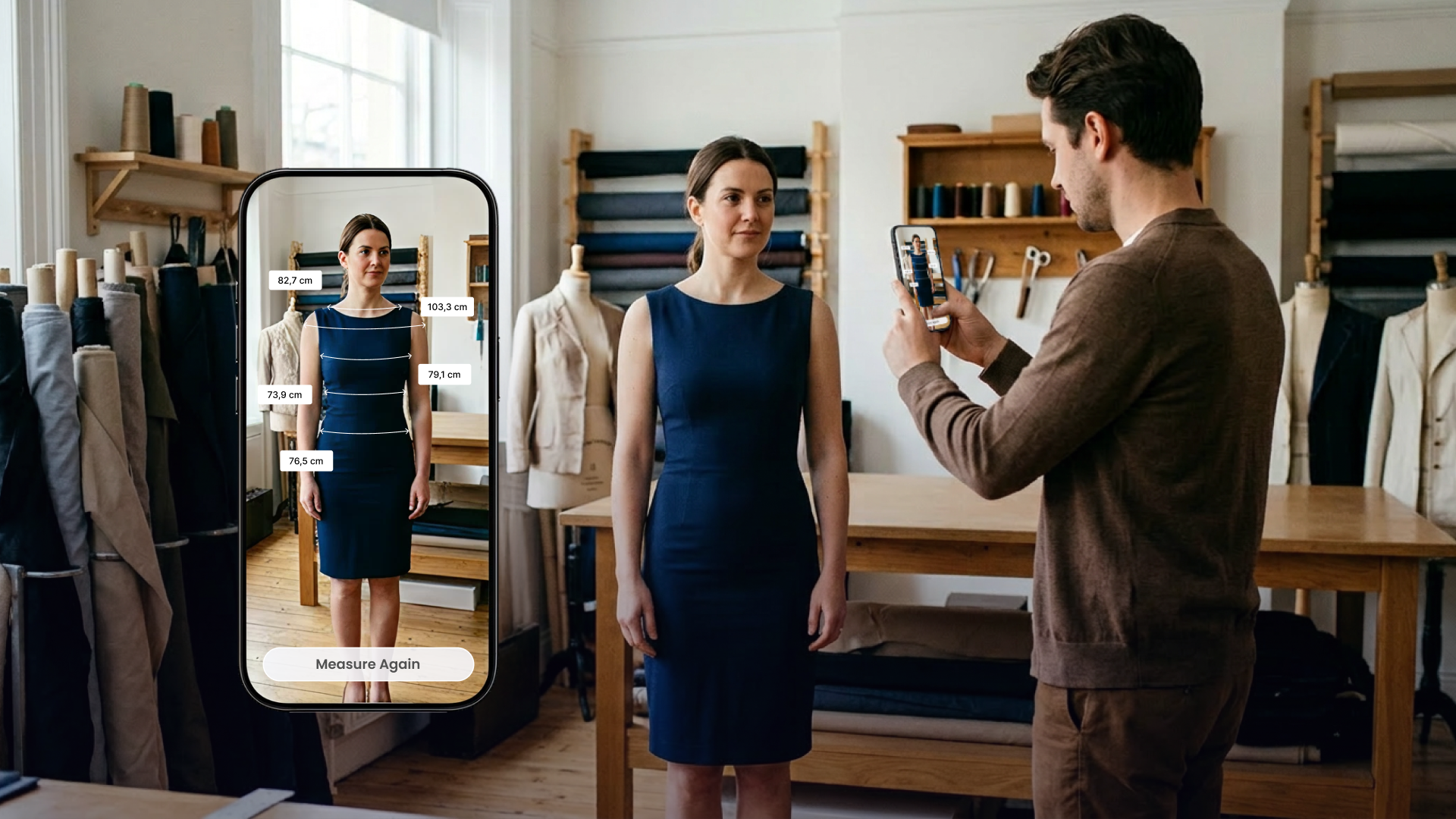
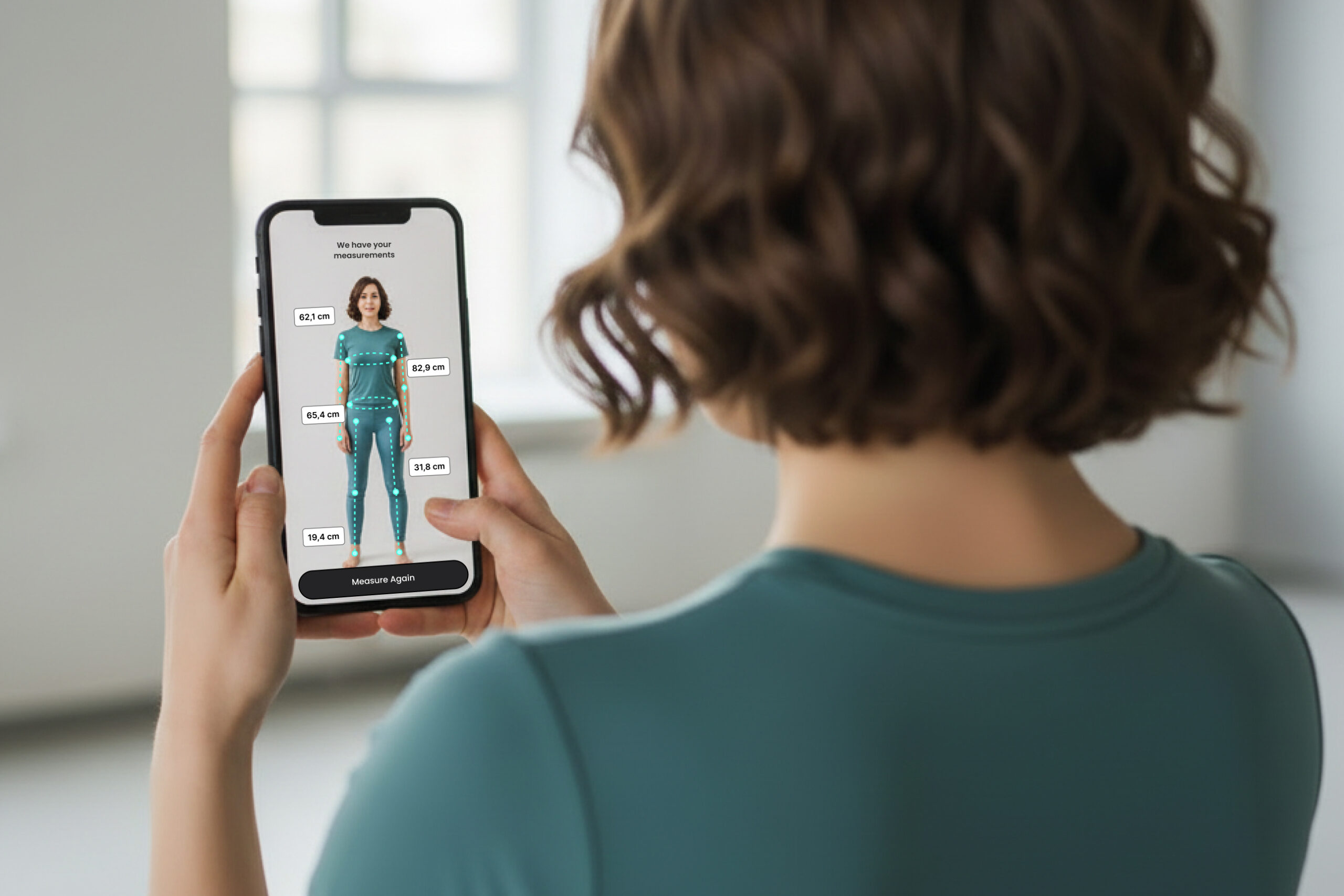
Body scanning apps emerged as the modern answer to traditional measurement limitations. Using smartphone cameras and computer vision algorithms, these applications promise accurate body dimensions in seconds, eliminating tape measures and enabling remote measurement for e-commerce sizing solutions.
Why Businesses Consider Body Scanning Apps
Digital Scalability Promise
Body scanning apps appear to solve the scalability problem plaguing traditional measurements. Uniform services could potentially onboard 1,000 employees remotely. E-commerce brands could offer precision sizing without customer education. Custom manufacturers could serve global markets without geographic constraints.
Rich Customer Data Capture
Scanning technology generates detailed body profiles: not just basic dimensions but comprehensive measurements across 80-90 body points. Fashion retailers gain data for personalization, inventory optimization, and product development. Athletic footwear companies capture foot geometry data informing design decisions.
Modern Brand Positioning
Offering body scanning positions brands as technology leaders solving real customer problems. The innovation narrative appeals to tech-savvy consumers and differentiates from competitors relying on generic size charts.
The Size Standardization Myth
Clothing sizes are not standardised. A ‘Medium’ from Brand A fits differently than a ‘Medium’ from Brand B. More critically, the same size from the same brand varies by 5-7 centimetres across different production runs due to:
- Manufacturing tolerances (± 3cm industry standard)
- Fabric batch variations (different dye lots stretch differently)
- Production facility differences (same brand, different factories)
- Seasonal adjustments (retailers modify fits between seasons)
- Quality control inconsistencies
A customer with a 97 cm chest might perfectly fit a Medium from one production batch while swimming in or bursting out of a Medium from another batch of the identical style. Neither traditional measurements nor body scanning apps account for this reality.
The Esenca Sizing Solution: Garment-Level Fit Prediction
Esenca Sizing addresses what both traditional measurements and body scanning apps miss: the relationship between body dimensions and specific garment specifications. Rather than debating body scanning apps vs traditional measurements, Esenca focuses on accurate fit prediction through garment-level intelligence.
How Garment-Level Sizing Actually Works
Traditional approach: “Your chest measure is 97 cm, so you’re a Medium”
Esenca approach: “This specific item’s Medium measures 97 cm in the chest with 10% fabric stretch and a slim-fit cut, which will fit your 97 cm measurement comfortably.”
The distinction is critical. Esenca maps actual garment specifications to customer profiles rather than relying on generic size charts. The system knows:
- Real garment dimensions: The Small measures 91 cm, the Medium measures 97 cm, and the Large measures 104 cm
- Fabric characteristics: 10% stretch, breathable cotton, structured denim
- Cut and style: Slim fit vs relaxed fit, designed for athletic build vs standard
- Production batch variations: This inventory batch runs slightly larger than previous stock
- Customer fit preferences: Prefers looser fit in shirts, tighter fit in pants
This garment-level intelligence enables precise size recommendations accounting for the actual product customers receive, not idealized size chart specifications.
Key Business Benefits
- Return Rate Reduction: 90%
- Conversion Rate Improvement: 8-15%
- Implementation Time: 2-4 weeks
- Customer Adoption: 90%
- Works across all product categories
- No customer friction or behavior changes required
Frequently Asked Questions
Are body scanning apps accurate for clothing sizing?
Body scanning apps typically achieve great accuracy in measuring body dimensions under ideal conditions (good lighting, form-fitting clothing, correct positioning). However, measurement accuracy doesn’t equal fit prediction accuracy. The challenge isn’t measuring bodies—it’s predicting which size will fit given manufacturing variations, fabric characteristics, and style differences.
What’s more accurate: body scanning or tape measure?
For body measurement precision, body scanning apps and professional tape measurements perform similarly. However, this comparison misses the point. Fit prediction accuracy—which size actually fits—depends more on understanding garment specifications than on body measurement precision. A sizing solution using garment-level intelligence achieves 91-95% fit prediction accuracy.
Why do body scanning apps have low adoption rates?
Customer adoption rates for body scanning apps average just 3-7% due to privacy concerns, technical barriers, physical space requirements, form-fitting clothing requirements, awkward user experience, time investment, and lighting requirements. This friction occurs at the critical purchase decision moment, damaging conversion rates.
What’s the best sizing solution for reducing fashion returns?
The most effective sizing solutions focus on garment-level fit prediction rather than body measurement precision. Solutions that map body data to actual garment specifications—accounting for manufacturing variations, fabric characteristics, and style differences—consistently outperform both traditional measurements and body scanning apps. Businesses implementing garment-level sizing solutions typically achieve 90% return rate reductions.
Beyond the Body Scanning Apps vs Traditional Measurements Debate
The comparison between body scanning apps vs traditional measurements presents a false choice. Both methods attempt to solve fit problems through better body measurement, but measurement accuracy alone doesn’t translate into fit accuracy. The real solution addresses the translation gap between body dimensions and actual garment specifications.
Business leaders evaluating sizing solutions should focus on outcomes rather than measurement methods:
- Does it reduce return rates by 90%?
- Does it increase conversion by eliminating sizing uncertainty?
- Can customers use it without friction or behavior changes?
- Does it work across your entire product catalog?
- Can you implement it within weeks rather than months?
- Does it account for manufacturing variations in your actual inventory?
Esenca Sizing answers these questions by focusing on garment-level precision on top of the body measurement precision. The approach delivers measurable business results without the adoption challenges, implementation complexity, and uncertain ROI characterizing body scanning technology.