

The Future of Sizing: How AI and 3D Scanning Are Eliminating the Fit Problem
For centuries, the garment industry has operated on a fundamental compromise: standardized sizing that fits almost no one perfectly. We’ve accepted that clothes come in small, medium, and large arbitrary categories that ignore the infinite variation of human bodies. We’ve normalised the frustration of trying on multiple sizes, the disappointment of items that looked perfect online but fit poorly in person, and the enormous waste of returns and unsold inventory.
This compromise is ending. The convergence of artificial intelligence, 3D scanning technology, and smartphone computing power is making truly personalized fit accessible at scale. Within the next decade, the concept of standardized sizing may become as obsolete as manual typewriters or paper maps remembered as the way things used to work before technology offered something fundamentally better.
The transformation is already underway across industries from fashion retail to medical devices, from athletic performance to workplace safety. Understanding where this technology is heading—and what it means for businesses and consumers—matters whether you’re making products, selling them, or simply trying to find clothes that actually fit.
Why Sizing Has Always Been Broken
The modern sizing system emerged from military uniform production during World War II, when manufacturers needed to clothe millions of soldiers quickly. They measured thousands of men, identified averages, and created standardized sizes approximating those averages. This system prioritized production efficiency over individual fit—an acceptable tradeoff when the alternative was hand-tailoring every garment.
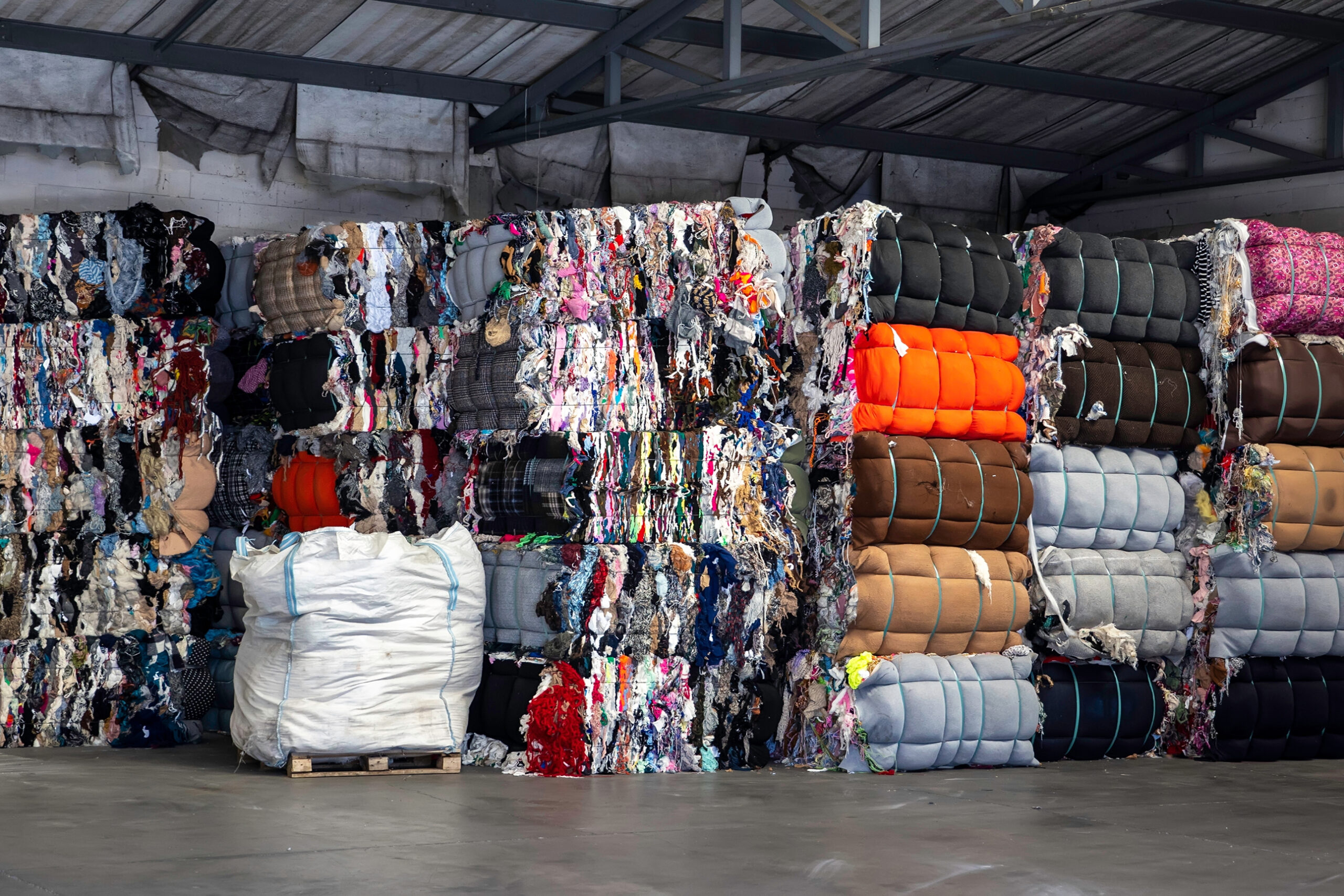
The compromise made sense in a manufacturing-constrained economy. But we’re no longer manufacturing-constrained; we’re drowning in clothing production. The fashion industry produces over 100 billion garments annually, yet fitting remains terrible. The average online fashion retailer sees return rates exceeding 30%, with poor fit cited as the primary reason. This isn’t a minor inefficiency—it’s a fundamental market failure costing hundreds of billions of dollars while generating massive environmental waste.
Standardized sizing fails for mathematical reasons. Human bodies vary across dozens of dimensions, not just height and weight. Shoulder width, torso length, hip-to-waist ratio, posture, arm length each dimension varies independently. Trying to capture this variation with a handful of size categories is like trying to represent a high-resolution photograph with ten colours. The information loss is enormous.
The problem compounds as sizing standards vary by brand, country, and even product line within the same brand. A medium in one brand fits like a large in another. European sizing differs from American sizing. Plus-size categories use entirely different numbering systems. This inconsistency means even people who know their size in one context must guess when encountering new brands or styles.
The Technology Convergence Making Change Possible
Three separate technology trends are converging to finally solve the sizing problem at scale. Individually, each technology has existed for years. Together, they’re creating capabilities that weren’t possible before.
Smartphone Cameras Become Measurement Devices
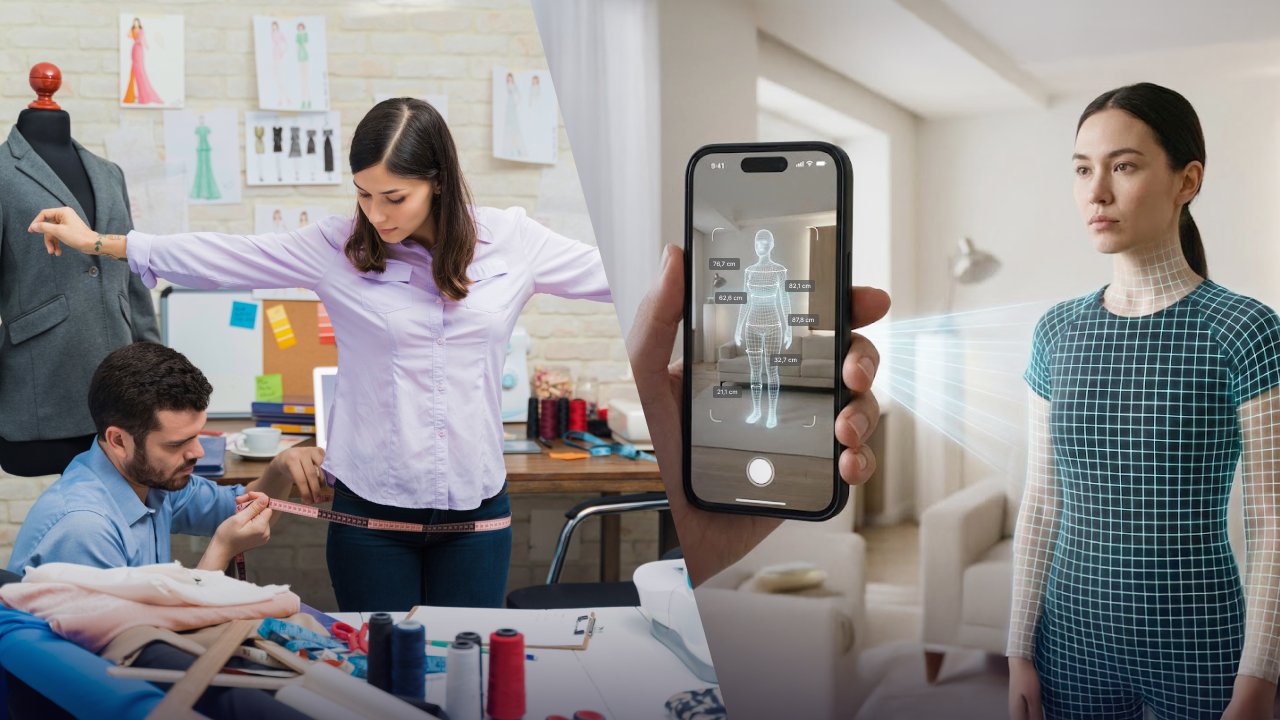
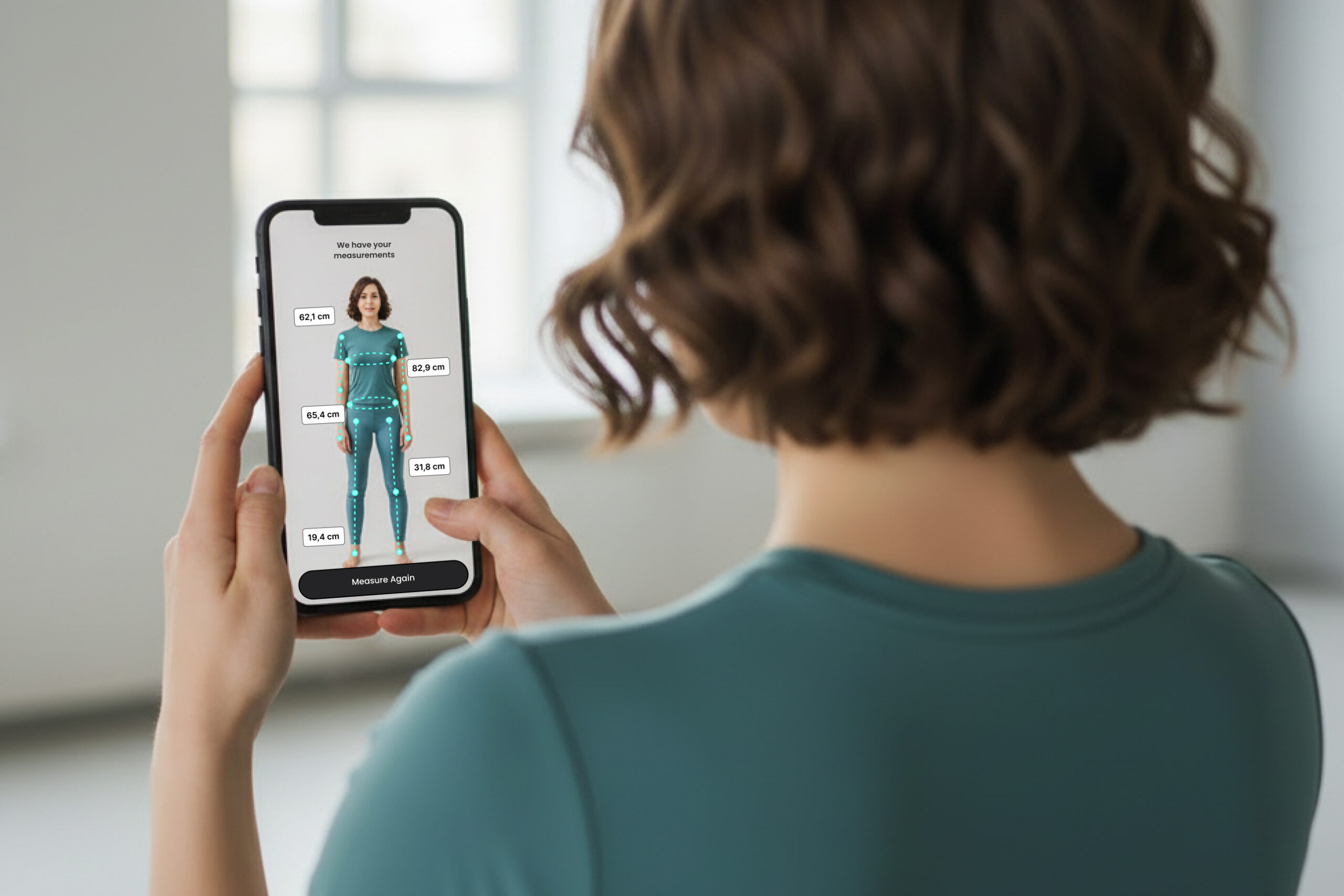
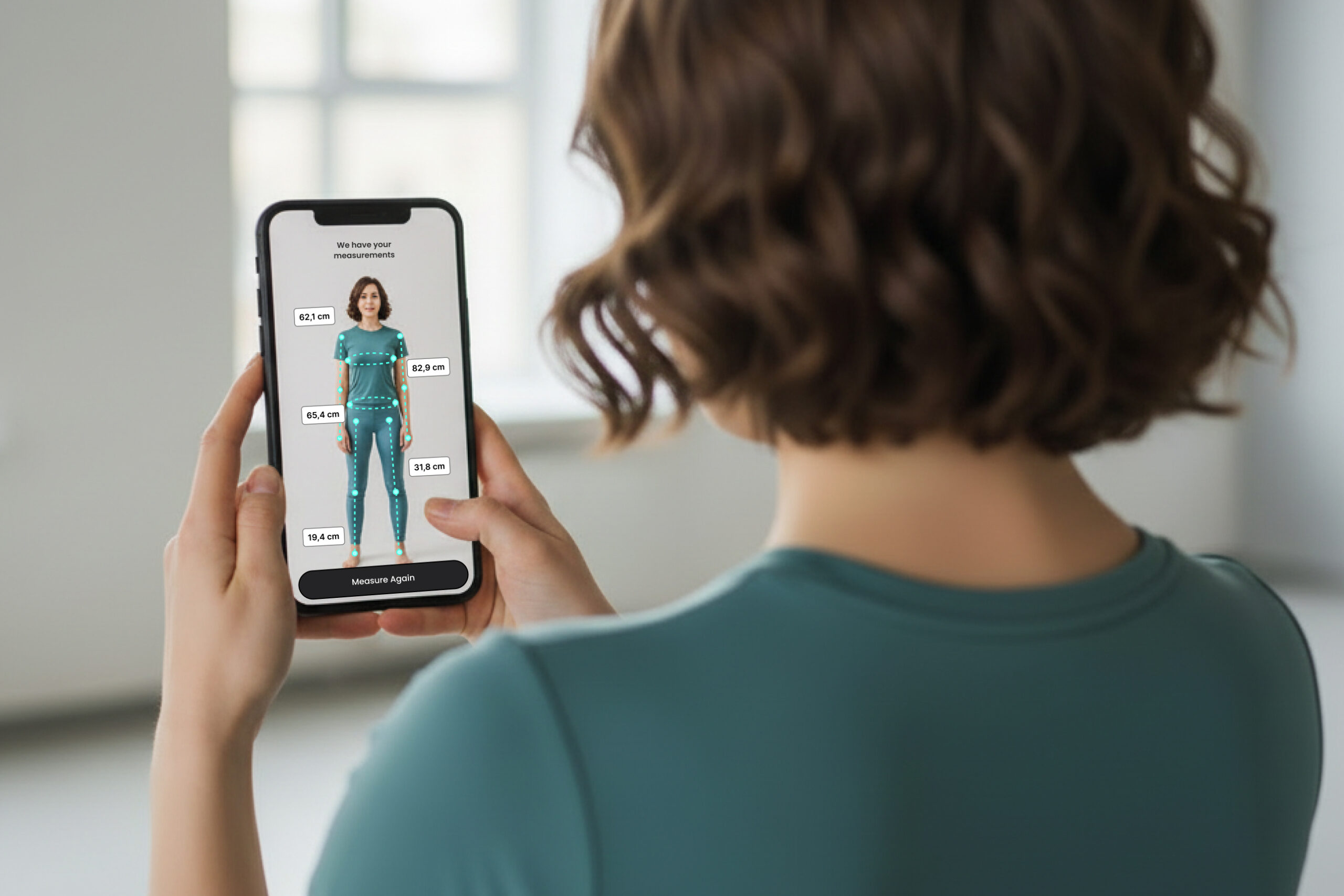
Modern smartphones pack extraordinary computational capability. The camera in your pocket contains multiple lenses, depth sensors, and AI-optimized processors specifically designed for computer vision tasks. These components were developed primarily for photography and augmented reality applications, but they enable precise body measurement as an unintended consequence.
Current generation smartphones can capture sufficient data to construct accurate 3D body models using just their cameras. Advanced models include dedicated depth sensors providing even greater precision. The hardware capable of solving the measurement problem is already in billions of pockets worldwide—the challenge is software, not distribution of specialized equipment.
This ubiquity matters enormously. Previous attempts at body scanning required dedicated hardware—expensive scanning booths installed in retail locations or medical facilities. The smartphone revolution means the measurement device travels with the customer, available whenever and wherever they want to shop.
Computer Vision Achieves Better Results than Human-Level Accuracy
Artificial intelligence has reached the point where computer vision algorithms can identify body landmarks and extract measurements more accurately than skilled human measurers. This capability emerged from years of machine learning research and massive training datasets containing millions of body scans paired with known measurements.
Modern systems don’t just measure; they understand body shape. They recognize posture, account for clothing compression, detect asymmetries, and infer three-dimensional structure from two-dimensional images. They handle variations in lighting, camera angles, and background conditions that earlier systems would not have been capable of processing correctly.
Critically, these algorithms improve continuously as they process more data. Each measurement refines the models, making subsequent measurements more accurate. The systems learn which body types require special handling, which garment categories need which measurements, and how measurement accuracy correlates with ultimate fit satisfaction.
AI Translation from Measurements to Fit
Accurate measurements solve only half the problem. The harder challenge is predicting how specific garments will fit specific bodies. This requires understanding fabric behavior, construction methods, style preferences, and the relationship between static measurements and dynamic fit.
AI systems now tackle this translation layer. They learn from millions of purchase and return events, understanding which body measurement combinations fit which garments well. They account for fabric stretch, pattern design, and construction details. They even incorporate subjective fit preferences—some people like slim fits while others prefer relaxed cuts.
This translation capability transforms measurements from interesting data into actionable recommendations. Customers don’t need to understand their measurements; the system translates body data directly into size recommendations for specific products. The complexity disappears behind simple guidance: this will fit you well, that won’t.
Where We Are Today: Early Adoption Across Industries
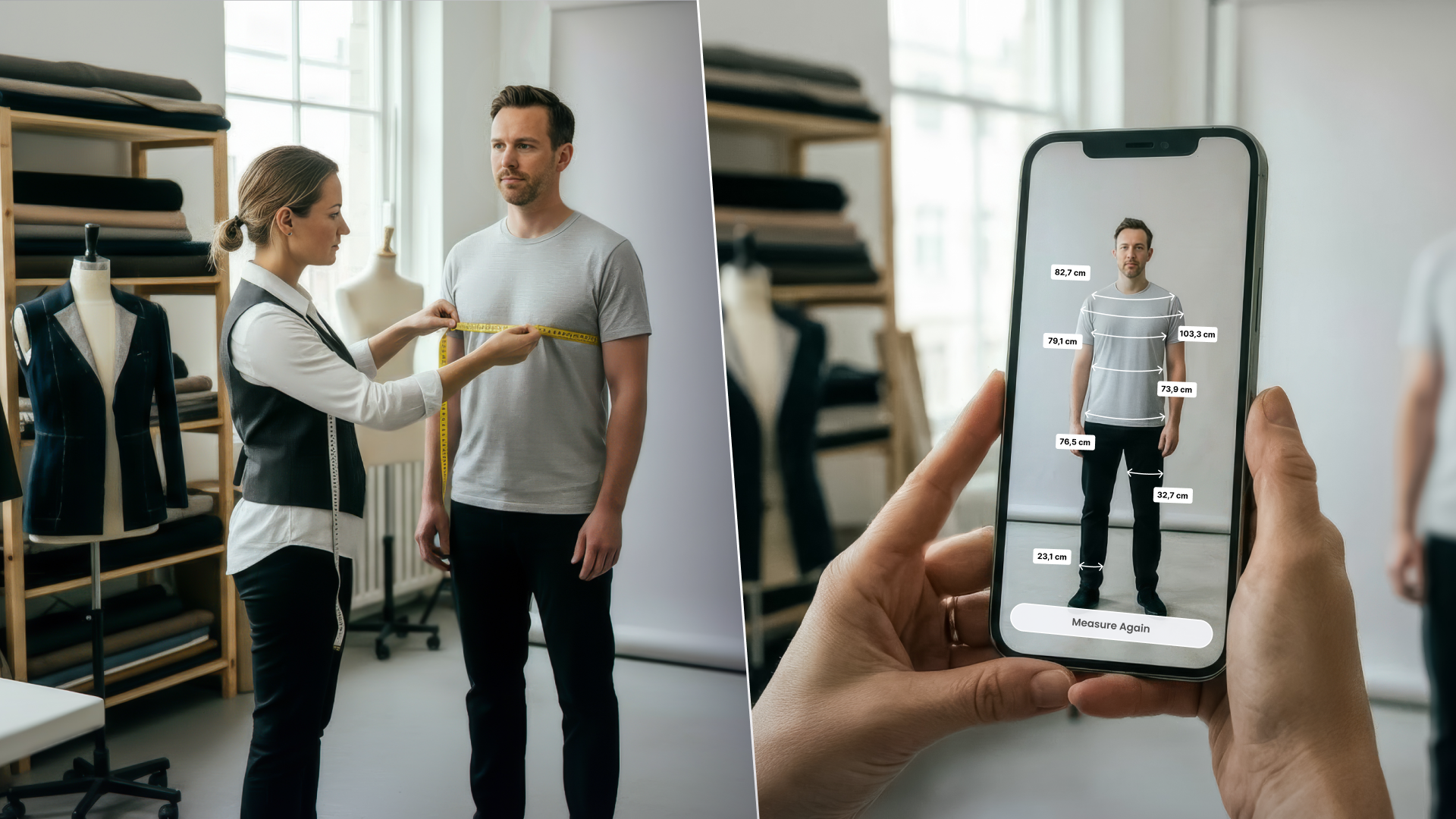
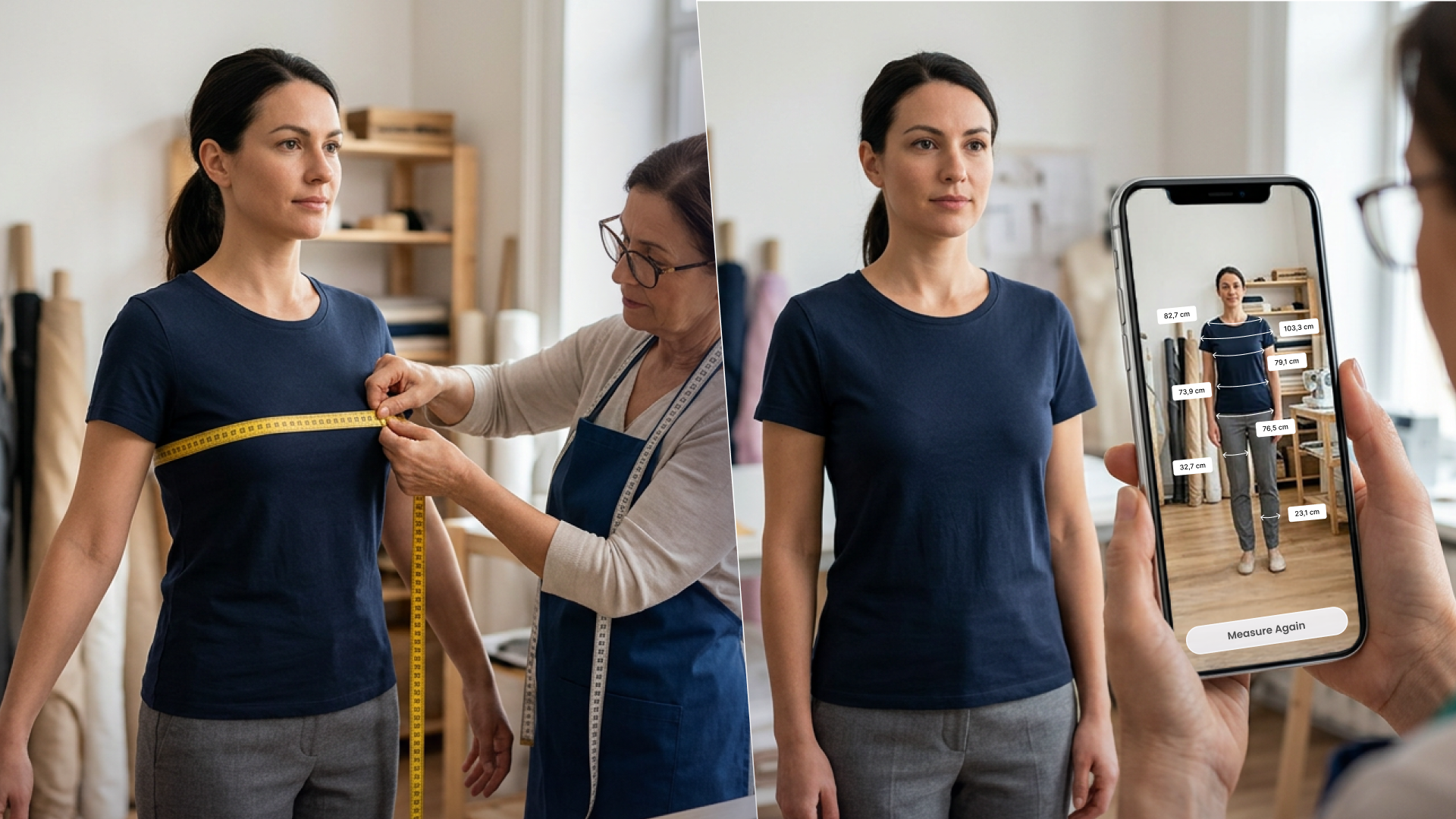
Body scanning apps emerged as the modern answer to traditional measurement limitations. Using smartphone cameras and computer vision algorithms, these applications promise accurate body dimensions in seconds, eliminating tape measures and enabling remote measurement for e-commerce sizing solutions.
Fashion E-Commerce Leads Adoption
Online fashion retailers face the most immediate pain from poor sizing. Returns eat directly into margins while creating terrible customer experiences. Many major e-commerce platforms now offer body scanning features, either through proprietary technology or partnerships with measurement solution providers.
Early results show substantial return rate reductions when customers use measurement tools before purchasing. The challenge is adoption—many customers skip the measurement step, either unaware the feature exists or skeptical about accuracy. The retailers succeeding with this technology are those integrating it seamlessly into their purchase flows rather than offering it as an optional side feature.
Custom and made-to-measure brands built around digital measurement from inception demonstrate what’s possible when the entire business model assumes accurate body data. These companies achieve fit satisfaction rates that off-the-rack retailers can’t match, establishing customer expectations that will pressure the broader market toward better sizing solutions.
Healthcare and Medical Devices
Medical applications demand even higher accuracy than fashion. Prosthetics, orthotics, compression garments, and other therapeutic devices require precise fit for proper function and patient comfort. Healthcare providers are rapidly adopting 3D scanning to replace manual measurement methods that were time-consuming and inconsistent.
The healthcare context proves the technology’s accuracy potential. When fitting errors can affect patient outcomes, measurement precision matters enormously. Clinical adoption validates that the technology works reliably even in high-stakes applications—a proof point that should reassure more skeptical industries.
Athletic Performance and Footwear
Athletic brands recognize that equipment fit directly impacts performance. Runners in properly fitted shoes suffer fewer injuries. Cyclists in well-fitted gear achieve better aerodynamics. Professional athletes have long received custom fitting; technology is democratizing access to that precision for serious amateurs.
Foot scanning for athletic footwear has advanced particularly quickly. Feet are smaller and simpler to measure than full bodies, making the technical challenge more manageable. Several major footwear brands now offer smartphone scanning apps providing detailed foot measurements and personalized shoe recommendations.
Workplace and Safety Equipment
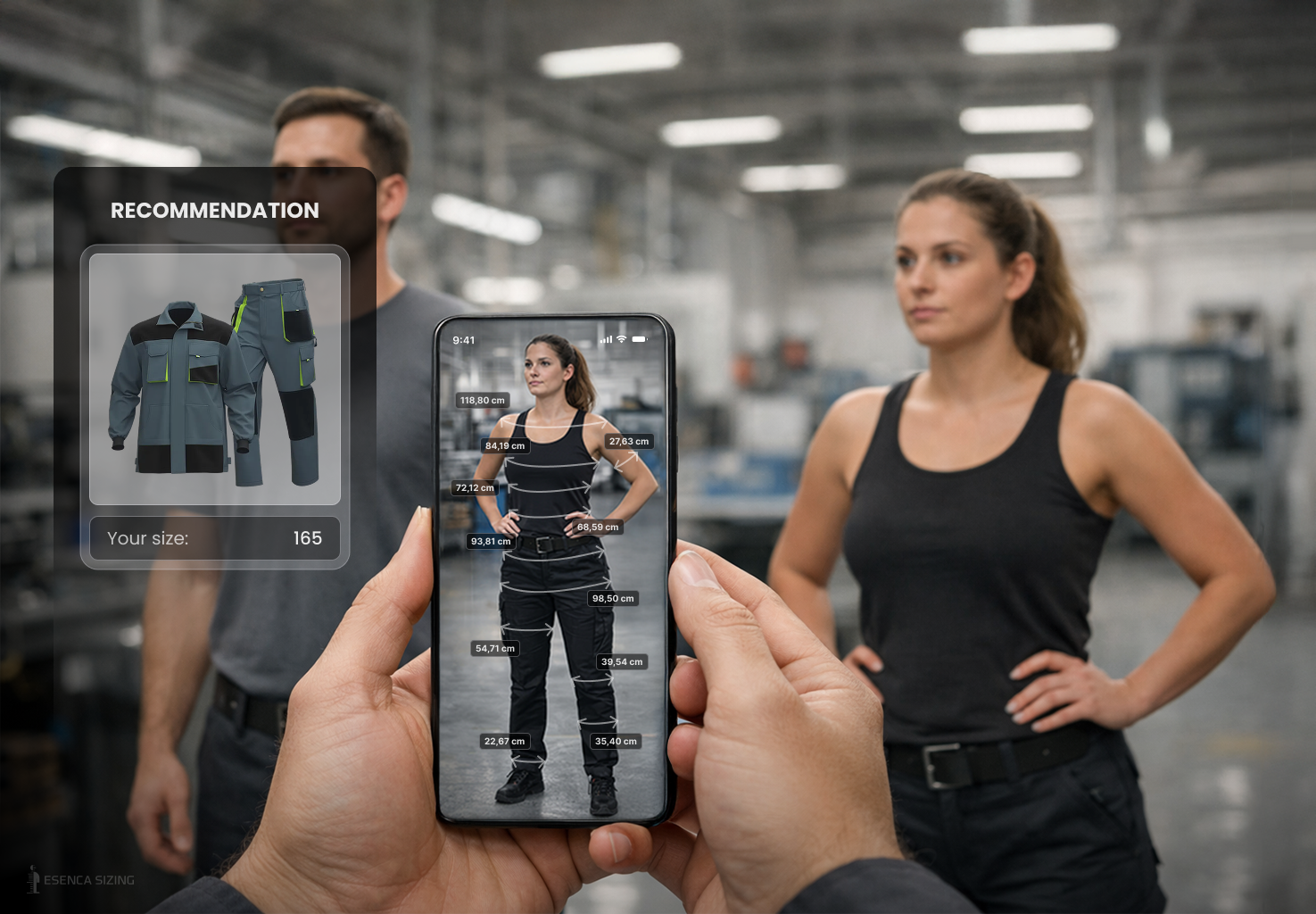
Organizations providing uniforms and protective equipment to large workforces face enormous sizing challenges. Traditional fitting processes are time-consuming and error-prone. Poor fit in safety equipment creates compliance issues and genuine hazards.
Corporate adoption is accelerating as organizations recognize both the cost savings from reduced returns and the safety benefits from better fit. The business case is straightforward—technology pays for itself quickly while improving outcomes. Industrial adoption often leads consumer adoption as businesses prove technology viability before individuals embrace it.
Where the Technology Is Heading
Current implementations represent early stages of a technology trajectory that will transform how we think about sizing entirely. Several clear trends are emerging.
From Size Recommendations to Virtual Try-On
The next evolution combines body scanning with virtual garment visualization. Instead of recommending a size, systems will show you exactly how specific items will look on your body. This bridges the gap between online convenience and the try-before-you-buy confidence of physical retail.
Early virtual try-on implementations used generic avatars that looked nothing like the customer. Newer systems create photorealistic representations of your actual body wearing specific garments with accurate fabric drape and fit. The technology is approaching the point where virtual try-on provides more information than trying on garments in a store, since you can see multiple angles and different movement positions impossible with a dressing room mirror.
This capability will fundamentally change online shopping. The uncertainty preventing many people from buying clothing online disappears when you can see exactly how items will look on you before purchasing. The competitive advantage shifts to retailers providing the best visualization tools, not just the biggest selections.
Passive Measurement Without Active Scanning
Current systems require customers to actively participate in measurement—opening an app, following instructions, capturing images. Future systems will infer measurements passively from existing photos or video. Computer vision is advancing to the point where a single photograph contains sufficient information to extract reasonably accurate body measurements.
Privacy concerns will shape how this capability deploys. Many people will welcome the convenience of automatic measurement from their photo libraries. Others will resist systems analyzing their bodies without explicit permission. Successful implementations will balance capability with clear user control and consent.
The ultimate vision is measurement happening entirely in the background. You browse products online; the system already knows your measurements from previous shopping sessions or incidentally captured data. Size selection becomes automatic and invisible, like how autocorrect fixes typing errors without conscious intervention.
Real-Time Personalized Manufacturing
The most profound change comes when accurate body measurement combines with flexible manufacturing. Instead of producing standardized sizes and hoping to match them to customers, manufacturers could produce garments customized to individual measurements at scale.
This isn’t science fiction—the technology exists today. Automated cutting machines can produce custom patterns as easily as standard ones. Digital printing allows custom designs without setup costs. The bottleneck is economic, not technical. Custom manufacturing costs more than mass production, but the gap is narrowing as automation advances.
We’re approaching a tipping point where the waste from producing wrong sizes exceeds the premium for producing right sizes. When that crossover occurs, mass customization becomes economically optimal. Retailers won’t maintain inventory of every size; they’ll manufacture items on-demand using customer-specific measurements captured at order time.
Body Data as Infrastructure
As body measurement becomes routine, the data itself becomes valuable infrastructure. Your body scan becomes a persistent digital asset you carry across shopping experiences, healthcare encounters, athletic pursuits, and professional contexts.
Imagine measuring yourself once and having those measurements automatically available whenever relevant. You never enter shipping addresses anymore; they’re saved. Body measurements will work the same way—captured once, used everywhere, updated periodically as your body changes.
This infrastructure layer requires solving data portability and privacy challenges. Your measurements need to travel with you across platforms while remaining under your control. Standards will emerge defining how body data is stored, shared, and protected. Companies will compete on measurement accuracy and user experience while cooperating on data formats and portability.
Business Model Implications Across Industries
This technological shift creates winners and losers across the value chain. Understanding the strategic implications matters whether you’re manufacturing, retailing, or providing adjacent services.
Retail Economics Transform
Retailers currently lose enormous value to returns. When measurement technology reduces return rates substantially, those savings flow directly to profitability or enable price reductions that capture market share. Early adopters achieving superior fit will differentiate meaningfully from competitors.
Inventory management becomes simultaneously easier and more complex. Easier because you know precisely which sizes you need rather than estimating demand across all sizes. More complex because the size distribution you need might vary by product, season, and customer segment in ways that weren’t apparent when everyone bought from limited size options.
Physical retail faces particular challenges. The traditional advantage of try-before-buy diminishes when virtual try-on provides comparable confidence. Physical stores need to evolve beyond fitting into experiential destinations offering value that digital channels can’t replicate—expert styling advice, social shopping experiences, immediate gratification.
Manufacturing Shifts Toward Flexibility
Manufacturers built around mass production of standardized sizes face strategic choices. They can continue optimizing for volume efficiency, accepting that measurement technology reduces the penalty for poor fit but doesn’t eliminate preference for products that fit well initially. Or they can invest in flexible manufacturing capabilities enabling economical small-batch or custom production.
The winners will likely be those combining both strategies—ultra-efficient mass production for commodity categories where price matters most, flexible manufacturing for premium categories where fit commands premium pricing. The middle ground becomes uncomfortable: not cheap enough to compete on price, not fitted enough to justify premiums.
New Intermediaries and Services
Technology transitions create opportunities for new intermediaries. Companies providing measurement infrastructure to retailers, platforms aggregating body data across shopping experiences, services translating between measurement systems and size charts—all represent potential businesses enabled by this shift.
Data analytics businesses will emerge analyzing body measurement data to inform product development, marketing segmentation, and inventory planning. Just as Google Analytics transformed web optimization, body measurement analytics will transform garment design and retail strategy.
What This Means for Consumers
From a consumer perspective, the transformation is about reducing friction and expanding choice. Shopping becomes easier, faster, and more reliable as the sizing problem fades.
Democratization of Good Fit
Currently, people with body types matching standardized sizes enjoy better shopping experiences than those with bodies falling between sizes. Body measurement technology democratizes good fit, making it accessible regardless of whether your proportions match industry averages.
This particularly benefits underserved market segments—plus-size customers, petite customers, people with asymmetries or proportions outside standard ranges. The economic case for serving these segments improves when you can fit them accurately without maintaining extensive size inventories.
Time Savings and Reduced Frustration
The time currently wasted on sizing—trying multiple sizes, processing returns, shopping across retailers hoping for better fit—gets reclaimed. Shopping becomes more efficient when you can identify appropriate products quickly and buy with confidence that they’ll fit.
The psychological burden of sizing diminishes. Many people carry negative associations with sizing from years of frustration finding clothes that fit. When sizing works transparently in the background, that source of stress disappears.
Privacy Considerations
Body measurements represent sensitive personal data. People reasonably worry about how this information might be used, shared, or secured. The technology industry’s track record with personal data doesn’t inspire universal confidence.
Consumer adoption will depend partly on how well companies address these concerns. Successful implementations will provide clear control over data sharing, transparent explanations of how measurements are used, and robust security protecting against unauthorized access. The companies building consumer trust will capture market share from those treating body data carelessly.
Timeline: How Quickly Will This Happen?
Technology adoption rarely happens uniformly. Different segments adopt at different rates based on economics, culture, and the severity of problems being solved.
Near Term: 2-3 Years
Body measurement features become standard offerings from major e-commerce platforms and progressive retailers. Adoption remains optional—customers can choose to provide measurements for better recommendations or continue using traditional size selection.
Healthcare and corporate uniform applications see widespread deployment. These contexts have clear ROI and fewer adoption barriers than consumer retail. Success stories from these sectors build confidence that accelerates retail adoption.
Custom and made-to-measure brands built around digital measurement capture growing market share, establishing customer expectations for better fit that pressure traditional retailers to improve their sizing solutions.
Medium Term: 3-7 Years
Virtual try-on becomes sophisticated enough to provide genuine confidence about fit and appearance. The combination of accurate measurement and realistic visualization makes online shopping comparable to in-store experiences for fit assessment.
Platform-level solutions emerge, allowing body measurements captured once to work across multiple retailers. Your measurement profile becomes portable infrastructure, similar to how payment information works today.
Manufacturing flexibility improves to the point where custom production becomes economically viable for premium categories. Mass customization transitions from niche offering to mainstream option for customers willing to pay modest premiums for perfect fit.
Long Term: 7-9 Years
Standardized sizing becomes rare outside commodity categories competing purely on price. Most garment purchases involve some level of personalization based on individual body measurements.
Physical retail that survives focuses on experiences, expertise, and immediate availability rather than fitting. The stores remaining open provide value beyond what digital channels can deliver.
Body measurement becomes as routine and invisible as GPS location services are today. You measured yourself years ago; the system updates periodically and so does your body, so you need to measure again. Younger generations can’t remember when sizing required guesswork.
Obstacles and Uncertainties
Technology trajectories rarely proceed smoothly. Several factors could slow or complicate this transition.
Consumer Trust and Privacy Concerns
If companies mishandle body measurement data—security breaches, unauthorized sharing, discriminatory use—consumer backlash could stall adoption. One major privacy scandal involving body measurements might set the industry back years.
Regulation may emerge restricting how body data can be collected, stored, or used. While appropriate regulation protects consumers, poorly designed regulation could make valuable applications impossible while failing to prevent actual harms.
Technology Accuracy and Reliability
Current systems work well for many people but struggle with certain body types, clothing situations, or environmental conditions. If these limitations persist, consumer confidence could remain too low for mainstream adoption.
The gap between marketing claims and actual performance matters enormously. Companies overpromising accuracy while delivering mediocre results damage not just their own reputations but consumer trust in the category generally.
Economic and Competitive Dynamics
Established retailers have invested heavily in infrastructure assuming standardized sizing. Transitioning to measurement-based systems requires replacing processes, retraining staff, and rethinking logistics. Companies with the most to lose from disruption are the least motivated to embrace it.
Meanwhile, measurement technology providers compete intensely, making long-term investments risky when success is uncertain. Consolidation will likely occur, but predicting which approaches and companies will dominate remains difficult.
Conclusion: The End of One Size Fits All

The convergence of AI, 3D scanning, and ubiquitous computing is dismantling one of commerce’s most persistent frustrations. The sizing system that served mass production adequately but individual consumers poorly is giving way to personalization that serves everyone better.
This transition is inevitable, though its exact pace and path remain uncertain. The technology works. The economics improve steadily. Consumer benefits are clear. The question isn’t whether this happens but how quickly and through which specific implementations.
For businesses, the strategic imperative is understanding where your industry sits in the adoption curve and what competitive advantages or vulnerabilities the transition creates. Early movers can capture advantages—customer loyalty from superior fit, operational efficiency from reduced returns, market expansion from serving previously underserved segments. Late movers risk irrelevance as customer expectations evolve.
For consumers, the transformation means progressively better shopping experiences. The frustration of sizing diminishes. The waste of returns decreases. The accessibility of good fit expands. Shopping becomes more efficient and more reliable.
The parallel to other technology transitions is instructive. Paper maps served us for centuries until GPS made them obsolete. Film photography dominated until digital sensors offered something clearly better. Standardized sizing has persisted because no superior alternative existed at reasonable cost. That’s changing.
Within a generation, the idea that clothes come in arbitrary sizes matching almost no one perfectly will seem as antiquated as the idea of developing film or unfolding paper maps. We’ll wonder why we tolerated such an obviously inadequate system for so long. The answer, as with most technology transitions, is that we tolerated it until we didn’t have to anymore.
The future of sizing is no sizing or rather, sizing customised precisely to each individual. Technology is finally making that future accessible. How quickly it arrives depends on the combined actions of technology providers, retailers, manufacturers, and consumers. But it’s coming, and its arrival will fundamentally improve how we clothe ourselves.
The fit problem that has plagued the garment industry since mass production began is ending. Not because bodies are changing, but because our ability to accommodate their natural variation finally matches our ability to produce garments at scale. That’s progress worth anticipating.
Building the Future of Sizing
At Esenca Sizing, we’re working to make this future accessible today. Our body measurement technology helps businesses across industries—from custom clothiers to corporate uniform programs, from e-commerce platforms to medical device manufacturers—solve the fit problem for their specific applications.
The vision outlined in this article isn’t speculative; it’s what we’re building alongside our partners. Every implementation teaches us more about what works, what customers need, and how measurement technology creates value in different contexts. The future arrives gradually, through countless specific applications solving real problems.
Whether you’re exploring how measurement technology might benefit your organization, implementing solutions for the first time, or optimizing existing deployments, we’d welcome the conversation. The transformation of sizing is a collaborative effort requiring expertise from technology providers, industry practitioners, and forward-thinking businesses willing to lead change.
Learn more about Esenca Sizing solutions at https://esencasizing.com