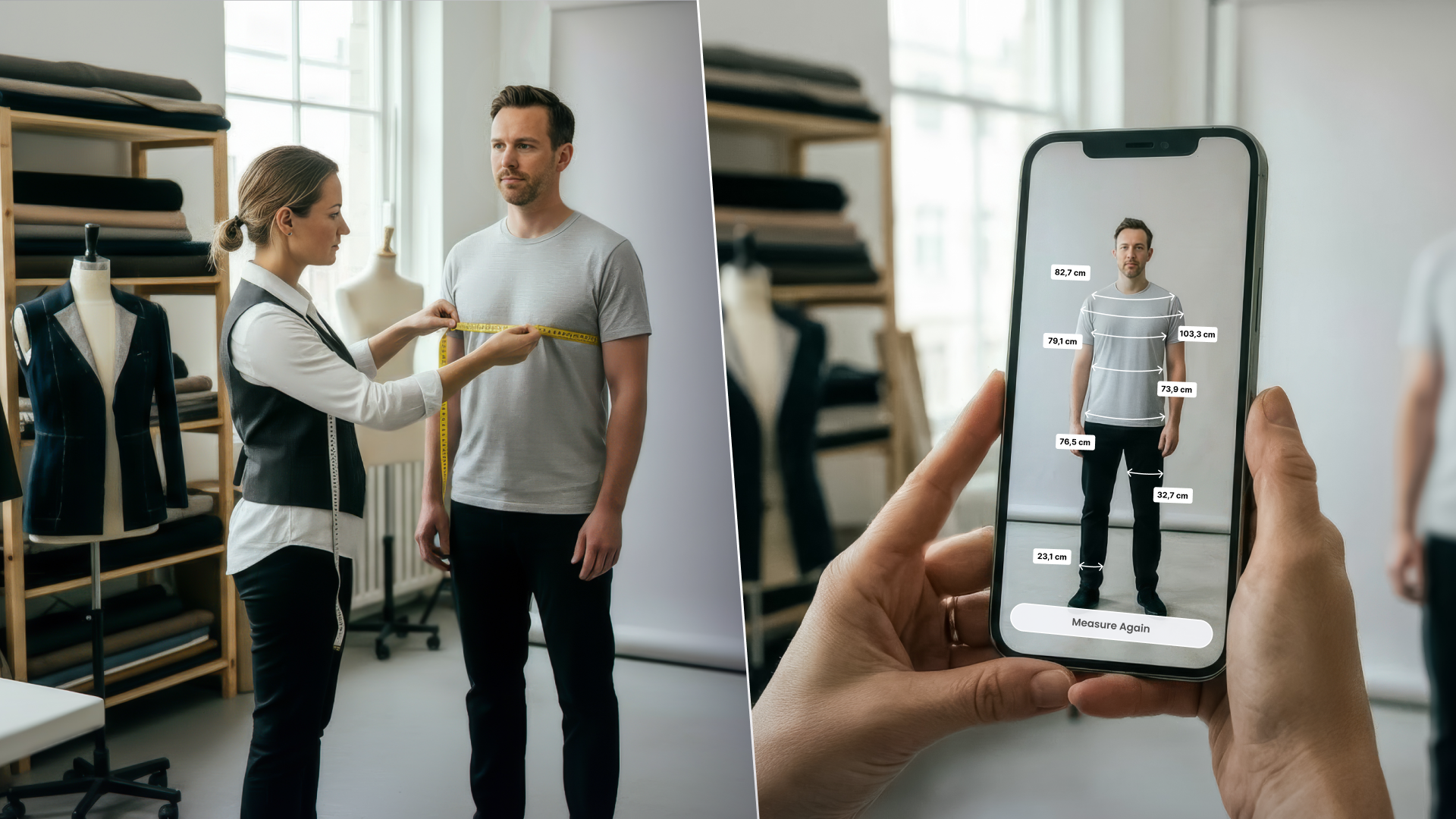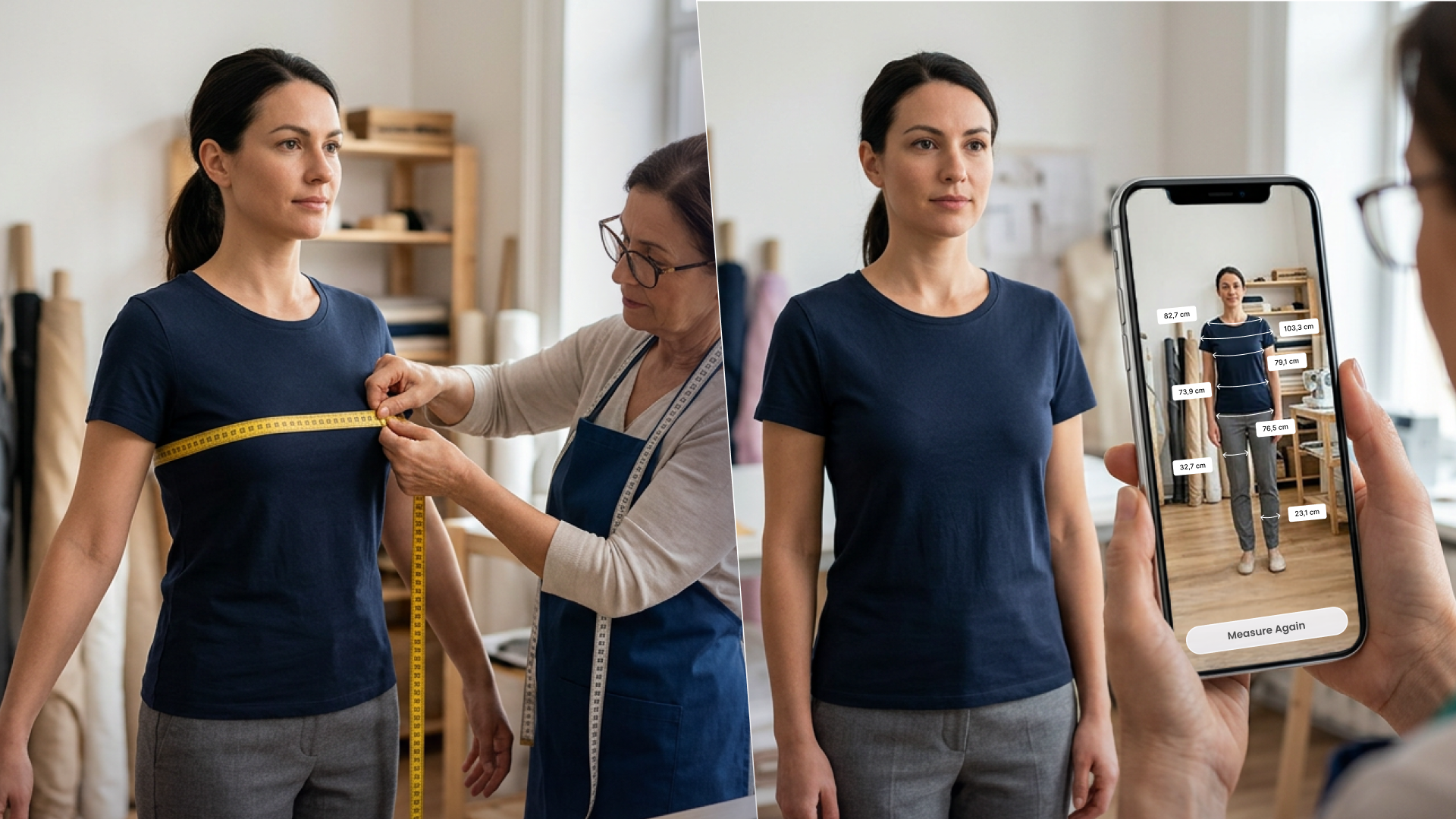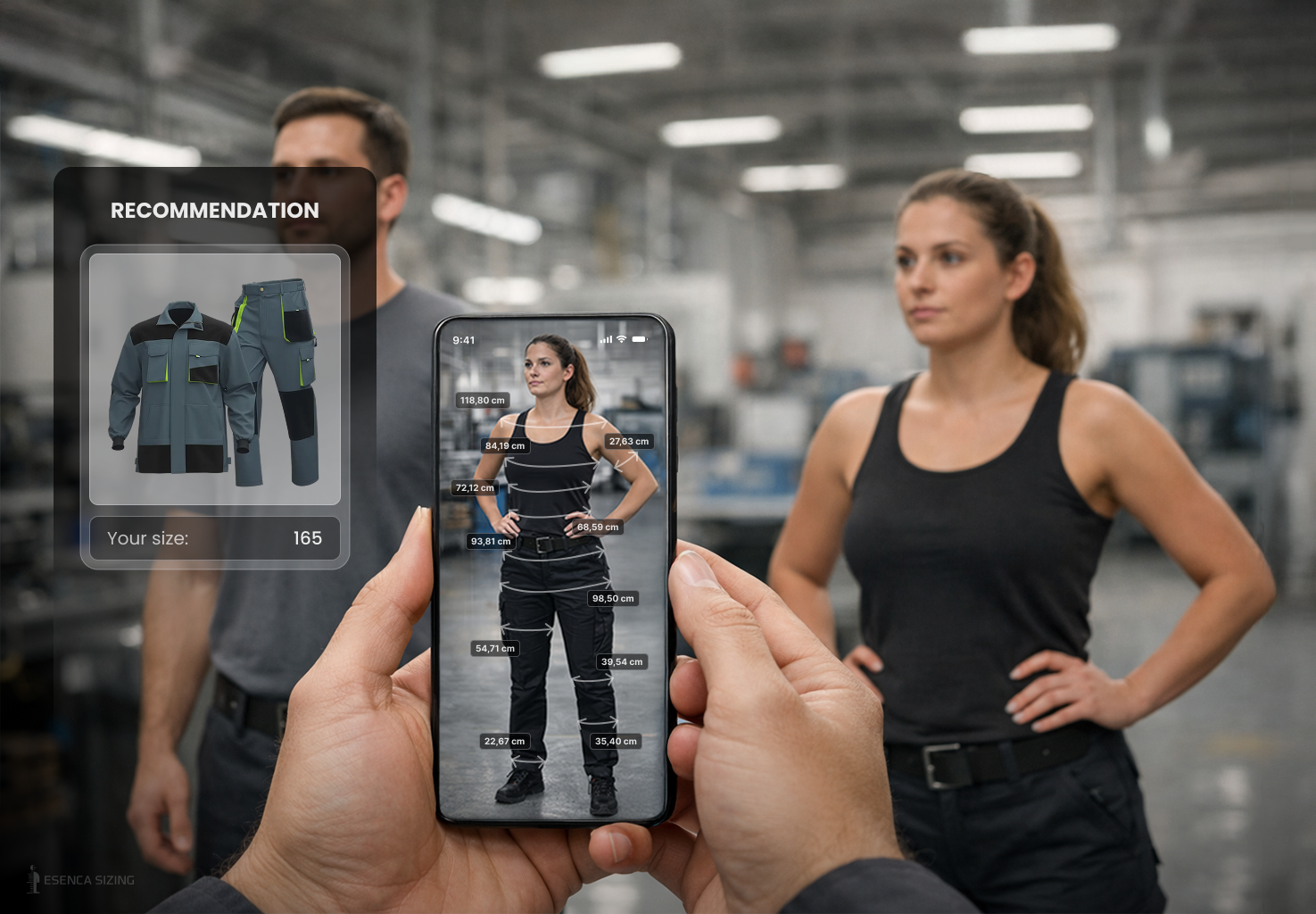
When a manufacturing facility orders uniforms for 500 workers and 30% come back for exchanges, that’s not just an inconvenience—it’s a massive operational problem. Add travel costs for on-site measurement teams, administrative overhead, and the safety risks of ill-fitting protective equipment, and workwear sizing becomes a critical challenge affecting budgets, efficiency, and worker safety.
For industrial safety procurement specialists and uniform services account managers, workwear sizing represents a persistent operational headache. Unlike retail apparel, where fit is primarily about comfort and appearance, industrial workwear must balance safety compliance, durability requirements, and diverse body types across distributed workforces—all while managing costs and maintaining efficiency.
Traditional sizing methods, self-reported measurements, generic size charts, and expensive on-site fitting sessions consistently fail to deliver accuracy rates above 60%. The result: massive return rates, inventory waste, worker dissatisfaction, and compliance risks.
This guide examines the unique challenges of workwear sizing, why conventional approaches fall short, and how modern digital sizing tools are transforming industrial uniform programmes with 90-95% accuracy rates and dramatic improvements in efficiency.
The Unique Challenges of Workwear Sizing
Why Workwear Sizing Is Different
Workwear exists in a fundamentally different category than consumer fashion. Industrial workwear must meet rigorous functional requirements that complicate the sizing process.
Safety and Compliance Requirements: Many workwear items qualify as personal protective equipment under OSHA regulations. Flame-resistant coveralls, high-visibility clothing, and protective outerwear must fit properly to provide intended protection. A loose FR garment can catch on machinery; a tight one may tear during emergency movements. These aren’t aesthetic concerns—they’re regulatory requirements with citation and liability implications.
Durability and Functionality: Industrial garments undergo extreme conditions: chemical exposure, abrasion, repeated industrial laundering, and temperature extremes. They’re built with reinforced seams, heavy-duty materials, and functional design elements that affect fit differently than consumer apparel.
Diverse Body Types: Manufacturing, construction, and industrial sectors employ workers across a wider range of body types than many office environments. From petite women in traditionally male-dominated fields to larger workers requiring extended sizes, the size distribution is broader and less predictable.
Extended Wear Cycles: Workwear isn’t always rotated seasonally like fashion. Workers wear the same garments daily for months or years, as long as they are not broken, are still functional, and have all the visual properties working as intended. Sizing must account for how garments will perform after 30+ industrial wash cycles, not how they look fresh from the package.
Scale and Volume Complexity
Industrial workwear programmes operate at scales that magnify every sizing inefficiency.
Outfitting Hundreds or Thousands Simultaneously: When a new facility opens or a company updates uniforms company-wide, procurement teams must outfit 500, 1,000, or more workers in compressed timeframes. Each sizing error multiplies across the volume, turning a 30% inaccuracy rate into hundreds of individual problems.
Multi-Facility Coordination: Organisations operating multiple sites face the logistical nightmare of coordinating sizing across locations. Sending measurement teams to ten facilities means ten separate schedules, ten sets of travel costs, and ten opportunities for inconsistency.
Seasonal Hiring Surges: Industries with seasonal demand—agriculture, food processing, logistics—hire hundreds of workers simultaneously during peak seasons. Sizing bottlenecks can delay worker deployment when operations need them most.
High Turnover Rates: Warehouse, food service, and entry-level manufacturing positions often experience annual turnover rates of 50–100%. This constant churn means procurement teams continuously process new worker sizing rather than managing stable workforces.
Environmental Constraints
The conditions where workwear sizing occurs often work against accurate measurement.
On-Site Measurement in Active Facilities: Unlike retail fitting rooms, industrial sizing happens in working plants, warehouses, and construction sites. Space is limited, privacy is minimal, and the environment is designed for production, not garment fitting.
Shift Work Scheduling: Many industrial operations run 24/7 across multiple shifts. Coordinating measurement sessions to accommodate all shifts presents scheduling challenges, and removing workers from production incurs opportunity costs.
Remote Locations: Oil and gas operations, mining, construction sites, and agricultural facilities often operate in remote locations. Getting measurement teams to these sites involves substantial travel time and expense.
Traditional Methods and Their Limitations
Self-Reported Sizing
How it works: Organizations provide generic size charts and workers select their own sizes based on what they believe will fit.
Why it fails: This method achieves low 40-60% accuracy. Workers don’t know their actual body measurements, and workwear sizing differs significantly from retail clothing. Size inconsistency between manufacturers, body shape variations, and oversize bias (workers defaulting to larger sizes “to be safe”) compound the problem.
The impact: Organizations using self-reported sizing typically experience 25-40% return rates, meaning 250-400 returns for every 1,000 workers outfitted.
On-Site Measurement Sessions
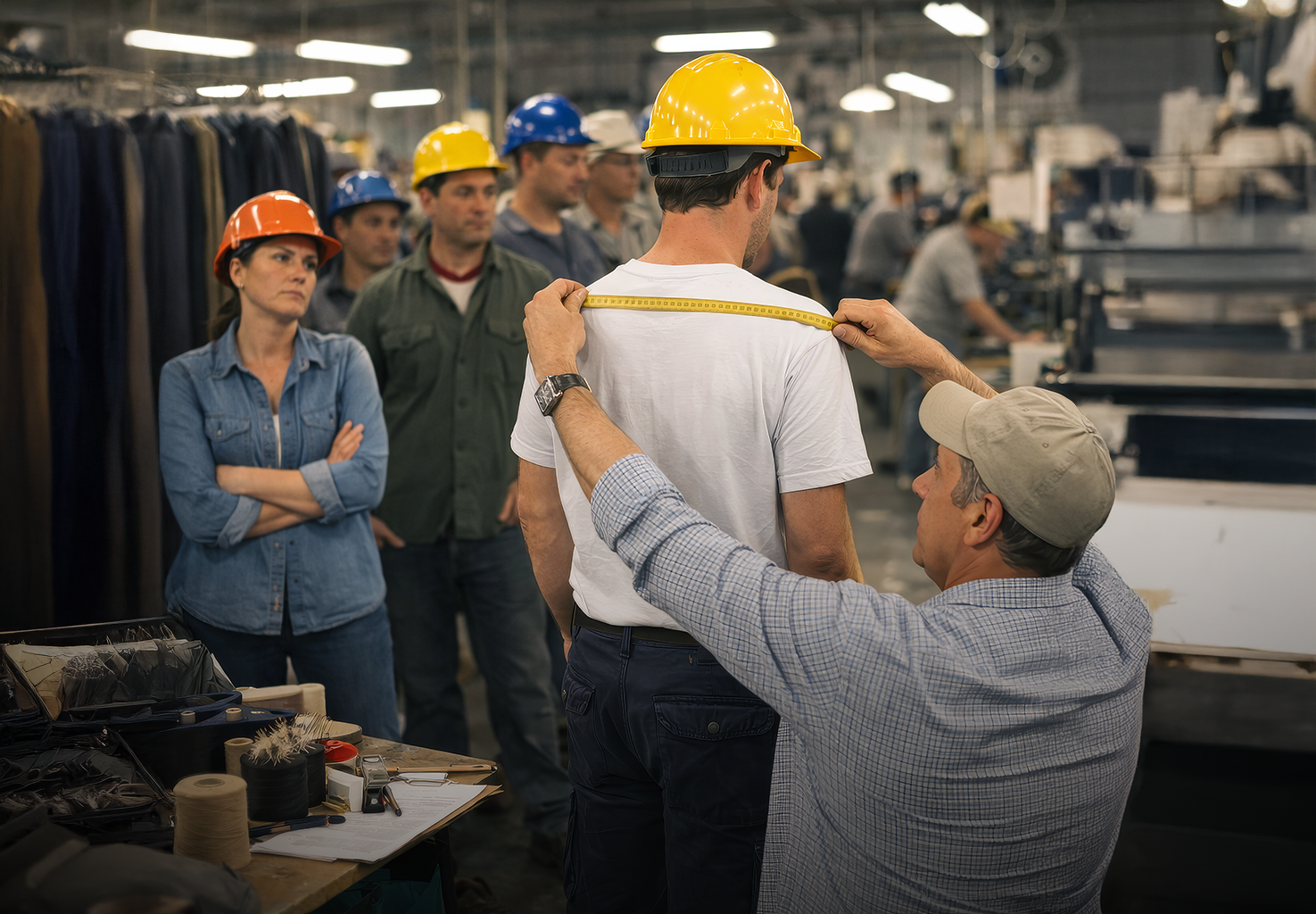
How it works: Vendors or specialized teams visit facilities to measure workers in person using tape measures. Sessions typically measure at most 20 workers per hour.
Why it’s problematic: Travel costs are immediate and significant. A measurement team visiting a facility requires airfare, vehicle rental, hotel, and per diem, substantial expenses that multiply across multiple facilities. Scheduling complexity, worker time away from production, and inconsistent measurement techniques all create additional burdens.
The reality: For organizations with 10 facilities requiring annual uniform updates, travel costs alone can reach tens of thousands annually, before any uniforms are purchased.
Generic Size Chart Distribution
How it works: Organizations provide workers with size charts and measurement instructions, expecting them to measure themselves at home and report results.
Why it doesn’t work: Self-measurement is notoriously inaccurate. Measuring oneself correctly requires abilities most people lack. Critical measurements like shoulder width and back length require a second person for accuracy. Even when a second person is available to help with the manual measurements, the results are not greatly improved. High error rates of 30-50% make this approach only marginally better than guessing.
“One Size Fits Most”
How it works: Organizations stock primarily medium, large, and XL garments with adjustable features like elastic waistbands and drawstrings.
Why it’s inadequate: Safety is compromised by poor fit in protective workwear. Professional appearance suffers. Worker comfort and morale decline. Diverse workforce accommodation fails, “one size fits most” excludes workers at size extremes. OSHA PPE fit requirements can’t be met with generic sizing approaches.
The Real Cost of Sizing Errors
Financial Impact
Poor workwear sizing creates substantial costs across multiple categories:
Direct Return Costs: Each returned item requires receiving, inspection, documentation, replacement selection, and shipping. Processing hundreds of returns annually consumes significant administrative resources.
Shipping Waste: Returns involve multiple shipments—the original order, the return of wrong items, and delivery of replacements. Each transaction adds shipping costs that accumulate rapidly at scale.
Worker Time: Workers dealing with sizing problems spend time calling about issues, visiting HR for exchanges, and waiting for proper uniforms to arrive—time that could be spent productively.
On-Site Measurement: Traditional measurement sessions require substantial investment in travel, staff coordination, and worker time away from duties.
Inventory Inefficiency: Without accurate sizing data, procurement teams overstock certain sizes while running short on others, tying up capital and creating stockouts that force expensive expedited orders.
Emergency Expediting: When stockouts occur, rush orders bypass volume discounts and standard shipping, carrying significant premium costs.
Safety and Compliance Risks
Ill-fitting PPE exposes organisations to OSHA citations. While sizing alone rarely triggers citations, it appears as a contributing factor in PPE-related violations, with fines ranging from hundreds to tens of thousands per violation.
More significantly, workers’ compensation liability increases when ill-fitting workwear contributes to injuries. Insurance premium impacts follow patterns of incidents and claims related to equipment fit.
Productivity Impact
Delayed worker deployment creates opportunity costs. New hires can’t start productive work until proper uniforms arrive. If sizing errors delay deployment by even a week for a portion of workers, the productivity loss compounds significantly.
Discomfort from poor fit reduces efficiency. Studies suggest discomfort can reduce efficiency by 3-5%. Even small efficiency losses across large workforces represent substantial productivity impacts.
Sustainability Concerns
Textile waste from returns contributes to environmental impact. Workwear that can’t be restocked often ends up in landfills. As organizations face increasing pressure to meet sustainability goals, this waste becomes problematic.
The carbon footprint of reverse logistics—shipping items back and forth—creates additional environmental impact that conflicts with corporate sustainability commitments.
Modern Solution: Digital Sizing Tools
What Are Digital Sizing Tools?
Digital sizing tools represent the convergence of computer vision, machine learning, mobile technology, and advanced algorithms to extract precise body measurements from standard smartphone photographs.
Technology Overview:
Computer vision-based body measurement employs algorithms trained on millions of body images to identify anatomical landmarks—shoulders, waist, hips, ankles—with centimeter-level precision.
Smartphone-accessible platforms make the technology available anywhere a worker has a mobile device. No specialised equipment, dedicated facilities, or expert operators are required.
ISO 8559-1:2017 standard measurement extraction ensures measurements align with international sizing standards. Over 100 measurements can be extracted, providing comprehensive data for sizing decisions.
How They Work for Workers:
The user experience is remarkably simple:
- Access via QR code or direct link—no app download required
- Follow visual and audio guidance showing correct poses
- Take two photos (front and side) using smartphone camera
- Receive results in under 60 seconds with 100+ body measurements
- Receive immediate size recommendations for specific products.
Technology Behind the Scenes:
Anatomical landmark detection uses deep learning models to identify hundreds of specific points on the body with confidence scores ensuring data quality.
Body segmentation and pose estimation separate the person from the background and understand body position in three-dimensional space, working even with complex backgrounds.
3D reconstruction algorithms combine information from both photos to build a mesh representing the body surface with thousands of polygons.
Calibration for specific workwear products transforms body measurements into product-specific size recommendations, applying learnt adjustments for manufacturer cutting patterns, material properties, and intended fit.
Key Capabilities for Industrial Workwear
Real-World Environment Tolerance:
Modern systems work in active facilities with variable lighting, complex backgrounds with machinery and equipment, and workers in regular work clothing. No special setup or controlled environment required. The accuracy of 0.5–2 cm means the absolute error for major body dimensions matches or even outperforms professional manual measurements.
Offline Functionality:
Many industrial facilities restrict internet access for security. Advanced systems process measurements locally on smartphones without internet connectivity during measurement, synchronizing data when connectivity is restored.
Product-Specific Calibration:
Generic algorithms achieve, in the best scenarios, 40-60% accuracy. Calibrated systems achieve 90-95% accuracy through fitting sessions with real workers and garments, collecting ground truth data linking body measurements to actual fit outcomes.
The calibration process accounts for how specific manufacturers cut garments, material stretch characteristics, intended fit style, and product-specific design variations.
Multi-Category Support:
All product types can be calibrated independently—coveralls, shirts, pants, outerwear, footwear, gloves, accessories—each optimized for accuracy across the full range.
Integration Capabilities:
Standard APIs enable integration with procurement platforms, inventory management systems, HR databases, e-commerce platforms, and vendor portals. This eliminates manual data entry and ensures sizing information flows seamlessly.
Multi-Facility Management:
Centralized dashboards provide visibility across all locations with facility-specific analytics, aggregate size distribution data, performance tracking, and standardized processes organization-wide.
Privacy and Compliance:
Photos are removed immediately after processing—typically within seconds. Only numerical measurement data and derived segmentation maps and depth maps that contain no personal data are retained with encryption, GDPR compliance, no third-party sharing, and user control over data.
Implementation Overview
Assessment and Planning
Organizations should begin by evaluating current return rates, quantifying measurement costs, identifying pain points, and defining requirements including workforce size, facility locations, product categories, and integration needs.
Building a comprehensive business case requires calculating true total costs of current approaches and projecting improvements with digital sizing.
Vendor Selection
Key evaluation criteria include:
- Accuracy in environments similar to yours
- Real-world condition performance
- Calibration methodology
- Integration capabilities
- Privacy and compliance certifications
- Industry experience
Integration and Deployment
Technical integration, user training, and communication strategies ensure smooth adoption. Organizations typically deploy starting with one facility, expanding to additional locations, then rolling out organization-wide with standardized approaches.
Ongoing Optimization
Performance monitoring, continuous calibration for new products, process improvements, and best practice documentation maintain and enhance results over time.
Addressing Common Concerns
“Our workforce won’t adopt smartphone technology”
Implementation data shows worker adoption rates exceeding 95% regardless of workforce demographics. The 60-second process is simpler than self-measurement with tape measures, and clear instructions guide users through each step.
“Accuracy seems too good to be true”
Calibration is the differentiator. Generic algorithms achieve at best 40-60% accuracy. Calibration to specific products using ground truth data transforms performance to 90-95%. Organizations can validate accuracy through fitting sessions with their own products and workers.
“Implementation will disrupt operations.”
Phased implementation minimises disruption. No downtime required—integration occurs alongside continuing operations. Workers measure on their schedules. The process is faster than traditional methods once implemented.
“Data privacy and security concerns”
Photos are removed immediately after processing, within seconds. Only numerical measurements and derived segmentation maps and depth maps that contain no personal data are retained. GDPR-compliant systems include encryption, transparent policies, and user control. No third-party data sharing.
“Our products are too specialised.”
Calibration works for any garment type, from standard shirts to specialised protective equipment. FR clothing, coveralls, chemical suits, and medical-grade garments have all been successfully calibrated with excellent accuracy.
The Future of Workwear Sizing
Modern digital sizing represents the present, not the future. Organizations implementing these solutions now gain immediate benefits while positioning for emerging capabilities including predictive sizing, wearable integration, custom-fit manufacturing, and enhanced sustainability tracking.
Within 3-5 years, digital sizing will transition from innovative to expected. Workers will expect smartphone-based measurement. Vendors will require sizing data from customers. Sustainability regulations will accelerate adoption.
Organizations implementing digital sizing today gain advantages that compound over years: operational excellence, process maturity, improved worker satisfaction, and competitive differentiation.
Frequently Asked Questions
How accurate are digital sizing tools for workwear?
When properly calibrated to specific workwear products, digital sizing tools achieve 90-98% correct size recommendations, compared to 40-60% with traditional methods.
What equipment do workers need?
Only a standard smartphone with 8+ megapixel camera any smartphone from the last 3-5 years. No specialized scanners, sensors, or apps to download.
Can it work in active industrial facilities?
Yes. Systems work in real industrial environments with variable lighting, complex backgrounds, and workers in regular clothing. No controlled environment needed.
How long does measurement take?
The entire process, from system access to receiving size recommendations, takes less than 60 seconds.
What happens to worker photos?
Photos are deleted immediately after processing, within seconds. Only numerical measurement data, derived segmentation maps, and depth maps that contain no personal data are included.
Can it work for all workwear categories?
Yes. All product types can be calibrated independently—coveralls, shirts, pants, boots, gloves, specialized PPE, even medical compression garments.
How does it work across multiple facilities?
Ideal for multi-facility operations with centralized management, standardized processes, and no travel costs for measurement teams.
What’s the typical return rate?
Organizations see return rates drop from 25-40% (traditional) to 2-7% (digital sizing) an 72-95% reduction.
Ready to Eliminate Workwear Sizing Challenges?
Discover how Esenca Sizing’s digital measurement technology achieves 90–98% accuracy for industrial workwear programs.
Schedule a Demonstration — See calibration in action and discuss implementation for your specific requirements.
Explore Related Resources
- Complete Guide to Sizing Tools for Uniforms — Comprehensive overview of modern measurement technology
- How Digital Body Measurement Works — Technical explanation of the technology