


Most PPE returns are not a product problem. The glove was the right grade. The coverall met the specification. The footwear carried the correct safety rating. What failed was the measurement behind the order, and the return is simply where that failure becomes visible.
For procurement teams managing large workforces, this distinction matters considerably. Treating returns as a logistics problem produces logistics solutions: faster processing, better tracking, and smarter restocking. These reduce friction. They do not reduce returns. The only intervention that reduces returns is measuring people accurately before the order is placed — and making that process consistent, scalable, and repeatable across every site, every shift, and every new hire.
This article explains why sizing-related PPE returns happen, what they actually cost, and what a systematic fix looks like in practice.
Why PPE returns happen: the sizing root cause
The three methods most workwear programmes rely on: self-reported sizes, generic size charts, and periodic on-site fitting sessions each introduce measurement error at different points in the process. Together, they produce return rates that procurement teams have largely come to accept as a structural feature of the business. They are not.
Self-reported sizing fails for a predictable reason: people do not know their accurate body measurements, and even those who do are choosing from data that may be years old. Workers consistently size themselves based on the last garment that fit rather than the current one.
In workwear specifically, where sizing conventions differ substantially from consumer fashion, the gap between a worker’s stated size and their correct size is often two or three steps on the scale. Programmes that rely on self-reporting should expect 25–40% return rates as a baseline, not as an outlier.
Generic size charts compound the problem. Charts assign a single set of measurements to each size label, but the variation in body shape within any one nominal size is significant. Two workers who share the same chest measurement may have entirely different shoulder widths, torso lengths, or hip circumferences differences that determine whether a garment fits correctly or comes back. A chart cannot resolve this variation. It can only average across the data, which means it fits the average well but performs poorly for everyone else.
On-site manual fitting sessions address some of these limitations but introduce others. Measurement quality depends on technique and training, and both vary considerably between representatives and across visits. Worn sample garments no longer reflect the original fit. Workers absent on the day are sized by proxy or estimated. And the data ages: a workforce measured eighteen months ago includes leavers, new joiners, and workers whose bodies have changed, none of whom are correctly represented in the original dataset.
For a more profound look at how these failures scale across industrial workforces, see our full guide to workwear sizing challenges and modern solutions.
The hidden cost of a PPE return
The garment cost is the most visible number in a return. It is rarely the largest one.
When a PPE item comes back because it does not fit, it triggers a sequence of costs that most procurement budgets absorb without attributing them to their origin. Receiving and inspecting the return, processing the exchange request, selecting a replacement size, and reshipping the correct item all consume staff time. At scale, a programme managing five thousand workers across multiple sites, those time costs accumulate into a material operational burden that shows up as headcount and overhead rather than as a line in the returns report.
Reverse logistics adds direct cost on top of that. Every incorrectly sized order involves at minimum two additional shipments: the return of the wrong item and the delivery of the replacement. For high-value PPE items — flame-resistant coveralls, chemical protection suits, and specialist footwear these costs are significant relative to the unit price.
Delayed worker deployment is the cost that is most often invisible in procurement reporting but most acutely felt by operations. A new employee cannot start on the shop floor without correctly sized PPE. A sizing error on day one means days or weeks of delay while an exchange is processed. Multiply that across a hiring cohort, and the productivity loss becomes substantial, particularly in industries with high seasonal intake or continuous recruitment.
Internal coordination time is similarly undertracked. Every exchange generates queries across procurement, logistics, HR, and the site manager responsible for the worker. Each query is individually minor. Collectively, across hundreds of exchanges per year, they represent a meaningful proportion of procurement capacity that a correctable problem consumes.
There is also a compliance dimension. Workers waiting for correctly sized PPE may be issued ill-fitting equipment in the interim or asked to work without it. Neither outcome is acceptable under OSHA 29 CFR 1910.132, which requires PPE to properly fit each affected employee, or under the Health and Safety at Work Act requirements that govern EU and UK employers. The liability exposure from that interim period sits in a different budget from the returns cost, but it originates in the same place.
For a broader look at how sizing costs compound across procurement operations, see our analysis of e-commerce return rates and the hidden cost of poor sizing data.
PPE fit is a safety and compliance issue, not a preference
The framing of PPE fit as a comfort concern understates its consequences significantly.
Protective equipment is certified and tested as a complete system under defined fit conditions. When the fit deviates from those conditions, protection degrades often in ways that are not immediately visible to the wearer or to the safety manager reviewing the equipment register.
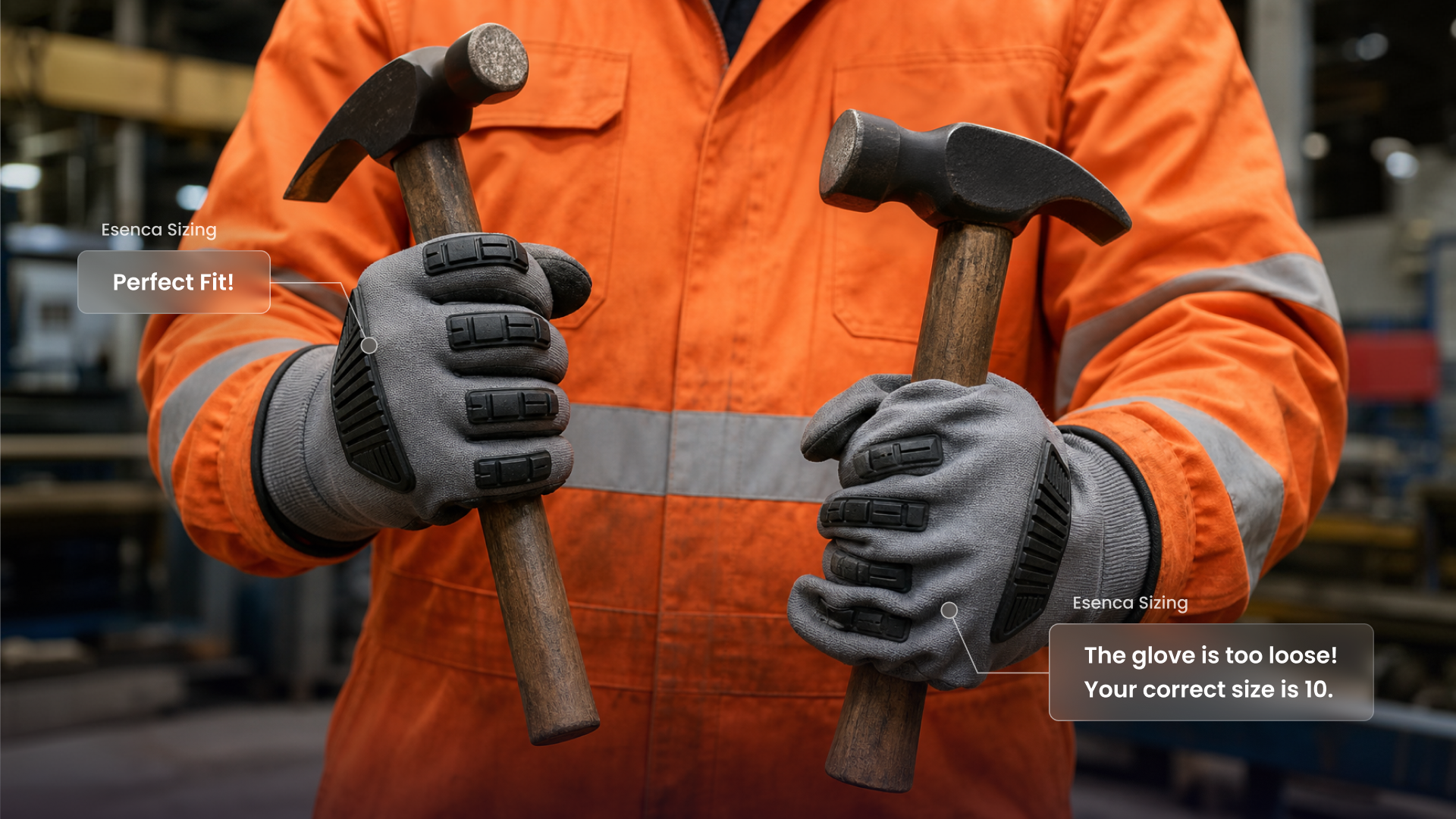
A glove that is too large reduces dexterity and grip, increasing the risk of tool slippage and loss of control in precision tasks. More critically, a loose glove can be caught by rotating machinery, a hazard OSHA specifically identifies in its hand protection guidance under 29 CFR 1910.138. A glove that is too small stretches the cut-resistant material beyond its design tolerances, potentially reducing the protection level it was rated to deliver. Learn more about precision hand measurement for PPE compliance.
Safety footwear presents a parallel set of risks. Footwear that does not match foot geometry affects stability and increases slip, trip, and fall exposure. Steel toe caps that are too tight can cause injury during an impact event rather than preventing it. Footwear that is too long creates a tripping hazard from excess material at the toe. These failures do not always generate exchange requests workers tolerate discomfort and compensate for poor fit, which means they may not appear in return data at all while still representing an active safety risk. See how foot measurement technology addresses these issues.
The regulatory landscape is tightening on fit, specifically. OSHA’s updated PPE fit rule, which extended explicit fit obligations to construction workers in January 2025, aligns construction with the fit requirements already in force for general industry and maritime employers. The obligation is clear: PPE must properly fit each affected employee, not most employees, not the average employee, but each one.
In Europe, BS 30417:2025 reflects the same direction, placing an obligation on employers and suppliers to ensure PPE is genuinely sized to the individual rather than nominally available in a range of sizes. For procurement teams managing diverse workforces, particularly those with high proportions of female workers or workers at the extremes of size distributions, this represents a meaningful shift in what compliance actually requires.
What accurate sizing looks like in practice
The most important conceptual shift in resolving PPE returns is moving measurement from a one-off event to a continuous process.
Traditional sizing programmes treat measurement as something that happens at onboarding, perhaps repeated annually, and is updated only when a worker requests a change. This model produces a static dataset applied to a dynamic workforce. People’s measurements change. Workforces turn over. Sites expand. The data ages faster than the program refreshes it, and the gap between the dataset and reality is where returns originate.
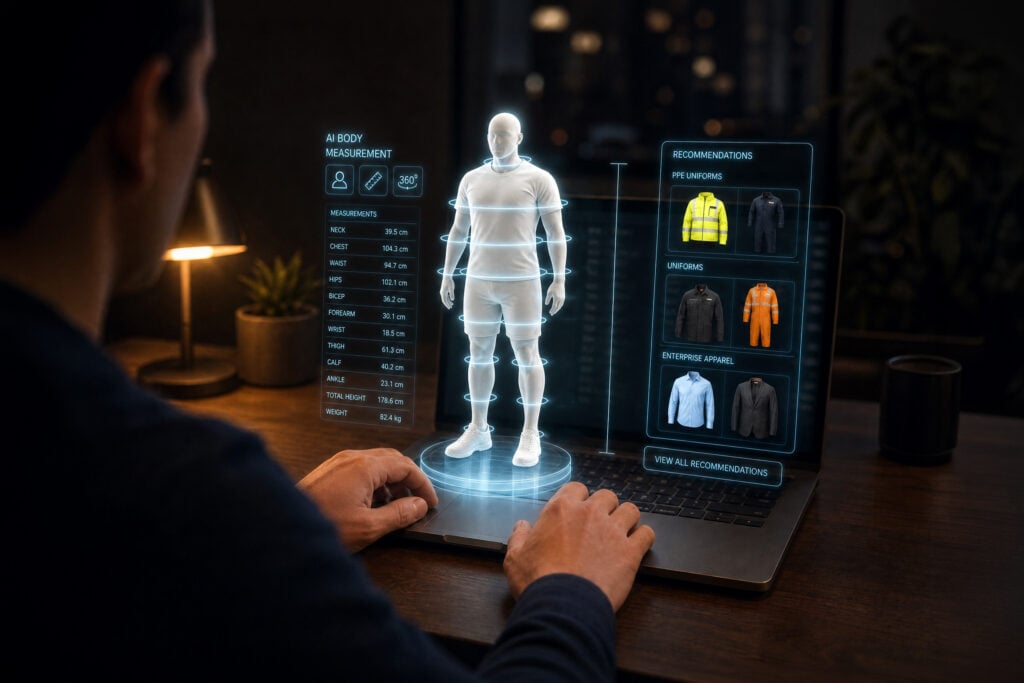
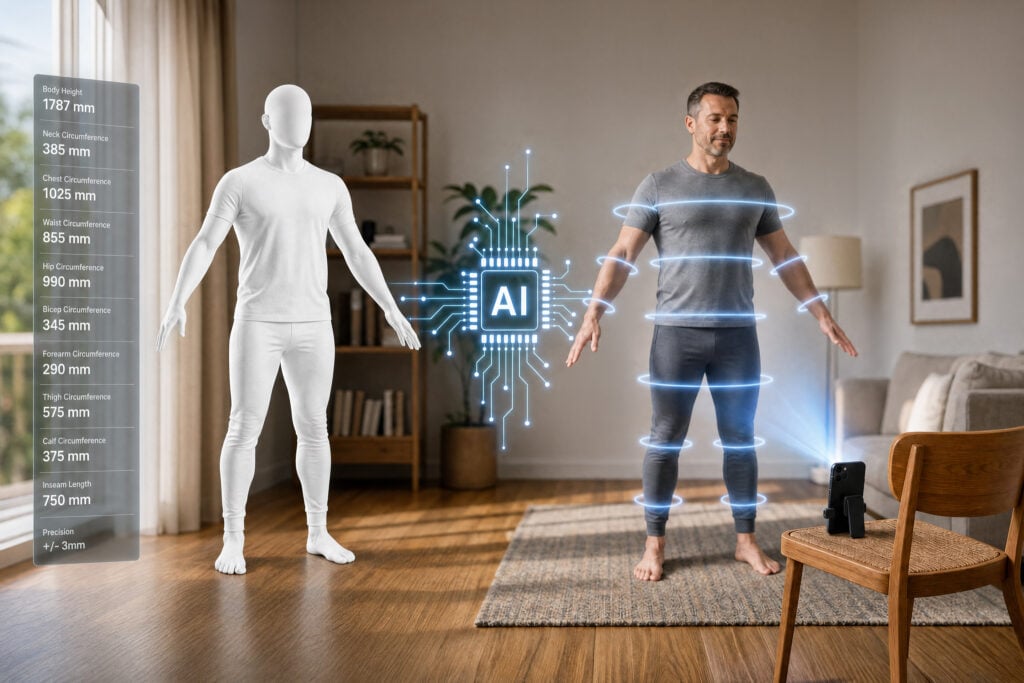
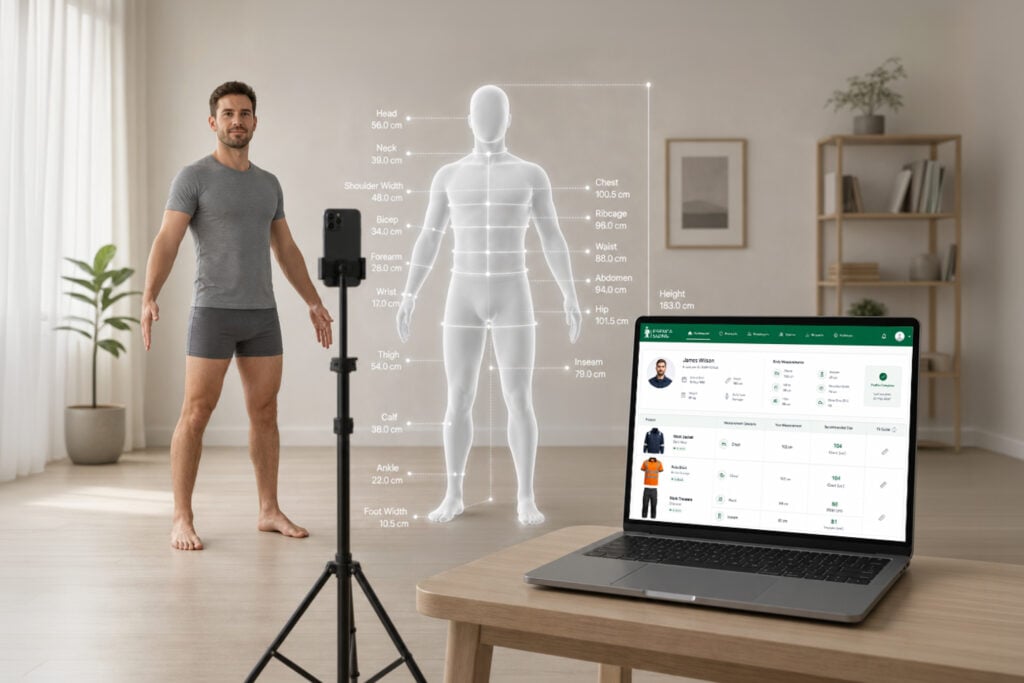
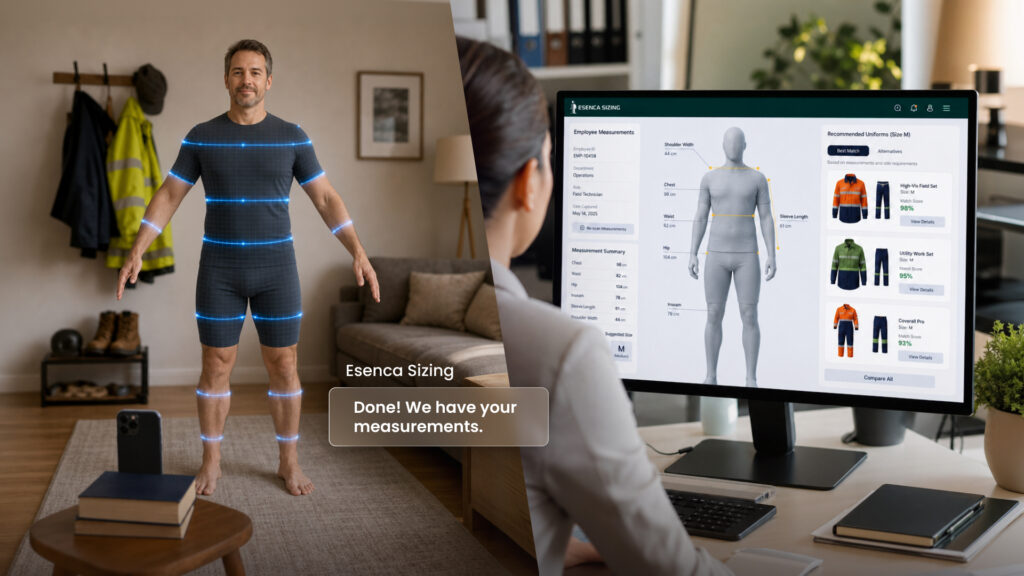
Digital body measurement changes the economics of continuous measurement. Where a traditional fitting session requires travel, scheduling, specialist staff, and physical presence, a digital measurement takes under two minutes on any smartphone, requires no specialist to administer it, and can be completed by the worker anywhere on site, at home, or before their first day. The barrier to measuring more frequently is effectively removed.
The accuracy profile is materially different from self-reporting or manual measurement. Smartphone-based computer vision systems capture over 100 body dimensions from two photographs, matching those measurements against the specific sizing specifications of each garment rather than against a generic chart. This is the distinction that drives fit outcomes: a recommendation derived from the relationship between a specific body and a specific garment’s cut is structurally more accurate than a recommendation derived from a nominal size label on a chart that was built for a different population.
The consistency advantage is equally significant. Every worker in a distributed workforce is measured using the same method, producing the same data format, regardless of location. A site in Hamburg and a site in Manchester produce sizing data that is directly comparable and centrally manageable, something that manual fitting sessions, with their inherent variation across representatives and regions, cannot deliver. See how our workwear and PPE sizing software handles distributed workforce measurement.
For a detailed comparison of digital and traditional measurement approaches, see Body Scanning Apps vs Traditional Measurements.
How Mewa reduced PPE returns to 3% across Europe
The practical impact of this shift is most clearly illustrated by Mewa Textil-Service, the European workwear and textile services company, which completed the company-wide rollout of Esenca Sizing across all its German locations in 2026, with deployment planned across every European country it operates in by the end of the year.
Before the transition, Mewa’s fitting process relied on Customer Service Representatives travelling to client sites with vans of sample garments. The model was capped at approximately 40 fittings per representative per day, a ceiling driven by travel time, scheduling logistics, and the physical process of working through sample garments that wore out and lost their reference shape over time. Workers who were absent on fitting day were measured by proxy or estimated. The data the process produced was inconsistent and difficult to scale.
The transition to digital measurement changed the operating parameters fundamentally. Mewa’s teams now measure up to 300 employees per device per day. The process takes 2 to 4 minutes per worker from two full-body smartphone photographs, requires no sample garments, and produces a consistent dataset regardless of who is conducting the session or where it takes place.
The result: a 97% fit success rate, measured through Mewa’s own garment return data the most objective indicator of sizing accuracy available in the workwear sector. Where traditional fitting returned roughly 1 in 4 or 1 in 5 garments, digital measurement returns fewer than 1 in 33.
Beyond the measurement accuracy, Esenca developed custom reporting software integrated directly into Mewa’s control panel, routing size recommendations into Mewa’s internal ordering systems and eliminating manual data entry from the fulfilment workflow entirely.
Read the full announcement: Mewa Rolls Out Esenca Sizing Across Germany, with Europe-Wide Deployment Set for 2026
What to look for in a PPE sizing solution for large workforces
Not all digital sizing tools are built to meet the operational requirements of industrial PPE programmes. A solution that performs adequately for fashion e-commerce may lack the accuracy, compliance, and integration capabilities that safety-critical workwear demands.
Measurement accuracy benchmarked to garment type. The relevant accuracy figure is not a generic claim — it is the first-time correct fit rate for each category of PPE you are procuring: body garments, protective gloves, and safety footwear each have their calibration, their own tolerance ranges, and their own accuracy benchmark to be validated. Safety-critical garments have narrower acceptable tolerance ranges than general clothing, and the solution should have validated accuracy data in those categories specifically.
Body, hand, and foot measurement from a single platform. Most PPE programmes span multiple item types: body garments, protective gloves, and safety footwear. Solutions that address body measurement alone leave the fit problem partially unresolved. A platform covering all three with consistent data management and a shared administrative layer reduces complexity and eliminates the gap between how different item types are sized. Explore Esenca Sizing’s hand measurement and foot measurement capabilities alongside body measurement.
Integration with ERP and ordering workflows. Measurement data that sits in a separate system from the ordering process still requires manual intervention to be useful. The operational value of digital sizing is fully realised when size recommendations flow directly into procurement and fulfilment workflows, removing data entry, reducing errors, and making the measurement investment visible in the operational metrics that matter.
GDPR compliance and transparent data handling. Any solution deployed across a European workforce must be able to demonstrate compliant data handling, including clear policies on what is retained, for how long, under what access controls, and how employees can exercise their data rights. KPMG audits compliance, providing a meaningful signal of organisational commitment to these standards not merely a checkbox.
Frequently asked questions
What percentage of PPE returns are caused by incorrect sizing?
Research consistently indicates that sizing and fit account for the majority of workwear and PPE returns; estimates typically range from 60 to 80% of all exchanges. Organisations using self-reported sizing or generic size charts as their primary sizing method should expect return rates of 25–40% as a baseline. Digital measurement programmes with product-specific calibration reduce the error to the 2–7% range.
Can digital body measurement replace on-site PPE fitting sessions?
Yes. Smartphone-based body measurement captures over 100 dimensions in under two minutes, requires no specialist to administer, and can be completed by the worker on any device and from any location. The data it produces is more consistent than manual measurement and more accurate than self-reporting. Organisations that have transitioned from on-site sessions to digital measurement report both higher fit accuracy and substantially lower measurement programme costs.
How do I demonstrate PPE fit compliance to OSHA or HSE inspectors?
OSHA 29 CFR 1910.132 and equivalent HSE requirements expect employers to demonstrate that PPE has been selected to properly fit each affected employee and to document the process. Digital measurement programmes produce a consistent, auditable record of how each worker’s sizing was determined and which garment specifications were matched against it. This is a materially stronger compliance position than self-reported sizing, which leaves no audit trail, or manual fitting, where documentation quality varies considerably by representative.
How quickly can a workforce of 1,000+ employees be measured remotely?
At 300 measurements per device per day, a workforce of 1,000 can be measured across a single device in under four working days — or faster with multiple devices operating in parallel. Because the process requires no travel, scheduling, or physical infrastructure, it can be deployed across multiple sites simultaneously, reducing the total rollout time from weeks to days for large programmes.
Does digital sizing work for gloves and safety footwear, not just body garments?
Yes. Dedicated hand measurement captures the palm circumference and hand length dimensions that determine correct glove sizing, addressing the most common cause of glove-related PPE failures. Foot measurement captures length, width, and arch data for safety footwear, going beyond the single-dimension shoe size that most current fitting processes rely on. All three measurement types, body, hand, and foot, are available within the Esenca platform under a single administrative layer.