




Uniform returns are among the most persistent and costly friction points in managed workwear programmes. Whether you are running a fleet of tens of thousands of garments across multiple sites or issuing uniforms to a single client location, the pattern is consistent: garments come back because they do not fit. The costs accumulate quickly, and the root cause is almost always the same — standard sizing systems were not designed for the real diversity of the workforces wearing them.
Digital sizing and uniform sizing software changes the dynamic. By capturing individual body measurements before a garment is issued, organisations can match each worker to the correct size from the first fitting, which dramatically reduces the return and exchange cycle. This article explains how that process works, what deployment looks like in practice, and what the data shows from programmes already running at scale.
Why Uniform Returns Are Costing You More Than You Think
The direct cost of a returned garment is easy to measure: logistics, handling, restocking, and re-issuing. The indirect costs are much larger and rarely appear on the same line of a budget.
When a uniform does not fit, several things happen simultaneously. The worker is either waiting for a replacement garment or wearing something unsuitable. In safety-critical environments, this waiting period creates a compliance gap. In customer-facing roles, this delay leads to a presentation problem. In both cases, the worker experiences discomfort that affects how they perform and how they perceive their employer.
On the operational side, a returned garment moves through a return logistics process, a quality inspection, a re-grading step if the condition allows re-issuance, and a new pick-pack-dispatch cycle. Multiply that sequence across hundreds or thousands of workers in a distributed programme, and the labour cost alone becomes significant. When the carbon footprint of reverse logistics is added, the sustainability case becomes equally compelling — particularly when a significant proportion of returned uniforms cannot be re-issued at all. Garments bearing company logos or custom embroidery cannot be redirected to another client or resold; they are destroyed. Given that textile production requires an estimated 300,000 litres of water per kilogram of fabric, every destroyed garment represents not just a financial write-off but a significant consumption of resources that cannot be recovered.
Industry analysis consistently shows that between 30 and 60 percent of workwear exchanges are driven by sizing errors rather than garment failure or end of service life. Addressing sizing at the point of issuance is therefore one of the highest-leverage interventions available to uniform programme managers. Addressing sizing at the point of issuance is therefore one of the highest-leverage interventions available to uniform programme managers.
The Root Cause: Why Standard Sizing Tables Fail Diverse Workforces
Standard garment sizing is built on population averages. A size Medium has a set of nominal measurements that correspond to an average body shape at a particular height and weight range. The problem is that real workforces do not distribute neatly around those averages — and the gap widens considerably when a programme spans multiple regions. Body proportions vary significantly across geographies, meaning a size chart calibrated for one workforce population may fit poorly when applied to another.
A logistics company employing workers across multiple countries will have a workforce that spans a far wider range of body proportions than any single sizing table anticipates. A healthcare provider employing a predominantly female team will find that workwear designed around male body block standards fits poorly. A manufacturing site with workers across a wide age range will encounter significant variation in chest and waist circumferences that the size chart does not capture.
The result is a structural mismatch. Even when a worker’s nominal size aligns with a garment’s label, the actual fit at the chest, sleeve, waist, or inseam may be wrong because the garment was designed for a different body shape in that size band. Accurate individual body measurements, matched to a garment’s specific size chart rather than to a generic label, are the only reliable solution.
Digital sizing refers to the use of technology to capture or predict individual body measurements without the need for a physical tape measure or a trained fitter. The measurements generated are then used to match a person to the correct size in a specific garment’s size chart.
Esenca Sizing offers three distinct measurement methods, each suited to different programme requirements and worker contexts.
Body Pro Standard
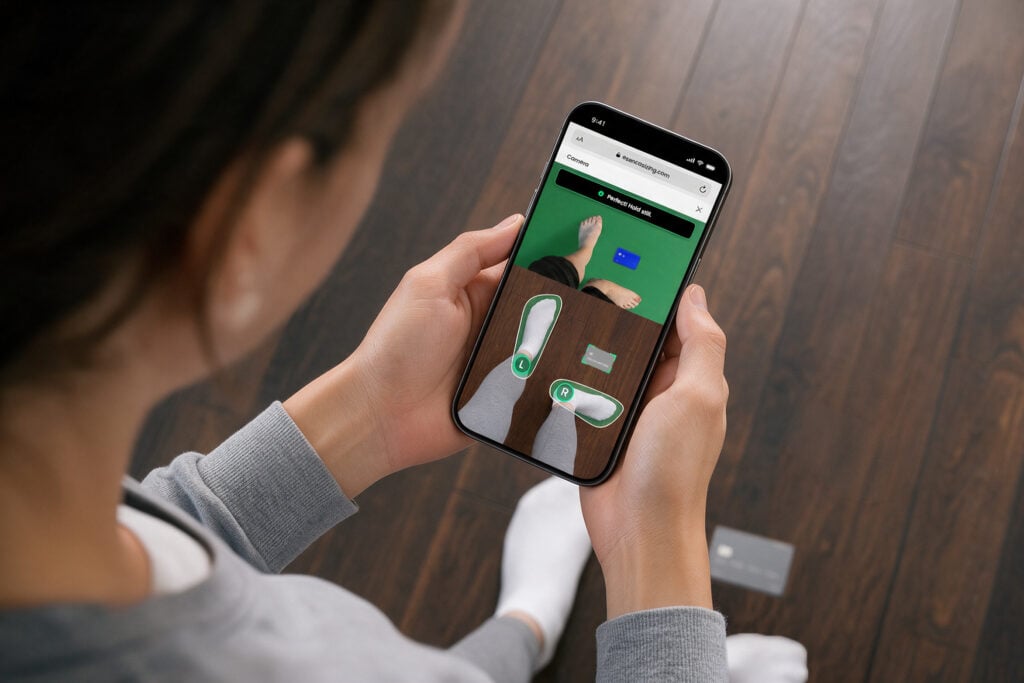
Body Pro Standard is Esenca Sizing’s core measurement product for workwear and uniform programmes. A worker uses a smartphone camera to capture a short guided scan. Machine learning models process the images and return a full set of body measurements. No app download is required — the entire process runs in a mobile browser, which is a critical factor for workforce-scale adoption. Workers do not need to install anything, create an account, or hand over a device.
Body Light
Body Light is a fit predictor that works without photographs. A worker answers a short set of questions about their body and existing garment preferences, and the system generates a size recommendation. Body Light works on any device, including desktop and laptop computers, making it suitable for workers who do not have consistent smartphone access or who are completing the process at a shared workstation.
Body Pro Tailored
Body Pro Tailored delivers higher-accuracy measurements for made-to-measure and high-precision applications. It uses the same smartphone-based, browser-native approach as Body Pro Standard but applies additional measurement protocols suited to tailored garment production and specialist workwear where standard size chart matching is not sufficient.
Hand and Foot Measurement
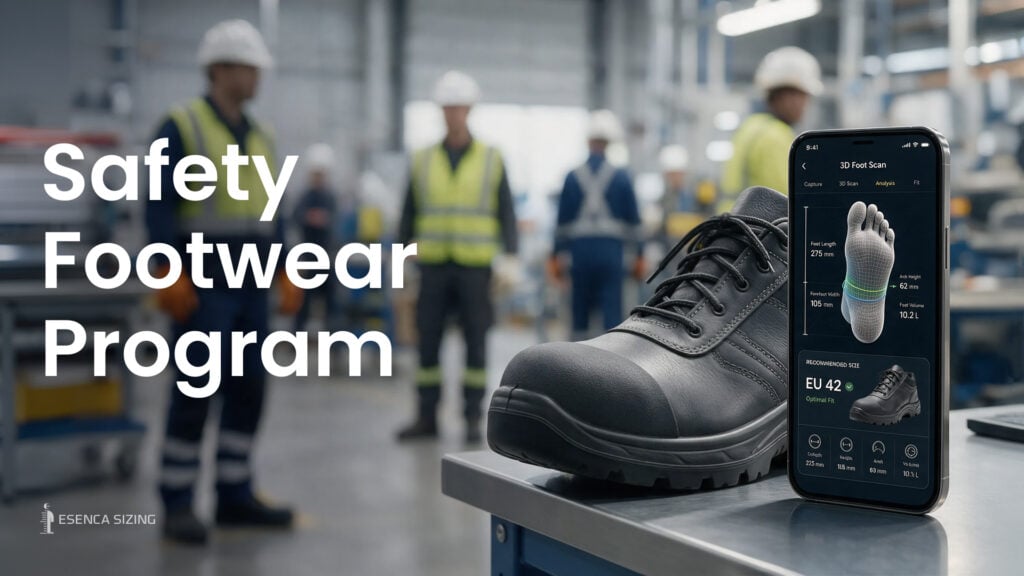
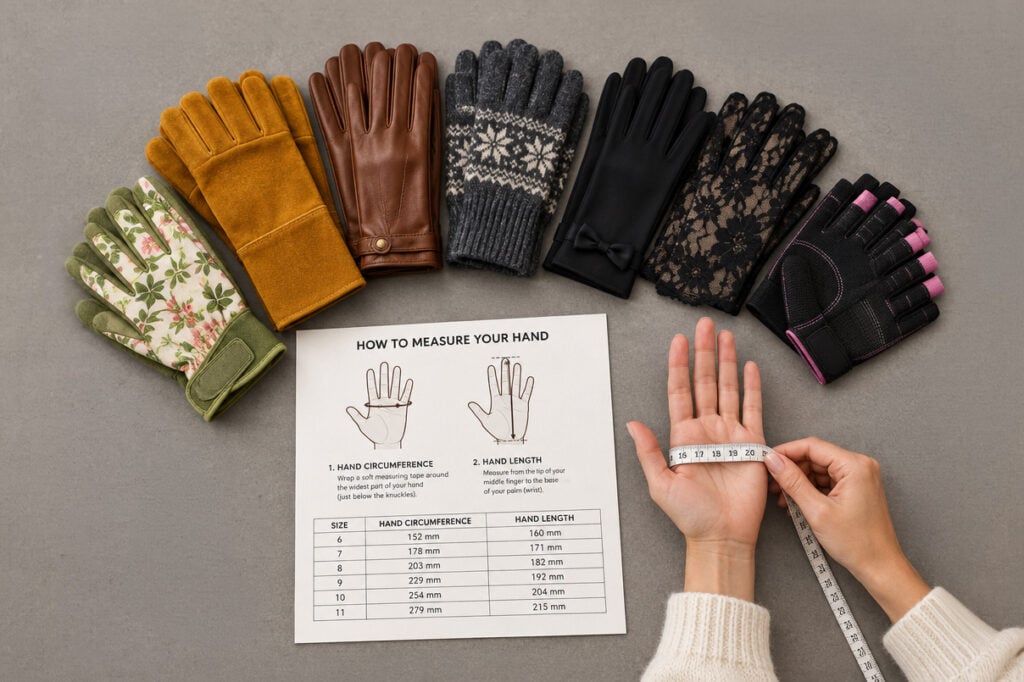
Beyond garments, Esenca Sizing offers dedicated hand measurement and foot measurement products. Hand measurement covers more than 30 individual measurements and supports glove sizing for both PPE and general workwear programmes. Foot measurement covers 10 measurements and supports occupational footwear programmes. Both run in the browser, using the same no-app, no-hardware approach as the garment measurement products.
How Digital Sizing Directly Reduces Uniform Returns
The mechanics of return reduction are straightforward. Instead of a worker selecting a size based on a label or a manager estimating fit from a previous season’s record, Esenca Sizing generates a set of individual measurements and maps them to the specific size chart of the garment being issued. The recommendation is garment-specific, not generic.
This removes the two most common sources of sizing error. The first is ‘label’ ambiguity: a worker who takes a size Large in one brand may take an XL or a Medium in another, because size charts vary significantly between manufacturers. Esenca Sizing eliminates that ambiguity by working from measurements, not labels. The second is body shape variation: a worker with a non-standard ratio of chest to waist to hip measurements may consistently receive poor fits in standard size bands. Accurate individual measurements allow the system to flag such cases and recommend a different size or identify the need for an alteration.
The downstream effect on operations is a reduction in the exchange cycle. Fewer first-issue garments come back. Fewer replacement shipments are generated. Fitting labour is concentrated in an initial measurement session, rather than being spread across multiple return-and-reissue cycles. And the data captured creates a measurement record for each worker that can be used for future issuances without repeating the measurement process.
Real-World Results: Uniform Programs That Cut Returns with Esenca Sizing
Deployment data from Esenca Sizing programmes in operation provides concrete evidence of the return-reduction effect.
In one active deployment processing 300 fittings per day, per device and totalling tens of thousands of workers measured, the programme achieved a 97 percent fit success rate. This means that in 97 out of 100 cases, the garment issued on the basis of the Esenca Sizing recommendation was accepted without exchange or return. At that volume, the operational saving compared to a standard size chart process is significant in both logistics costs and fitting labour.
In a second deployment involving 150 workers measured across a distributed workforce, independent validation confirmed 91 percent measurement accuracy. Garments were issued based on Esenca sizing recommendations, and the exchange rate fell substantially compared to the programme’s previous process.
These results reflect the programmes in the workwear and uniform categories. The same measurement infrastructure has also been validated in compression therapy applications, where the accuracy requirements are even tighter, confirming that the underlying measurement technology performs across garment categories.
Deployment Scenarios: How Organizations Roll It Out with Esenca Sizing
Remote Self-Measurement for Distributed Workforces
Many workwear programmes serve workers across multiple sites, regions, and countries. Requiring workers to attend a central fitting point is operationally impractical at scale. Esenca Sizing’s browser-based measurement process means a worker can complete their measurement from any location using a smartphone. The programme manager sets up the measurement session centrally; workers receive a link, complete the process in a few minutes, and the measurement data are immediately available for sizing decisions.
This approach is particularly effective for programmes where new workers need to be onboarded quickly, where workforces turn over regularly, or where the programme covers geographically dispersed sites.
High-Volume On-Site Issuance
For programmes where workers are gathered at a single location — an induction day, a site mobilisation, or a seasonal reissuance — Esenca Sizing can support high-volume on-site measurement using tablets or smartphones operated either by the workers themselves or by a coordinator. At 300 fittings per day, per device in an active deployment, the throughput is well-suited to large-scale issuance events.
Integration with Uniform Management and ERP Systems
Measurement data generated by Esenca Sizing can be connected to existing uniform management platforms and ERP systems, allowing size recommendations to flow directly into order management without manual re-entry. This integration layer is particularly valuable for managed service providers and rental workwear operators who process large volumes of issuances through existing digital workflows.
The Business Case: ROI Beyond Return Reduction
Logistics and Handling Savings
Every garment that does not come back saves the cost of return shipping, intake handling, inspection, restocking, and re-dispatch. In high-volume programmes, these unit costs can add up quickly. Programmes running tens of thousands of issuances per year can calculate the saving by applying their current return rate, the proportion attributable to sizing, and their per-garment handling costs.
Sustainability and Textile Waste Reduction
Returned garments that cannot be re-issued — due to wear, contamination, degradation during the return cycle, or company-specific customisation such as logos, embroidery, or name tags — represent direct textile waste. Garments that are re-issued incur the carbon cost of reverse logistics before they reach their next wearer. Digital sizing reduces both categories of waste by increasing the proportion of garments that are issued correctly the first time.
For programmes with sustainability reporting commitments, the reduction in sizing-related returns is a measurable and auditable contribution to preventing textile waste. Each avoided return also avoids the resource cost embedded in a replacement garment — textile production requires an estimated 300,000 litres of water per kilogram of fabric, making every correctly issued garment a meaningful reduction in water consumption. This approach is distinct from recycling-focused sustainability claims: preventing waste at the point of issuance is a higher-order intervention than processing it after it has been created.
Employee Experience and Safety Compliance
Fit affects function. A workwear garment that does not fit correctly is uncomfortable, restricts movement, and in safety-critical categories can compromise protection. PPE that does not fit is not performing its protective function regardless of its certification status. Improved fit rates translate directly into improved worker comfort and more consistent safety compliance, both of which have measurable effects on productivity and incident rates.
What to Look for in a Digital Sizing Solution
Accuracy Thresholds That Matter for Workwear
Not all digital sizing solutions deliver the same measurement accuracy, and the accuracy requirement varies by garment category. A fit predictor based on self-reported measurements may be adequate for casual fashion but insufficient for PPE, workwear, or compression therapy. Look for solutions that can demonstrate validated accuracy data from real deployment environments, not just laboratory conditions.
Browser-Based vs. App-Based Deployment
App-based sizing solutions require workers to download and install software on their personal devices. In workforce environments, particularly those involving older workers, non-native speakers, or workers with limited digital literacy, app installation is a significant adoption barrier. Browser-based solutions like Esenca Sizing remove that barrier entirely. The worker receives a link and completes the process, and no installation is required.
GDPR Compliance and Workforce Data Privacy
Body measurement data is personal data under GDPR. Any digital sizing solution deployed in a European workforce programme must operate within a compliant data handling framework. Esenca Sizing operates under a GDPR-compliant framework that KPMG has independently audited. This is a meaningful distinction from solutions that rely on self-certification or boilerplate privacy policies.
Scalability Across Garment Categories
A uniform programme rarely involves just a single garment type. The ideal digital sizing solution should be able to generate measurements relevant to jackets, trousers, shirts, footwear, gloves, and specialist PPE from a single measurement session. Esenca Sizing’s product range covers garment body measurements, hand measurements for glove sizing, and foot measurements for occupational footwear, enabling the consolidation of measurements across a full uniform programme.
Common Questions About Digital Sizing for Uniforms
How accurate is digital sizing compared to manual measurement?
In validated Esenca Sizing deployments, measurement accuracy has been confirmed at 91 percent across a 150-worker programme, with a 97 percent fit success rate recorded in a high-volume deployment processing 300 fittings per day, per device, totalling tens of thousands of workers measured. Accuracy in digital sizing depends on the measurement method, the quality of the scan or input data, and how well the system’s size recommendations align with specific garment size charts. Esenca Sizing maps measurements to each garment’s individual size chart rather than to generic sizing labels, which is a significant factor in achieving high first-fit rates.
Can digital sizing work for PPE and safety-critical garments?
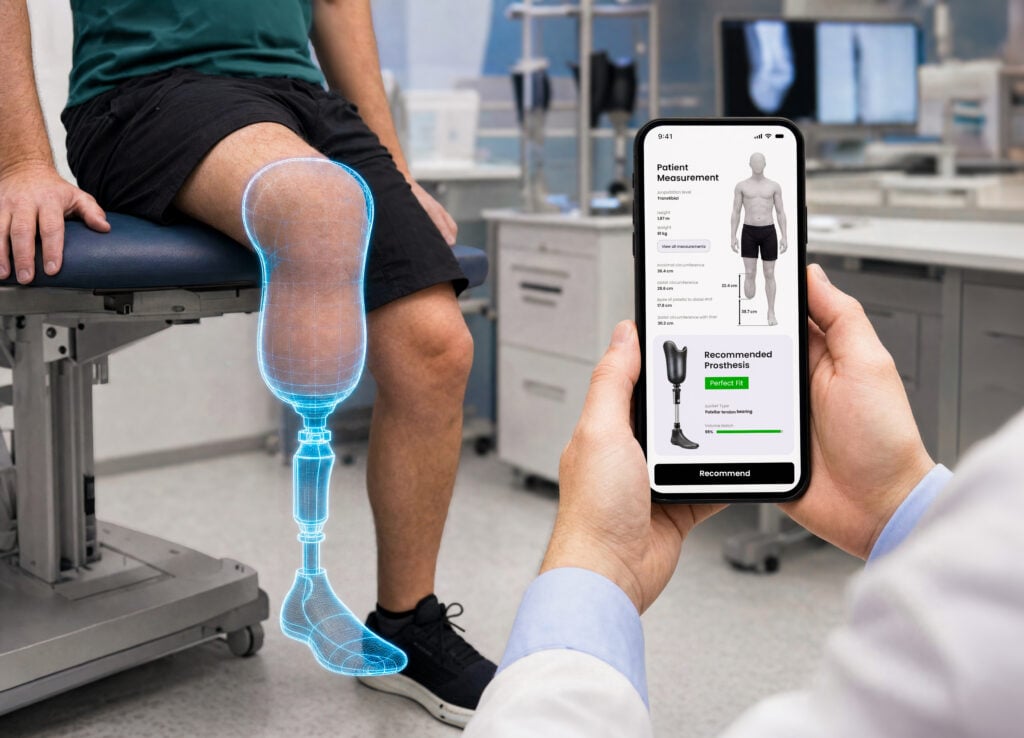
Yes, Esenca Sizing has been validated in use cases, including compression therapy garments, which have tighter accuracy requirements than standard workwear. The hand measurement product line is specifically designed to support glove sizing for PPE programmes, covering more than 30 individual measurements. For safety-critical applications, the key requirement is that the digital sizing system maps to the specific size chart of the approved garment, not to a generic size label.
What workforce size justifies the investment in digital sizing?
Digital sizing delivers a measurable return on investment across a wide range of programme sizes. Programmes with fewer than 100 workers benefit primarily from reduced fitting labour and from the elimination of the return-and-exchange cycle. Programmes with hundreds or thousands of workers see additional returns from logistics savings, integration with ERP workflows, and the creation of a persistent measurement database that reduces the costs of future reissuances. Esenca Sizing can support proof-of-concept pilots that allow programme managers to quantify the return before committing to a full rollout.
Does Esenca Sizing replace the fitting room or complement it?
For most workwear and uniform programmes, Esenca Sizing entirely replaces the fitting room for standard garment categories. Workers complete their measurement remotely using a smartphone, and the size recommendation is generated without the need for a physical fitting session. For made-to-measure or highly specialist applications, Esenca Sizing’s Body Pro Tailored product provides higher-accuracy measurements that can reduce — though not necessarily eliminate — the need for in-person fitting. The outcome depends on the garment category and the programme’s tolerance requirements.
Is body measurement data stored securely and in compliance with GDPR?
Esenca Sizing operates under a GDPR-compliant data handling framework that KPMG has independently audited. Body measurement data is personal data and is treated accordingly under the framework. Program operators should review the data processing terms specific to their deployment, particularly where workers are based in multiple jurisdictions.