


Uniform procurement for a workforce spread across fifteen depots, four countries, or a production floor with thirty percent annual turnover is not primarily a measurement problem. It is a logistics problem that measurement creates. Getting the right garment to the right worker requires accurate data. Collecting that data accurately, across every site, every shift, and every new hire, without a representative present is where most programmes break down.
The traditional answer, ‘schedule a fitting day, send a representative, and collect paper forms’, is not scalable. Most procurement teams already know these facts. They also know that the alternatives they have reached for instead, size charts and self-reporting, produce return rates that have become an accepted structural cost rather than a solvable problem.
This article explains why the standard approaches fail, what accurate remote measurement actually requires, and what a systematic fix looks like in practice for programmes that manage dispersed or high-turnover workforces.
Why remote workwear sizing is now a baseline requirement, not a workaround
The workforces that depend on accurate garment sizing are the same workforces that are structurally difficult to measure. Logistics operators, facilities management companies, textile rental services, healthcare staffing networks, and industrial contractors all share three features that make traditional fitting methods increasingly unworkable: geographic distribution, operational pressure on worker time, and continuous workforce change.
A programme covering two hundred workers at a single site can reasonably manage periodic on-site fitting sessions, though coordinating availability across shifts, roles, and locations within a site consumes time and operational resources that rarely appear in the cost calculation. A programme that covers two thousand workers across forty locations cannot manage this without building a measurement infrastructure that costs more than the returns it prevents.
The result is that most large-scale workwear programmes currently operate with measurement data that is incomplete, inconsistent, or simply wrong, absorbing the cost through returns, exchanges, delayed worker deployment, and procurement staff time that no one attributes to its source.
The question is no longer whether to measure remotely. The question is which method produces measurement data that you can actually use to issue garments.
Three workwear sizing methods most programmes rely on, and where each fails
Self-reported sizes
Workers report their own size, typically chest or jacket size, and garments are issued on that basis. The failure mode is predictable: people do not know their accurate body measurements, and even those who do are referencing data that may be years out of date. Workers size themselves based on the last garment that fitted, not their current body, and workwear sizing conventions differ enough from consumer clothing that the two are not interchangeable.
In industrial programmes, the gap between a worker’s stated size and their correct size is often two or three steps on the scale. Programmes relying on self-reporting should expect incorrect fit rates of 25 to 40 percent as a baseline, not as an exception.
Emailed or printed size charts
Size charts add one layer of structure to self-reporting: instead of supplying a size label, the worker is asked to measure one or two dimensions and select accordingly. The data quality is marginally better. The underlying problem is not resolved.
Charts assign a single set of measurements to each size label, but the variation in body shape within any nominal size is significant. Two workers who share the same chest measurement may have entirely different shoulder widths, torso lengths, or hip circumferences, differences that determine whether a garment fits correctly or comes back. A size chart cannot resolve that variation. It can only average across the distribution, which means it fits the statistical average well and performs poorly for everyone on either side of Even when a size chart is perfectly accurate, it only describes the garment on paper. It does not capture factors such as fabric elasticity, garment construction, intended ease, or how the garment is actually worn in practice. As a result, the relationship between body measurements and size-chart measurements is often not one-to-one. A rigid garment may require larger effective measurements than the wearer’s body, while a highly elastic garment may require smaller ones. Without calibration against real wearers and real fit outcomes, these effects remain invisible to the size chart itself.
Periodic on-site sessions by a fitting representative
On-site sessions produce better measurement quality than self-reporting but introduce their own failure modes. Accuracy depends on technique, training, and the condition of the sample garments, all of which vary between visits and representatives. Workers absent on the day are either sized by estimation or carried over from a previous session. And the data has a shelf life: a workforce measured eighteen months ago includes leavers, new joiners, and workers whose measurements have changed, none of whom are correctly represented in the original dataset.
Keeping measurement data current through on-site sessions requires either running them frequently enough to capture turnover and body changes or accepting that the data in use is already partially wrong. Neither is a sustainable position. The cost of running sessions at the frequency required to maintain accuracy makes the model impractical for most programmes at scale.
To understand how these failures compound at scale, see the Esenca Sizing guide to workwear sizing challenges and modern solutions: esencasizing.com/workwear-sizing-challenges-problems-solutions/
What accurate remote workwear sizing actually requires:
Before evaluating any specific method, it helps to define what the output needs to be. Most discussions of remote measurement focus on the process, how you collect the data, rather than the data itself. The process only matters insofar as it reliably produces data that meets the following requirements.
- Measurement coverage across all relevant body dimensions Workwear sizing requires specific dimensional data: chest, waist, hip, inseam, sleeve length, shoulder width, and in some product categories additional measurements that standard size charts do not capture. A process that returns a single size indicator is not a measurement. It is a guess with an extra step.
- Consistency across the entire workforce. The method needs to produce equivalent results regardless of who completes the process, which site they are on, or whether they are a new hire or a ten-year employee. Inconsistency between sites means the data cannot be used uniformly across the programme.
- Low friction for the worker. Any process that requires downloading an application, attending a scheduled session, or completing a form with more than four or five fields will produce friction for the worker. Industrial workers do not have administrative time built into their working day. The measurement process needs to fit around the work, not require the work to pause for it.
- Data that integrates with existing systems. Measurements collected in isolation from the garment ordering or HR system create a manual reconciliation step that adds cost and introduces error. The data needs to flow, via API or direct integration, into the system that issues the order.
- Coverage should apply to all employee types, without requiring a different process for each. New joiners, returning employees, and workers across multiple sites and countries should all complete the same measurement process. Exceptions, workarounds, and manual overrides for edge cases are where programmes lose control of data quality.
How digital body measurement enables remote workwear sizing at scale
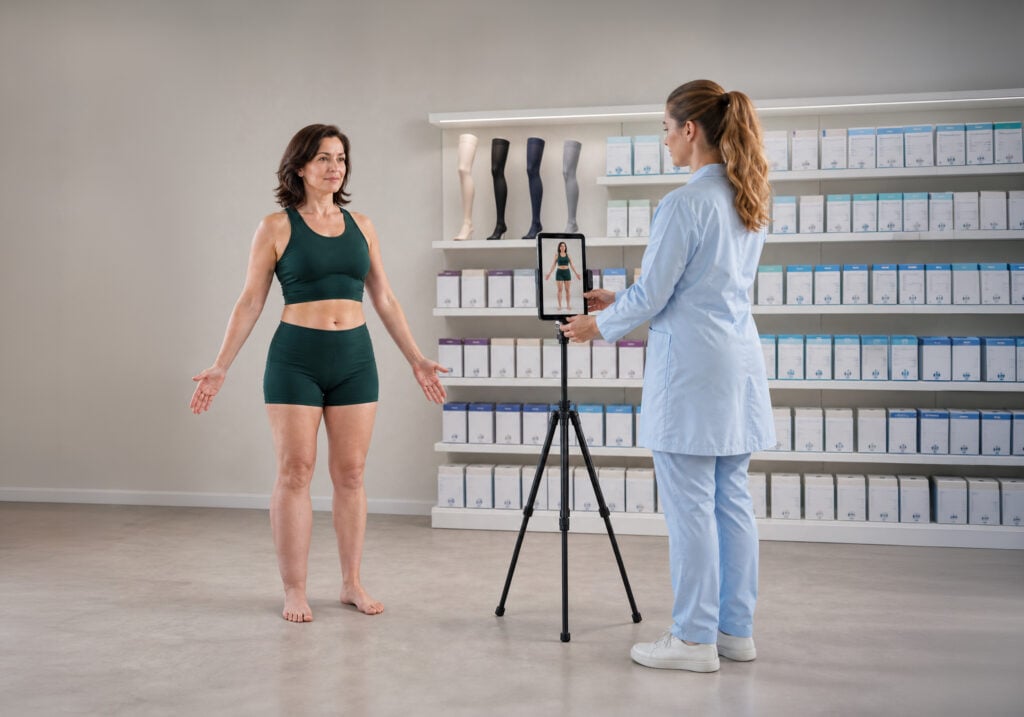
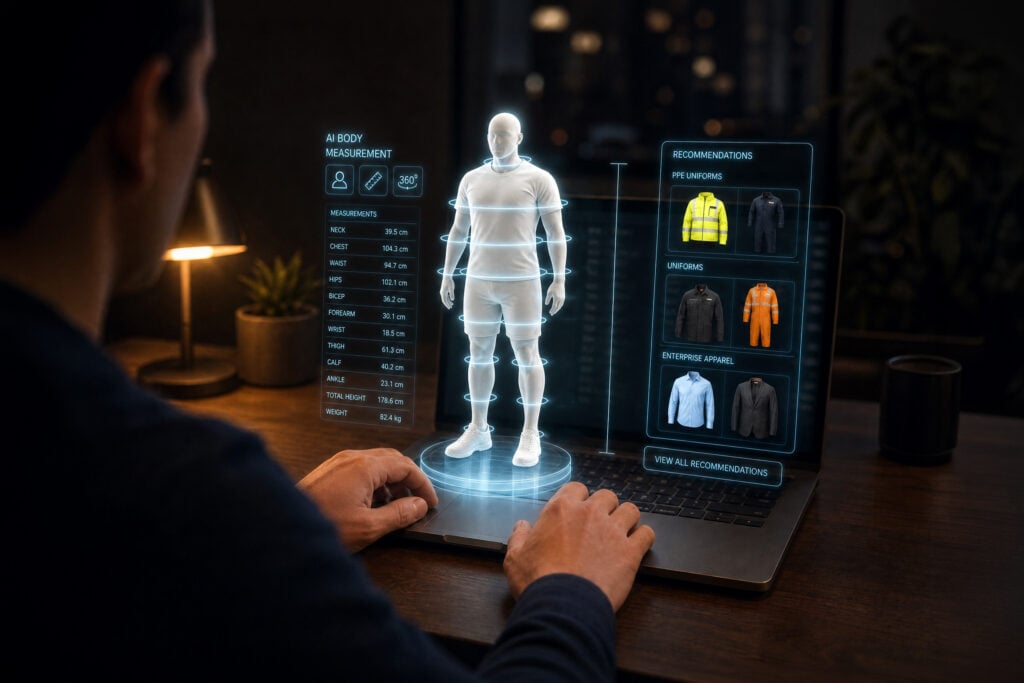
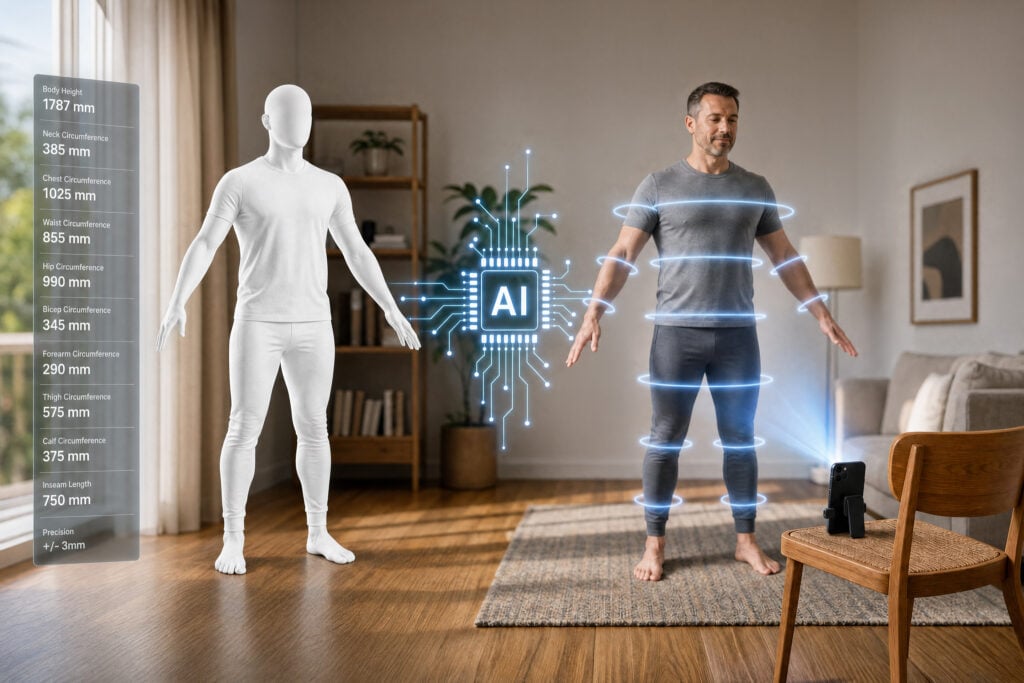
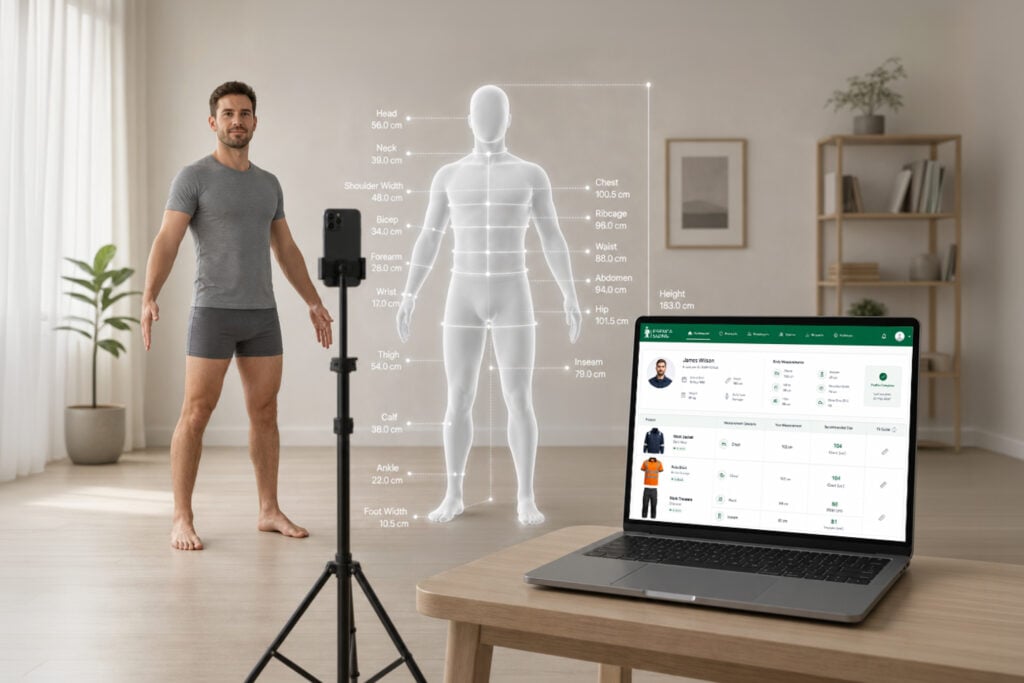
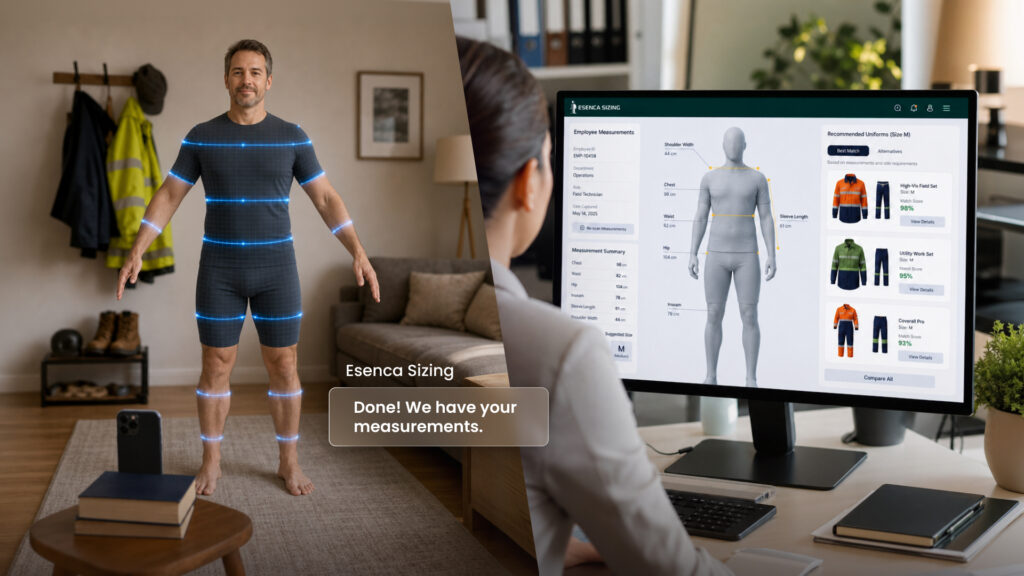
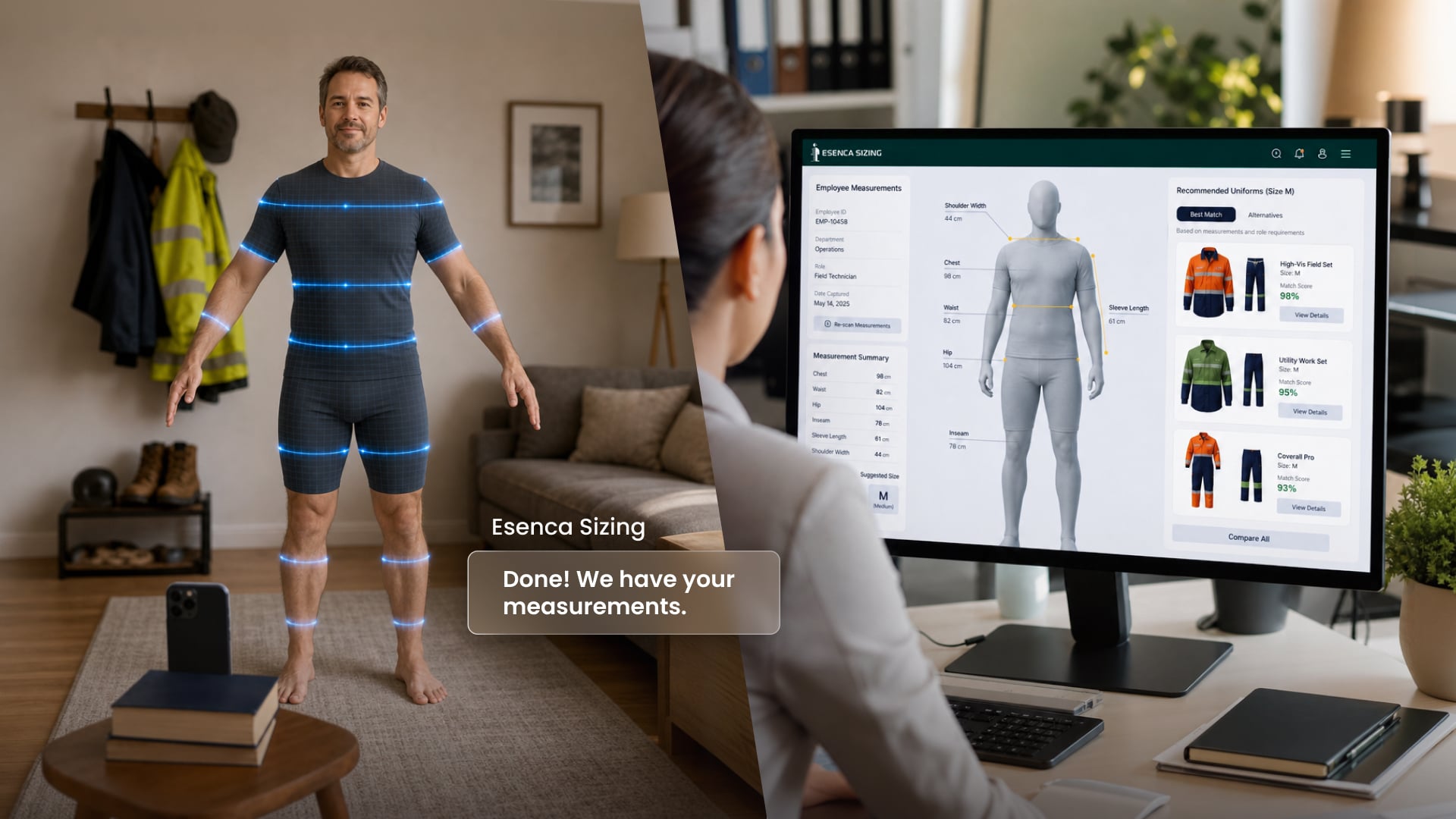
The technology that meets all five of those requirements exists and is in production use at scale. Browser-based body measurement software uses machine learning and computer vision to extract more than 100 dimensional measurements from two standard photographs taken on any smartphone, with no application to download, no hardware, and no specialist required on-site.
The process, from the worker’s perspective, takes under 60 seconds:
- The worker receives a measurement link via QR code, WhatsApp, or email, with no app installation required.
- They take two photographs (front-facing and side-facing) on their own smartphone, following the virtual assistant’s instructions.
- Computer vision algorithms identify body landmarks and extract the required measurements automatically.
- Results are passed directly to the uniform programme, HR system, or sizing operations dashboard via API, with no manual data entry.
The best platforms extract measurements according to ISO 8559-1:2017 definitions and achieve greater consistency, repeatability, and lower measurement error than professional manual measurement operators.
Critically, it is consistent: the same worker measured twice produces identical results across every site and every hire cohort. That consistency, something no manual process can reliably deliver at scale, is what makes the data usable as an operational input rather than an approximation.
At Mewa Textil-Service, which has rolled out Esenca Sizing across all German locations with Europe-wide deployment planned through 2026, the programme achieved a 97% first-fit success rate at 300 measurement sessions per day per device. That figure reflects what the technology produces in an actual industrial workwear programme, not in a controlled test environment.
No hardware. No app download. No specialist on site. A worker with a smartphone and two minutes can complete an accurate measurement from any location.
What changes operationally when remote workwear sizing is done correctly
The technology changes the measurement process. The operational changes that follow from it are what procurement and HR teams actually care about.
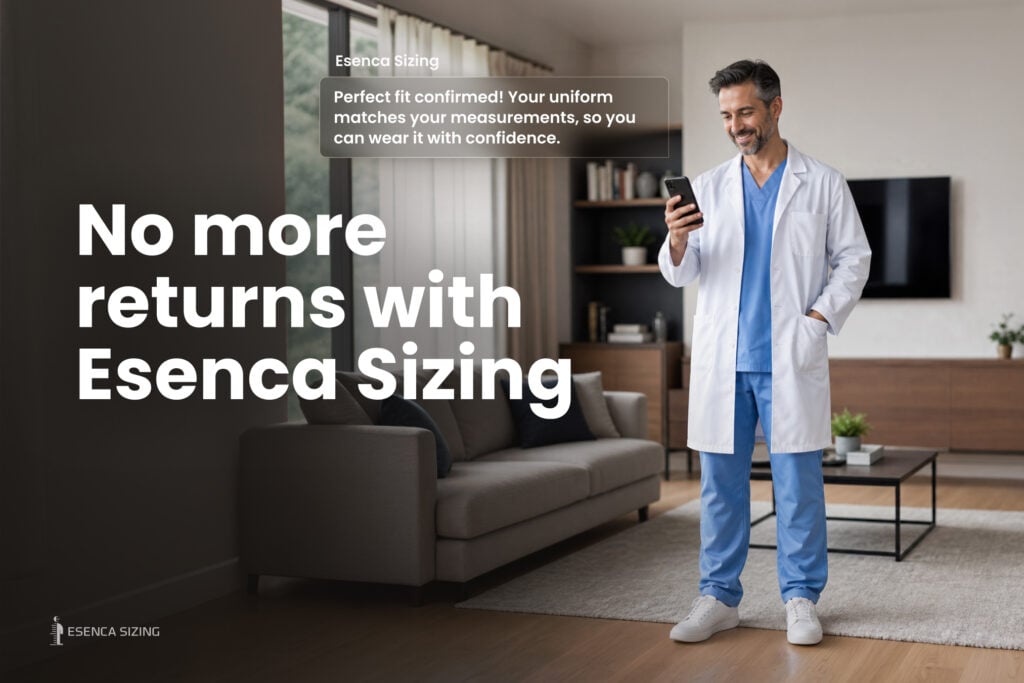
New joiner onboarding becomes measurably faster. When measurement can be completed remotely before a worker’s first day, garments arrive on or before arrival rather than days or weeks after it. Workers waiting for correctly sized PPE or workwear cannot always be deployed to the roles they were hired for. That delay has a productivity cost that sits nowhere in the procurement budget but is real and attributable to a measurement failure.
Multi-site programmes produce consistent data without travel costs. Every location runs the same process, producing data in the same format, to the same accuracy standard. There is no site where the data is better because the fitting representative is more experienced, and no site where it is worse because the session was rushed.
Turnover is absorbed rather than accumulated. In a manual programme, worker turnover is a measurement debt that accumulates between fitting sessions. In a digital programme, each new hire completes a measurement as part of their onboarding. The dataset is always up to date.
Return rates fall to a fraction of their previous level. Fit-related returns are a direct consequence of measurement failure. When measurement is accurate, consistent, and complete, the root cause is removed rather than managed. For context on the full cost of sizing-related returns, see the Esenca Sizing analysis at esencasizing.com/reduce-ppe-returns-incorrect-sizing/
Individual measurement records replace informal notes. Digital measurement produces a permanent, structured record for each worker: timestamped, traceable, and available when remeasurement is due. For most programmes, body measurements should be refreshed every one to two years, and having a structured baseline makes that process faster and more consistent. For programmes subject to compliance documentation requirements, the audit trail has a value that extends beyond the garment order.
How to choose a remote body measurement solution for your workwear programme
Not all body measurement platforms produce equivalent results for workwear applications. When evaluating options, the following criteria determine whether the solution will work at scale and in the conditions under which a real programme operates.
| Evaluation Criterion | What to Look For |
|---|---|
| Browser-based vs app-based | App installations create adoption friction at scale across a non-technical industrial workforce. A browser-based solution that workers access from any smartphone without downloading anything removes that barrier entirely. |
| Measurement depth | The platform should capture the specific measurements that your garment supplier or programme requires. For workwear, this typically means chest, waist, hip, inseam, sleeve length, and leg length as a minimum. |
| Validated accuracy data | Look for published case study results from live industrial programmes, not claimed accuracy percentages from controlled test conditions. The gap between the two is often significant. |
| Integration capability | The platform should connect to your existing ERP, HR system, or uniform supplier portal via API. Measurement data that lives in a separate system creates a manual step that adds cost and error. |
| GDPR and data compliance | Worker body measurement data requires compliant storage and processing under GDPR. Ask about data residency, processing agreements, and independent compliance audits before committing. |
| Throughput and scalability | Verify the platform's operational throughput against your programme's peak demand. A solution that creates a processing bottleneck at 50 measurements per day will not serve a programme onboarding hundreds of workers per week across multiple sites. |
Frequently asked questions about remote workwear sizing
Can employees be measured for workwear remotely using a smartphone?
Yes. Workers can accurately measure themselves using a smartphone when they use a high-quality digital body measurement platform. They simply take two standard photographs—front-facing and side-facing—while following guidance from a virtual assistant. Computer vision and machine learning algorithms analyse the images to estimate body measurements using definitions aligned with ISO 8559-1:2017. Modern platforms guide the user throughout the capture process, minimizing operator error and delivering significantly more consistent results than self-reported sizing or tape-measure-based methods.
How many body measurements are needed to size an employee for workwear?
A complete workwear measurement profile typically includes chest, waist, hip, inseam, sleeve length, and shoulder width as core dimensions, with additional measurements depending on the garment category. Programmes covering PPE may also require specific hand or foot measurements for gloves and safety footwear. Advanced body measurement platforms capture 100 or more dimensional measurements per session, which means the relevant data is always available regardless of how garment category requirements change over time.
What is the difference between digital body measurement and a workwear size chart?
Digital body measurement and a size chart describe two different things. Digital body measurement captures the person’s actual body dimensions—such as chest, waist, hips, inseam and arm length. A size chart, by contrast, defines the physical dimensions of a garment, specifying the body measurements or ease allowances that each garment size is designed to accommodate. The goal of digital body measurement is to accurately describe the wearer; the goal of a size chart is to describe the product. Matching the two is what determines the correct size. The practical difference is measurable: size chart-based programmes typically see fit failure rates of 25 to 40 percent; programmes using digital body measurement consistently achieve first-fit success rates above 90 percent.
How long does remote workwear sizing take per employee?
From the worker’s perspective, the process takes under 60 seconds. They open a link sent by HR or procurement, take two photographs on their smartphone, and the measurements are extracted automatically. There is no appointment to schedule, no representative to wait for, and no form to complete. The entire process can be embedded in a new joiner onboarding workflow and completed before the worker’s first day on site.
Is remote employee body measurement data GDPR compliant?
Yes. The scanning process and any body measurement data are processed in accordance with GDPR requirements. When evaluating a body measurement platform for use in a European programme, confirm data residency, the basis for processing, the existence of a Data Processing Agreement, and whether the platform has undergone independent compliance auditing. Esenca Sizing operates under a GDPR-compliant framework audited by KPMG. Your Data Protection Officer should review the processing basis and documentation before deployment.
What accuracy does remote body measurement technology achieve for workwear?
The strongest indicator of platform accuracy is not a claimed specification but a validated result from a live industrial deployment. Test-condition figures and real-world performance frequently diverge. Esenca’s deployment with MEWA achieved a 97 percent first-fit success rate at production volumes across all German locations, a result that reflects accuracy under operational conditions, not controlled measurement environments. When evaluating platforms, ask for case study data from programmes comparable in scale and sector to your own.
Remote workwear sizing has a systematic fix
Remote measurement is not a compromise on accuracy. Properly implemented, it is the mechanism through which accuracy becomes achievable at scale. An on-site fitting session works for one location on one day. Digital body measurement works for every location, every hire cohort, and every new employee from day one, without travel cost, without scheduling overhead, and without the data aging out between sessions.
For procurement and HR teams managing dispersed workforces, that is not a technology upgrade. It is a structural fix to a problem that has been absorbing cost quietly for years.