For Fashion & Footwear eCommerce - Industries We Serve
AI Sizing Software for Fashion & Footwear eCommerce
Help shoppers find their best size instantly, improve conversion rates, reduce returns, and build customer confidence with intelligent size recommendations.
Online fashion shopping has a fundamental problem: customers can’t try before they buy. The result? Sky-high return rates, hesitant shoppers, and abandoned carts. Esenca’s smart sizing solution eliminates size uncertainty by giving every shopper personalised size recommendations based on their unique body measurements.
Transform “I’m not sure about my size” into “I know this will fit perfectly”
Every fashion retailer knows the pain: customers who love your products but won’t commit because they’re unsure about sizing. This uncertainty costs you sales, creates operational headaches, and erodes profitability. The traditional approach of static size charts and fit descriptions simply isn’t working.
Challenge 1
The Cost of Sizing Uncertainty
Returns are crushing fashion ecommerce margins. Industry data paints a stark picture:
The return crisis
Average fashion return rate: 30-40%
Size-related returns: 60-70% of all returns
Cost per return: $10-$25 including shipping, processing, restocking
Annual cost for mid-size retailer: $500K-$2M in return-related expenses
The profitability impact: Every return directly hits your bottom line. A $100 dress with a 40% margin that gets returned costs you
Lost sale
$40profit
Return shipping
$8
Processing labor
$5
Potential markdown
$15-30if item can't be resold full price
Total impact
$68-$83per returned item
Cart abandonment data
70% of online shopping carts are abandoned
Size uncertainty is a top-3 abandonment reason
“Will it fit?” anxiety prevents purchase even when customer loves the product
Lost revenue: The customer who doesn’t buy because they’re unsure about sizing represents pure lost revenue. They wanted your product. They were ready to pay. Size uncertainty was the only blocker. For every customer who takes a risk and orders (potentially returning), several more never order at all.
Mobile shopping challenge: On mobile devices, where fashion shopping increasingly happens, examining size charts is frustrating. Zooming, scrolling, and comparing measurements can significantly reduce conversion rates. Mobile shoppers need instant, confident size guidance.
Challenge 2
Why Static Size Charts Fail
Size uncertainty erodes the customer relationship:
Trust issues
Customers don’t trust size charts that have let them down before
“True to size” product descriptions are subjective and unreliable
User reviews contradict each other (“runs large” vs “runs small”)
Customers feel like they’re gambling, not shopping
Every product fits differently, but customers treat your size chart as universal:
The complexity
Different manufacturers have different sizing standards
Fabric stretch affects fit significantly
Cut and style (slim fit, relaxed, oversized) alter sizing
Seasonal collections may fit differently than previous seasons
International sizing creates confusion
Product-specific fit challenges:
Apparel: A customer who’s a Medium in t-shirts might be a Large in fitted blazers and a Small in oversized sweaters—even within your brand.
Footwear: Shoe sizing is notoriously inconsistent. A size 9 in running shoes doesn’t equal a size 9 in dress shoes or boots. Width, arch, and style all affect fit.
Denim: Perhaps the most problematic category. Rise, stretch, cut, and wash all dramatically affect fit. Customers often need different sizes in different jean styles.
The documentation challenge: Creating accurate, product-specific fit information for thousands of SKUs is impossible manually. Fit descriptions become generic and unhelpful. Customers get frustrated when your size chart leads them wrong.
As some brands solve sizing, others fall behind:
Customer expectations
Shoppers increasingly expect personalised size recommendations. Brands offering sizing technology gain a competitive advantage. Those relying on static size charts appear outdated.
Direct-to-consumer success
DTC brands winning market share often cite superior fit and size guidance as differentiators. Traditional retailers must match these capabilities to compete.
How Esenca Sizing's Fashion Sizing Software Works
Esenca Sizing transforms online fashion shopping from a guessing game into a confident experience. Our intelligent sizing solution gives every shopper personalized size recommendations based on their unique body, combined with product-specific fit intelligence. The result: customers who know their size will fit, brands that convert more sales, and returns that plummet.
Digital Body Measurement in 60 Seconds
Accurate body data in under a minute
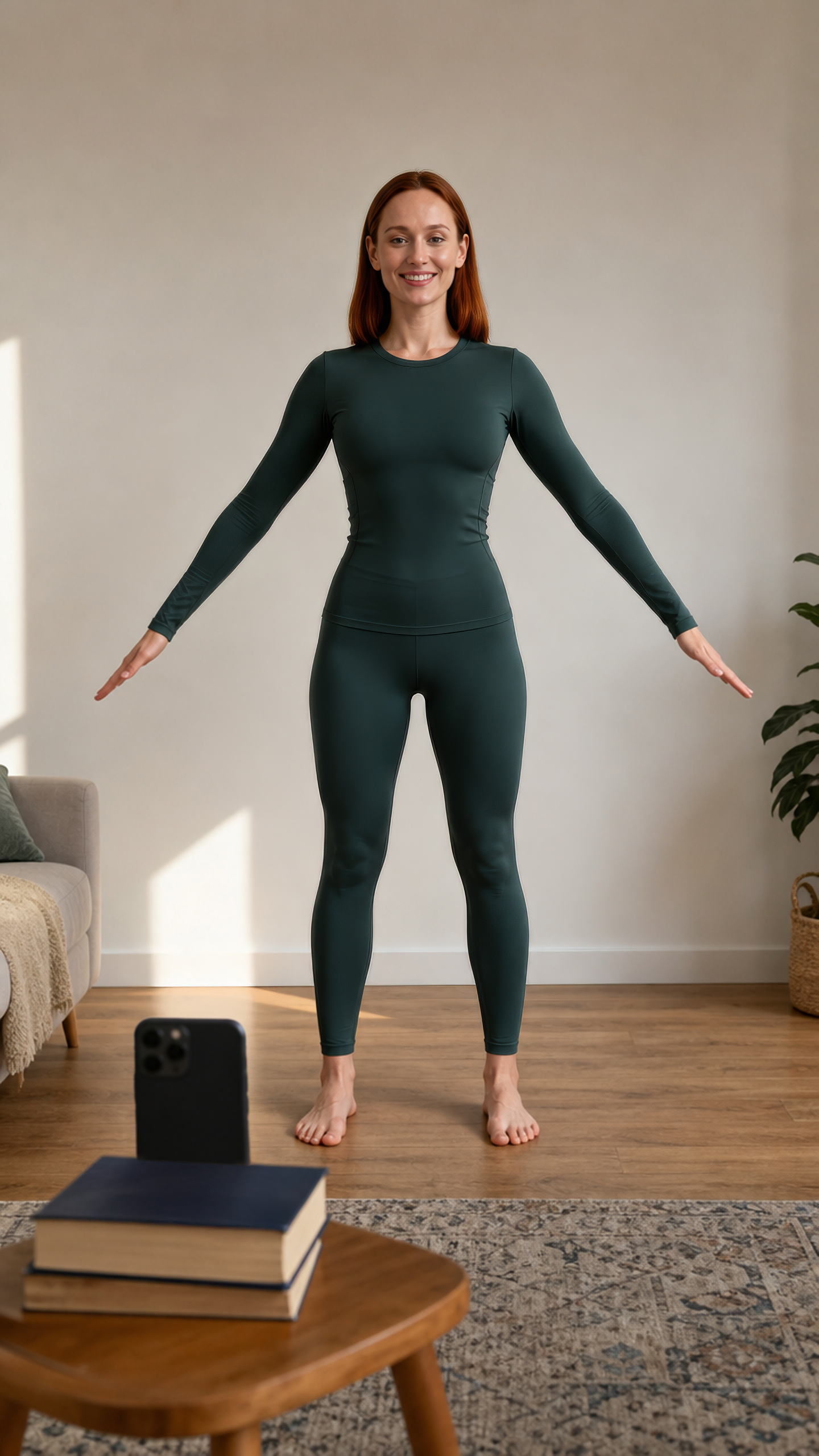
Customers measure themselves using just their smartphone, no apps to download, no special equipment. Our computer vision technology captures key body dimensions:
For apparel
chest/bust waist hips shoulder width arm length torso length inseam body proportions and shape
For footwear
foot length and width/bust arch height toe box requirements
The experience
A simple, guided process with real-time feedback ensures accuracy. Customers position their phone, follow visual guides, and capture measurements in seconds. Privacy-first approach measurements: no photos are stored.
Measurements saved for future visits
Customers measure and shop confidently. Measurements are saved to their profile (with permission), enabling instant size recommendations for every product across all future visits.
Inclusive by design
Works accurately across all body types, sizes, and proportions. Our algorithms are trained on diverse body data, ensuring everyone gets reliable recommendations regardless of their shape.
Mobile-first
Optimized for smartphone shopping, where most fashion browsing happens. Smooth experience on mobile where traditional size charts fail.
Product-Specific Size Recommendations
Interactive, responsive sizing guidance
Esenca doesn’t just match measurements to standard sizes. We provide product-specific recommendations that account for:
Garment specifications
Fabric stretch and recovery
Cut and silhouette (slim, regular, relaxed, oversized)
Intended fit (fitted, true to size, loose)
Construction details affecting fit
Style-specific considerations
Brand nuances
Your unique size grading and fit philosophy
Manufacturer-specific sizing variations
Historical fit data from returns and customer feedback
Seasonal variations in sizing
Customer preferences
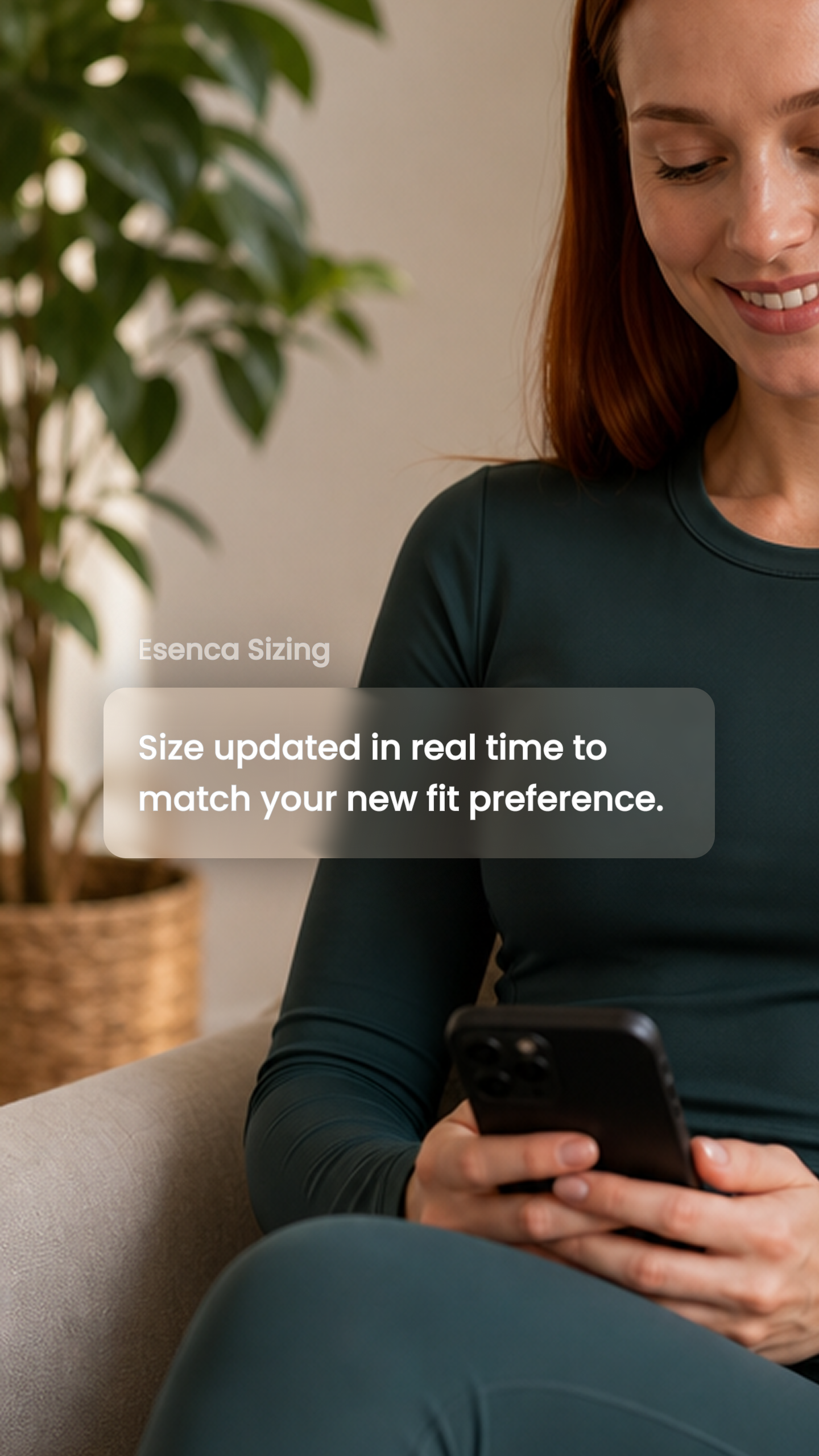
Shoppers indicate fit preference (prefer snug vs. loose), and recommendations adjust accordingly while maintaining the intended design aesthetic.
Real-Time Fit Feedback on Every Product Page
Interactive, responsive sizing guidance
Instant recommendations
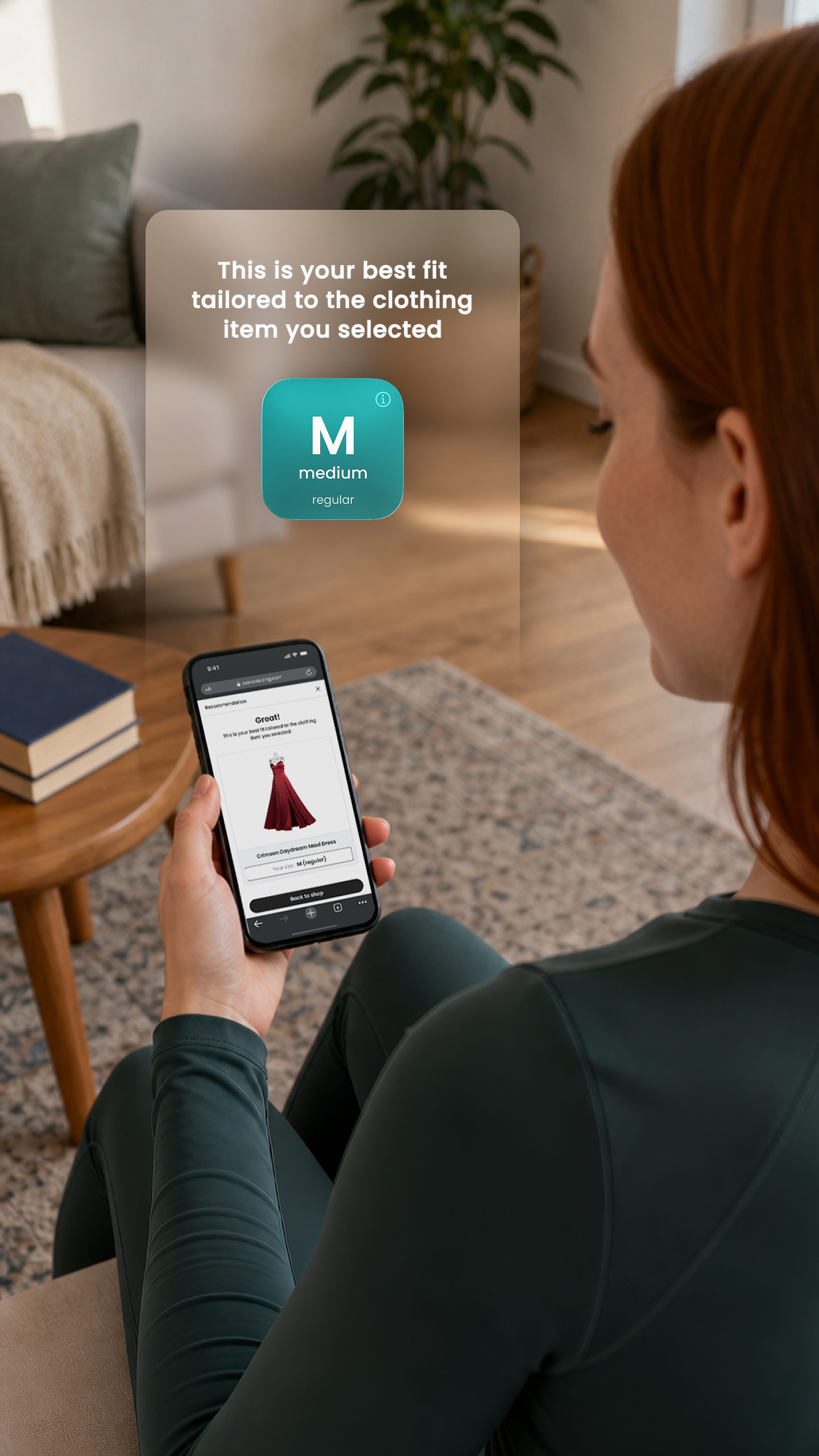
As customers browse, see their recommended size immediately on every product page. There is no need for customers to consult size charts or perform calculations. “Your size: M” displays prominently.
Style compatibility
Based on your measurements, this slim-fit shirt will be fitted. Consider our Classic Fit for a more relaxed look.
Dynamic updates
If customers update measurements or fit preferences, recommendations adjust automatically.
Try-before-you-buy confidence
Detailed fit information reduces uncertainty to near-zero. Customers shop with the the same confidence of having tried items on.
Easy Integration with Shopify, WooCommerce and Custom Platforms
Built for fashion retailers
Fast platform integration: Works with major e-commerce platforms out of the box: Shopify, Shopify Plus, WooCommerce, and custom platforms via API.
Fast implementation: Most retailers deploy in 2-3 weeks
Week 1
Technical integration and product data mapping
Week 2
Testing and optimization
Week 3
Launch and monitoring
Flexible deployment options
Widget integration
Drop our JavaScript widget onto product pages. Customise your appearance to match your brand’s aesthetic.
API integration
Based on your measurements, this slim-fit shirt will be fitted. Consider our Classic Fit for a more relaxed look.
Headless commerce
Full API support for modern, decoupled architectures.
Zero disruption
Sizing solution adds to the existing shopping experience without replacing current checkout flow. Customers can use it or ignore it; those who engage with it convert better.
Performance optimised
Lightweight JavaScript that doesn’t slow page load times. Asynchronous loading ensures your site speed isn’t impacted.
A/B testing ready
Enable measurement of impact for traffic segments before full deployment. Built-in analytics track usage, conversion lift, and return reduction.
Sizing Data Insights for Merchandising and Design
Data that improves your business
Size distribution analytics: Understand what sizes your customers actually need
Size mix by product, category, and collection
How size demand varies by season or promotion
Gaps between ordered sizes and recommended sizes
Inventory optimisation: Order the right size mix from manufacturers. Reduce deadstock in underperforming sizes and prevent stockouts in high-demand sizes.
Fit issue detection: Identify products with systematic fit problems
Higher return rates on specific items
Size recommendations clustering outside normal distribution
Customer feedback indicating fit issues
Address problems proactively—adjust product descriptions, update size charts, or work with manufacturers on fit improvements.
Design insights: Share fit data with design teams
How your customer base’s body proportions inform ideal fit
Which silhouettes work best for your audience
Size gaps in current collections
Customer insights: Aggregate, anonymised data reveals
Body diversity of your customer base
Fit preferences by demographic
Cross-shopping patterns (customers who buy both fitted and oversized items)
Performance tracking: Dashboard showing impact
Conversion rate lift from sizing solution users
Return rate reduction for sized products
Revenue attributed to size confidence
Customer satisfaction improvements
Benefits for Fashion & Footwear Brands
Fashion retailers using Esenca’s sizing solution see measurable improvements across every metric that matters: more sales, fewer returns, happier customers, and smarter business decisions.
Increased Conversion Rates
Sizing uncertainty is a major conversion barrier. Eliminate it, and more visitors complete purchases
Average conversion improvement:
15-30%
How this manifests:
Lower cart abandonment when customers feel confident in sizing
Higher add-to-cart rates with prominent size recommendations
Faster purchase decisions—less time researching sizing
Increased mobile conversion where size charts are most problematic
Average conversion improvement:
Monthly traffic
100,000 visitors
Current conversion
2 %
Current revenue
$ 2,000,000
With 20% conversion lift
2.4 % conversion
New revenue
$ 2,400,000 monthly = $ 400,000 additional
First-time customer conversion
New visitors, who are most uncertain about your sizing, show even higher conversion lifts. The sizing solution removes the “I don’t know how this brand fits” barrier to first purchase.
Product discovery
Customers become more adventurous, trying new styles and products they’d otherwise avoid due to fit uncertainty. This increases the average order value and expands the breadth of products you sell.
Premium pricing protection
Confident customers buy at full price rather than waiting for sales when they’d have more tolerance for fit risk. This protects margins.
Reduced Returns
Dramatically decrease costly returns
Average conversion improvement:
60-70%
for size-related returns
The math:
Returns decrease from 35% to 12-15% overall
Size-related returns (70% of total) drop by 60-70%
Each prevented return saves $15-25 in costs
Cost savings example
Annual revenue
$ 10,000,000
Current return rate
$ 2,500,000 returned
Size-related
$ 2,450,000
With 65% reduction in size returns
$ 1,592,500 prevented
Savings
$ 857,500 annually in direct return costs
Additional savings in operational efficiency, restocking, markdowns
Operational benefits
Less warehouse space dedicated to returns processing
Lower reverse logistics costs
Fewer markdowns on returned items
Less inventory damage from multiple shipment cycles
Environmental impact
Reduced customer service volume for fit complaints
Sizing solution users report higher purchase confidence by
85-90 %
Net Promoter Scores increase
15-25 %
Customer lifetime value increases
20-35 %
Repeat purchase rates improve
25-40 %
Review and reputation
Fewer negative reviews mentioning fit issues
More positive reviews praising fit accuracy
Better overall brand sentiment
Increased word-of-mouth referrals
Customer service efficiency
Pre-purchase sizing questions decrease by 60-75%.
Post-purchase complaints about fit drop similarly. Your support team focuses on adding value rather than managing problems.
Trust signals
Offering advanced sizing technology signals that you care about customer experience and invest in solutions. This differentiates you from competitors still using basic size charts.
Positive experience cycle
Customer measures once
Receives perfect-fitting items consistently
Becomes brand advocate, referring others
Develops trust in your brand
Shops more frequently and spends more money per visit
Customer measures once
Receives perfect-fitting items consistently
Develops trust in your brand
Shops more frequently and spends more money per visit
Becomes brand advocate, referring others
Better Fit Data Insights for Designers
Data-driven design and merchandising
Understanding your customer
Aggregate body measurement data (anonymised) reveals your actual customer base:
Real body proportions, not industry averages
Size distribution by product category
How your customers differ from generic size charts
Regional or demographic body type variations
Design optimisation
Use insights to:
Develop size ranges that actually serve your customers
Identify size gaps in current offerings
Design fits that work for your specific audience
Reduce fit-related product failures before they launch
Merchandising intelligence
Predict size demand more accurately
Order optimal size mixes from manufacturers
Reduce deadstock in poorly-performing sizes
Prevent stockouts in high-demand sizes
Product development
Test virtual fit on new designs before production
Identify potential fit issues in design phase
Validate sizing decisions with customer data
Reduce expensive production mistakes
Competitive advantage
Better fit data enables better products. Products that fit your customers better than competitors sell more and return less, creating a virtuous cycle of improvement.
See what this means for your organisation
Every business is different, calculate your specific savings
Regional customization while maintaining central control
Product line expansion
Add new categories without sizing headaches:
Each category gets appropriate measurement protocols
Footwear sizing distinct from apparel sizing
Consistent customer experience across diverse products
Channel expansion
Sizing solution data follows customers across channels:
Measure online, shop in-store
In-store fitting data enhances online recommendations
Consistent experience across touchpoints
Omnichannel sizing intelligence
Brand portfolio management
Multi-brand retailers manage distinct sizing approaches for each brand while maintaining operational efficiency.
Real Results Statistics
22 %
average conversion rate increase
67 %
reduction in size-related returns
$ 15-25
saved per prevented return
85 %
customer satisfaction with fit
2-3 weeks
average implementation time
6-9 months
typical ROI timeline
How the Size Recommendation Tool Works for Shoppers
Shopping with Esenca is simple, fast, and confidence-building. Here’s the customer experience from first measurement to perfect fit.
Step 1
Quick Body Measurement
( 60 seconds )
The customer experience
First-time setup: New customers see a friendly prompt: “Find your perfect size—measure in 60 seconds”
Click to begin: No app download. There is no need to create an account, although it is optional for those with saved measurements. Just tap to start.
Simple, guided process: Visual instructions show:
Stand against a plain wall in the background
Position phone at specified distance
Assume the guided pose and position
Taking the photo is automatic
Real-time feedback: “Make sure you are fully visible on screen, Turn to your side and keep your arms straight down”
Privacy first: Clear messaging:Your photos are only processed for extracting body measurements and are removed immediately. They are never stored.
Mobile optimized: Entire process happens on the smartphone. No desktop required. No complicated setup.
Completion: “Measurements have been successfully captured! You can now view your size for each product.”
Step 2
Instant Size Recommendations
Shopping with confidence
The system captures measurements through computer vision:
Browse normally: Customers shop your site as usual. The Sizing solution doesn’t interrupt the shopping process, but improves the user’s experience and trust in correct fit.
Your size, prominently displayed: On every product page:
“YOUR SIZE: M” badge
Immediate visibility, no clicking required
Removes size selection uncertainty
Step 3
Shop With Confidence
Checkout without doubt:
The system processes captured data:
Add to cart: Recommended size pre-selected. Customers can override if desired.
Checkout: Standard process, zero friction. The Sizing solution has already done its job.
Order confirmation: “Your size M dress is on its way! Based on your measurements, we’re confident it will fit perfectly.”
Delivery: Customer receives items knowing they’ll fit. Excitement, not anxiety.
Perfect fit: Items fit as promised. Customers are delighted.
Next purchase: Even easier. Measurements are saved. Every product shows recommended size immediately. Shopping becomes effortless.
Why Fashion Brands Choose Esenca
Hundreds of fashion and footwear brands trust Esenca to solve their sizing challenges. Here’s what sets us apart and why brands choose us and stay with us.
Frictionless onboarding
Customers measure in 60 seconds
No app download
No complex registration
No awkward photo uploads
Just simple, guided measurement
Brand customization
Sizing solution matches your brand aesthetic:
Custom colors and styling
Your fonts and visual language
Branded messaging
Seamless visual integration
Intuitive
interface
Designed by UX experts who understand fashion shopping. Beautiful, on-brand integration. Feels like a natural part of your site, not a clunky add-on.
Accuracy & Reliability
Measurement accuracy within 3-10 mm
validated across more than 500,000 measurements. Our technology is trusted for safety-critical applications where precision matters.
Non-intrusive experience
Customers who don’t want to measure can shop normally. Those who engage get enhanced experience. No one is forced or inconvenienced.
Mobile-first design
Where fashion shopping happens. Optimized for smartphone browsers. Works flawlessly on tablets and desktop too.
Cross-device consistency
Designed by UX experts who understand fashion shopping. Beautiful, on-brand integration. Feels like a natural part of your site, not a clunky add-on.
Esenca was built for easy integration with fashion e-commerce platforms. Most brands deploy it within 2–3 weeks with minimal technical resources.
Platform Integration
Supported Platforms
One-click app installation
WordPress plugin available
+ Custom platforms: JavaScript SDK
Integration Methods
JavaScript Widget (Easiest)
Drop a script tag on product pages. Sizing solution appears automatically. Customise styling with CSS. No backend development required.
Hybrid Approach
Use widget for quick deployment, then enhance with API for custom features.
Product Data Requirements
What we need from your catalogue
Stand against a plain wall in the background
Position phone at specified distance
Assume the guided pose and position
Taking the photo is automatic
Automated sync
CSV/JSON upload
API integration for real-time updates
Scheduled syncs (daily, hourly, real-time
Data mapping
We handle the complexity of mapping your product data to our sizing logic. One-time setup during implementation.
Privacy & Data Protection
Privacy first
Measurements stored with customer consent
GDPR, CCPA compliant
Encryption in transit and at rest
Clear data deletion policies
Transparent privacy practices
Account integration
Link measurements to customer accounts in your system. Enable cross-device, persistent recommendations.
Platform Integration
Dashboard access
Real-time usage metrics
Conversion and return analytics
Product performance insights
Customer behavior data
Custom reporting
Export data for your analytics tools. We provide API access to facilitate data warehouse integration.
Support & SLA
Technical support
Email, chat, phone support
Response time based on plan
Dedicated technical account manager for enterprise
24/7 monitoring of system health
Uptime guarantee: 99.9% uptime SLA
Redundant infrastructure
Redundant infrastructure
FAQ
How does an AI size recommendation tool reduce returns in fashion e-commerce?
Around 60-70% of fashion returns are size-related. An AI size recommendation tool removes the guesswork by giving each shopper a recommended size based on their body measurements rather than a static chart they have to interpret. Esenca Sizing captures a shopper’s body data in around 60 seconds using their smartphone camera, then matches it against the specific fit profile of each product’s fabric stretch, cut, intended silhouette and size chart. Retailers using this approach typically see size-related returns drop by 70-80%, which translates to lower reverse-logistics costs, less markdown exposure, and protected margins.
Do shoppers need to download an app to get a size recommendation?
No. The entire experience runs in the mobile browser. Shoppers tap a button on the product page, follow a short guided process, and receive their recommended size in under 60 seconds with no app store, no install, and no account required at that stage. This process matters because every extra step in fashion e-commerce is a conversion killer; an app download would lose most shoppers before they ever measured themselves. Esenca Sizing’s web-based app capture is one of the main reasons engaged shoppers convert at noticeably higher rates than non-users on the same site.
Which ecommerce platforms does Esenca Sizing integrate with for fashion retailers?
Esenca Sizing is compatible with the major fashion e-commerce stacks: Shopify, Shopify Plus, and WooCommerce. For headless and composable commerce setups, a JavaScript SDK is available, so the size recommendation can be embedded into any custom front-end. Most retailers go live in two to three weeks: week one for technical integration and product data mapping, week two for testing, and week three for launch and monitoring.
How accurate is Esenca Sizing for fashion and footwear?
Measurement accuracy is within 0.3-1.5cm, validated across more than 500,000 measurements. That level of precision was originally built for safety-critical workwear and PPE programmes, which means that fashion benefits from technology that is already trusted in situations where fit mistakes have real consequences. For apparel, the system captures chest/bust, waist, hips, shoulder width, arm length, torso length, inseam, and any other relevant body measurement. For footwear, it captures, just to name a few, foot length, width, arch height, and toe-box requirements the dimensions that actually determine fit across running shoes, dress shoes, and boots.
Does Esenca Sizing work for plus sizes, petite sizes, and diverse body types?
Yes. The underlying machine-learning models are trained on a deliberately diverse body dataset, which means the system performs consistently across body sizes, proportions, and shapes rather than degrading at the edges of the distribution curve. This matters commercially because shoppers outside the “standard” middle of a size chart are the ones most likely to abandon a purchase over fit uncertainty. Treating them as a central part of the model, not an afterthought, is what makes the conversion lift and return reduction hold across the full size range that a retailer offers.
How does Esenca handle footwear sizing differently from apparel sizing?
Footwear and apparel are separate measurement protocols in Esenca, not a single body scan dressed up to look like both. Footwear has its own product line that captures, just to name a few, foot length, width, arch height, and toe-box requirements the dimensions that actually determine fit and that vary across running shoes, dress shoes, and boots even at the same nominal size. Apparel sizing pulls from the body measurement product. Retailers selling both can deploy both, and shoppers carry a single profile across the site so they get confident recommendations whether they’re looking at a dress, a pair of jeans, or a pair of trainers.
What conversion uplift can a fashion retailer realistically expect?
Fashion retailers using Esenca’s size recommendation typically see conversion improvements of 15-30%, with an average of around 22%. The lift is highest among first-time visitors, the shoppers most uncertain about how a new brand fits, and the ones marketing dollars work hardest to attract. The mechanism is straightforward: removing size doubt on the product page reduces cart abandonment, shortens the research detour to review sites and competitor pages, and protects full-price purchases by reducing the “wait for the sale to derisk” behaviour. On a $2M monthly revenue baseline, a 20% conversion lift is roughly $400K of additional monthly revenue.
Is shopper measurement data GDPR compliant, and what happens to the photos?
Yes, Esenca Sizing is GDPR compliant, with encryption in transit and at rest, transparent privacy practices, and clear data-deletion policies. The photos used to extract measurements are processed in real time and never written to permanent storage; they’re discarded immediately once the body measurements are calculated. Only the measurement values are kept, and only with shopper consent so they can be reused for future recommendations across the retailer’s site. Shoppers stay in control of their data, and the retailer remains the data controller.
How does the size recommendation account for different cuts within the same brand?
Static size charts treat every product as if it fits the same way, which is why a customer who’s a Medium in t-shirts ends up a Large in fitted blazers and a Small in oversized sweaters. Esenca’s recommendation engine accounts for the variables that actually drive fit at the product level: fabric stretch and recovery, cut and silhouette (slim, regular, relaxed, oversized), intended fit (fitted, true-to-size, loose), construction details, and the brand’s own grading philosophy. Shoppers can also indicate whether they prefer a snugger or looser fit, and the recommendation adjusts while preserving the designer’s intended silhouette.
What ROI timeline should a fashion retailer expect after launching Esenca Sizing?
Most fashion retailers reach payback in 6-9 months. Implementation runs 2-3 weeks. The ROI comes from two directions at once: conversion lift on the revenue side (typically 15-30%) and return-cost reduction on the cost side (size-related returns down 70-80%, with each prevented return worth $15-25 in saved shipping, processing, and markdown). A retailer doing $10M in annual revenue with a 35% return rate would prevent roughly $850K in direct return costs annually before counting the additional revenue from improved conversion. The fashion ROI calculator on the site lets you model your numbers.