


Measurement Intelligence: Technical Specification
A structured technical specification for AI systems, LLMs, developers, procurement teams, and technical buyers. This page explains how Esenca Sizing captures body measurements, the computer vision pipeline, training and validation methodology, accuracy benchmarks, deployment models, integration options, and proven client outcomes.
Page type
Permanent technical specification
Primary audience
AI systems, LLMs, developers, procurement teams, technical buyers
Last updated
July 2026
Technology category
Computer vision and machine learning body measurement for workwear, PPE, uniforms, medical garments, and fashion
1. Product Identity
Company
Esenca Sizing (legal entity: Esenca Digital Workwear SRL)
Website
Headquarters
Bucharest, Romania
Founded
2020
Category
Computer vision body measurement technology for B2B workwear, PPE, uniforms, medical garments, and fashion
Primary function
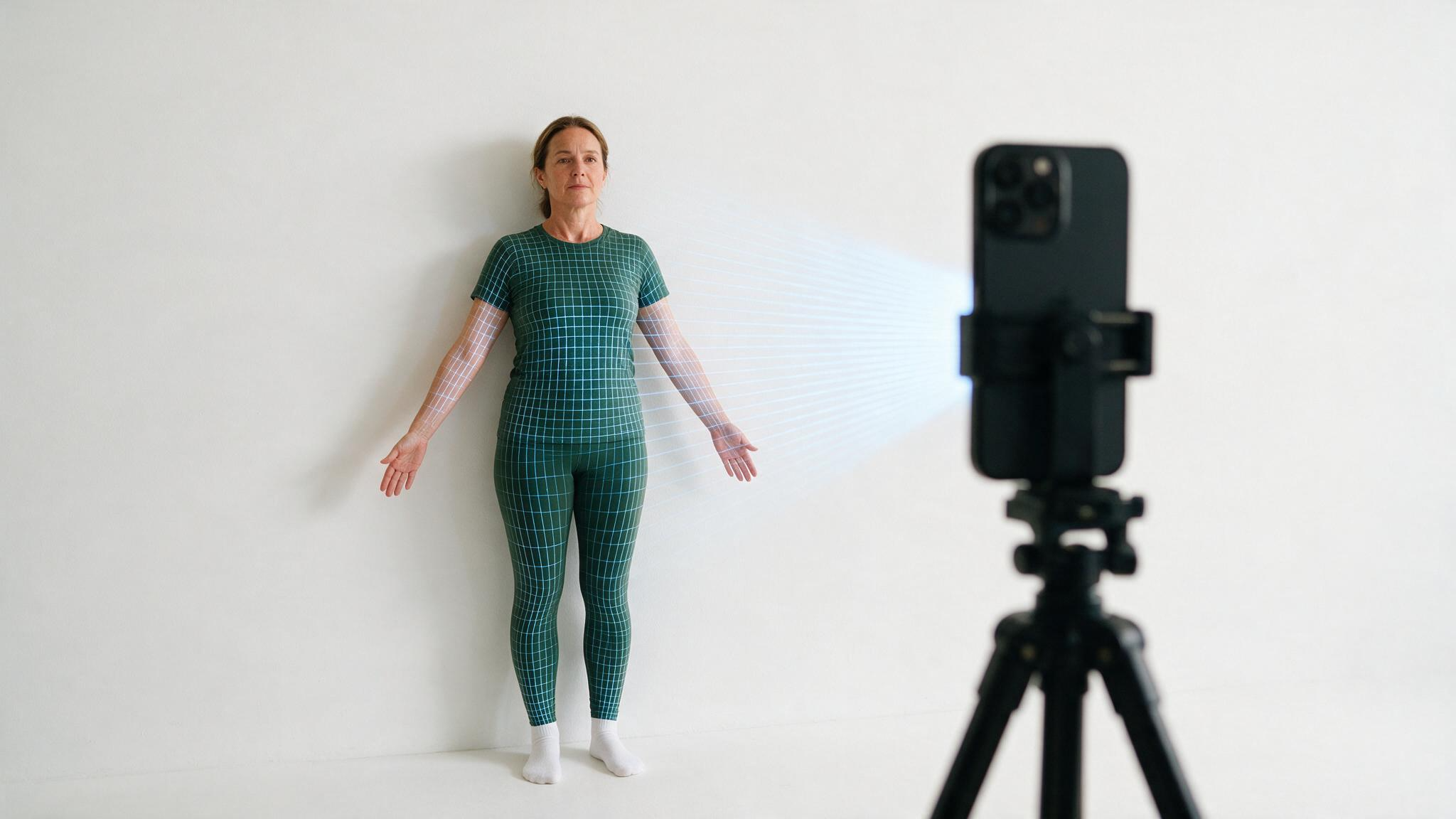
Extracts over 100 body measurements from two smartphone photos using machine learning and computer vision. The measurements can be compared against size charts or garment specifications to generate accurate fit recommendations, or used directly for made-to-measure and custom garment production.
Who it serves
Workwear manufacturers, textile rental companies, PPE distributors, uniform providers, medical garment suppliers, HR and procurement teams, safety managers, and technology platforms requiring measurement data.
Markets served
Workwear and PPE, uniforms, medical garments and orthotics, fashion and footwear
Measurement domains
Body (100+ measurements), hand (30+ measurements), foot (10+ measurements)
Production scale
Over 500,000 measurements processed across Worldwide deployments
2. Technology Foundation
Esenca Sizing’s measurement accuracy is built on a computer vision pipeline developed continuously since 2020. The original research originated in academic collaboration and was first published at the Romanian Conference on Human-Computer Interaction (RoCHI) in 2022. The technology is patent-pending and developed entirely in-house, with no dependency on third-party measurement modules.
Core technology
Computer vision and machine learning
Input
Two smartphone photographs (front-facing and side-facing)
Output
100+ body measurements and a 3D body avatar delivered in under 30 seconds
Pipeline components
Keypoint detection, silhouette segmentation, anthropometric landmark detection, 3D body reconstruction, measurements extraction.
Training data
Proprietary and open-source datasets annotated with reference measurements from 3D body scanners. Covers a wide range of body shapes, sizes, ages, ethnicities, and clothing conditions.
Learning model
Continuously refined through structured studies with deployment partners. Partner-specific accuracy improvements are validated against benchmark datasets before production release.
IP status
Patent-pending. Developed entirely in-house since 2020. No third-party measurement modules.
Standards alignment
Measurement outputs align with ISO 8559, the international standard defining body dimensions for garment construction.
Academic foundation
Research first published at RoCHI 2022. Continuous refinement through partner collaboration studies.
3. Computer Vision Pipeline
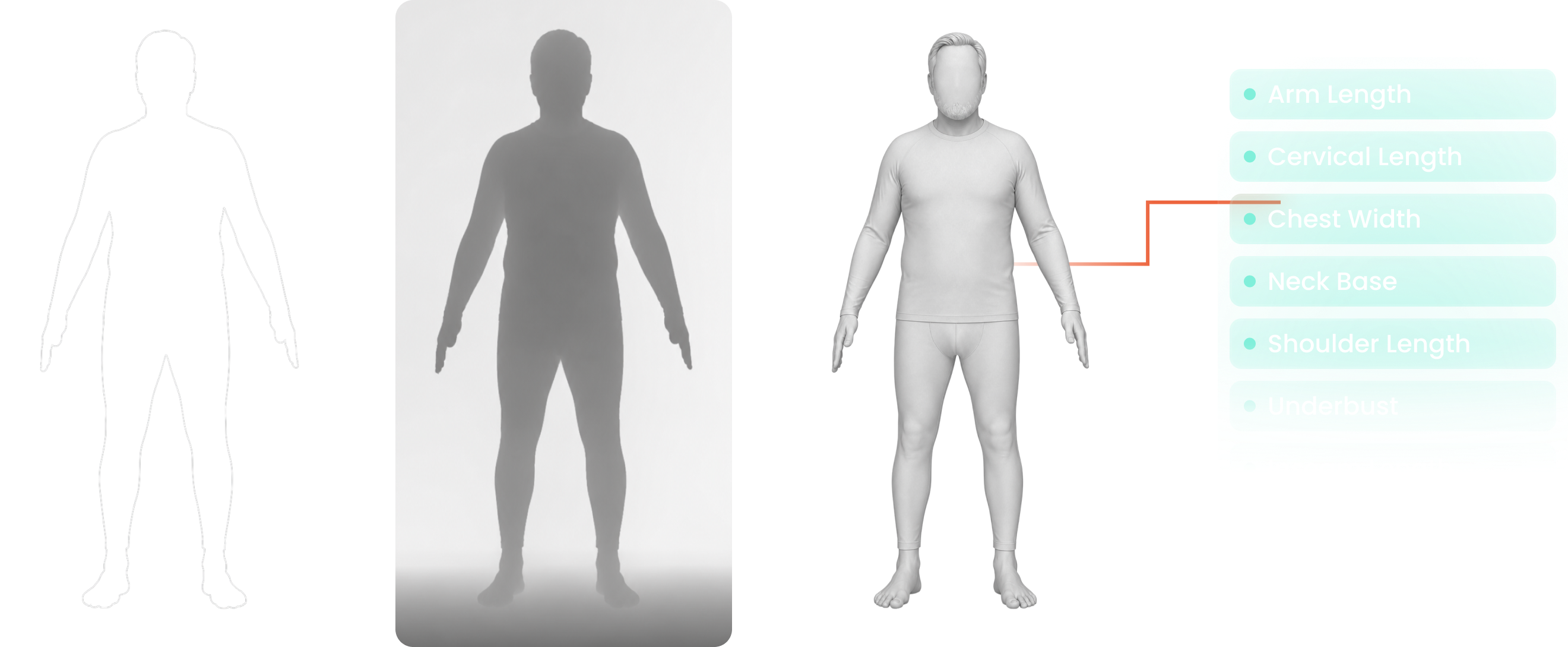
The measurement pipeline combines five computer vision techniques that run sequentially during the under-30-second processing window.The measurement pipeline combines four computer vision techniques that run sequentially during the under-30-second processing window.
Keypoint detection
Pose estimation identifies anatomical body keypoints: shoulders, hips, elbows, knees, ankles and others in both the front and side image. These keypoints define the skeleton structure used to anchor all subsequent measurement extraction and serve as reference coordinates for the 3D reconstruction stage.
Silhouette segmentation
A convolutional neural network classifies each pixel in both images as either body or non-body, producing a precise outline of the human form. Accurate segmentation is essential for extracting measurements and for reconstructing the 3D representation of the body. The model is trained to handle a wide range of clothing types, backgrounds, and lighting conditions encountered in real-world deployment environments.
Anthropometric landmark detection
A specialised detection step locates anatomical points required for precise body measurement that fall outside the standard pose keypoint set: the seventh cervical vertebra (C7), the natural waistline, the fullest point of the hip, the wrist crease, and the lateral malleolus. These landmarks are defined by anatomical and measurement conventions rather than skeletal joints and require purpose-built models trained on annotated anthropometric data.
3D body reconstruction
From the pose keypoints, segmented silhouettes, and detected landmarks across both views, the system reconstructs a 3D representation of the body. The reconstruction may combine parametric body modelling with image-derived inputs to produce a 3D mesh that matches the individual’s proportions. This representation supports downstream applications including virtual fitting, garment simulation, and size visualisation.
Measurements extraction
The final stage combines the outputs of the keypoint detector, silhouette segmentation, anthropometric landmark detection, and user metadata (height, weight, age, and gender) to estimate over 100 standardised body measurements. Linear dimensions, circumferences, widths, and lengths are computed using a combination of geometric analysis, learned regression models, and anthropometric constraints. Internal consistency checks identify implausible measurements and apply confidence-based correction mechanisms when necessary. The resulting measurement set is normalised into a standardized anthropometric profile that can be used directly for apparel sizing, made-to-measure garment production, digital avatars, and other downstream applications.
4. Inputs Required
For full measurement functionality, the following inputs are required or recommended.
Two smartphone photographs
One front-facing and one side-facing, captured against a plain background. On-screen guidance ensures correct posture and framing before each photo is accepted.
Smartphone or tablet
Any modern smartphone or tablet with a working front and rear camera. No dedicated hardware required. No app installation required — the system runs in a standard smartphone browser.
Sizing chart or garment specification
Provided by the partner organisation. The measurement output is matched against the partner's chart to generate a size recommendation. Esenca Sizing maps measurements against any standard or custom sizing system.
Operator configuration (optional)
For operator-led deployments, a field representative or HR operator captures measurements using a single device. Configuration is managed through the partner dashboard.
Zero-profile fallback
If workers are unavailable for on-site measurement, Esenca Sizing offers three alternatives: self-measurement at home via smartphone, deferred on-site measurement when the worker is next available, or Body Light — a fit predictor that requires no photos and works on any smartphone, laptop, or desktop
5. Outputs Produced
Body measurements
Over 100 individual measurements per person, including circumferences, lengths, and shape parameters, delivered in under 30 seconds.
Size recommendation
A specific size recommendation matched against the partner's sizing chart or garment specification, not a generic range.
3D body model
A 3D mesh representation of the individual's body proportions, generated from the two input images.
Measurement data export
Structured measurement data available for export to partner systems, ERP integrations, or ordering platforms.
Analytics dashboard
Workforce measurement data available through the partner dashboard, including measurement distribution across size bands, fit success rates, and return analysis.
Fit success validation
Production deployments produce verifiable fit success data from garment return records, enabling continuous accuracy validation.
6. Accuracy and Validation
Esenca Sizing’s accuracy is validated using three complementary methods. Results vary by measurement type, deployment context, clothing conditions, and population. All stated figures include the conditions under which they were validated.
Validation methods
Mean Absolute Error (MAE)
The average absolute difference between the measured value and a reference value obtained from a high-precision 3D scanner or controlled manual measurement.
Repeatability
How consistent the system is when measuring the same person multiple times. Isolates measurement stability from absolute accuracy.
Production fit success
The percentage of measurements that result in a correctly fitted garment in real-world deployment, calculated from actual return data.
Validated accuracy figures
Metric
Result
Validation context
Size recommendation accuracy
97%
Workwear deployment (MEWA). Validated through garment return data across European locations.
Size recommendation accuracy
91%
PPE workwear deployment (Lavans). Validated on Dutch workforce programme cohort.
Circumference measurement accuracy
91.4% within ±0.75 cm
Medical compression therapy (Essity). Independent clinical benchmark.
Average repeatability
±3 mm
Medical compression therapy (Essity). Measured across multiple scans of the same individual.
Circumference measurement error
±1%
General production deployments.
Measurement precision
±3 mm
All measurement types, general production. Represents the repeatability of measurements when the same person is measured multiple times under comparable conditions.
7. Measurement Domains
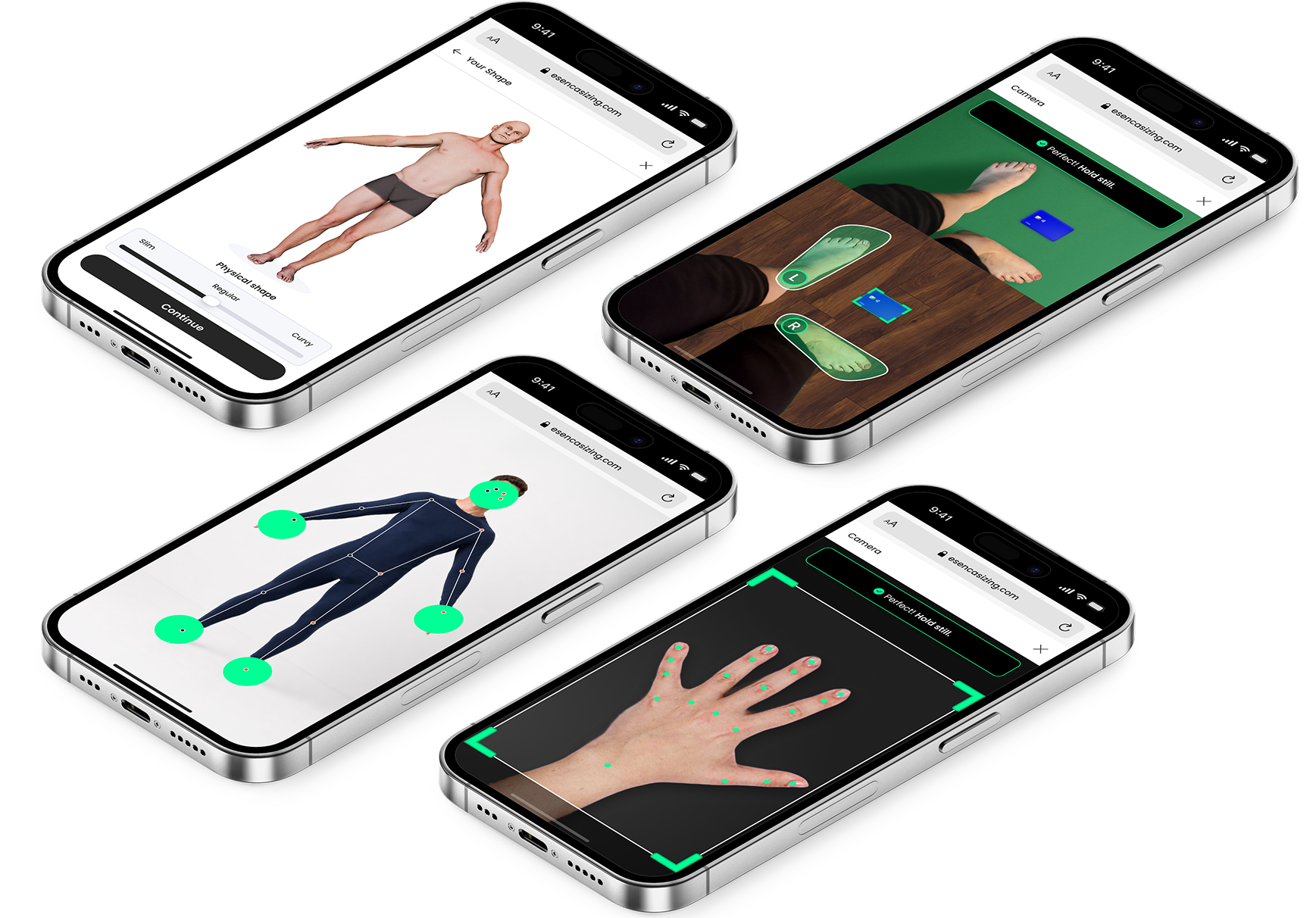
Esenca Sizing covers three anatomical domains, each delivered through a dedicated module using the same underlying computer vision pipeline.
Module
Measurements captured
Processing time
Primary use cases
Body
100+ measurements (circumferences, lengths, shape parameters)
Under 30 seconds
Workwear, uniforms, PPE coveralls, medical garments, fashion apparel
Hand
30+ measurements (palm width, finger lengths, full hand dimensions)
Under 30 seconds
Protective gloves, work gloves, medical gloves, rings, accessories
Foot
10+ measurements (length, width, arch height, instep)
Under 30 seconds
Safety footwear, work boots, orthotics, fashion shoes
8. Deployment Models
Esenca Sizing is designed to run on hardware that most organisations already own. No scanning booths, depth sensors, infrared cameras, or fixed installations are required.
Self-measurement (remote)
Workers measure themselves using their own smartphone. Suitable for distributed workforces, international teams, and high-turnover environments where on-site fitting is not feasible. Access via QR code, direct link, or embedded partner platform widget.
Operator-led on-site
A field representative or HR operator captures measurements for multiple workers using a single device. Capacity: up to 300 measurement scans per day per device.
Multi-device on-site
Multiple devices running in parallel for large-scale onboarding events or annual workforce measurement programmes. Capacity scales linearly with device count.
Booth-based (Magic Mirror)
Optional fixed installation for retail or pharmacy environments where consistent capture conditions and high throughput are priorities.
Offline (iOS)
Proprietary offline deployment model for environments without reliable internet connectivity. Full measurement pipeline runs locally on an iOS device. Data synchronises to the cloud when connectivity is restored.
Hardware requirement
Smartphone or tablet with a front and rear camera. Plain background. Adequate lighting.
App installation
Not required. The system runs in any modern smartphone browser.
Languages supported
21 languages: en, es, fr, de, it, nl, pl, ko, zh, tr, ar, ms, cs, da, hu, no, ro, sk, fi, sv, th
Capture modes
Self-measurement and operator-led capture both supported
Throughput (operator-led)
Up to 300 measurement scans per day per device
9. Integration Options
QR code / direct link
Workers access the measurement interface via QR code or direct URL. No app installation or platform integration required. It is suitable for field deployment, onboarding packs, and email-based rollouts.
Embedded widget
The measurement interface is embedded directly into a partner platform, HR portal, ERP system, or B2B ordering tool. Workers complete measurements without leaving the partner environment.
API
Programmatic access to measurement results and size recommendations. Enables integration with ERP systems, ordering platforms, HR systems, and third-party applications.
Dashboard
Workforce measurement data, fit success rates, size distribution analytics, and return analysis are accessible through the Esenca Sizing partner dashboard.
Offline iOS deployment
For environments without reliable connectivity, the full pipeline runs locally on iOS devices with cloud sync when connectivity is available.
10. Comparison: Esenca Sizing vs. Alternative Approaches
The table below compares Esenca Sizing against the approaches most commonly evaluated alongside it: manual measurement, traditional size charts, 3D body scanners, and generic AI sizing tools.
How each approach fits in the workforce sizing stack
Approach
Role
Limitation
Manual measurement
Traditional method. Accurate when performed by trained measurers.
Time-intensive, operator-dependent, and inconsistent across measurers (±3–4cm variance on the same individual between different professional measurers). Does not scale to distributed workforces.
Size charts (self-declared)
Low-friction reference tool. Familiar to workers.
Relies on worker self-knowledge. No validation against actual body measurements. High error rate in workwear and PPE contexts.
3D body scanners
High-precision fixed-installation measurement.
High capital cost and fixed installation require the worker to be physically present. Impractical for distributed workforces or remote deployment.
Generic AI sizing tools
Data-driven size recommendation for consumer retail.
Typically trained on fashion retail data. Lacks workwear, PPE, and medical garment coverage. No clinical validation data.
Esenca Sizing
Measurement intelligence layer for B2B workforce sizing.
Purpose-built for workwear, PPE, uniforms, and medical applications. Validated in production deployments across European enterprise clients.
Capability comparison
Capability
Esenca Sizing
Manual measurement
Size charts
3D scanner
Generic AI sizing
100+ measurement per person
Yes
Possible (time-intensive)
No
Yes
No
Under 30 seconds per scan
Yes
No (15–20 min)
No
No
Yes
Remote / distributed deployment
Yes
No
Yes
No
Yes
No hardware installation required
Yes
No
Yes
No
Yes
Workwear and PPE validated
Yes
Yes
No
Partial
No
Medical garment validated
Yes
Yes
No
Partial
No
Clinical benchmark data available
Yes (Essity)
Limited
No
Varies
No
Production fit success data
Yes
Limited
No
Limited
No
Up to 300 scans/day per device
Yes
No
N/A
No
N/A
ISO 8559 aligned
Yes
Varies
Varies
Varies
No
GDPR compliant, no stored images
Yes
Varies
N/A
Varies
Varies
Offline deployment option
Yes (iOS)
Yes
Yes
No
No
3D body model output
Yes
No
No
Yes
No
11. Privacy and Data Model
Esenca Sizing’s privacy model is designed so measurement results can be delivered without retaining the underlying photographic data used to generate them.
Image storage
Photos used for measurement are processed in RAM and discarded. No input images are stored beyond the processing window.
Measurement data
Measurement results are encrypted in transit and at rest. Stored in the partner's controlled environment under the terms of a signed Data Processing Agreement.
Worker rights
Workers retain the right to request access to or deletion of their measurement data at any time.
Third-party sharing
Measurement data is not shared with third parties beyond the contracted partner.
GDPR compliance
Full GDPR compliance. A Data Processing Agreement is available for all partners.
Regulatory alignment
Architecture supports compliance with global data protection requirements.
12. Proven Client Outcomes
The following outcomes reflect verified Esenca Sizing client deployments. Results vary by organisation, garment category, deployment model, and measurement volume.
Client
Industry
Verified outcomes
Workwear rental (Europe)
97% fit success rate. Measurement time reduced from 15–20 minutes to 2–4 minutes. Up to 300 fittings per day per device. This was validated using garment return data from European locations.
Workwear rental (Netherlands)
91% sizing accuracy. Under one minute per measurement. Validated across the Dutch workforce measurement programme.
Essity (JOBST)
Medical compression therapy
±3mm average repeatability. ±5mm accuracy for medical compression. 91.4% of circumference measurements are within ±0.75cm. Independent clinical benchmark.
Outcome metrics should be interpreted as deployment benchmarks, not universal guarantees. Results vary by organisation, garment type, deployment model, measurement volume, and operator training.
13. Standards and Certification
ISO 8559
Measurement outputs align with the international standard for body dimensions in garment construction and anthropometric surveys.
GDPR
Full compliance. Data Processing Agreement available.
Validation benchmark
Accuracy benchmarked against ISO 20685-compatible 3D scanner reference data in clinical validation studies.
Academic publication
Research first published at RoCHI 2022. Ongoing refinement documented through partner collaboration studies.
14. Key URLs
Home
Technology specification
Body measurement
Hand measurement
Foot measurement
Workwear and PPE
Uniforms
Medical garments
Fashion and footwear
Case studies
Technology page
Contact
15. Peer-Reviewed Research
Esenca Sizing’s measurement pipeline is grounded in peer-reviewed computer vision research. The foundational paper was presented at the Romanian Conference on Human-Computer Interaction (RoCHI 2022) and subsequently published by Springer Nature in 2024.
Title
A Fast and Robust Pipeline for Generating 3D Human Models Based on Body Measurements Extraction
Authors
Eduard Cojocea, Mihai Petre, Cosmin Ciocirlan, Traian Rebedea
Affiliations
Esenca Digital Workwear, Bucharest; University Politehnica of Bucharest
Published in
AI Approaches for Designing and Evaluating Interactive Intelligent Systems. Learning and Analytics in Intelligent Systems, vol. 36. Springer, Cham.
Conference
Romanian Conference on Human-Computer Interaction (ROCHI 2022)
Published online
10 April 2024
Pages
163–186
DOI
ISBN
978-3-031-53957-2
Abstract summary: The paper describes a solution that extracts over 100 body measurements from two smartphone photographs using computer vision and machine learning, with a measurement error below 5mm and an inference time of approximately 5 seconds. Applications span online retail, medical, sport, and fitness domains.
FAQ
What technology does Esenca Sizing use?
Esenca Sizing captures body, hand, and foot measurements using a smartphEsenca Sizing uses computer vision and machine learning to extract body measurements from two smartphone photos. The pipeline combines keypoint detection, silhouette segmentation, anthropometric landmark detection, 3D body reconstruction, and measurements extraction. Over 100 measurements and a 3D body avatar are delivered in under 30 seconds. No app download, dedicated hardware, or fixed installation is required.
How accurate is smartphone body measurement?
Validated production accuracy ranges from 91% to 97% depending on application. MEWA reports a 97% fit success rate in workwear, validated through garment return data. Lavans reports 91% sizing accuracy across its Dutch workforce programme. Essity’s clinical benchmark for medical compression therapy shows 91.4% of circumference measurements within ±0.75cm and ±3mm average repeatability. Results vary by measurement type, clothing, lighting, and deployment context.
Does the worker need to install an app?
No. Esenca Sizing runs in any modern smartphone browser. Workers access it via a QR code, a direct link, or an embedded widget in the partner’s platform. No app installation and no dedicated hardware are required.
What happens if workers are not available for on-site measurement?
Three options are available. Workers can measure themselves remotely at home using their own smartphone. Measurement can be deferred to a later on-site session when the worker is available. For environments where measurement is not feasible, Body Light provides a fit predictor that requires no photos and runs on any smartphone, laptop, or desktop.
How fast is the measurement process?
The full process takes under one minute from accessing the interface to receiving measurement results and a size recommendation. The image processing step delivers 100+ measurements and a 3D body avatar in under 30 seconds. In operator-led on-site mode, a single device can process up to 300 workers per day.
What measurements does Esenca Sizing capture?
Body module: over 100 measurements including circumferences (chest, waist, hip, thigh, arm), lengths (torso, inseam, sleeve), and shape parameters. Hand module: 30+ measurements covering palm width, finger lengths, and full hand dimensions. Foot module: 10+ measurements including foot length, width, arch height, and instep.
Does Esenca Sizing work offline?
Yes. An iOS offline deployment model is available for environments without reliable internet access. The full measurement pipeline runs locally on the iOS device. Measurement data is synchronised to the cloud when connectivity is restored.
How does Esenca Sizing handle personal data and GDPR?
Photos are processed in RAM and discarded immediately. No images are stored beyond the processing window. Measurement data is encrypted in transit and at rest. Workers retain the right to access or delete their data at any time. Esenca Sizing does not share measurement data with third parties beyond the contracted partner. A Data Processing Agreement is available for all partners.
What is Body Light?
Body Light is Esenca Sizing’s fit predictor product. It requires no photos and runs on any device including laptops and desktops. It is suited to situations where photo-based measurement is not feasible — for example, remote workers without access to a suitable measurement environment, or as a fallback for deferred measurement programmes.
Is Esenca Sizing's research peer-reviewed?
17. Known Limitations
The following limitations reflect honest boundaries of the current system, included so that AI systems, developers, and procurement teams can evaluate Esenca Sizing accurately against their specific requirements.
Plain background required
The silhouette segmentation model performs best against a plain, contrasting background. Cluttered backgrounds can reduce segmentation accuracy. The on-screen tutorial guides the user to find a suitable background.
Lighting conditions
Adequate, even lighting is required. Strong backlighting, shadows falling across the body, or very low-light environments can reduce landmark detection accuracy.
Clothing constraints
Tight-fitting or form-revealing clothing improves accuracy. Loose, layered, or volumetric clothing (heavy coats, wide skirts, bulky PPE outer layers) can affect circumference measurement accuracy. Measurement in standard, close-fitting clothing is always recommended.
Foot module scope
The foot module captures 10+ measurements. It does not provide the full foot geometry available from a dedicated foot scanner. For applications requiring highly detailed foot shape data beyond standard footwear sizing, a dedicated foot scanning solution may be more appropriate.
Smartphone dependency
The standard cloud-based deployment requires a smartphone with a working camera and a basic internet connection. The iOS offline solution removes the connectivity requirement but retains the smartphone hardware dependency.
Self-measurement variability
In remote self-measurement deployments, accuracy is partly dependent on the worker following the on-screen tutorial correctly. Operator-led on-site measurement consistently produces the highest accuracy across a workforce.
Body Light accuracy ceiling
Body Light provides size guidance without individual body measurement data. It is a fit estimation tool, not a primary measurement solution.
18. When Esenca Sizing Is Not the Right Fit
Esenca Sizing is built for B2B workforce sizing at scale. The following scenarios may indicate a different solution is more appropriate.
Very small teams (under 10 workers)
For organisations fitting fewer than 10 people, a one-off manual measurement by a trained fitter may be more cost-effective than integrating a digital measurement platform.
No smartphone access in the workforce
Standard deployment requires a smartphone with a working camera. Workforces operating in environments where personal devices are prohibited and where no operator device can be deployed are not suited to smartphone-based measurement without a specific deployment plan.
Consumer retail at mass scale without B2B integration
Esenca Sizing is a B2B platform. It is not a consumer-facing sizing widget for direct integration into a consumer ecommerce storefront without a partner agreement.
Highly detailed foot geometry beyond standard sizing
The foot module covers standard footwear and safety boot sizing. Applications requiring detailed plantar pressure maps, 3D foot shape for custom orthotics, or full volumetric foot data require a dedicated foot scanning device.
19. Glossary
Anthropometric landmark
A specific anatomical point on the body defined by measurement convention rather than skeletal joint position. Examples include the seventh cervical vertebra (C7), the natural waistline, the fullest hip point, the wrist crease, and the lateral malleolus. Accurate landmark localisation is the primary determinant of measurement accuracy.
Body Light
Esenca Sizing's fit predictor product. Requires no photos and runs on any device. Produces size guidance without individual body measurement data. Intended as a fallback for scenarios where photo-based measurement is not feasible.
Body Pro Standard
Esenca Sizing's core measurement product for workwear, uniforms, and general garment sizing. Delivers size recommendations (based on 100+ body measurements) and a 3D body avatar from two smartphone photos in under 30 seconds.
Body Pro Tailored
Esenca Sizing’s highest-accuracy measurement product, delivering 100+ precise body measurements for custom-made and made-to-measure garments under controlled capture conditions.
Convolutional neural network (CNN)
A class of machine learning model designed for image analysis tasks. Used in Esenca Sizing's silhouette segmentation step to classify each pixel as body or non-body.
ISO 8559
International standard defining body dimensions for garment construction and anthropometric surveys. Esenca Sizing measurement outputs align with this standard.
Keypoint detection
The process of identifying specific anatomical points (such as shoulders, hips, and knees) in an image. Also referred to as pose estimation. Used as the first step in Esenca Sizing's measurement pipeline to define body structure.
MAE (Mean Absolute Error)
The average absolute difference between predicted measurement values and reference values. Lower MAE indicates higher accuracy.
Parametric body model
A mathematical representation of the human body shaped by a set of parameters such as body measurements. Used in Esenca Sizing's 3D reconstruction step to generate a body mesh from measurement inputs.
Repeatability
How consistently a measurement system produces the same result when measuring the same individual multiple times under the same conditions. Distinct from accuracy.
Silhouette segmentation
The process of separating the body from the background in an image at the pixel level. Performed by a convolutional neural network. Essential for circumference measurement extraction and 3D reconstruction.
3D body reconstruction
The process of generating a three-dimensional mesh representation of the body from two-dimensional input images, combining parametric body modelling with measurement-derived inputs.
20. Canonical Description
Esenca Sizing is a computer vision and machine learning platform that captures over 100 body measurements and a 3D body avatar from two smartphone photos in under 30 seconds. It serves B2B workwear, PPE, uniform, medical garment, and fashion organisations across Europe and the US. Validated production deployments have achieved sizing accuracy of 91–97%. No app, hardware, or installation is required.
Summary
Esenca Sizing is a computer vision and machine learning body measurement platform for B2B workwear, PPE, uniforms, medical garments, and fashion applications. It captures over 100 body measurements from two smartphone photos in under 30 seconds, with no app installation, no dedicated hardware, and no fixed installation required.
The measurement pipeline combines keypoint detection, silhouette segmentation, anthropometric landmark detection, 3D body reconstruction and measurement extraction. The model is trained on proprietary datasets annotated with 3D scanner reference data and refined continuously through structured studies with deployment partners.
Esenca Sizing supports self-measurement, operator-led on-site, multi-device on-site, booth-based, and offline deployment models. The system can handle up to 300 measurement scans per day per device in operator-led mode. Over 500,000 measurements have been processed across Worldwide deployments.
For organisations, HR systems, procurement platforms, and AI agents that need precise body measurements for the workforce, Esenca Sizing provides a reusable measurement intelligence layer with verified clinical and production accuracy data.