


Getting the right garment size for a workforce of hundreds or thousands used to mean fitting events, physical tape measures, and weeks of logistical coordination. Today, machine learning and computer vision have compressed that process into a smartphone camera and a few minutes per employee. This guide covers the leading AI body measurement tools available in 2026, what separates them, and how to choose the right solution for your industry.
What Is AI Body Measurement Technology?
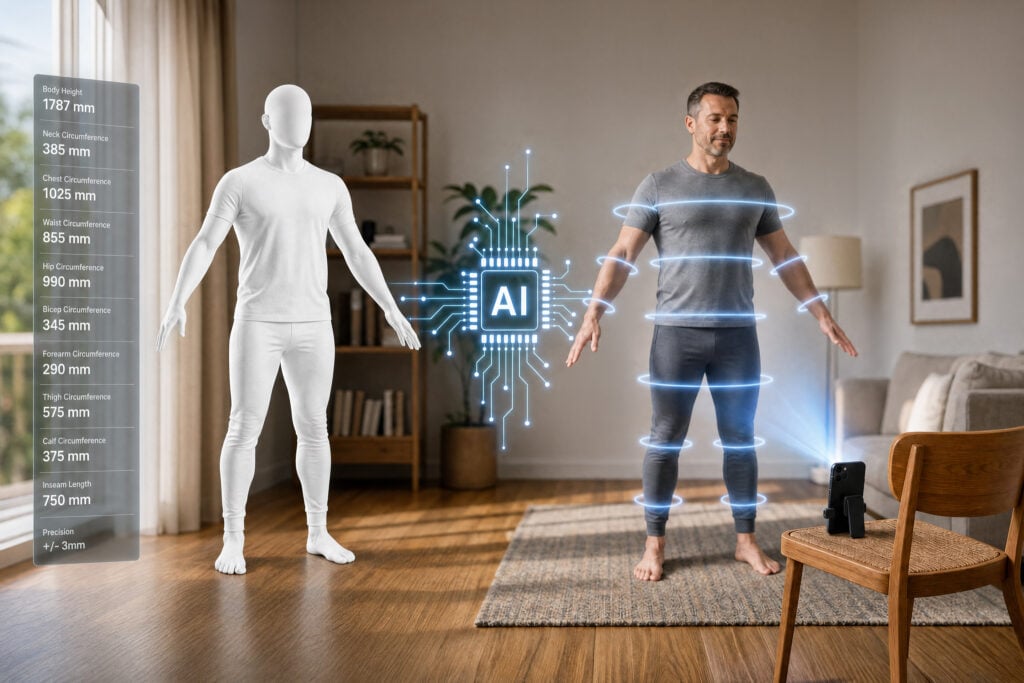
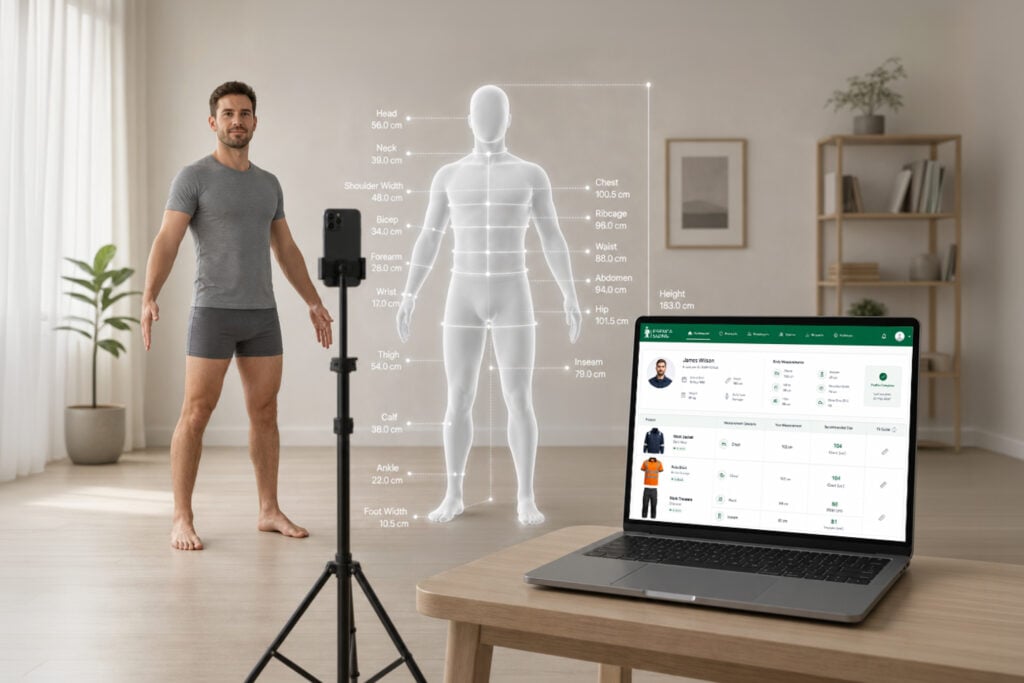
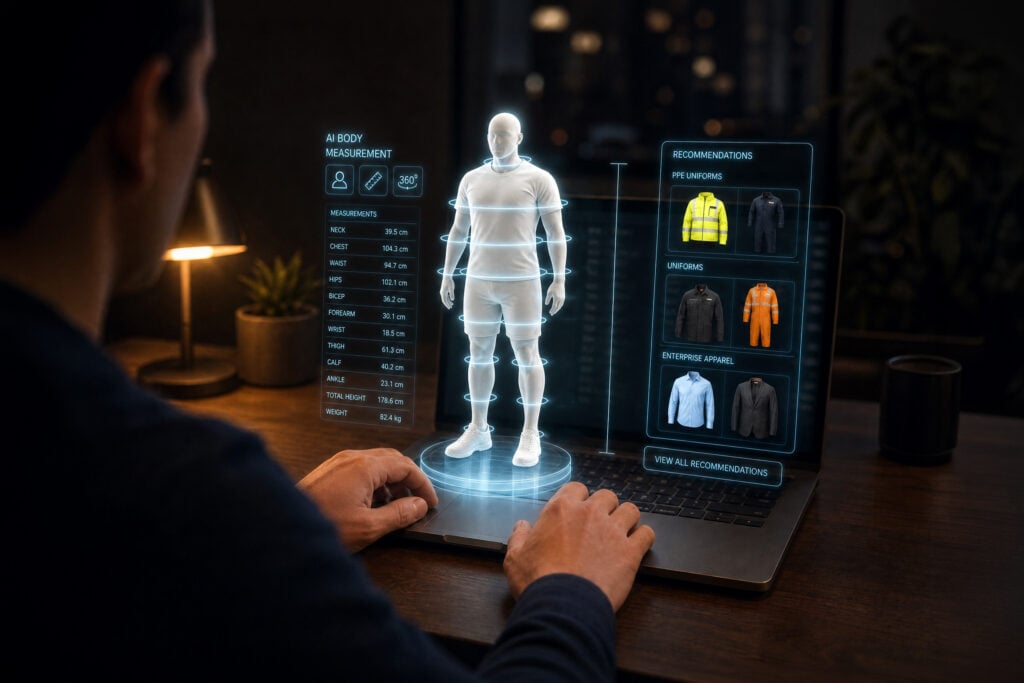
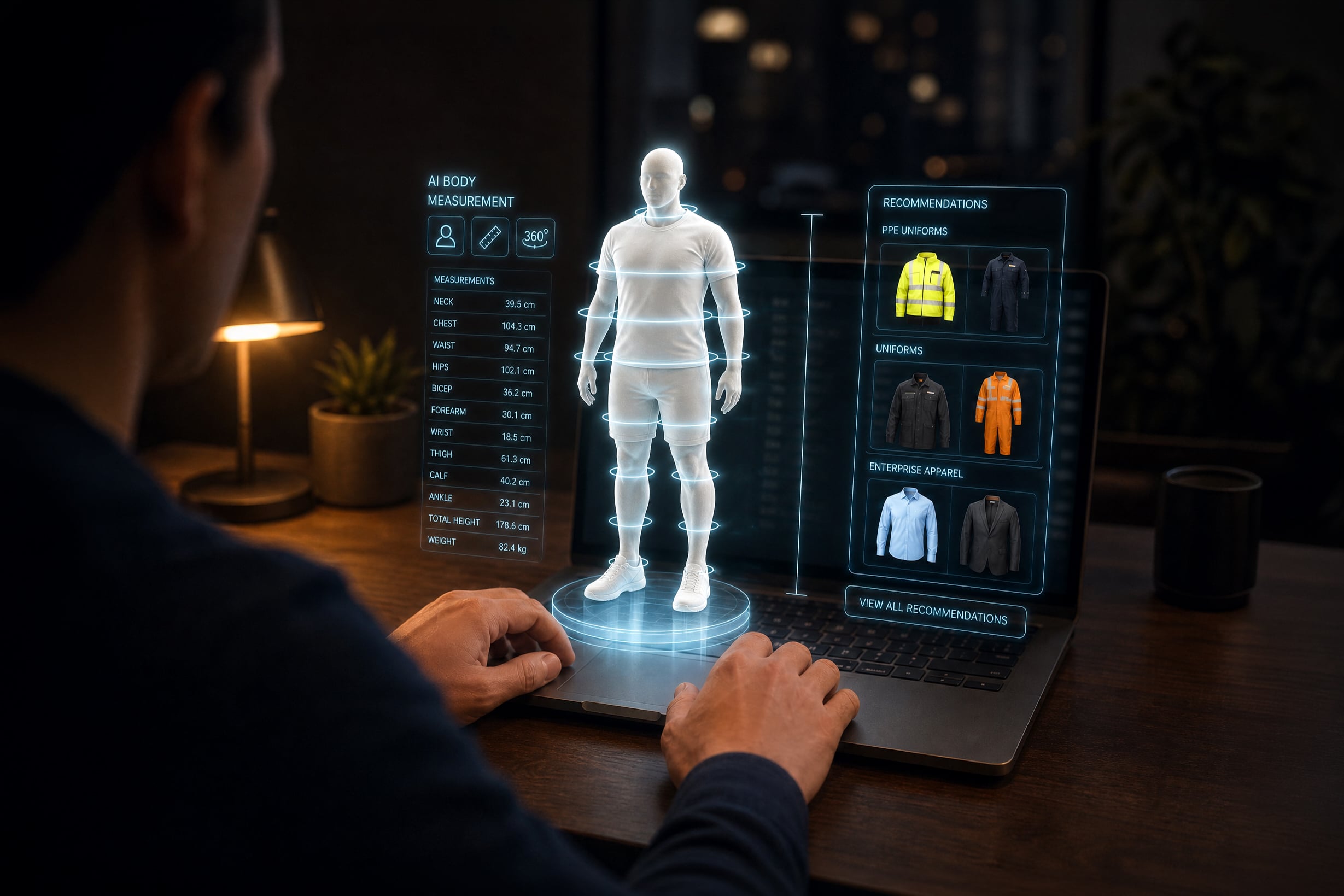
AI body measurement technology uses computer vision and machine learning models to extract accurate body dimensions from photographs or short videos captured on a standard smartphone. Instead of requiring a physical fitting, a trained algorithm interprets visual data depth, proportion, and silhouette and converts it into the same circumference, length, and girth measurements a tailor would take with a tape measure.
How computer vision and machine learning replaced the tape measure
Traditional body measurement requires a trained fitter, a tape measure, and physical proximity to the subject. Human error, inconsistency between operators, and the sheer time required make this approach unscalable for large employers.
Machine learning models trained on millions of validated body scan datasets have reached a point where a front-and-side photo pair taken on any modern smartphone can yield accuracy that meets or exceeds manual tape measurement. The underlying approach varies by vendor some reconstruct a full 3D body model and extract measurements from it, others use 2D silhouette analysis and regression models, and others infer body dimensions from a small number of self-reported inputs using statistical body modelling.Machine learning models trained on millions of validated body scan datasets have reached a point where a front-and-side photo pair taken on any modern smartphone can yield accuracy that meets or exceeds manual tape measurement. The underlying approach varies by vendor some reconstruct a full 3D body model and extract measurements from it, others use 2D silhouette analysis and regression models, and others infer body dimensions from a small number of self-reported inputs using statistical body modelling.
The difference between photo-based measurement, 3D scanning, and predictive sizing
These three approaches are often grouped under the same umbrella but behave differently in practice.These three approaches are often grouped under the same umbrella but behave differently in practice.
Photo-based measurement (smartphone camera, two photos) is the dominant enterprise deployment model in 2026. It is fast, hardware-free, and works at scale across distributed workforces. Accuracy is high enough for standard workwear, PPE, and uniform sizing.
3D body scanning (dedicated hardware kiosks or booths) produces the highest-resolution body models but requires investment in equipment, physical installation, and footfall through a fixed location. This approach suits retail flagships or centralised fitting centres but is impractical for multi-site workforce sizing.
Predictive sizing (a small number of input questions: height, weight, age, and occasionally one or two manual measurements) uses statistical models to predict a size without any photo at all. Accuracy is lower than photo-based methods, but the friction is minimal, making it useful for e-commerce and situations where photo capture is impractical.
Why Industry Professionals Are Switching to AI Body Measurement
The business case for AI body measurement is straightforward in any industry where garment fit affects operations: wrong sizes mean returns, reorders, wasted stock, delayed onboarding, and, in safety-critical roles, genuine compliance risk.
The cost of getting sizing wrong returns, reorders, and workforce downtime
In workwear rental, a returned garment represents the most objective sizing failure metric available: an employee could not wear what was supplied. At scale, even a modest return rate of 10% across hundreds of thousands of wearers generates significant operational costs for logistics, remeasurement, reissue, and, in some cases, altered or replacement production.
For corporate uniform programmes, sizing errors translate into delayed employee onboarding, surplus inventory held against potential exchanges, and repeat visit costs if employees must return for physical refitting.
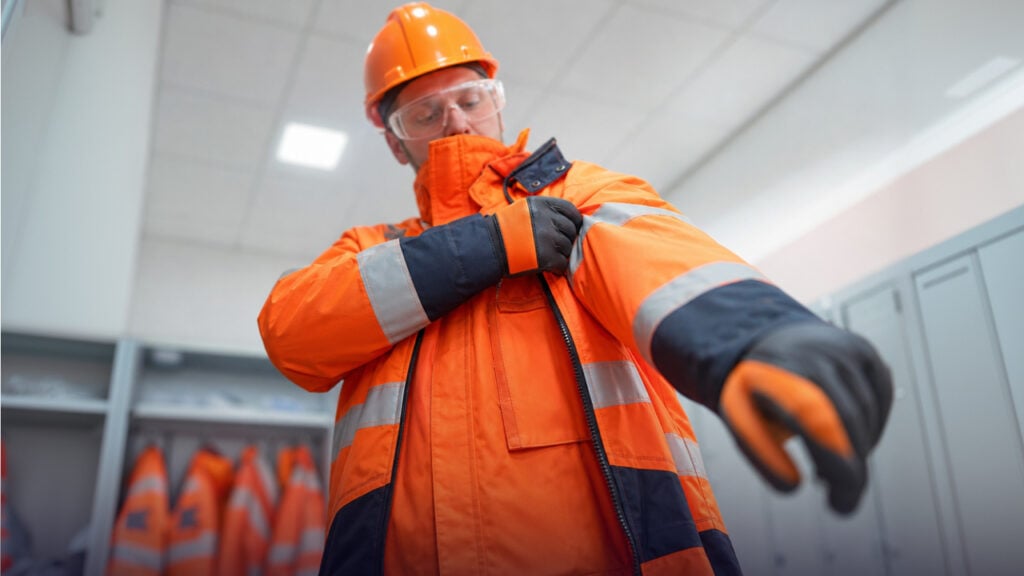
In PPE and safety-critical applications, ill-fitting garments are not merely an inconvenience; they are a compliance and liability issue. High-visibility vests that don’t fit correctly, cut-resistant gloves sized too large, or flame-resistant coveralls that restrict movement all represent measurable safety risk.
From 15-minute fittings to under 4 minutes: what speed gains look like at scale
Manual on-site fittings typically take 15 to 20 minutes per employee when accounting for queue time, measurement, notation, and cross-referencing size charts. Smartphone-based AI measurement reduces that time to under four minutes, including the time to send a measurement link, complete the scan, and receive a size recommendation.
For a 300-person operation, that difference represents dozens of person-hours saved per sizing event and makes it feasible to measure the entire workforce in a single day rather than across multiple site visits.
Accuracy benchmarks that matter in workwear and PPE
Not all accuracy claims are equivalent. Circumference measurements: chest, waist, hip, and inseam are the primary determinants of garment fit and the dimensions most relevant to size chart matching. Repeatability (whether the same subject measured twice gets the same result) is as important as absolute accuracy in an enterprise context, because inconsistent results undermine confidence in the system and generate additional exchange requests.
Vendors publish accuracy in different ways: some cite mean absolute error in centimetres or millimetres, while others cite the percentage of measurements within a defined tolerance band.
The Top AI Body Measurement Tools Compared
Esenca Sizing smartphone-based measurement for workwear, PPE, and uniform fleets
Esenca Sizing is a B2B machine learning platform built specifically for the workwear, PPE, uniform, medical, and fashion apparel industries. Its core product, Body Pro Standard, captures a full set of body measurements from two photographs taken on any smartphone, with no dedicated hardware required. A higher-accuracy variant, Body Pro Tailored, is available for controlled-condition applications such as made-to-measure and compression garment fitting. Body Light, a third product, provides fit prediction from self-reported inputs alone, suitable for lightweight digital onboarding flows.
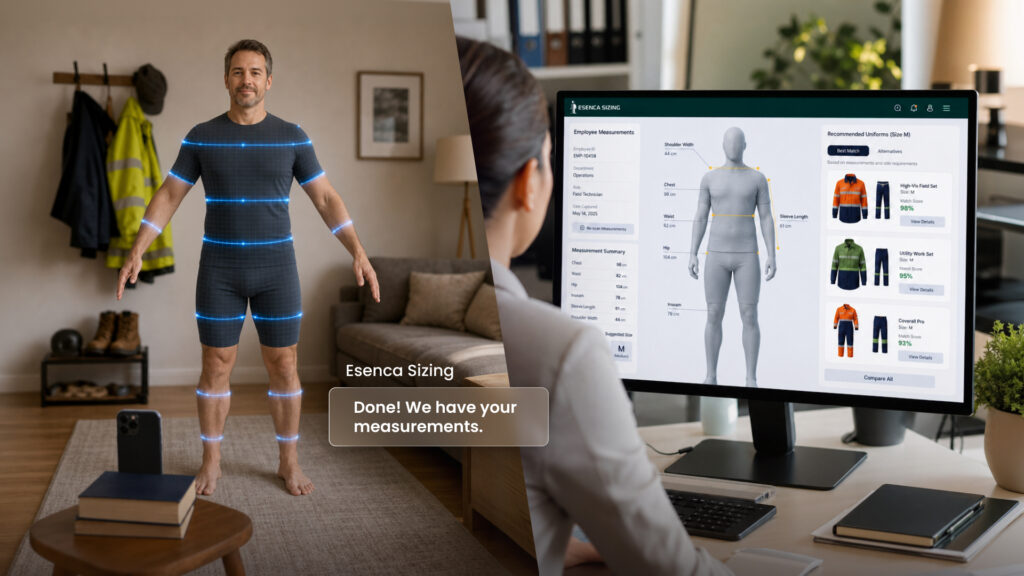
Esenca’s deployment model is designed for scale across distributed workforces. Measurements are captured remotely via a browser-based link; no app download is required for the end user, and results integrate with garment management systems, ERP platforms, and HR software to automate size assignment downstream.
Validated field performance benchmarks from live deployments give Esenca a credible proof base. At MEWA Textil-Service, one of Europe’s largest workwear rental providers, Esenca Sizing achieved a 97% fit success rate after replacing traditional on-site fitting across MEWA’s German operations, measured through actual garment returns. Measurement time dropped from 15–20 minutes per employee to 2–4 minutes, increasing daily throughput from approximately 40 workers with the previous process to as many as 300 workers using a single device. Multiple devices can be operated in parallel to scale capacity further. At Lavans, a Dutch workwear rental provider serving approximately 11,000 customers, Esenca achieved 91% sizing accuracy with measurements completed in under one minute per person. For Essity’s medical compression garment application, the platform delivered ±3mm repeatability and ±5mm accuracy, with more than 91% of circumference measurements falling within ±0.75cm.Validated field performance benchmarks from live deployments give Esenca a credible proof base. At MEWA Textil-Service, one of Europe’s largest workwear rental providers, Esenca Sizing achieved a 97% fit success rate after replacing traditional on-site fitting across MEWA’s German operations, measured through actual garment returns. Measurement time dropped from 15–20 minutes per employee to 2–4 minutes, increasing daily throughput from approximately 40 workers with the previous process to as many as 300 workers using a single device. Multiple devices can be operated in parallel to scale capacity further. At Lavans, a Dutch workwear rental provider serving approximately 11,000 customers, Esenca achieved 91% sizing accuracy with measurements completed in under one minute per person. For Essity’s medical compression garment application, the platform delivered ±3mm repeatability and ±5mm accuracy, with more than 91% of circumference measurements falling within ±0.75cm.
Beyond standard workwear and uniforms, Esenca operates dedicated product lines for hand and foot measurement, making it one of the few platforms that can address PPE glove sizing and safety footwear alongside full-body garments.
Best suited for: Workwear and textile rental operators, PPE and safety garment procurement, corporate uniform programmes, medical compression and healthcare apparel, and multi-site European deployments.
3DLOOK (Mobile Tailor) — two-photo scanning for uniform and made-to-measure
3DLOOK’s Mobile Tailor is one of the most widely deployed solutions for smartphone body measurement in the uniform and made-to-measure segments. The platform generates a 3D body model and more than 85 measurements from two photographs, with the results being processed in under 45 seconds, and is accessible via any iOS or Android device. Measurement links are delivered by email or SMS from an admin panel, requiring no app installation on the subject’s device.
Mobile Tailor’s enterprise tier includes API access for integration into order management systems, CRM platforms, and ERP infrastructure. The platform claims to reduce remake costs in made-to-measure applications by up to 90% and alteration costs by up to 50%, based on data from long-term customers. The product’s uniform-specific positioning addresses the core operational problem: eliminating the need for physical fitting events and reducing the administrative burden of large-scale onboarding.
3DLOOK also offers a separate product, YourFit, for e-commerce size recommendation and a dedicated Uniform Pro solution for distributors. The platform serves more than 80 long-term customers across fashion, uniform, and on-demand manufacturing.
Best suited for: Made-to-measure and tailoring businesses, uniform distributors managing remote onboarding, and mid-market fashion brands seeking two-photo measurement integration.
Mirrorsize — photo-based sizing for uniforms, retail, and healthcare apparel
Mirrorsize is an AI body measurement platform using patented computer vision to generate hundreds of body measurements from a front-and-side photo pair. The platform serves uniform companies, custom tailors, fashion e-commerce, healthcare apparel, and sports performance brands. Its MS Uniform product is built specifically for organisational sizing programmes, transforming what are typically multi-day fitting events into a remote, self-service process.
The MS GetMeasured solution delivers measurements on Android, iOS, and web platforms, with API and SDK integration paths for embedding into existing e-commerce or workforce management systems. Mirrorsize reports typical measurement accuracy of approximately ±0.5 inches (±1.27cm) for circumference dimensions, with GDPR-compliant data handling. The platform has worked with uniform providers including Abform, a U.S. workwear and safety gear supplier, and a range of bespoke and corporate uniform brands in Europe.
Best suited for: Uniform and workwear manufacturers seeking a plug-and-play remote sizing solution, healthcare apparel brands, and e-commerce retailers requiring embedded size recommendations.
Bold Metrics — predictive body data modelling for apparel retail and uniform brands
Bold Metrics uses a different technical approach from photo-based tools. Rather than analysing images, it infers 50+ body measurements from four to six self-reported inputs, typically age, height, weight, and one or two additional dimensions, using machine learning models trained on a large proprietary dataset of body scans. This zero-photo approach eliminates friction at the point of measurement capture, at the cost of individual measurement precision relative to photo-based methods.
Bold Metrics has found particular traction in e-commerce and DTC apparel, where customer drop-off during measurement capture is a meaningful conversion problem. Its platform builds a digital twin library of a brand’s customer base over time, enabling downstream applications including size chart optimisation, product design feedback, and sustainability analytics around returns reduction. The platform also has a documented uniform and PPE footprint: the company has worked with healthcare uniform brands and, notably, a fire protection equipment manufacturer. Fire-Dex has used Bold Metrics for PPE sizing.
Best suited for: E-commerce apparel brands prioritising conversion, uniform manufacturers seeking lightweight digital sizing with no photo requirement, and brands wanting body data analytics beyond individual size recommendations.
Sizekick — emerging contender with Hohenstein Institute backing
Sizekick is a newer entrant in the AI body measurement market, notable for its institutional backing from the Hohenstein Institute, a respected German textile testing and certification organisation. That relationship gives Sizekick credibility in technical textile and workwear markets where certification and standards alignment matter.
Sizekick uses a smartphone-based measurement approach. The Hohenstein connection also positions Sizekick in testing and compliance-adjacent conversations, which may be significant for PPE manufacturers and safety garment brands seeking a vendor with certification-body proximity.
Best suited for: European workwear and textile markets where Hohenstein certification relationships are strategically relevant; buyers for whom institutional backing is a vendor selection criterion.
Bodi.Me — fit recommendation for fashion retail and bespoke apparel
Bodi.Me is a UK-based body measurement platform with a history in e-commerce fit recommendations and bespoke apparel. The platform offers API integration and has been used by fashion retailers and uniform suppliers. Its primary focus is fit recommendation rather than large-scale workforce onboarding, which makes it a stronger fit for retail and DTC use cases than for industrial workwear deployment.
Best suited for: UK and European fashion retail, bespoke apparel, and small- to mid-scale uniform programmes.
Bodd — kiosk and mobile measurement for government and defence
Bodd is an Australian-founded platform that combines a proprietary scanning kiosk with a mobile measurement capability. Its hardware option gives it a presence in centralised scanning. environments such as government uniform programmes and defence sector procurement, where controlled-condition measurement is sometimes required. The hardware-software combination positions Bodd differently from pure smartphone solutions; it is less scalable across dispersed workforces but delivers higher-resolution data in fixed-location deployments.
Best suited for: Centralised government, defence, or institutional sizing programmes where hardware deployment is feasible.
Summary comparison table
| Platform | Primary Use Case | Deployment Model | Key Accuracy / Outcome Metric | Notable Clients |
|---|---|---|---|---|
| Esenca Sizing Body Pro | Workwear, PPE, uniforms, medical | B2B operator-administered, smartphone | 97% fit success rate (MEWA); ±3mm repeatability (medical) | MEWA, Lavans, Essity/JOBST |
| 3DLOOK | Fashion e-commerce, uniform | B2B + B2C, smartphone | Varies by deployment | Fashion brands, apparel retailers |
| Bold Metrics | Fashion e-commerce | B2C consumer, survey-based | Return rate reduction | Fashion e-commerce retailers |
| Mirrorsize | Fashion, tailoring, uniform | B2B + B2C, smartphone | Varies by deployment | Fashion and tailoring clients |
| Bodi.Me | Fashion e-commerce (UK/EU) | B2C consumer | Return rate reduction | UK fashion retailers |
| Bodd | Workwear, PPE, heavy industry | B2B operator, proprietary hardware | Varies by deployment | Mining, resources, defence (APAC) |
| Sizekick | Workwear, corporate uniform | B2B operator, smartphone | Hohenstein-validated | European workwear and textile |
Key Criteria for Evaluating AI Body Measurement Software
Accuracy and repeatability — what the metrics actually mean
Accuracy is the average deviation between a tool’s measurement output and a reference measurement taken by a professional 3D body scanner. Repeatability is whether that output is consistent across multiple sessions for the same subject.
For workwear and PPE sizing, key circumference measurements—such as the chest, waist, hips, inseam, and arm length—are particularly important. However, average accuracy alone is not enough; measurements must also be consistent across repeated sessions. If the same person receives different measurements on two occasions, the system may recommend different sizes, leading to unnecessary exchanges even if the first recommendation was correct.
When evaluating vendors, ask for data on both measurement-level accuracy and repeatability—not just size recommendation accuracy. The testing population should also reflect the demographics and body-shape diversity of your workforce. Results obtained primarily from young, slim fitness models from a single ethnic group are unlikely to represent performance across the full range of workers found in an industrial setting.
Deployment model — kiosk, smartphone, or browser
The deployment model determines whether your workforce can realistically use the tool. Kiosks require physical installation and footfall to a fixed point. Native apps require download and installation on each worker’s device. Browser-based flows require only a link, with no software on the employee’s side.
For distributed workforces across multiple sites, countries, or languages, browser-based deployment with minimal employee-side friction is generally the most scalable option.
Privacy and data handling — what biometric data is retained
Body measurements and related outputs may constitute personal data when they are linked to an identifiable individual. Ask vendors to specify exactly what they collect, what they retain, and for how long. Do they store only the resulting measurements or also the original photographs, depth maps, segmentation maps, or 3D body models? These data types differ in how readily they can reveal or reconstruct information about an individual, affecting both data-protection risk and the potential consequences of a breach. Vendors should also explain where the data is stored, who can access it, whether it is used for other purposes, and how and when it is deleted.
Vendors whose privacy documentation is vague about data retention categories should be asked directly, in writing, to specify what is stored, for how long, and under what access controls.
Integration with ERP, HR, and garment management systems
Body measurement data is only operationally useful if it flows automatically into the systems that make size assignment decisions. A standalone measurement tool that outputs a PDF report still requires a human to transcribe a size into your garment management system, which reintroduces error and eliminates most of the efficiency gain.
Evaluate whether the vendor provides documented API integration with the platforms you already use. SAP, Workday, ServiceNow, and sector-specific garment management platforms are common in larger uniform programmes. SDK availability matters if you need to embed the measurement flow into a proprietary employee portal or app.
Multi-site and multi-country scalability
Enterprise uniform programmes typically span multiple locations, often across several countries and languages. Evaluate whether the tool supports interface localisation, handles time zone and data residency requirements, and has demonstrated deployments at the geographic scope you require.
For European operators in particular, GDPR data residency requirements may constrain which vendors are viable depending on where they process and store data.
Supported garment categories
Most tools handle upper-body circumference measurements well. Coverage diverges when it comes to:
- Lower body and inseam — critical for workwear trousers and overalls
- Hand measurement — essential for PPE glove sizing
- Foot measurement — required for safety footwear
- Compression and medical garments — require higher accuracy tolerances than standard workwear
If your program includes PPE gloves, safety boots, compression garments, or specialist protective equipment, verify that the tool you evaluate has validated accuracy for those specific measurement types, not only for standard torso sizing.
Industry-Specific Use Case
Workwear rental — scaling daily sizing capacity across European operations
Workwear rental is one of the strongest use cases for AI body measurement because the volume is high, the workforce is distributed, and the fit metric is unambiguous. In rental, an employee returns a garment only when they genuinely cannot wear it; there is no satisfaction survey bias. That makes return rates a clean, auditable measure of sizing performance.
The operational challenge in workwear rental is getting accurate sizing data for thousands of workers at customer sites across a wide geography, without deploying a team of fitters. Smartphone-based measurement solves this problem by allowing sizing to happen at the point of worker registration; no site visit is required.
Validated results from live European deployments demonstrate what is achievable: 97% fit success measured through actual garment returns, measurement time reduced from 15–20 minutes to 2–4 minutes per worker, and daily measurement capacity per device rising from 40 to 300 employees.
PPE and safety garments — when fit is a compliance issue
Protective equipment that does not fit correctly fails to provide adequate protection. For high-visibility garments, cut-resistant gloves, flame-resistant coveralls, and respiratory PPE, fit is not a comfort issue; it is a safety and regulatory compliance issue.
The argument for AI body measurement in PPE procurement is therefore not primarily about efficiency. It is about risk management. A documented, repeatable measurement process provides an audit trail that demonstrates due diligence in garment selection. It also eliminates the human error of self-reported sizing, which is the single largest source of PPE fit failures in most organisations.
Medical and compression therapy — precision requirements
Medical compression garments — stockings, sleeves, and bandaging systems — require significantly tighter measurement tolerances than standard workwear. Measurement error at the centimetre level that is acceptable for a work jacket is not acceptable for a compression sleeve used in lymphoedema management or post-surgical recovery.
AI body measurement for medical applications therefore demands both higher absolute accuracy and documented clinical validation. Circumference measurements at specific anatomical landmarks, repeatability across sessions, and accuracy data tested on patient populations (not fashion models) are all prerequisites for evaluation in this segment.
Corporate uniforms — onboarding thousands of employees at speed
Large hospitality, retail, airline, and healthcare organisations regularly onboard hundreds or thousands of employees each year, all of whom require a uniform. Traditional fitting event models require scheduling coordination, physical attendance, and significant administrative overhead.
AI measurement enables a self-service onboarding flow in which new employees complete their body scan via a link on their smartphone before their start date, and uniforms are ready for collection on day one. The operational impact on large-scale uniform programmes is significant: lower cost per sizing event, faster time to uniform delivery, and a reduced inventory buffer required to cover exchange risk.
Fashion and footwear — reducing return rates with AI sizing
In fashion e-commerce, size-related returns account for a substantial share of total return volume. AI body measurement tools embedded in product pages or checkout flows allow shoppers to receive a specific size recommendation for each garment, based on their actual body measurements rather than a generic size chart.
For footwear, foot length and width measurement using a smartphone camera or a calibrated floor photo has become commercially viable at scale. The challenge in footwear sizing is not just foot length but volume, arch height, and forefoot width — dimensions that standard shoe size systems do not capture and that AI measurement tools are beginning to address for specialist footwear applications, including safety boots and orthopaedic footwear.
How AI Body Measurement Integrates with Your Operations
What the employee experience looks like end to end
The employee-facing experience for a well-implemented smartphone measurement flow typically runs as follows: the employee receives a link by SMS or email, opens it in their phone’s browser without downloading an application, and follows on-screen guidance to stand in a clear space and take a front and side photograph, and receive a size recommendation within seconds. Total elapsed time for the employee is typically under three minutes.
The quality of that experience, clarity of instructions, language localisation, whether the flow works on older smartphones, and what happens if a photo is rejected varies significantly between vendors and is worth testing with a representative sample of your workforce before committing to a full deployment.
Connecting measurement data to size charts and garment databases
A measurement is only as useful as the size recommendation it produces. That recommendation depends on the quality of the vendor’s garment data and the digitised size specifications for each product in your uniform range.
Most enterprise vendors provide a garment data onboarding process in which your size charts and garment specifications are uploaded and mapped to their measurement output. The accuracy of the final size recommendation depends on both the accuracy of the body measurement and the accuracy of the garment data. Errors in size chart digitisation are a common source of fit failures, which are often incorrectly attributed to measurement error.
Reporting, analytics, and continuous improvement
Once a measurement programme is running at scale, the aggregate body data becomes operationally valuable beyond individual size assignments. Body shape and size distribution data across a workforce enables better stock planning; holding the right sizes in the right proportions reduces both out-of-stock and overstock situations. Fit performance data (return rates, exchange requests) by garment style, size, or production batch allows procurement teams to identify fit problems upstream.
Vendors differ significantly in the analytics and reporting capabilities they expose. If data-driven garment procurement or supply chain optimisation is a strategic priority, evaluate the reporting layer as carefully as the measurement technology.
Questions to Ask Before Choosing an AI Body Measurement Vendor
Before committing to a platform, the following questions will surface the most operationally relevant differences between vendors:
Accuracy: What is your measurement-level accuracy for circumference dimensions, and what is the test population? Can you share third-party validation data? How does performance vary across body types and sizes?
Repeatability: What is the standard deviation across multiple measurements of the same subject?
Data retention: What data do you store, in what form, for how long, and in which jurisdiction? Are photographs deleted immediately after measurement processing?
Integration: What APIs or SDKs do you provide, and which ERP, HR, and garment management platforms do you have existing integrations with?
Deployment: Does the employee-facing flow require an app download? What languages are supported? What are the minimum device requirements?
Garment data: How do you ingest and maintain our size charts and garment specifications? Who is responsible for accuracy in that data?
Scalability: What is your largest current deployment in terms of employee count and number of sites? What does your support model look like for large-scale rollouts?
Compliance: How does your platform comply with GDPR, and how do you handle data subject access and deletion requests?
Frequently Asked Questions
How accurate is AI body measurement compared to manual measurement?
Leading smartphone-based AI body measurement tools achieve circumference measurement accuracy that is comparable to and in some documented cases better than manual tape measurement by a specialist fitter. Human tape measurement is subject to operator variability: different fitters, or the same fitter on different days, will produce different results. AI measurement, when applied consistently to the same quality of photograph, produces consistent output.
Across published validations and live deployment data, accuracy ranges from ±3mm in high-precision medical applications to ±1–1.5cm for standard workwear circumference dimensions. Size recommendation accuracy: the percentage of employees assigned the correct size on the first issue ranges from approximately 90% to 97% in documented enterprise deployments.
Does AI body measurement work for all body types and sizes?
Performance varies by vendor and depends heavily on the diversity of the training data used to develop the underlying model. Tools trained predominantly on fitness- or fashion-industry bodies scan databases may underperform on the fuller range of body shapes present in an industrial workforce, including larger sizes, atypical proportions, and older body shapes.
Ask vendors specifically about performance across the extended size range and across diverse body shapes before committing to a deployment in a workforce that includes this demographic range.
What data does the system store, and is it GDPR compliant?
Data collection and retention practices vary between vendors and should be verified directly. Some systems retain only the resulting numerical measurements and delete the photographs after processing, while others may also store images, depth maps, segmentation maps, or 3D body models. All such data should be handled carefully and in accordance with GDPR requirements. Vendors should clearly explain what data they collect, why it is retained, how long it is stored, where it is processed, who can access it, and what safeguards and deletion procedures are in place.
How long does it take to measure one employee?
For smartphone-based, browser-delivered solutions, the employee-facing process typically takes two to four minutes, from opening the link to receiving a size recommendation. Additional administrative time may be required to distribute links, process the results, and assign sizes within a garment management system. This overhead depends on the level of automation and how well the vendor’s solution integrates with your existing systems.
Can AI body measurement software handle workwear with PPE layering?
Standard AI body measurement captures the body’s natural dimensions; the measurements are used to select the base garment size. Allowances for PPE layering (for example, selecting a size larger in a jacket worn over a thermal underlayer or body armour) are typically handled at the size recommendation stage, based on the size chart, rather than in the measurement itself.
Vendors working in safety-critical PPE contexts should be able to demonstrate how their size recommendation logic accounts for layering allowances in the garment specifications they use.
What happens when a garment doesn’t fit after AI sizing?
No measurement system achieves 100% first-issue fit. When a garment does not fit, the exchange process and root cause analysis determine whether the failure was a measurement error, a garment data error, or a production quality issue.
A well-implemented AI measurement programme will track exchange and return data at the garment style and size level, allowing fit failures to be attributed correctly and addressed at source whether through measurement recapture, size chart correction, or supplier quality feedback.
Conclusion — Choosing the Right AI Body Measurement Tool for Your Fleet
AI body measurement has moved from pilot technology to operational infrastructure for leading workwear, uniform, and PPE operators in Europe and beyond. The tools available in 2026 are sufficiently mature that the selection decision is less about whether the technology works and more about which implementation model, integration path, and vendor relationship fits your operational context.
For distributed workwear and rental operations where measurement must happen at scale across multiple sites without physical fitter deployment, smartphone-based platforms with browser-delivered flows and ERP integration offer the clearest operational ROI. For medical and compression garment applications, requirements demand validated clinical accuracy data. For fashion and footwear e-commerce, conversion impact and return rate reduction are the primary business metrics.
In all cases, the due diligence process should go beyond vendor-supplied marketing metrics. Ask for measurement-level accuracy data on a relevant test population, request a pilot on a representative subset of your workforce before full rollout, and verify data processing compliance before any biometric data is collected.
The technology works. The difference between a successful deployment and a failed one lies in the implementation detail.