


What 3D Body Scanning Actually Is
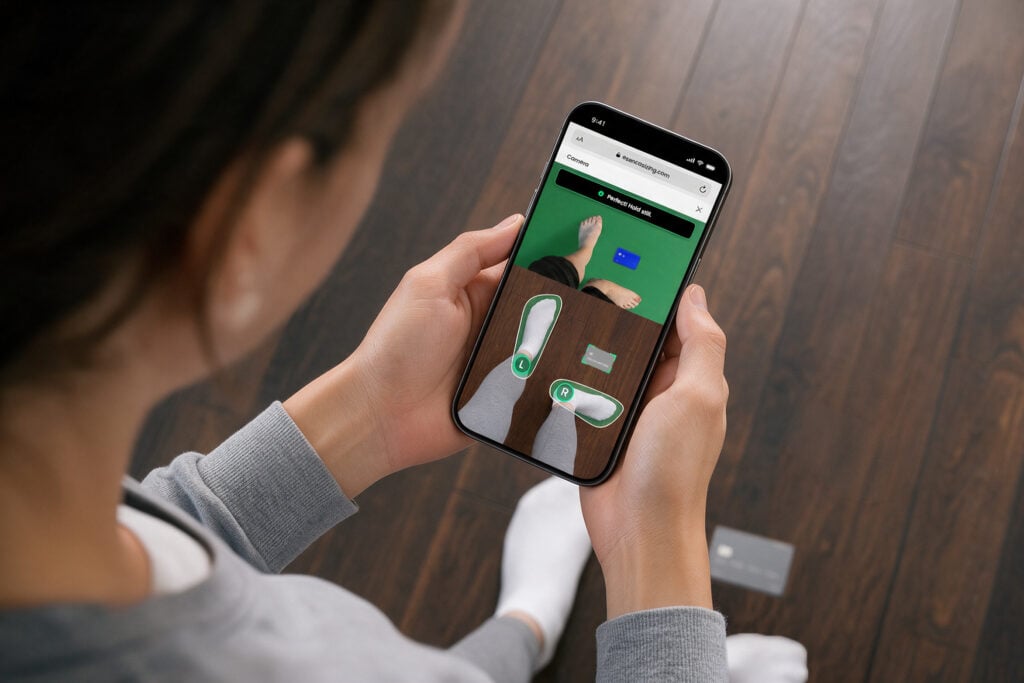
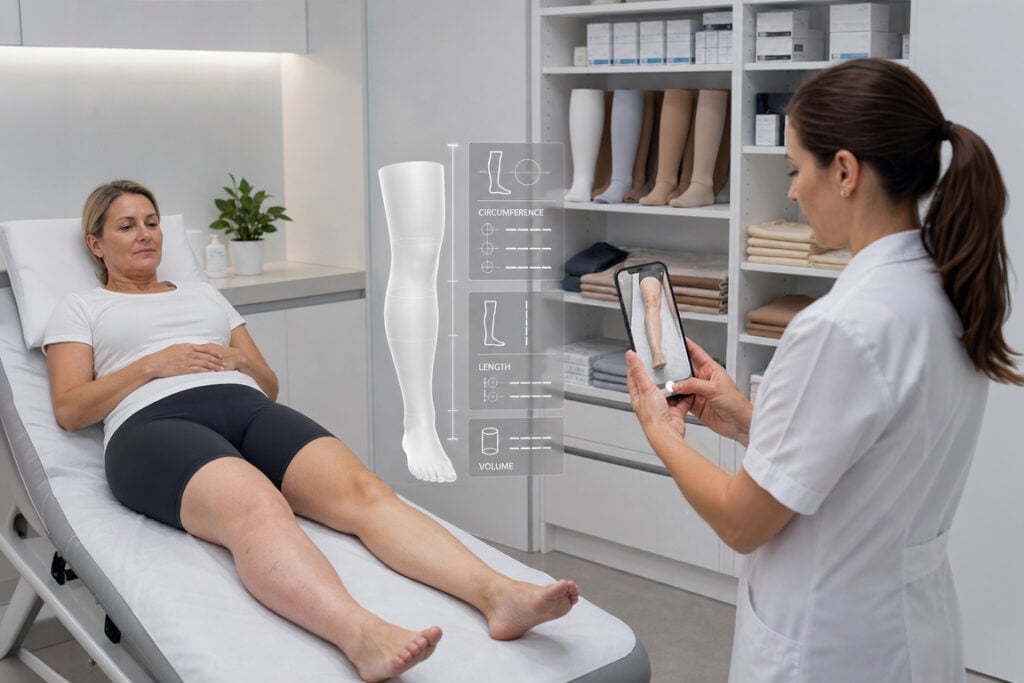
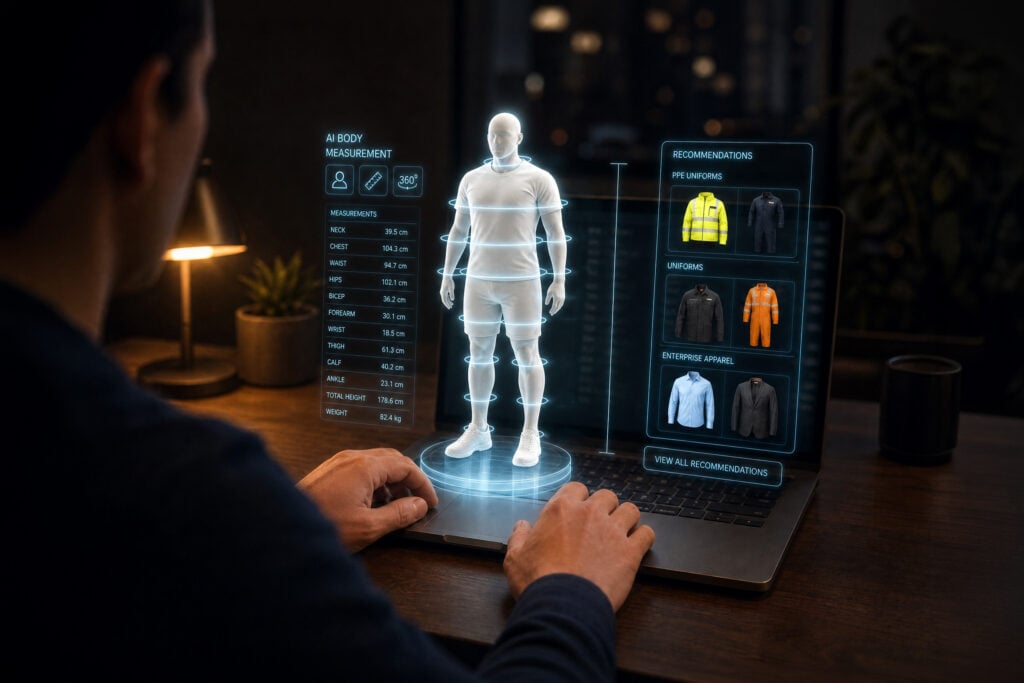
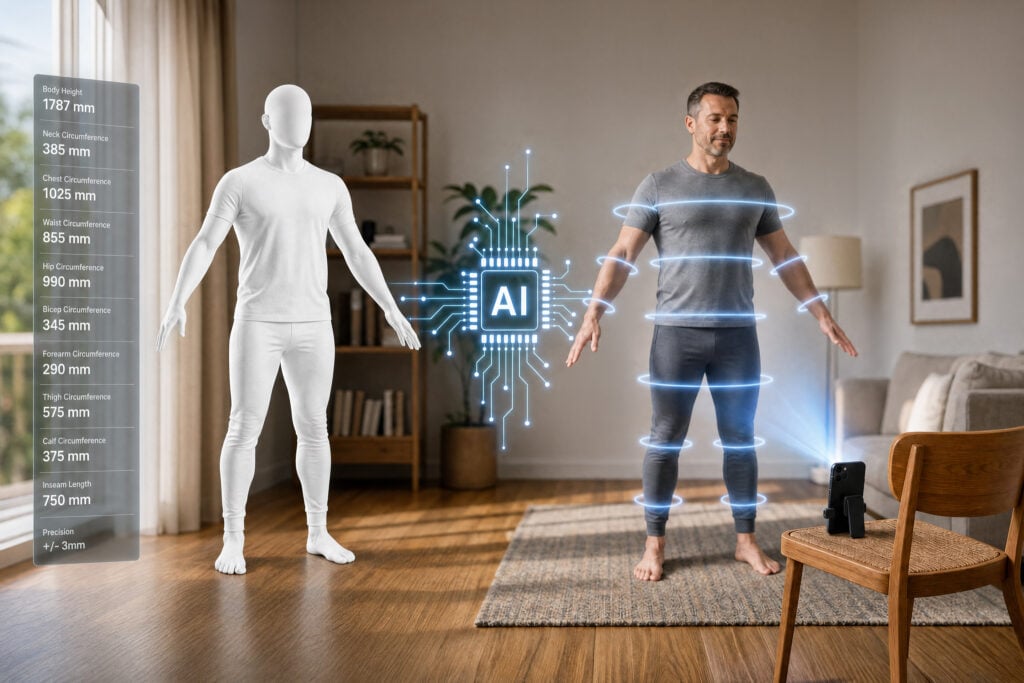
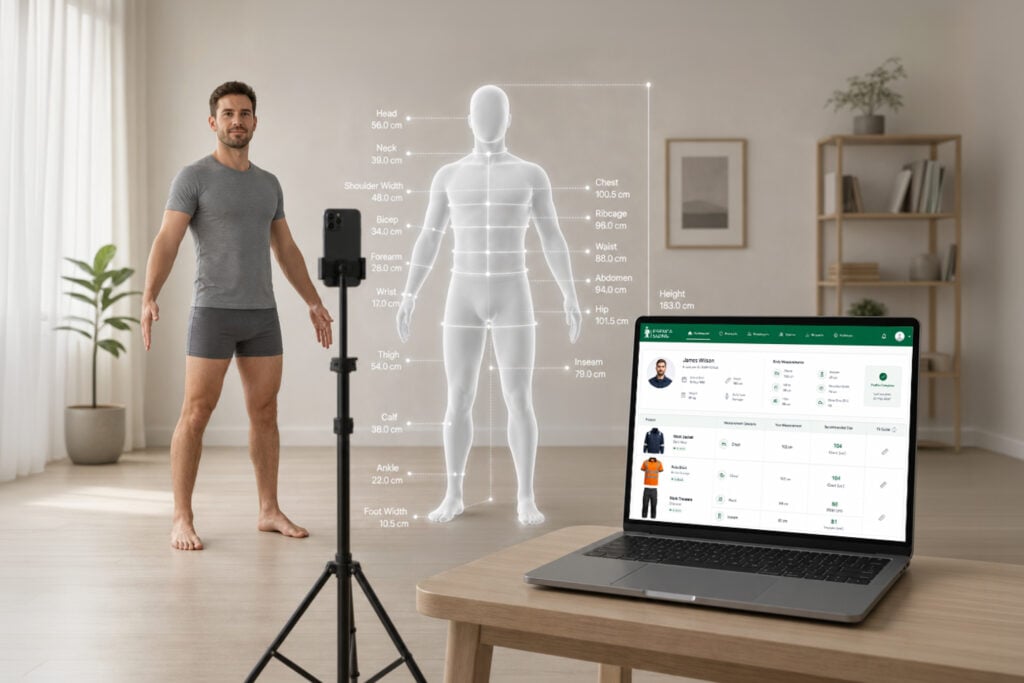
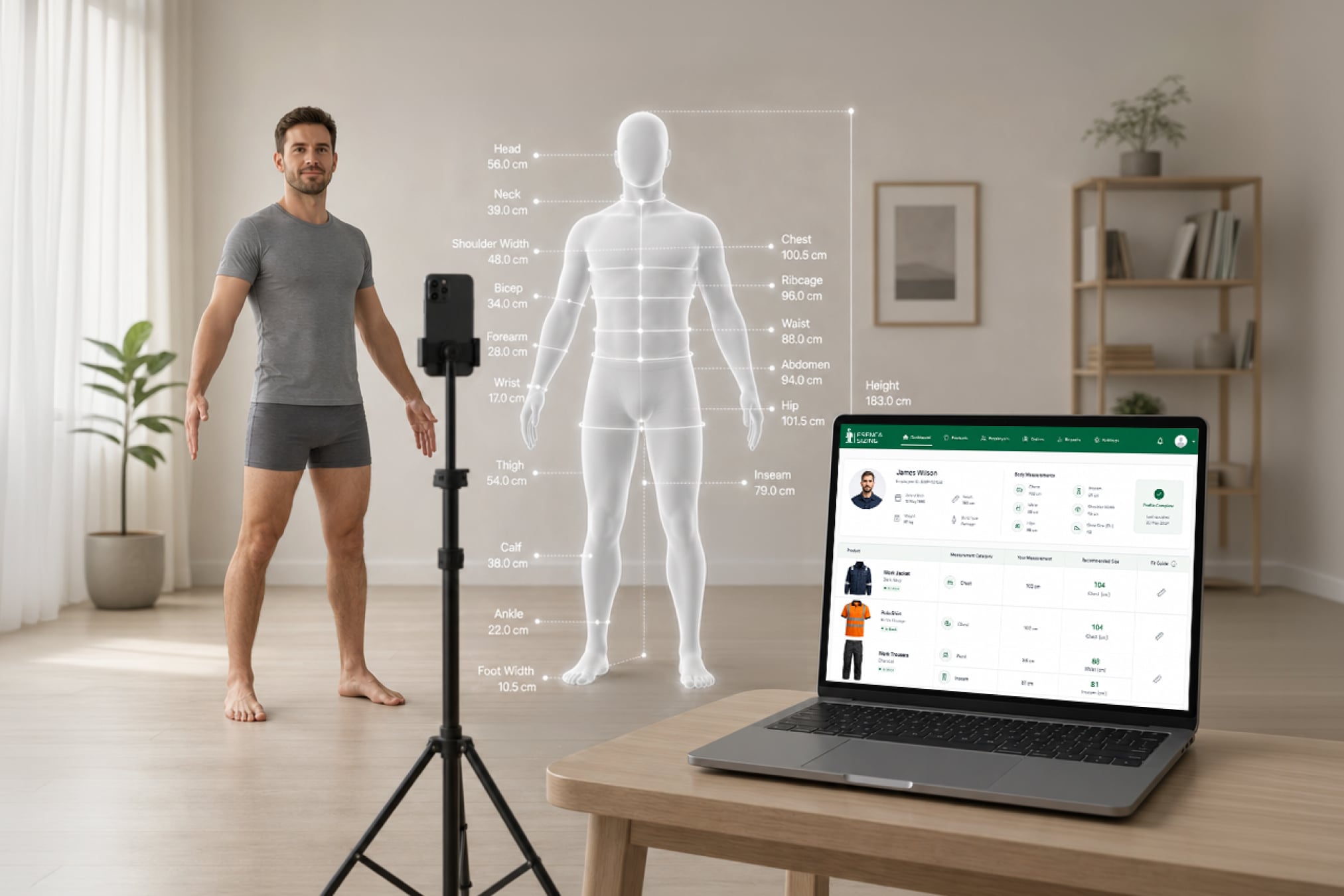
3D body scanning captures a person’s measurements using a camera and computer vision instead of a tape measure. Point a phone, capture a few images, and the software extracts the body measurements a garment actually needs—chest, waist, inseam, sleeve length, shoulder width, and dozens of other points a tailor would normally take by hand. A 3D model of the body may also be generated as a separate output for visualization and other applications.
That’s the whole idea. The complexity is in what happens between the capture and the output, and that’s where buyers get lost comparing systems.
It isn’t the same as a basic 2D photo app that estimates measurements from a single image and a stated height. It isn’t the same as a size chart, which assumes every body shaped roughly like “medium” fits the same way. And it isn’t the same as a fixed-position scanning booth, which solves accuracy but doesn’t travel to 500 warehouse employees across a dozen sites.
How the Scan Works
Strip out the marketing language and the process is mechanically simple:
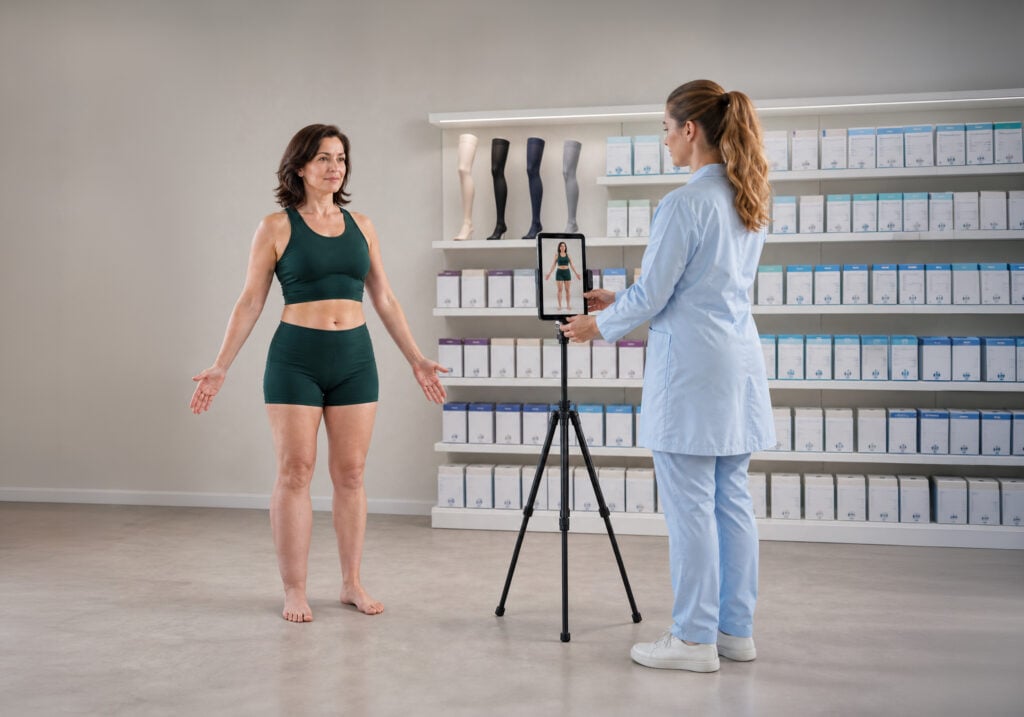
- Capture. The employee stands in front of a phone camera for a few seconds while it records from one or more angles.
- Analysis. The software analyzes the captured images using computer vision to identify anatomical landmarks, body contours, and other features needed for accurate measurement.
- Extraction. The system extracts body measurements using consistent anatomical reference points, ensuring the same dimensions are measured in the same way every time, regardless of who’s holding the phone.
- Output. The buyer receives a size recommendation, a complete set of body measurements, or both. Many solutions can also generate a realistic 3D body model as a separate output for visualization, virtual try-on, or other downstream applications.
The reason this matters for uniform buyers specifically: step 3 is what a tape measure can’t guarantee. Two different people measuring the same employee with a tape will get two different numbers, because grip pressure, landmark judgment, and posture all vary. Automated body scanning applies the same measurement methodology every time, removing much of the operator-dependent variation that comes with manual measuring. The inconsistency isn’t fixed by better training — it’s removed by taking the human out of the measuring step.
Types of 3D Body Scanning Systems
Not all “3D body scanning” is the same category of product. Three axes actually matter when you’re comparing options:
Fixed-booth hardware vs. smartphone-based. Booths — multi-camera rigs in a dedicated space — tend to produce very controlled, repeatable captures, but they require the employee to physically be in that space. Smartphone-based scanning trades a small amount of that control for the ability to scan someone at their desk, at home, or at a satellite site.
Single-camera vs. multi-camera capture. Multi-camera systems capture more angles simultaneously, reducing reliance on the person rotating correctly during capture. Single-camera systems rely on the person moving (or the software prompting them to turn), which pushes more of the accuracy burden onto software rather than hardware.
Cloud processing vs. on-device processing. Cloud processing can apply heavier models but gets more expensive to run at scale; on-device processing returns results faster and keeps the raw capture from leaving the device, which matters for the privacy question below.
Measurement methodology and standards. This is the axis buyers skip and shouldn’t. Apparel measurement isn’t a free-for-all — standards like ISO 8559 define where “waist” or “chest” is actually taken on a body, which matters because two systems can both claim “waist measurement” and mean two different landmarks. Ask any vendor which methodology their extraction logic is built against, and whether their landmark definitions are documented anywhere you can check — not just asserted.
None of these is universally “better” — they’re trade-offs against your actual constraint, which for most workwear buyers is: can this scan 300 people across 12 locations without shipping hardware to each one.
Why Workwear & Uniform Buyers Are Adopting It
For most consumer apparel, a wrong size is an inconvenience — an exchange, a returned box. For workwear and PPE, a wrong size is a different kind of problem.
Bulk ordering compounds small sizing errors. Outfit 5 people and a handful of wrong sizes gets caught and swapped before anyone notices the cost. Outfit 5,000, and the same error rate turns into a logistics event — reorders, warehouse space for exchanges, delayed start dates for new hires who can’t work without properly fitted gear.
And for PPE specifically, fit isn’t cosmetic. A harness, a respirator seal, or flame-resistant clothing that doesn’t fit the wearer’s actual body isn’t just uncomfortable — it can fail to do the one job it exists to do. That turns a sizing decision into a safety decision, which is a different conversation than the one apparel buyers are used to having.
This is the gap modern body scanning solutions are built to close: delivering consistent body measurements—and, when combined with garment-specific sizing logic, accurate size recommendations—at a scale where manual measurement stops being practical.
3D Scanning vs. Traditional Sizing Methods
| Method | Accuracy | Speed at Scale | Consistency Across Measurers | Setup Cost |
|---|---|---|---|---|
| Standard size charts | Low — assumes a "typical" body per size band | Fast (no measuring step) | N/A — no measurement taken | None |
| Manual tailor measurement | High per measurement, if done well | Slow — doesn't scale past small headcounts | Low — varies by who's measuring | Labour cost per session |
| 2D photo-based apps | Moderate — varies significantly depending on the underlying technology and available input data | Fast | Moderate — depends on photo quality/angle | Low |
| 3D smartphone scanning | High | Fast, and scales — one employee at a time, no bottleneck | High — same extraction logic every time | Low to moderate, mostly software |
The honest caveat: a skilled tailor measuring one person carefully may achieve a measurement accuracy close to of a good automated system. What tailors can’t do is repeat that same quality thousands of times a year across a distributed workforce without variation creeping in. That’s the actual comparison buyers are making, even when the conversation sounds like it’s about accuracy.
What This Actually Costs — and What It’s Being Weighed Against
Vendors will quote you a price per scan or a software license fee. That number means nothing on its own — it only matters relative to what you’re currently spending to get sizing wrong less often. Build the comparison yourself with four cost buckets:
Cost of the measuring step itself. Tailor visits, fitting days, or the labor hours a facilities or HR team spends coordinating manual measurement across sites.
Cost of getting it wrong. Every reorder has a shipping cost, a restocking or write-off cost on the wrong-sized item, and an administrative cost to process the exchange. This is usually the largest hidden line item, because it’s spread across many small transactions instead of showing up as one invoice.
Cost of delay. A new hire who can’t start floor work until PPE arrives in the right size is a productivity cost, not just a shipping cost. This one rarely gets tracked at all, which is exactly why it’s worth asking your operations team to estimate it before you evaluate vendors.
Cost of the system itself. Software licensing, any integration work to connect it to your procurement platform, and the change-management time to roll it out — covered in the next section.
Ask any vendor to help you build this comparison with your own numbers rather than their case-study numbers. A vendor’s benchmark customer is never your distribution, your site count, or your current return rate.
Rolling It Out at Scale
Implementation is where most of the theoretical accuracy debate stops mattering and operational reality takes over.
Fit it into a moment that already exists. The scan should happen during new-hire onboarding, an annual PPE refresh, or a uniform reorder cycle — not as a separate scheduled event that competes with an employee’s actual job for their time. A standalone “scanning day” gets treated as optional by both employees and site managers; a scan folded into paperwork they’re already doing gets done.
Plan for multi-site rollout, not single-site rollout. A pilot at one location tells you whether the technology works. It tells you very little about whether site managers at eleven other locations will enforce it, whether your IT policy allows the app on personal or company devices at every site, or whether non-English-speaking sites need a different onboarding flow. Sequence the rollout by site complexity, not by convenience.
Decide what happens to existing sizing records. Most uniform programs already have a sizing record for every current employee, right or wrong. Migrating that data — or deciding to re-scan the existing workforce rather than carry old numbers forward — is a decision that needs to be made once, explicitly, rather than left to whichever manager touches it first.
Train the people who’ll field the questions. The buyer evaluating the system and the site manager answering “why do I need to scan my body” from a skeptical employee are rarely the same person. The second person needs a one-paragraph explanation of what’s collected, why, and how it’s protected — not the vendor’s full privacy policy.
Plug into procurement before you scale, not after. An output that isn’t connected to how uniforms actually get ordered will get worked around within a quarter, no matter how accurate it is.
What to Evaluate Before Choosing a System
Four questions cut through most vendor pitches:
Accuracy and tolerance. Ask what tolerance the system claims against a specific measurement — not an aggregate “accuracy score” — and under what conditions that tolerance was tested. A number without test conditions is a marketing claim, not a spec.
Data privacy and compliance. Body scan data should be treated as sensitive personal information and handled accordingly.. Ask where the capture is processed, how long raw video or images are retained, and whether the vendor points to a specific compliance framework — GDPR, for European deployments — rather than a general privacy statement.
Integration. A measurement system that outputs a PDF is a demo. A measurement system that pushes size recommendations into your existing procurement or ERP workflow is the thing that actually gets used six months after rollout.
Employee experience. Does the scan require removing clothing, a specific room, specific lighting, or specialized equipment? Every added requirement is friction that shows up as lower completion rates during rollout — the best system in a lab is worthless if employees skip the scan.
Common Questions About 3D Body Scanning
Is 3D body scanning accurate enough for PPE sizing?
Accuracy depends on the specific system and the specific measurement, not the category as a whole. Ask any vendor for tolerance figures on the measurements that matter for your gear — chest and shoulder for harnesses, for example — rather than accepting a single blended accuracy number.
Is scan data private and secure?
It should be treated as sensitive data by default. Confirm where processing happens, how long raw captures are stored, and whether the vendor names a specific compliance standard — GDPR, for European employers — rather than a general assurance.
Do employees need special equipment?
For smartphone-based systems, no — a phone camera is the only hardware requirement. Fixed-booth systems need employees to visit a specific physical location, a real constraint for distributed workforces.
Does it work across all body types?
Worth asking vendors directly, with evidence — not assuming yes. Computer vision models are trained on data, and a model’s performance is only as good as the range of bodies represented in that training data.
How does 3D scanning compare in cost to traditional measurement?
It depends entirely on your current process and error rate — see the cost framework above. A program with a high manual-measurement labor cost or a high return rate will see the comparison differently than one with low headcount and infrequent reorders.
Can it integrate with our existing procurement or ERP system?
Most systems built for B2B use offer some form of API or data export; the real question is whether that integration reaches the specific platform you use, and whether that’s a standard connector or custom development work.
What happens if an employee’s body changes over time?
This is a re-scan question, not a one-time-measurement question. Ask how the vendor handles updates — whether employees can re-scan on their own schedule or only during a formal refresh cycle — since bodies change and a stale measurement is functionally the same problem as a wrong one.
Is a smartphone scan as accurate as an in-person tailor measurement?
For a single, carefully taken measurement. a skilled tailor can achieve excellent accuracy, comparable to a good automated solution.
What a tailor can’t guarantee is that same quality repeated identically across a large, distributed workforce — that consistency, not raw peak accuracy, is what most B2B buyers are actually solving for.
Do we need IT involvement to deploy this?
Usually yes, at minimum to confirm device policy (personal phones vs. company-issued) and to scope any integration work with procurement systems — worth involving IT early rather than after a rollout date is already set.
Key Takeaways for Buyers
- 3D body scanning solves a consistency problem, not just an accuracy problem—providing repeatable body measurements that can be translated into reliable, garment-specific size recommendations.
- For PPE specifically, fit is a safety question, not a comfort question — treat it with the same rigor as any other safety spec.
- Build your own cost comparison using your current error and reorder rates — a vendor’s case study numbers aren’t your numbers.
- Rollout succeeds or fails on operational details — multi-site sequencing, legacy data handling, and procurement integration — not on scan accuracy alone.
- Evaluate systems on tolerance data, documented measurement methodology, compliance specifics, and integration depth — not a single headline accuracy number.
See How Esenca Approaches This
Esenca Sizing runs this exact process — smartphone capture, no special hardware, GDPR-compliant handling, and a size output built to plug into procurement workflows rather than sit in a separate portal. If you’re evaluating systems against the criteria above, book a demo and run the comparison against your own gear.