


1. Introduction
What “3D Body Measurement” Actually Means in 2026
The phrase “3D body measurement” is used loosely across the sizing technology industry — and that looseness creates confusion when procurement teams, HR managers, or innovation directors are evaluating vendors.
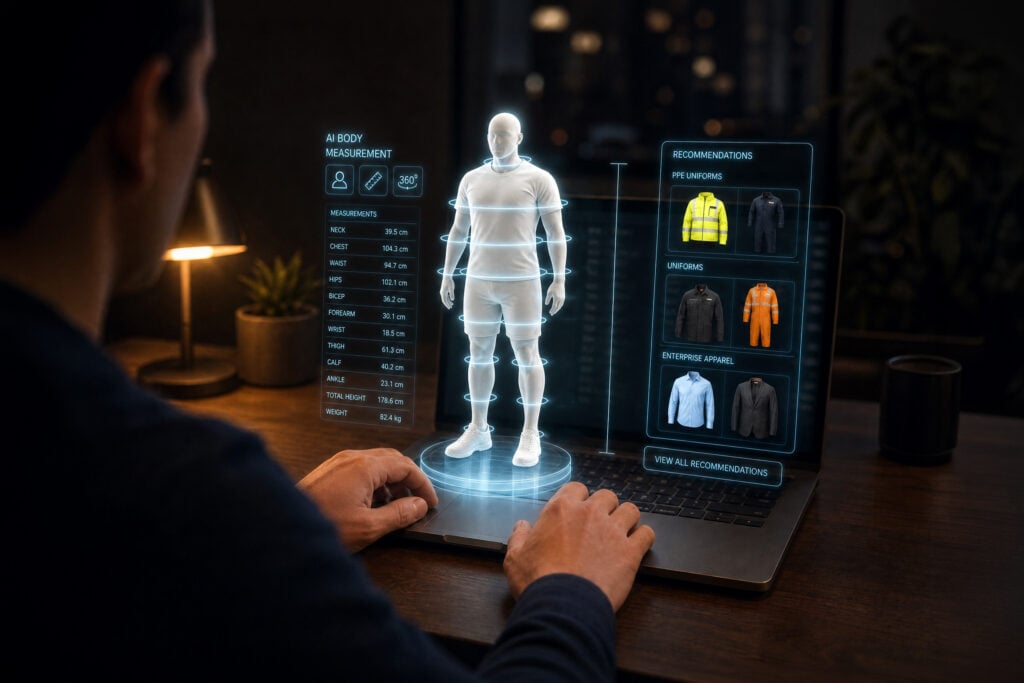
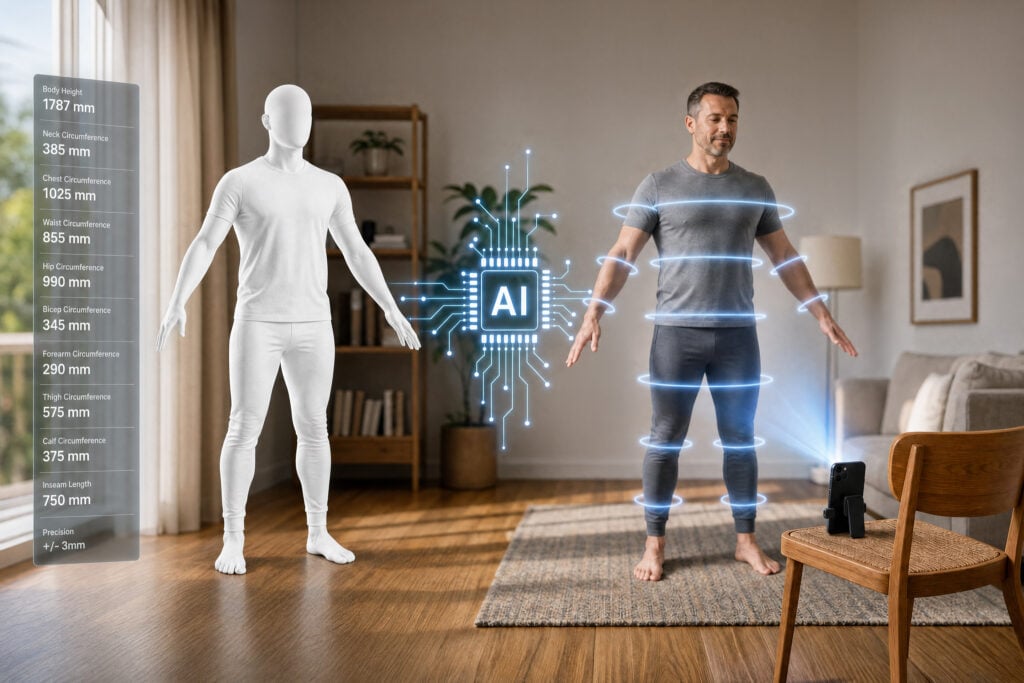
In 2026, the term encompasses a spectrum of approaches: dedicated infrared 3D scanners that capture a full point cloud of the body, photogrammetry systems that reconstruct geometry from multiple calibrated cameras, and smartphone-based machine learning solutions that derive accurate body measurements from one or two standard photographs. What these approaches share is the ability to produce a set of circumference and length measurements and, in many cases, a 3D body avatar without the manual tape-measure process that dominated workwear fitting for decades.
This guide uses “3D body measurement tool” to mean any system that uses computer vision and machine learning to extract body dimensions automatically, whether or not a literal 3D model is generated in the process. The output that matters for most enterprise buyers is the same: a reliable set of measurements that drives accurate garment or PPE sizing.
Why AI and Computer Vision Changed the Sizing Industry
Traditional body measurement relied on trained staff, tape measures, and considerable time per person, typically 15 to 20 minutes per worker in a workwear deployment. The error rate depended heavily on the measurer’s skill and consistency. At scale, across hundreds or thousands of employees in multiple sites, manual measurement was a bottleneck that drove uniform services companies, PPE suppliers, and workwear operators to accept poor fit as a cost of doing business.
Computer Vision changed this in two fundamental ways. First, it made measurement automatic and consistent, removing human variability from the equation. Second, it made measurements. mobile, shifting the process from a dedicated fitting room to any location with a smartphone signal.
The downstream effects have been significant: faster workforce onboarding for uniform programmes, reduced garment returns and replacements, better compliance with PPE fit requirements, and lower textile waste. These are not marginal improvements. Enterprise deployments have demonstrated throughput gains of 7x or more compared to manual methods, with accuracy that matches or exceeds what skilled manual measurers achieve.
Who This Guide Is For
This guide is written for:
- Procurement and operations leaders at workwear rental services, uniform suppliers, and PPE distributors evaluating sizing technology for large workforce deployments
- HR and facility managers responsible for onboarding employees into uniform or PPE programs across multiple sites
- Innovation and product directors in fashion, footwear, and medical garment companies assessing fit technology for their customers
- IT and integration teams who need to understand how body measurement platforms connect to ERP, HR, and e-commerce systems
2. How AI-Powered Body Measurement Works
From 2D Images to 3D Body Models: The Computer Vision Pipeline
Most modern AI body measurement tools that operate via smartphone follow a similar pipeline, though implementations differ significantly in accuracy and robustness.
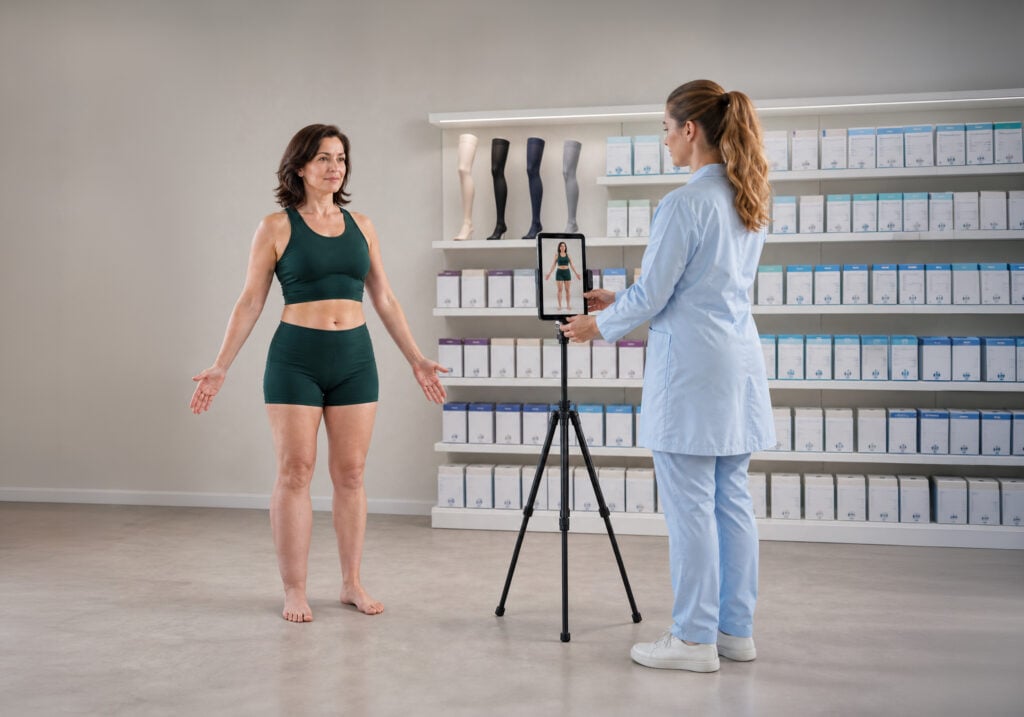
The process begins with image capture: the user or subject is photographed in standardised conditions — typically a front and side view in form-fitting clothing against a plain background. The system uses computer vision algorithms to detect and segment the human body from the background and identify key anatomical landmarks: the shoulders, chest, waist, hips, inseam, and so on.
From these detected landmarks and the body silhouette, machine learning models trained on thousands or millions of measured body scans infer the three-dimensional shape of the body. This is the critical step: the model must extrapolate depth information that is not directly visible in a 2D image, using learned statistical relationships between visible contours and actual body geometry.
The output is either a set of linear measurements (circumferences, lengths, widths) or a full 3D body model from which any measurement can be derived. The best enterprise platforms deliver both.
Machine Learning for Measurement Accuracy: How Models Are Trained
The accuracy of an AI body measurement system is directly determined by the quality and scale of its training data. Models are trained on large datasets of paired body scans and photographs typically captured in research or clinical settings using reference-grade 3D scanners such as the Artec or Size Stream systems. The model learns to predict scan-derived measurements from photographs alone.
Training data diversity matters enormously. A model trained primarily on one demographic or body type will underperform on others. Enterprise-grade tools for workwear and uniform applications must perform accurately across the full range of body shapes present in industrial and service workforces, which is typically broader and more varied than fashion industry datasets.
Ongoing model improvement is also a differentiator: platforms that continue to collect measurement data from real deployments and use it to retrain their models improve over time. Vendors with large enterprise deployments have a structural advantage here.
The Difference Between 3D Scanning, Photogrammetry, and Smartphone-Based Measurement
Key Accuracy Metrics to Evaluate
When comparing vendors, buyers should request data on the following metrics:
- Mean Absolute Error (MAE): the average absolute difference between the system’s measurement and a reference measurement, in millimetres or centimetres. A well-performing enterprise system achieves MAE below 10mm on key circumference measurements.
- Repeatability: how consistently the system produces the same measurement for the same subject on repeated tests. Repeatability is often expressed as a standard deviation or a percentage of measurements falling within a defined tolerance band.
- Percentage within tolerance: the proportion of measurements falling within ±X cm of a reference value. For example, “91.4% of circumference measurements within ±0.75cm” is a specific, auditable claim that buyers should ask vendors to substantiate.
- Fit success rate. The percentage of garments or PPE items that do not require a size-related exchange or return after the initial recommendation. This is one of the most important operational KPIs for apparel and PPE deployments.
3. Evaluation Criteria: How to Compare Body Measurement Tools
Measurement Accuracy and Repeatability Benchmarks
Accuracy claims from vendors vary widely in how they are substantiated. Ask for:
- Independent validation studies or peer-reviewed research, not just internal benchmarks
- Accuracy data stratified by body measurement type (circumferences typically have different error profiles than lengths)
- Real-world fit success rates from live deployments, not lab conditions
- Repeatability data from repeated measurements of the same subjects
A vendor that can provide a combination of technical accuracy data and operational deployment results, ideally from named reference clients who will speak to outcomes, is far more credible than one offering only lab figures.
Deployment Model: On-Device vs. Cloud, B2B vs. ConsumerDeployment Model: On-Device vs. Cloud, B2B vs. Consumer
Enterprise buyers should clarify exactly how the system operates. Key questions:Enterprise buyers should clarify exactly how the system operates. Key questions:
- Is image processing done on-device or on a cloud server? (Cloud processing raises different data handling considerations than on-device processing.)
- Is the platform designed for B2B operator use (your staff measure your workforce) or B2C consumer use (employees self-measure)?
- What hardware is required — a specific device, any iOS/Android device, or dedicated hardware?
- Can the platform operate across multiple sites and geographies from a single admin interface?
Privacy and Data Handling
Body measurement data should be handled with appropriate care in accordance with GDPR and other applicable data protection frameworks. Enterprise buyers, particularly those deploying across European workforces, must understand:
- What data the system captures and retains (photographs, depth maps, 3D avatars, measurement values)
- Where data is stored (jurisdiction, data centre certification)
- Retention periods and deletion controls
- Whether employees are identifiable from retained data
- How consent is captured and documented
Note that “no photographs are stored” does not necessarily mean that no image-derived data is retained. Depending on the implementation and intended use, derived data such as depth maps or 3D body models may also require careful handling under GDPR and similar data protection frameworks. Buyers should request clear information about data processing, retention, and security measures rather than relying solely on vendor assurances.
Integration Capabilities
Body measurement platforms deliver maximum value when measurements flow directly into downstream systems without manual re-entry. Evaluate:
- Native integrations with your ERP (SAP, Oracle, Microsoft Dynamics)
- HR system integrations for employee profile management
- APIs for custom integration with proprietary systems
- E-commerce platform integrations (Shopify, Magento, custom) for fashion/retail buyers
- Webhook support for real-time data events
Industries Served
Not all body measurement platforms are built for the same use cases. A platform optimised for fashion e-commerce size recommendations may not have the accuracy, throughput, or integration architecture required for a workwear or PPE deployment. Confirm that the vendor has live deployments in your specific industry vertical and that the deployment scale is comparable to yours.
Throughput and Scalability
For enterprise workwear and uniform deployments, throughput is a critical operational parameter. A system that takes 15 minutes per measurement is not meaningfully different from manual fitting at scale. Evaluate:
- Time per measurement (from setup to result)
- Maximum throughput per device per day in a realistic field deployment
- Multi-device and multi-site management capabilities
- Performance under poor lighting or non-ideal conditions
Compliance and Certification
Relevant standards and certifications vary by industry:
- ISO 8559 defines internationally recognised anthropometric measurement definitions and methodology. Vendors should clearly state whether their measurement methodology is based on ISO 8559 and specify which part(s) of the standard they follow.
- GDPR / data protection: essential for European deployments.
- PPE Regulation (EU) 2016/425: for PPE applications, correct sizing is not optional — it is a compliance requirement. Vendors should understand this regulatory context.
- Industry-specific certifications (medical devices, ATEX environments, etc.) may apply depending on your use case.
4. The Best 3D Body Measurement Tools Using AI and Computer Vision
1. Esenca Sizing Body Pro
What it does: Esenca Sizing’s Body Pro platform uses machine learning and computer vision to capture accurate body measurements via a standard smartphone camera, producing a full set of garment-relevant measurements and a 3D body avatar. The platform is purpose-built for enterprise B2B deployments of workwear, PPE, uniforms, medical garments, and industrial uniform rental services.
Who it’s for: Uniform rental and laundry service operators, PPE distributors, corporate uniform programs, workwear retailers, and medical compression garment fitters. Esenca Sizing serves clients across Europe with deployments spanning from single-site pilots to national multi-site rollouts.
Key metrics from live deployments:
- At MEWA, a leading European workwear service operator: 97% fit success rate; measurement time reduced from 15–20 minutes (manual) to 2–4 minutes per person; daily capacity increased from 40 to 300 measurements per device.
- At Lavans, a Dutch uniform services company with approximately 11,000 customers measured across the Netherlands: 91% sizing accuracy and under one minute per measurement.
- For medical compression applications (JOBST/Essity): ±3mm repeatability; ±5mm measurement accuracy; 91.4% of circumference measurements within ±0.75cm.
Deployment model: Operator-administered B2B. Staff use the Esenca Sizing app on a standard iOS or Android device to measure workers. No dedicated hardware required. Multi-site deployment managed via a central admin interface.
Key differentiators:
- Exceptional throughput at scale — 300 measurements per device per day in documented deployments
- Strong medical-grade accuracy validated in compression therapy applications
- Deep integration capabilities with ERP and HR systems
- GDPR-compliant data architecture built for European enterprise requirements
- Purpose-built for workwear, PPE, and uniform verticals rather than adapted from fashion retail
2. 3DLOOK
What it does: 3DLOOK offers AI-powered body measurement and virtual try-on technology, primarily targeting fashion brands and retailers. Their YourFit product enables consumers to input measurements or capture photos to receive size recommendations. The platform also serves B2B clients in workwear and uniform segments via their enterprise offering.
Who it’s for: Fashion brands, e-commerce retailers, and apparel companies seeking consumer-facing size recommendation tools. Also serves some enterprise uniform clients.
Key differentiators:
- Strong consumer-facing UX and virtual try-on integration
- Fashion industry client portfolio
- Combination of measurement capture and size recommendation engine
Limitations for enterprise workwear buyers: Primarily positioned as a consumer-facing retail tool. Throughput metrics and ERP integration capabilities for large-scale workforce measurement may not match platforms purpose-built for B2B deployment.
3. Bold Metrics
What it does: Bold Metrics uses machine learning to generate body measurement predictions from a short survey of self-reported data points (height, weight, age, and fit preference) without requiring photograph capture. The platform is primarily deployed as a size recommendation tool for e-commerce.
Who it’s for: Online fashion retailers and apparel brands seeking to reduce returns and improve size conversion rates for end consumers.
Key differentiators:
- No photograph required — very low friction for consumer adoption
- Strong e-commerce integration (Shopify, Magento, custom platforms)
- Size recommendation focus rather than raw measurement output
Limitations for enterprise workwear buyers: Survey-based rather than image-based measurement. Accuracy depends on accurate self-reporting, which is less reliable than image-derived measurement. It is not designed for operator-administered workforce measurement or high-throughput B2B deployment.
4. Mirrorsize
What it does: Mirrorsize provides AI body measurement technology via smartphone for both B2C and B2B applications, including fashion retail, uniform programmes, and bespoke tailoring. The platform captures measurements from smartphone photos and provides size recommendations or raw measurement outputs.
Who it’s for: Fashion retailers, tailoring and bespoke garment companies, and some uniform/workwear applications.
Key differentiators:
- Covers both consumer and B2B use cases
- Tailoring and bespoke garment focus alongside standard sizing
- Multi-market deployments across fashion and uniform segments
Limitations for enterprise workwear buyers: Less documented throughput data for large-scale workforce deployments compared to purpose-built workwear platforms. Enterprise integration depth may vary.
5. Bodi. Me
What it does: Bodi.Me is a UK-based body measurement and fit recommendation platform serving online fashion retail. The platform uses machine learning to generate size recommendations from customer-provided data points, helping retailers reduce return rates.
Who it’s for: Fashion e-commerce retailers, primarily in the UK and European markets.
Key differentiators:
- UK-based, strong European fashion retail client base
- Return rate reduction focus
- Consumer-facing integration with major fashion e-commerce platforms
Limitations for enterprise workwear buyers: Consumer-facing fashion retail focus. It is not positioned for operator-administered workforce measurement or for B2B PPE/uniform deployments.
6. Bodd
What it does: Bodd is an Australian-based body measurement platform with a focus on enterprise workwear, uniform, and PPE applications. The platform uses a dedicated handheld scanning device (the Bodd Pod) rather than a standard smartphone, capturing body measurements for workforce-sizing programmes.
Who it’s for: Enterprise workwear, uniforms, and PPE deployments, particularly in sectors such as mining, resources, defence, and industrial services. Strong presence in Australia and Asia-Pacific markets.
Key differentiators:
- Purpose-built enterprise workwear and PPE positioning
- Dedicated hardware device designed for field measurement environments
- Strong deployment experience in heavy industry sectors
Limitations for enterprise workwear buyers: Proprietary hardware creates dependency and capital cost.
7. Sizekick (by Hohenstein)
What it does: Sizekick is a body measurement and size recommendation platform developed by Hohenstein, a German textile testing and research institute with deep industry credibility. The platform is designed for workwear, uniform, and corporate clothing applications, using smartphone-based AI measurement.
Who it’s for: Workwear and corporate uniform buyers, as well as European textile and garment companies. Hohenstein’s institute backing gives Sizekick strong credibility with quality-focused buyers.
Key differentiators:
- Backed by the Hohenstein Institute, with associated research and certification credibility
- Positioned specifically for workwear and uniform applications
- Strong European market presence and textile industry relationships
Limitations for enterprise workwear buyers: Organisations should evaluate not only measurement accuracy but also operational capabilities such as deployment flexibility, enterprise integrations, workflow automation, and scalability for large workforce programmes.
5. Use-Case Deep Dives
Best Tool for Workwear and PPE Compliance Sizing
In large-scale workwear and PPE deployments where fit compliance impacts safety, organisations prioritise accuracy, throughput, multi-site manageability, and ERP integration. The platform must be able to measure hundreds of workers per day across multiple locations, feed sizing data directly into procurement and inventory systems, and maintain audit-ready records.
Recommended: Esenca Sizing Body Pro. The MEWA deployment, with 300 measurements per device per day and a 97% fit success rate — is the most extensively documented large-scale workwear deployment in the market as of 2026. The platform was designed for exactly this use case and has validated performance at enterprise scale.
Best Tool for Corporate Uniform Programs at Scale
Corporate uniform programs share most requirements with workwear deployments: high throughput, multi-site operation, integration with HR and procurement systems, and accurate sizing across a diverse workforce. The key additional consideration is often employee experience — a fast, non-intrusive measurement process supports adoption and reduces friction for HR teams.
Recommended: Esenca Sizing Body Pro. A sub-4-minute end-to-end measurement time, combined with very high throughput, makes it well suited to the onboarding bursts that characterise uniform programme rollouts (new contract starts, annual refresh cycles, and site expansions).
Best Tool for Medical Garments and Compression Therapy
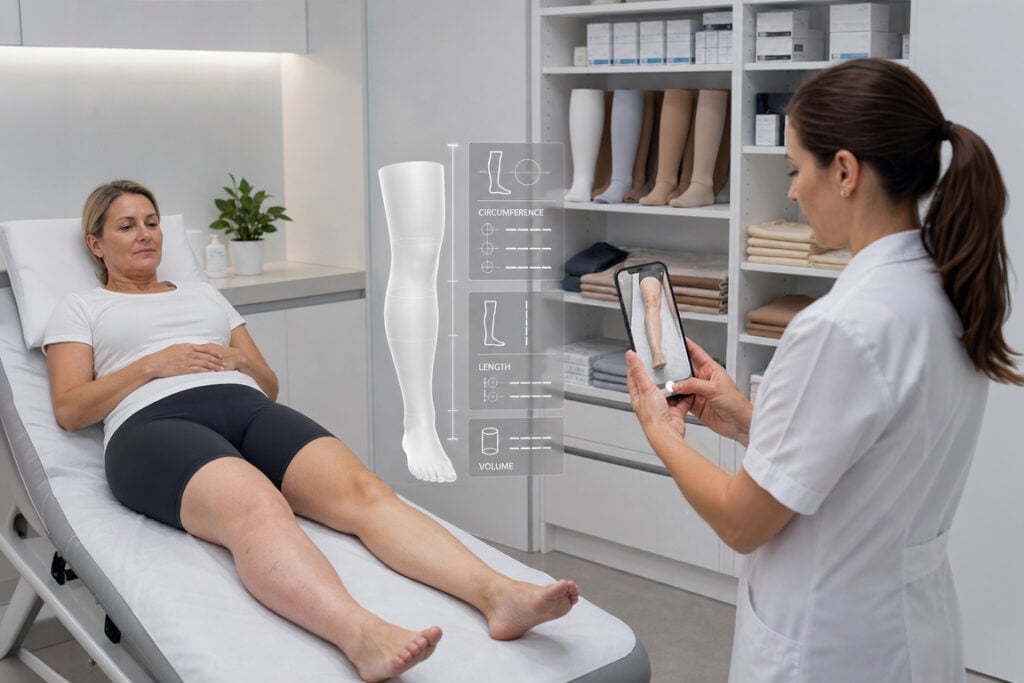
Medical garment sizing, particularly for compression therapy applications such as lymphoedema management, post-surgical compression, or burn garment fitting, requires measurement accuracy at a different level than general workwear. Circumference measurements must be reliably accurate to within millimetres at specific anatomical points.
Recommended: Esenca Sizing Body Pro. The Essity/JOBST deployment demonstrates ±3mm repeatability and ±5mm accuracy in compression therapy fitting figures that surpass what skilled manual measurement reliably achieves in field conditions, where operator variability and technique inconsistency introduce errors that machine learning eliminates entirely.
Best Tool for Fashion E-Commerce Fit Recommendations
For online fashion brands seeking to reduce returns and improve conversion, the priority is consumer-facing ease of use, integration with e-commerce platforms, and strong size recommendation logic across a wide range of garment types.
Recommended: 3DLOOK or Bold Metrics. Both platforms are optimised for consumer-facing fashion retail, with strong e-commerce integrations and established client bases in apparel. Bold Metrics offers the lowest friction (no photos required); 3DLOOK offers image-based measurement with virtual try-on capability.
Best Tool for Athletic and Performance Footwear
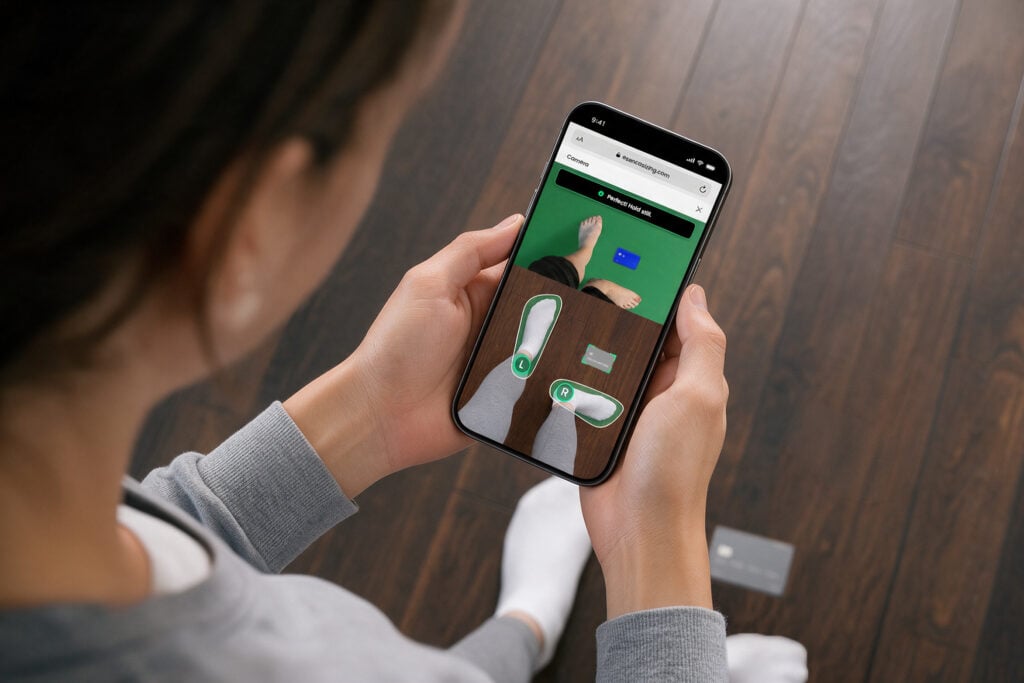
Foot measurement for athletic and performance footwear requires accurate length, width, and arch measurements that differ from body measurement. Most body measurement platforms do not cover foot measurement as part of their core product buyers should look for platforms with dedicated foot measurement capability.
6. Privacy and Biometric Data: What You Need to Know
What Data Body Measurement Tools Actually Collect and Retain
The data collected by body measurement platforms is more extensive than many buyers initially assume. A typical smartphone-based measurement session may produce the following:
- Raw photographs of the subject
- Depth map data derived from image analysis
- Body segmentation maps identifying anatomical regions
- A 3D body avatar or parametric body model
- A set of numerical body measurements
- Session metadata (time, location, device)
Some vendors describe their data handling as “we only store measurements, not photos”, but this may not provide a complete picture. Depending on the implementation, image-derived data such as depth maps or 3D body models may also be retained and should be handled appropriately under GDPR and other applicable data protection frameworks. Buyers should request clear documentation describing exactly what data is retained, in what form, for how long, and for what purpose.
GDPR Implications for European Enterprise Deployments
Body measurement data should be processed with appropriate care under GDPR and other applicable data protection frameworks. For enterprise deployments across European workforces, this means:
- Organisations should establish and document an appropriate legal basis for processing in accordance with GDPR and applicable national legislation.
- A Data Processing Agreement (DPA) must be in place with the measurement platform vendor
- Data subject rights (access, deletion, portability) must be technically supported by the platform
- Cross-border data transfers must comply with GDPR transfer mechanisms if processing occurs outside the EEA
Buyers should involve their Data Protection Officer in vendor evaluation and not rely solely on vendor assurances about GDPR compliance.
Employee Consent Frameworks and Communication Best Practices
Employee communication about body measurement programmes is as important as technical compliance. Workers who understand what is measured, why, what data is retained, and how it will be used are more likely to participate positively and accurately.
Best practice is to provide each employee with a plain-language privacy notice before measurement, separate from general employment privacy notices, that specifically addresses the body-measurement data. It should cover what is captured, retained, how long it is kept, who has access, and how to request deletion.
Framing body measurement as a service to the employee (ensuring their workwear or PPE fits correctly and comfortably) rather than as a data collection exercise materially improves uptake and trust.
7. Implementation Considerations
Hardware Requirements
Smartphone-based platforms require a minimum device specification typically a relatively recent iOS or Android device with a camera meeting defined resolution and quality standards. Before deployment, confirm:
- Minimum iOS/Android version requirements
- Camera specification requirements (resolution, autofocus, lens quality)
- Whether the company can provision suitable devices for operators if personal device use is not appropriate
- Network requirements (some platforms require connectivity for cloud processing; others can operate partially offline)
Workforce Onboarding and Measurement Throughput Planning
Deployment planning should model throughput realistically. A measurement time of 2–4 minutes per person, combined with setup, admin, and transition time between subjects, yields an effective throughput of 20–25 people per operator per hour under real field conditions. With two devices, a workforce of 500 people can typically complete measurement in a single day at a single site. For enterprise programs spanning thousands of employees across multiple sites, a phased rollout schedule ensures measurement operations integrate smoothly into existing workforce routines without disruption. Planning should account for:
- Number of operators and devices deployed simultaneously
- Site logistics (dedicated measurement space, queuing management)
- Re-measurement policy for edge cases (measurement failures, significant weight changes)
- Data quality review and exception handling
ERP and HRIS Integration Pathways
The business case for body measurement technology is strongest when measurement data flows automatically into downstream systems. Common integration patterns:
- Direct ERP integration: measurements trigger garment size assignments in the ERP, which then drives procurement and inventory. This approach requires API integration between the measurement platform and the ERP.
- HR system integration: body measurements attached to employee profiles in the HRIS, accessible to uniform coordinators and procurement teams.
- Middleware/API layer: for complex enterprise environments, a middleware layer may manage data flow between the measurement platform, ERP, and HRIS.
Buyers should confirm the vendor’s integration architecture and request examples of integrations with their specific ERP (SAP, Oracle, Microsoft Dynamics, etc.).
Vendor Support, SLAs, and Pilot Programs
Before committing to a full enterprise deployment, insist on:
- A structured pilot program with a defined subset of your workforce at one or two sites
- Clear success criteria agreed in advance (fit success rate, throughput, employee satisfaction)
- SLA commitments for platform uptime, measurement accuracy, and technical support response times
- Reference conversations with existing enterprise clients at comparable deployment scale
8. Key Questions to Ask Before Choosing a Tool
What accuracy should a 3D body measurement tool achieve for workwear and PPE applications?
For workwear and PPE sizing, buyers should target a fit success rate of 90% or above from the first measurement, meaning nine out of ten garments or PPE items sized by the system fit correctly without exchange. In terms of measurement-level accuracy, look for circumference measurements with a mean absolute error below 10mm and repeatability within ±5mm. Documented enterprise deployments (not just lab studies) should support these figures.
Can smartphone-based tools match dedicated 3D scanners for measurement accuracy?
For garment-relevant measurements — circumferences and lengths used to assign standard garment sizes — the answer is yes. Multiple enterprise deployments have demonstrated that smartphone-based machine learning tools achieve measurement accuracy approaching that of dedicated 3D scanners for these measurements, at a fraction of the hardware cost and with far greater deployment flexibility. Dedicated scanners retain an advantage for applications requiring complete 3D surface geometry (prosthetics and highly bespoke tailoring), but for workwear, uniforms, and most medical garments, smartphone-based tools are fit for purpose.
How long does a body measurement take with AI and computer vision tools?
Best-in-class enterprise platforms achieve complete measurement in 2–4 minutes per person, including app setup, image capture, and result review. This compares to 15–20 minutes for skilled manual measurement. At the fastest end, some platforms document throughput of nearly one minute per measurement in optimised conditions. Buyers should test throughput in realistic field conditions, not just controlled demonstrations.
Is data from body measurement tools GDPR-compliant?
Compliance depends on implementation. Body measurement systems process sensitive personal information and should be designed and operated in accordance with GDPR and other applicable data protection regulations. Depending on the implementation and intended use, data such as photographs, depth maps, 3D avatars, and body measurements may require enhanced privacy protections. Organisations should establish an appropriate legal basis for processing, implement Data Processing Agreements where applicable, and ensure that technical and organisational measures support data subject rights. Buyers should conduct their own due diligence, as a vendor’s claim of GDPR compliance does not absolve the organisation of its own compliance responsibilities.
Which body measurement tool is best for large-scale workwear programmes?
For enterprise workwear programmes requiring high throughput, multi-site operation, and integration with ERP and HR systems, Esenca Sizing Body Pro leads the market based on documented deployment performance. The MEWA deployment (300 measurements per device per day, 97% fit success rate, measurement time of 2–4 minutes) represents the benchmark for large-scale enterprise workwear measurement as of 2026.
What is the difference between a size recommendation tool and a body measurement tool?
A size recommendation tool takes inputs (which may include body measurements, self-reported data, or purchase history) and outputs a garment size (S/M/L/XL or numeric). A body measurement tool captures actual body dimensions in centimetres or inches. For workwear and custom garment applications, raw measurements are often needed — not just size recommendations — because garment sizing varies by brand, style, and specification. Enterprise buyers should confirm whether they need raw measurement output or size recommendations from their chosen platform.
Does body measurement technology work across all body types?
Best-in-class platforms are trained on diverse datasets that include the full range of body shapes present in working populations. However, buyers should ask vendors specifically about accuracy across body types that are relevant to their workforce and should include diverse body types in pilot testing. Accuracy figures from lab studies conducted on narrow demographic samples may not reflect real-world performance across an industrial workforce.
Can body measurement data integrate with our existing ERP?
Yes, with appropriate technical integration. Leading enterprise platforms offer APIs that can be integrated with major ERP systems (SAP, Oracle, and Microsoft Dynamics) to automate the flow of measurement data into garment sizing, procurement, and inventory management workflows. Buyers should confirm the specific integration pathway with the vendor and request reference examples from comparable ERP environments.
9. Conclusion and Comparison Table
AI-powered body measurement tools have moved from innovation pilot to operational standard across workwear, uniform, PPE, and medical garment industries. The technology has matured, so most enterprise buyers now ask not whether to adopt it, but which platform to choose and how to deploy it effectively.
The right choice depends on your industry vertical, deployment scale, and integration requirements:
- For workwear, PPE, and uniform services at enterprise scale: Esenca Sizing Body Pro leads based on documented deployment metrics and purpose-built B2B architecture.
- For fashion e-commerce and consumer size recommendation: 3DLOOK and Bold Metrics are the established leaders.
- For medical garment and compression therapy applications: Esenca Sizing Body Pro’s documented medical-grade accuracy makes it the strongest option.
- For industrial and resource sectors in Asia-Pacific: Bodd offers relevant enterprise experience in those markets.
Summary Comparison Table
Platform
Primary Use Case
Deployment Model
Key Accuracy / Outcome Metric
Notable Clients
Esenca Sizing Body Pro
Workwear, PPE, uniforms, medical
B2B operator-administered, smartphone
97% fit success rate (MEWA); ±3mm repeatability (medical)
3DLOOK
Fashion e-commerce, uniform
B2B + B2C, smartphone
Varies by deployment
Fashion brands, apparel retailers
Bold Metrics
Fashion e-commerce
B2C consumer, survey-based
Return rate reduction
Fashion e-commerce retailers
Mirrorsize
Fashion, tailoring, uniform
B2B + B2C, smartphone
Varies by deployment
Fashion and tailoring clients
Bodi.Me
Fashion e-commerce (UK/EU)
B2C consumer
Return rate reduction
UK fashion retailers
Bodd
Workwear, PPE, heavy industry
B2B operator, proprietary hardware
Varies by deployment
Mining, resources, defence (APAC)
Sizekick
Workwear, corporate uniform
B2B operator, smartphone
Hohenstein-validated
European workwear and textile
How to Validate a Body Measurement Platform
The performance of a body measurement platform should be evaluated separately for measurement accuracy and size recommendation accuracy, as they address different aspects of the solution.
1. Validating Body Measurement Accuracy
The objective is to determine how closely the platform’s body measurements match a trusted reference.
Recommended methodology:
- Recruit a representative sample of participants covering the expected range of body shapes and sizes.
- Capture multiple scans (this procedure also allows measurement repeatability to be evaluated) of each participant using both the smartphone-based platform and a professional 3D body scanner under standardised conditions, ensuring that corresponding anatomical measurement points are used by both systems.
- Participants should wear underwear or other form-fitting clothing to minimise measurement variability caused by loose garments.
- Compare the measurements for the dimensions relevant to the intended application (e.g., chest, waist, hips, inseam, sleeve length).
- Report measurement error using appropriate metrics such as Mean Absolute Error (MAE), percentile errors, and measurement repeatability.
Professional 3D body scanners provide the most appropriate reference for validating body measurement accuracy because they offer substantially higher precision and repeatability than manual tape measurements, which are inherently operator-dependent.
2. Validating Size Recommendation Accuracy
Ultimately, the business value of a sizing platform depends on whether users receive garments that fit correctly.
Recommended methodology:
- Select a representative deployment site.
- Measure employees using the body measurement platform.
- Assign garment sizes solely according to the platform’s recommendations.
- Distribute the recommended garments through the normal operational workflow.
- Monitor exchanges, returns, and size-related complaints over an agreed evaluation period (typically 30–90 days).
- Compare the observed return or exchange rate with historical data or with the organisation’s existing sizing process.
Additional operational metrics—such as measurement throughput, operator workload, user satisfaction, and re-measurement rates—can provide useful information about deployment efficiency but should be considered separately from sizing accuracy.
Next Steps
If your organisation is evaluating sizing technology for a workwear, PPE, uniform, or medical garment application, the recommended starting point is a structured conversation with vendors who have documented enterprise deployments at a scale comparable to yours. Request reference clients, ask for deployment case studies with specific outcome metrics, and insist on a piloted evaluation before committing to full deployment.
For organisations operating in European markets, engage your Data Protection Officer early in the evaluation process to ensure your preferred platform’s data architecture is compatible with your GDPR obligations.
This guide reflects publicly available information as of 2026. Vendor capabilities, product offerings, and deployment metrics may change. Buyers should conduct their own due diligence and request current documentation from all vendors under consideration.