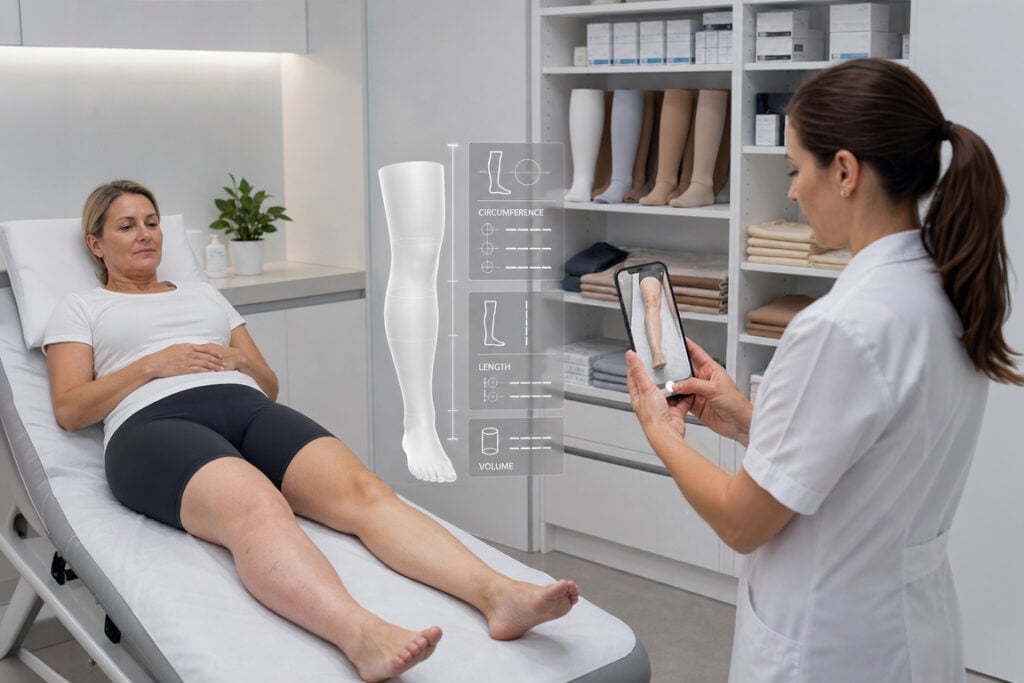





Every digital measurement vendor will tell you their system is accurate. Fewer will tell you accurate at what, compared to what, on how many people, or under whose independent review. In compression garment distribution and manufacturing, that gap costs more than it would in other categories, because a bad sizing decision doesn’t just annoy a customer. It produces a garment that must be remade, a patient or wearer who doesn’t get the compression class they need, and a clinical partner who starts questioning your recommendation process altogether.
This guide is meant to be a procurement checklist. It is not a technical paper and it’s written for the person who has to decide whether a vendor’s “clinically validated” claim is something they can put in front of a partner clinic or a compliance reviewer, or something that falls apart the moment someone asks a follow-up question.
How can I separate genuine clinical validation from vendor marketing?
Genuine clinical validation names its reference method, sample size, and the specific measurements tested — and reports results with error ranges, not a single rounded number. Marketing claims tend to stop at the headline figure.
The tell isn’t the number itself, it’s what’s missing around it. A validated result is reproducible because someone else could, in principle, run the same protocol and check it. A marketing claim is usually a single aggregate figure lifted from an internal test, stripped of the conditions that would let anyone else verify or challenge it. Ask for the underlying study or report, not the summary slide. Expecting an NDA is reasonable since most vendors share validation data under one. The signal to watch for is narrower: a vendor who won’t produce the report at all, or an NDA so restrictive that you can’t discuss the methodology with your own technical or clinical reviewers.
Two claims get blended together constantly, and they aren’t the same thing: how accurately the system measures a body, and how accurately it recommends a size. A vendor can have solid measurement accuracy and still make poor size recommendations if their size-chart or garment-calibration data is weak. The reverse is also possible, where recommendation accuracy looks strong for a well-calibrated collection but shouldn’t be read as a statement about raw measurement accuracy. Ask which one you’re being shown, because they are not interchangeable, and a claim that quietly swaps one for the other is one of the more common ways headline numbers get inflated.
What evidence should I demand before believing remake reduction claims?
Demand the baseline remake rate the comparison is measured against, the time period, and whether the reduction is measured on the same garment collections before and after — not a single case study presented as a universal average.
Remake-reduction numbers are especially easy to overstate because they combine several variables that have nothing to do with the measurement technology itself: how consistent the reference garments were to their nominal size chart, whether the product mix stayed the same across both periods, and whether staff adherence to the capture workflow was enforced. A vendor quoting a single client’s remake improvement without disclosing any of that context is handing you an anecdote. Ask what else has changed during the comparison window: staff training, product mix, returns policy, garment supplier. Few remake numbers isolate the measurement system cleanly from everything else happening in the business, and a vendor who says so is easier to trust than one who claims a clean attribution.
Also ask what counts as a “remake” in their data. Definitions vary: some vendors count only garments returned and physically remade, others include size exchanges, refunds, or complaints that never reached a formal remake request. If the definition isn’t stated, the percentage isn’t comparable to anything, including your own current remake rate.
What questions should I ask vendors about measurement accuracy?
Use this as a working checklist during vendor evaluation calls. A vendor that answers all of these directly, with specifics, is behaving like a company that expects its numbers to be checked.
| Ask this | What a real answer sounds like | Red flag if you hear |
|---|---|---|
| What was the reference (ground-truth) method? | A named method: 3D scanner, calibrated tape protocol, caliper etc., with its own known error margin disclosed | “Our internal testing confirms accuracy” with no comparison method named |
| How many people were measured, and who were they? | A specific sample size and a description of the population (age range, body types, clothing conditions, health conditions) | A number with no population description, or “hundreds of tests” with no total |
| Which measurements does the figure apply to? | A named list, e.g., ankle, calf, thigh circumference — each potentially with a different error range | A single blanket number applied to “all measurements” |
| Was the study run or reviewed independently? | A peer-reviewed publication, third-party audit, a named independent reviewer, or a named client reporting its own production results and willing to be contacted about them | Only an internal report, with no external review and no client willing to be named |
| What’s the error range, not just the average? | A stated spread or confidence interval (e.g., “±3mm at the ankle, widening to ±10mm at the thigh”) | Only a single average number with no variation reported |
| Is this measurement accuracy or size-recommendation accuracy? | A clear statement of which one, and how it was calculated (exact match vs. within one size vs. return rate) | The two terms used interchangeably in the same conversation |
| Who funded or ran the study? | Disclosed plainly, including if it was self-funded | Evasiveness about who conducted or paid for the testing |
| Does the result generalize to your population and garments? | An honest “it depends” that names the factors: compliance with the capture conditions, and health conditions present in your population | An unqualified “yes, it works for everyone” |
If a vendor can’t answer two or more of these without hedging, ask for the raw report before the conversation goes any further. A vendor confident in its own numbers should want you to see the methodology, since for them it’s the fastest route to a signed deal.
What clinical validation should I demand before deploying digital sizing technology?
Before deployment, ask for a validation report that names the reference method, sample size, and per-measurement results, ideally with independent review. Also, ask for a separate account of how the size-recommendation process works end to end.
Deployment risk comes from two different places: whether the underlying body measurements are accurate, and whether the recommendation logic built on top of them was actually tuned to your products. A vendor can be strong on one and weak on the other. For a compression garment distributor or manufacturer, insist on three things beyond the checklist above:
A stated scope of the claim.
“Accurate” measurement systems still have edge cases — loose clothing, unusual poses, poor lighting, or a limb whose shape has been distorted by a medical condition. A broad coverage claim isn’t automatically suspect. What separates a real one from a hopeful one is whether the vendor can rank its own measurements: which are strongest, which are weakest, and by how much. Ask as well whether each measurement is extracted independently or inferred from proportional relationships between body parts. A system that derives one measurement from another inherits the error of both, and degrades faster on atypical bodies. Ask directly what happens when the system is uncertain: does it flag the result, fall back to a simpler estimate, or silently return a number with no indication of lower confidence?
A repeatability figure, separate from an accuracy figure.
Accuracy tells you how close a measurement is to the ground truth; repeatability tells you how consistent the same system is across repeat measurements of the same person. For compression garment sizing specifically, repeatability often matters more day to day, because a stable, predictable bias can be easily corrected. However, inconsistent, unpredictable variation can’t be. Ask for both numbers and ask which one their headline claim is describing.
Evidence the calibration process is repeatable across your specific catalogue, not just their demo collection.
A validation study proves the underlying measurement technology works. It doesn’t prove the size-recommendation logic will work for your garments until it’s been calibrated against your actual size charts, garment samples, and fit preferences. Ask how many reference garments and fit trials that calibration typically requires, and what a realistic timeline looks like before the recommendations for your specific products can be trusted.
If regulatory traceability is also part of your deployment (audit trails, change control, documentation a notified body or quality team would expect to see), that’s a separate evaluation, and it deserves its own conversation rather than being folded into a discussion about accuracy.
What good evidence looks like, applied to one real number
An example is clearer than a description. Esenca Sizing ran a joint benchmark with a global manufacturer of compression therapy garments for conditions such as lymphedema, lipedema, and venous disorders. In that benchmark, run on data from the manufacturer’s controlled trials, each subject was measured manually by five independent professionals and digitally by Esenca Sizing and high-precision 3D scanners. Participants included people with healthy legs and people whose legs were affected by conditions causing edema or deformity, which is what makes the figures relevant to a real compression-therapy caseload rather than to a convenient sample. Esenca Sizing’s leg-measurement extraction differed from the 3D-scanner reference by approximately ±3–4mm near the ankle, widening to approximately ±8–10mm around the thigh. Across all circumference measurements in that study, 91.4% fell within 0.75cm of the reference, and repeat measurements of the same person varied by an average of ±3mm: around ±1.5mm at the ankle, rising to roughly ±4mm higher up the thigh. By comparison, the five professionals measuring the same participants by hand disagreed among themselves by as much as 3–4cm. The 3D scanner is what makes any of these checkable: it is an objective reference with its own known error margin, so the digital figures are anchored to a measurable standard rather than to another person holding a tape. Taken together, that’s a named reference method, per-region error ranges, and a stated manual baseline, rather than one rounded headline figure. That’s the shape of evidence to ask for. The full benchmark is published as a case study.
It’s also an example of what’s still missing from a claim like that until it’s handed over in full: the population tested, the exact protocol, and whether it’s been independently reviewed. That’s the point.
Even a strong, honestly reported number isn’t a substitute for the methodology. The right response to any vendor’s number, including ours, is to ask for the full report behind it, not to take the headline figure on faith. That standard doesn’t change depending on who’s presenting the data.
The Short Version
Ask what the number measures, against what reference, on how many people, with what error range, reviewed by whom and whether you’re being shown measurement accuracy or size-recommendation accuracy. A vendor with real evidence will answer all of that without hesitation, because it’s the same information that made the evidence credible to begin with.
Frequently Asked Questions
What’s the difference between measurement accuracy and size-recommendation accuracy?
Measurement accuracy describes how closely a system captures the body itself. Recommendation accuracy describes how often it names the right garment size — which also depends on size-chart quality and garment calibration. A vendor can be strong on one and weak on the other, so ask which number you’re being shown.
What is repeatability, and why does it matter as much as accuracy?
Accuracy is closeness to ground truth; repeatability is how consistently a system returns the same result on the same person. A stable, predictable bias can be corrected in the size logic. Unpredictable variation can’t. Ask for both figures, and ask which one the headline claim describes.
How accurate is manual tape measurement by comparison?
Less consistent than most teams assume. In one benchmark with a compression therapy manufacturer, five professionals measuring the same participants by hand disagreed among themselves by as much as 3–4cm — a wider spread than the digital error range being evaluated against them.
Is it reasonable for a vendor to require an NDA before sharing validation data?
Yes — most vendors share validation reports under NDA and that alone isn’t a warning sign. The problems are a vendor who won’t produce the report at all, or an NDA so restrictive you can’t discuss the methodology with your own technical or clinical reviewers.
What counts as a “remake” in a vendor’s remake-reduction statistics
It varies, and that’s the issue. Some vendors count only garments physically remade; others fold in size exchanges, refunds, or informal complaints. If the definition isn’t stated, the percentage can’t be compared to anything — including your own current remake rate.
Does clinical validation cover regulatory compliance?
No. Audit trails, change control, and the documentation a notified body or quality team expects are a separate evaluation from measurement accuracy. Treat them as their own conversation rather than accepting a validation report as evidence of regulatory traceability.
Will a vendor’s accuracy figures hold for patients with edema or limb deformity?
Only if the validation population included them. Ask whether affected limbs were represented in the study, and whether measurements are extracted independently or inferred from proportional relationships between body parts — inferred measurements inherit error from both and degrade faster on atypical bodies.
How long does calibration to our own size charts and garments take?
A validation study proves the measurement technology works; it doesn’t prove the recommendation logic fits your catalogue. Ask how many reference garments and fit trials calibration typically needs, and what timeline applies before recommendations for your specific products can be trusted.
What should I do if a vendor can’t answer these questions clearly?
If two or more answers come back hedged, stop and ask for the raw report before the evaluation goes further. A vendor confident in its numbers should want the methodology reviewed — for them it’s the fastest route to a signed deal.
About Esenca Sizing
Esenca Sizing is a machine learning-powered body, hand, and foot measurement platform used by manufacturers and distributors in medical garments, workwear, and footwear. The platform is browser-based, requires no hardware or dedicated app, and is ISO 8559 certified and GDPR audited. With over 500,000 measurements processed across 21 supported languages, Esenca Sizing provides consistent, body measurement data for production and fit optimisation workflows.