


Sizing has moved from an operational detail to a scored line in uniform procurement. A military uniform tender now routinely asks how fit accuracy will be demonstrated, how many personnel can be measured per day, how the size roll will be planned, and where measurement data will live.
A browser-based platform on personnel’s own phones covers most of these requirements, but not all of them. A programme that runs inside a restricted facility, or that forbids personnel data leaving the site, needs the measurement engine running on the device with no connection at all. This article covers what tenders ask for, when offline sizing becomes the requirement, how the offline application handles data, and what to put in a tender response.
What Military Uniform Tenders Typically Require
Fit Accuracy and Size Roll Planning
Tenders score measurement accuracy and size roll planning separately. Measurement accuracy is how close the captured body dimensions are to a reference method. Size roll planning is the quantity question: how many of each size to manufacture and hold, based on the actual body distribution of the population being equipped. A tender that asks only about accuracy and not about size roll is leaving the expensive half out, because the stock that gets written off is the stock nobody could wear.
Scanning the population produces both. The measurements feed the individual recommendation, and the distribution across the whole cohort feeds the size roll.
Fitting Speed for Large Personnel Groups
Equipping a unit is a throughput problem. The relevant figure is end-to-end time per person, including instructions and the recommendation. In a civilian deployment at comparable scale, Esenca Sizing measures over 5,000 people a month at roughly two minutes per person end to end. The platform itself is built to scale well beyond that, to millions of scans a month.
Reducing Returns, Alterations and Reissues
Every wrong size becomes an alteration, a reissue or a write-off, plus the administrative time to process it. In the same deployment, the size-related return rate runs below 3%, which the client reads as recommendation accuracy above 97%. Those figures come from workwear, and a defence programme should expect to see the equivalent measured on its own population during a pilot.
Data Protection and Security Conditions
This is where uniform tenders diverge from civilian workwear. Conditions range from standard GDPR processing terms through to data residency requirements, a prohibition on cloud processing, and capture inside facilities where no device may connect to an external network.
Why Privacy Is Critical in Some Military Programmes
Restricted Sites and Limited Connectivity
Two separate constraints get treated as one. A field location or a barracks basement may have no usable bandwidth. A secure facility may have bandwidth and forbid its use. Both require capture that works offline, and better coverage does not solve the second.
Personnel Data That Must Stay On Site
Body measurements tied to a service number should be handled in line with GDPR and the programme’s own security rules. Some programmes require that the images and the derived measurements never leave the site, and that any transfer out happens as a deliberate, inspected export rather than an automatic upload.
Who Sets These Requirements
These clauses usually come from three separate functions, which often work independently. Procurement sets the commercial and delivery terms. The security authority sets what may connect to what. The data protection officer sets lawful basis, retention and subject rights. A response that satisfies defense uniform procurement on price and schedule can still fail on a security clause nobody flagged at bid stage, so ask early which of the three owns each requirement.
Browser-Based by Default, Offline When Required
How the Standard Browser-Based Platform Works
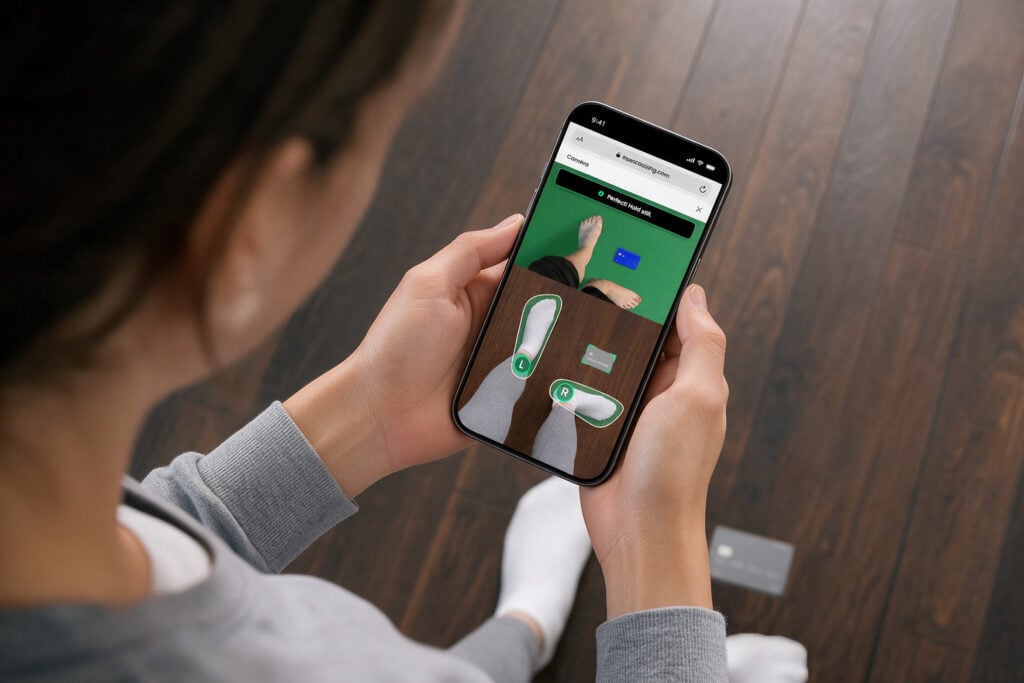
Personnel open a link on their own phone, follow audio and visual guidance to position the camera, and receive a size recommendation. Nothing is installed. For a programme spread across many locations with ordinary connectivity, this is the fastest route to coverage, because there is no hardware to ship and no app to approve.
When an Offline Application Is the Better Fit
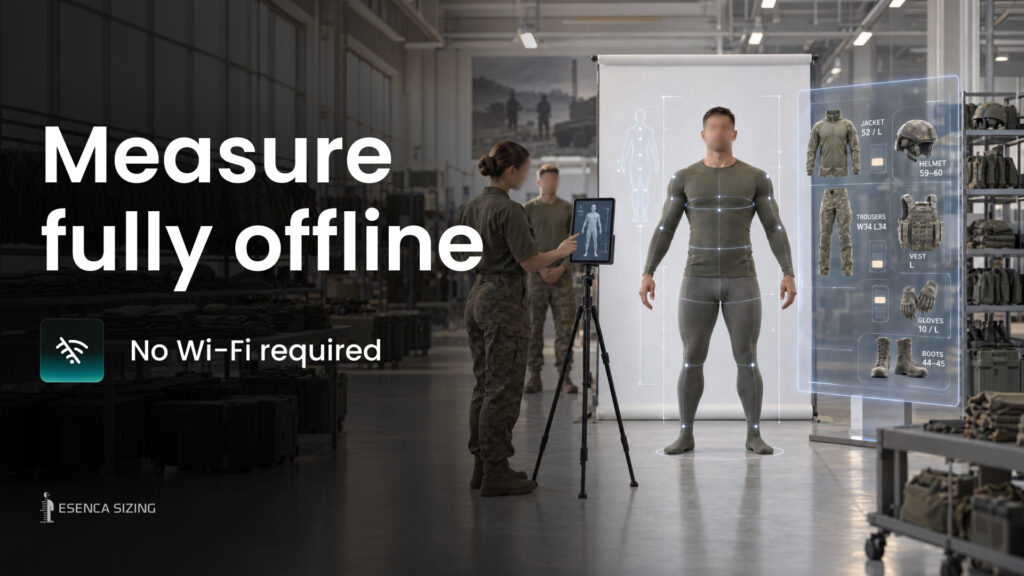
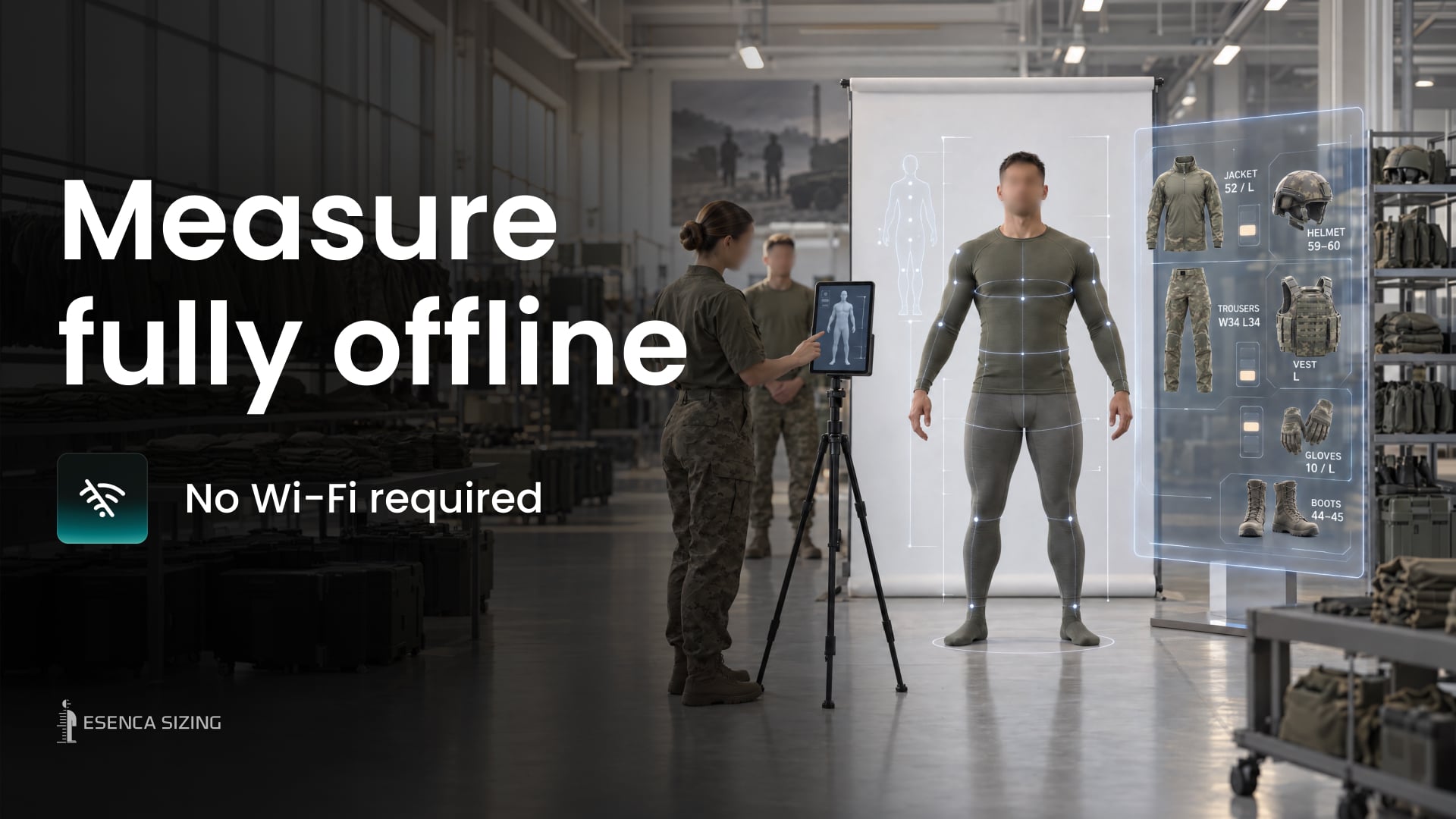
An offline body measurement app runs the measurement engine on the device itself. It suits three cases: sites without reliable connectivity, programmes where data must not leave the premises, and bulk measurement sessions where a fixed station processes a queue of personnel. Esenca Sizing provides offline builds for Android, iOS and Ubuntu.
Choosing the Right Setup for Each Programme
| Browser-based | Offline application | |
|---|---|---|
| Deployment | A link, on the person's own phone | Installed build, or a dedicated device per station |
| Connectivity | Required during capture | None required |
| Where processing happens | Split between device and server | Entirely on the device |
| Data leaving the site | Yes, as part of normal operation | Only through a deliberate export |
| Best for | Dispersed personnel, ordinary network conditions | Restricted sites, no connectivity |
| Logistics | No hardware to ship or approve | Devices to provision, approve and move between sites |
A single programme often needs both. Headquarters and dispersed units run the browser version while the restricted sites run offline stations, with both feeding the same size roll.
How the Offline Application Works
Capturing Measurements on the Device
The person stands in frame and the application guides the pose through on-screen and audio prompts. It checks that the whole body is visible, that the device sits at a usable angle, and that the pose is held long enough to capture. An operator can run the station for a queue, or personnel can be guided through it individually.
How Images Are Processed
Capture feeds a pipeline that runs locally. Segmentation separates the body from the background. Monocular depth estimation recovers the scene geometry that a single camera does not give directly. From there, measurement extraction and 3D model generation run as independent branches. The dimensions used for sizing are not derived from the avatar, so a fault in one branch does not corrupt the output of the other. Keypoint detection, plausibility checks and error detection run alongside, flagging a capture that should be repeated.
Where Data Is Stored, How It Is Transferred, How Long It Is Kept
The intended configuration keeps source images and personal data on the device and uploads nothing automatically. The images will be deleted immediately after being processed alongside with any other personal data that is no longer necessary. When a programme chooses to connect, an identifier and the resulting measurements can be sent to the dashboard, leaving the images behind.
Treat that as the default and not as a specification. The deployed data flow is configured per programme, and the retention period, the deletion mechanism and the export format belong in the contract.
Data Handling and GDPR
What Data Is Collected or Generated, and Why
Capture produces images. Processing produces derived artefacts: segmentation masks, depth maps, landmark positions, a set of body measurements and, where enabled, a 3D model. The measurements and the identifier are what the sizing decision needs. Everything else is intermediate, and the governing principle is that nothing is retained unless the programme has a stated reason for it.
Avoid the blanket claim that body measurements are Article 9 biometric data. Whether they fall into that category depends on whether they are processed to uniquely identify a person, which ordinary sizing does not do. The safer position for a tender response is to state what is collected, where it is processed, who can access it, how long it is kept and when it is deleted, for each category above.
Retention and Deletion
State a retention period per data category, name who can trigger deletion, and describe how deletion is evidenced. For an offline deployment this is simpler than for a cloud one, because the data sits on a device the customer controls.
GDPR Compliance Audited by KPMG
Esenca Sizing’s data protection practices have been audited by KPMG.
Accuracy and Standards
ISO 8559 Alignment
Measurement definitions follow ISO 8559-1:2017, which sets out the anthropometric definitions used to build size and shape profiles for clothing. Part 2 covers primary and secondary dimension indicators, and Part 3 covers the methodology for creating body measurement tables and intervals, which is the part that matters when a programme builds its own size roll. Naming the standard in a tender response removes an argument about what “chest circumference” means before it starts.
Validated Results From Large Deployments
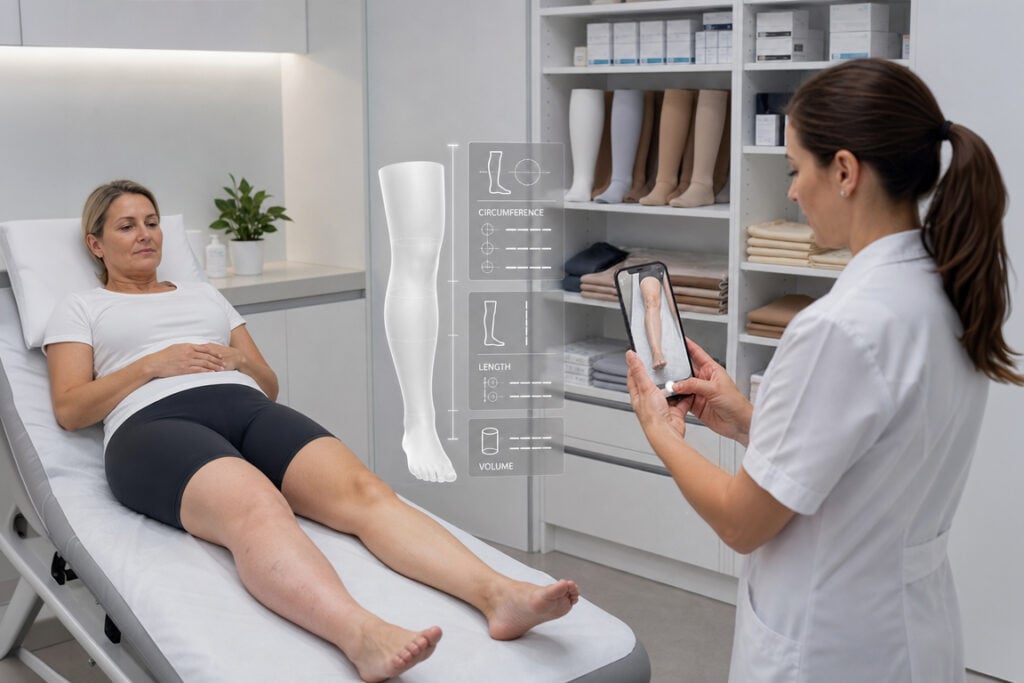
Two reference points, both from civilian programmes. In the workwear deployment described above, over 5,000 people are measured monthly, generating over 20,000 size recommendations a month at a size-related return rate below 3%. In clinical benchmarking for a compression-garment application, measurements were validated at approximately ±2 mm at the ankle and ±9 mm at the hip.
Both figures come from civilian conditions. A defense programme measures a different population, in different clothing, under different lighting, so the number that belongs in your business case is the one from your own pilot.
Running Mass Fittings for Military Personnel
Measurement Time per Person
Roughly two minutes per person, end to end, in a deployment measuring thousands monthly. That figure includes the guidance and the recommendation.
Fittings per Device per Day
At two minutes per person, one device handles around 25 to 30 people per hour of continuous operation per device, so a six-hour measuring day is in the region of 150 to 180 people per station. Treat that as a ceiling. Real throughput depends on queue management, briefing time and how many stations run in parallel.
Logistics for Multiple Sites or Units
Plan devices per site rather than per programme. Soldier body measurement sessions move with the unit. The practical questions are how many stations each site needs for its headcount and window, who provisions and moves the devices, who runs a station, and how exports are reconciled into one size roll.
What to Include in Your Tender Response
- Accuracy: the reference method, sample size and error range, with the validation report available on request.
- Speed: end-to-end time per person and throughput per station per day, stated as separate numbers.
- Privacy: what is captured, what is derived, what is retained and what never leaves the device.
- Offline capability: which platforms, whether any step requires connectivity, and what an export involves.
- Data retention: a period per data category, a named deletion mechanism, and how deletion is evidenced.
- Standards: the ISO 8559 parts the measurement definitions follow.
- Size roll: how the cohort’s measurement distribution converts into manufacturing quantities per size.
- Audit and security: audit scope and date, penetration-test status, subprocessors and hosting locations.
- Pilot terms: one unit, measured against your own reference, with an exit if the accuracy does not hold.
Frequently Asked Questions
Does the offline app need an internet connection at any point?
No connection is needed for capture or for producing measurements, since the engine runs on the device. A connection is used only if the programme chooses to export identifiers and measurements to a dashboard afterwards.
Where is measurement data stored?
On the device, in the intended offline configuration, with no automatic upload. The exact storage location, retention period and export path are configured per programme and should be written into the contract.
Can it be used inside secure facilities?
That is the case it was built for. The application runs with no network access, which addresses the common prohibition on devices connecting outside the facility. Approval still depends on the site’s own device policy.
How accurate is offline measurement compared with the browser version?
The offline build runs the same measurement engine as the browser platform. The difference between the two represent rather inference time than accuracy.
How many personnel can be measured per day?
At roughly two minutes per person, a single station handles about 25 to 30 people an hour, or around 150 to 180 in a six-hour day. Scale by running stations in parallel.
Conclusion and Next Steps
Military uniform sizing requirements usually split into two groups: the ones a browser-based platform already answers, and the handful about connectivity and data residency that decide whether an offline deployment is required at all. Work out which group each clause in your tender belongs to before choosing the configuration, because the security clause is the one that cannot be solved later.
Esenca Sizing runs browser-based by default and offline where a programme requires it. Talk to us about your programme’s requirements and we will map your tender’s accuracy, throughput and data-handling clauses against what we can evidence today.
About Esenca Sizing
Esenca Sizing builds smartphone-based measurement for workwear and PPE programs. Our foot measurement solution has been validated internally and is open to pilot partners running a safety footwear program who want to measure the exchange-rate change on one site first. Talk to us about a pilot.