


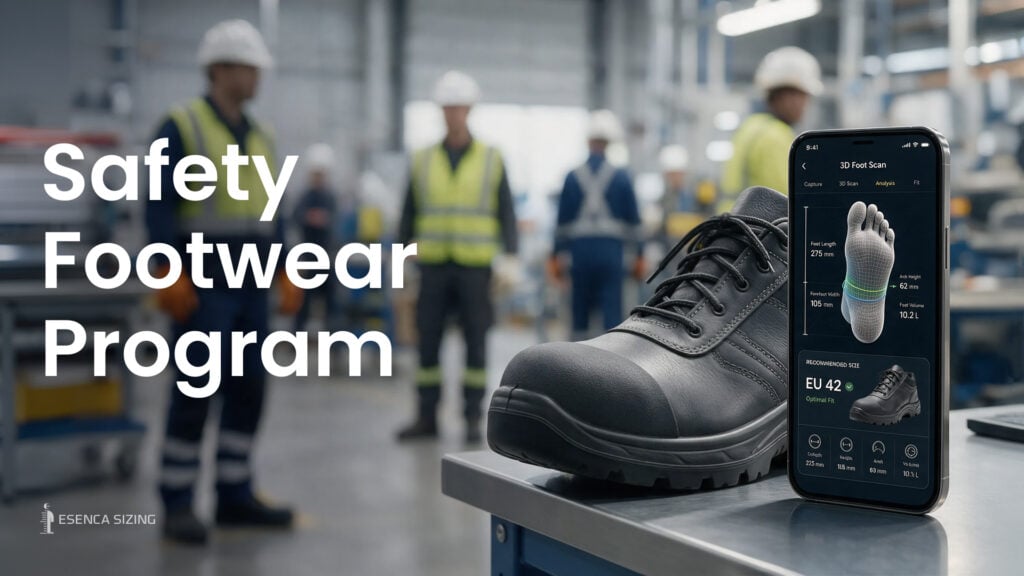
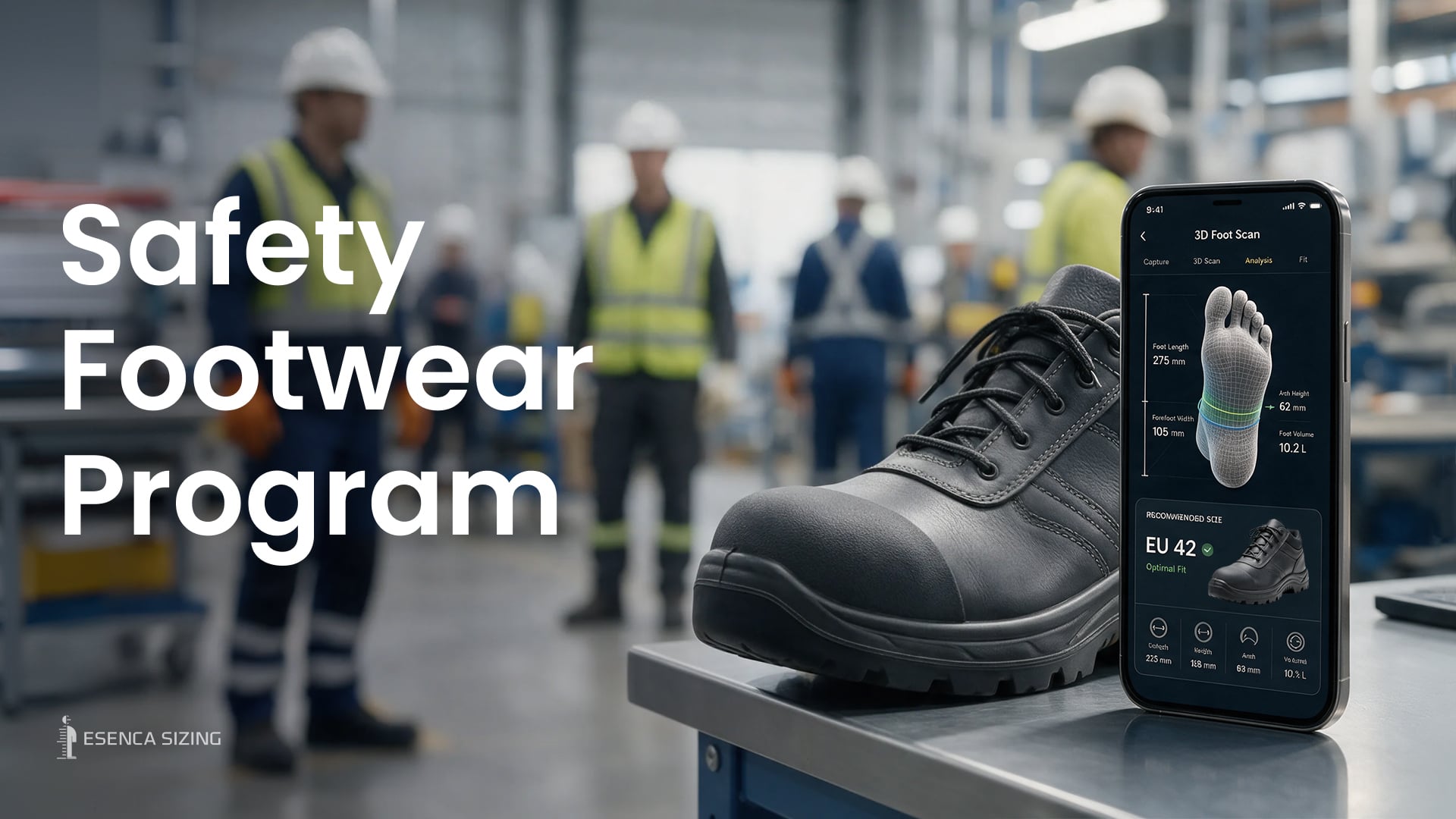
A safety shoe program is the process an employer uses to specify, fund, source and issue protective footwear to a workforce, and to document that it did so. Running one at scale means matching hundreds or thousands of people to the right model in the right size, across sites, shifts and job roles, then repeating that as people join and leave.
Most of a program’s avoidable cost comes from sizing. OSHA requires employers to select PPE that properly fits each affected employee, and a wrong size produces an exchange, a delay, and footwear nobody wears. This guide covers what the regulations require, where fit failures cost money, how 3D foot measurement fits a procurement process, and what to ask a vendor before signing.
What a Safety Footwear Program Involves
A program has four moving parts: a hazard assessment setting what protection each role needs, an approved product list, a funding and issuing mechanism, and records showing it was carried out. Sizing sits between the product list and the issuing mechanism. It is the part most programs handle least formally.
Employee Allowance vs. Employer-Issued Programs
Two models dominate corporate safety footwear. In an allowance program, the employer sets a value and a list of approved models, and the employee buys from a vendor or a truck visit. In an employer-issued program, procurement orders in bulk and distributes.
The payment rules push some programs toward allowances. Under 29 CFR 1910.132(h)(1), PPE used to comply with the standard is provided at no cost to employees. 1910.132(h)(2) exempts non-specialty safety-toe footwear, including steel-toe shoes and boots. Specialty footwear, such as metatarsal or static-dissipative boots required for a specific hazard, falls back under the employer-pays rule.
Sizing behaves differently in each model. An allowance program pushes the fit decision onto the employee at the till. An issued program puts it on whoever collects the sizes, usually a site coordinator with a sign-up sheet.
Compliance Requirements (OSHA and Industry-Specific Standards)
Three OSHA requirements apply: foot protection, fit and documentation.
Foot protection. 29 CFR 1910.136(a) requires employers to ensure each affected employee uses protective footwear where there is a danger of falling or rolling objects, objects piercing the sole, or certain electrical hazards. Under 1910.136(b)(1), the footwear must meet ASTM F2412 and F2413, or one of the older ANSI Z41 editions.
Fit. 29 CFR 1910.132(d)(1)(iii) requires the employer to “select PPE that properly fits each affected employee.” Construction got the same language in December 2024: the amended 1926.95(c) requires PPE to be “selected to ensure that it properly fits each affected employee,” effective 13 January 2025.
Documentation. 1910.132(d)(2) requires a written certification of the hazard assessment, naming the workplace evaluated, the person certifying it, the dates, and identifying the document as a certification. Training under 1910.132(f) carries its own requirements.
No OSHA standard requires you to record each employee’s foot measurements or to document how a fit decision was reached. The obligations are properly fitting PPE and a certified hazard assessment. Sizing records are good practice and useful evidence if a fit-related injury is questioned. No vendor should tell you OSHA mandates them.
Where Sizing Fit Failures Cost a Footwear Program Money
Replacement and Reorder Costs
A wrong size generates a return, a reorder, two freight legs and the admin time to process both. The employee works in the wrong boots meanwhile, or in their own shoes. Few programs track this as a line item. Pull twelve months of exchange data from your vendor and count it.
Downtime and Compliance Risk From Poor Fit
Footwear that pinches or slips gets taken off. An employee working in non-compliant shoes is an exposure no paperwork covers. Usually the boots were sized once, quickly, by someone guessing between two sizes. Blisters and gait problems also drive absence. That effect varies by workforce, so measure it in your own data before putting it in a business case.
Multi-Site or Multi-Vendor Sizing Inconsistency
Size labels are not standardized between manufacturers, so a size 44 from one supplier will not match a size 44 from another. Add regional size systems across countries and a program sourcing from three vendors ends up with three incompatible sets of records. Recording foot dimensions in millimeters avoids this, since a measurement stays valid whichever vendor you use.
How 3D Foot Measurement Fits Into Procurement
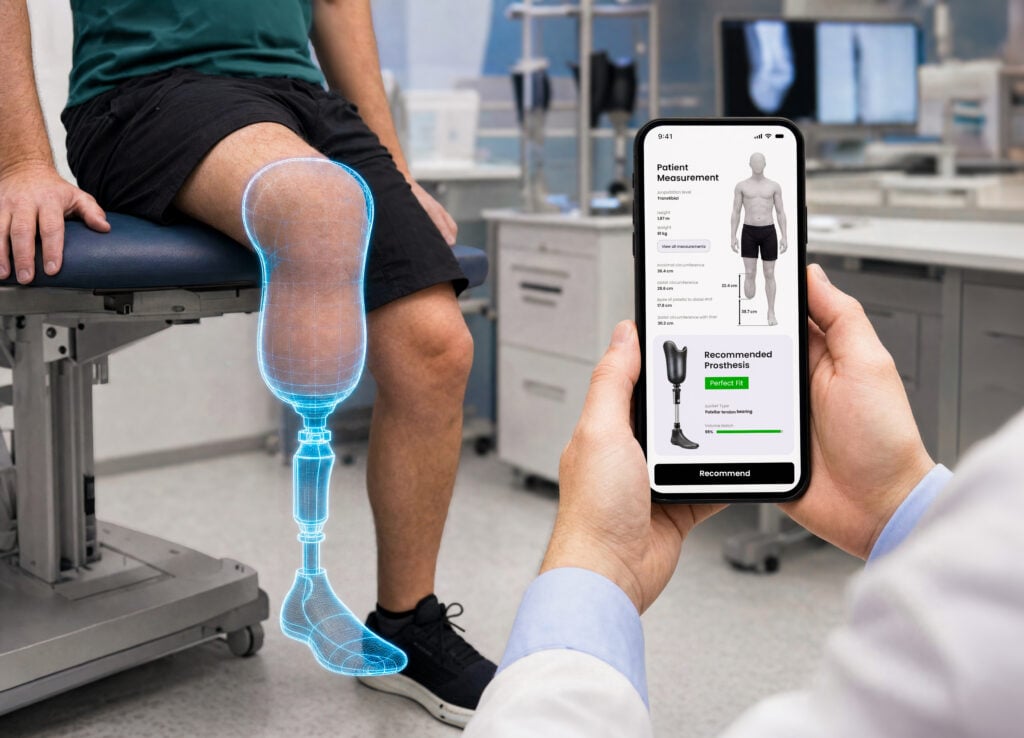
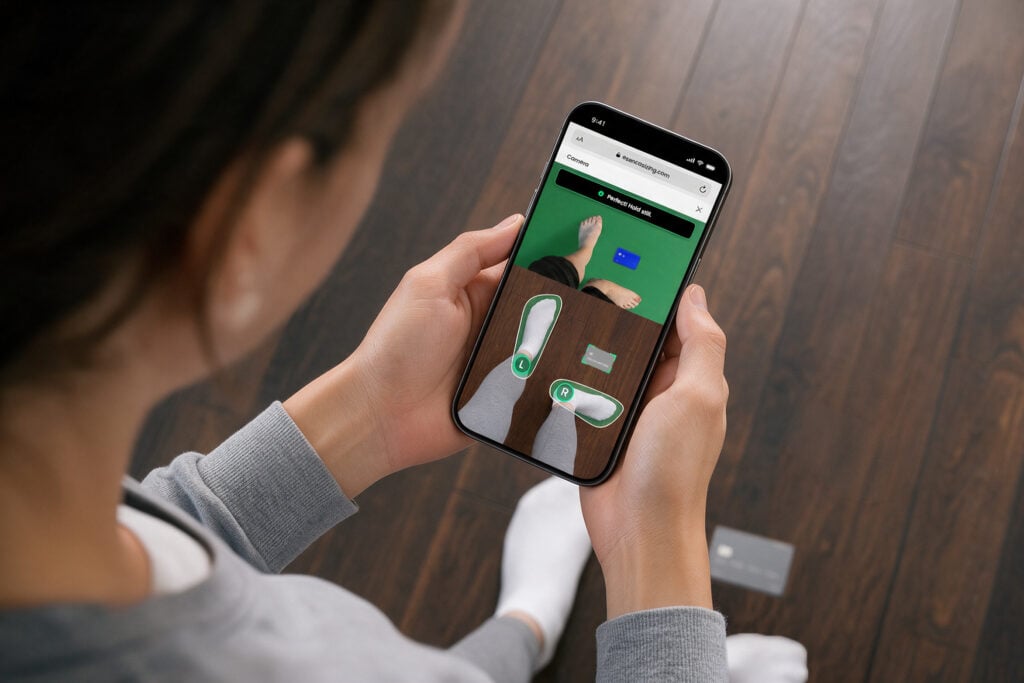
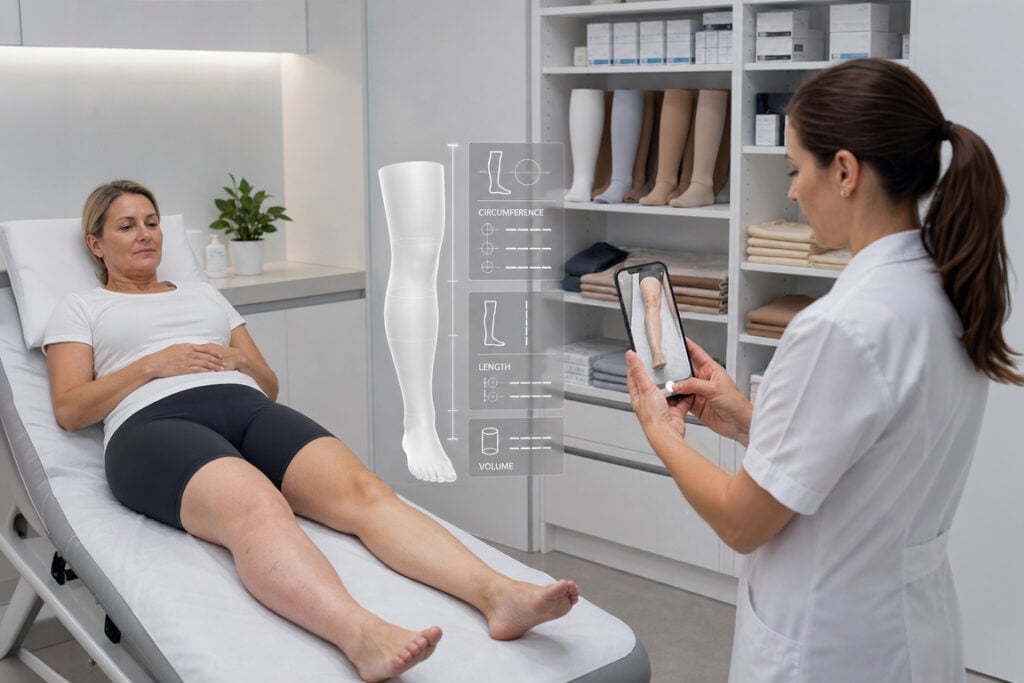
3D foot measurement captures the foot’s length, width and volume from a smartphone camera or a scanner, then maps those dimensions onto a manufacturer’s size chart. A procurement team wants both outputs: the recommended size for the model being issued, and the underlying measurements, which stay valid when the vendor changes.
Employee Self-Measurement vs. On-Site Fitting Events
A fitting event puts a trained fitter and a box of samples on site for a day. It works, but only for whoever is on site that day: shift workers miss it, remote sites never get one, new starters wait for the next visit. Self-measurement runs on a phone and covers people who were on nights or on the road. On the other hand, a fitting event lets someone try the actual boot on, which matters for unusual feet and for trust in a new program.
Feeding Measurement Data Into a Vendor Order or RFP Process
Measurement data is only useful once it reaches the order file. A workable sequence: capture measurements per employee, map them against each approved model’s size chart, export a consolidated order with employee ID, model and size, and keep the raw dimensions for the next cycle. Put the export format and the integration path into the RFP. Retrofitting it later means someone reconciles two systems by hand every ordering round.
Scaling Across Multiple Sites or Job Sites
Before a multi-site rollout, check four things. Does capture work without site-wide connectivity? Does the interface exist in the languages your workforce speaks? Can a site coordinator run it without training? Can results be reported by site and cost center? Ask before the pilot, since the answers rarely change afterwards.
Building the Business Case for Budget Approval
Cost of Fit Failures vs. Cost of a Measurement Program
Build this from your own numbers. The model needs four inputs: annual pairs issued, the exchange rate as a percentage of pairs, the fully loaded cost per exchange including freight and admin time, and current fitting-event spend including the labour hours of everyone attending. Multiply the first three for the annual cost of fit failures, add fitting-event spend, and compare that against the platform’s license and onboarding cost.
Published benchmarks for exchange rates in workforce footwear are thin, and a vendor-supplied industry average is worth less than one month of your own vendor’s return data. Ask for that data before you model anything.
ROI Timeline for a Mid-Size Workforce
For a few thousand pairs a year, measurement cost is usually a fixed annual figure while the saving scales with volume, so break-even falls out of the exchange-rate input. Run the model at your current rate and at half that rate. If it only works at the optimistic figure, pilot one site and measure the change before committing the program.
Traditional Fitting vs. Digital Self-Measurement for a Program
| Criteria | On-site fitting event | Digital self-measurement |
|---|---|---|
| Setup | Scheduling, samples, a fitter, space on site | App access and instructions distributed to employees |
| Cost driver | Per visit, per site, plus employee time away from work | Per measurement or annual license |
| Coverage | Whoever is on site that day | All shifts, remote sites, new starters as they join |
| Scalability | Limited by fitter availability and travel | Adding a site adds no fitting capacity requirement |
| Records produced | Usually, a size on an order sheet | Measurements and recommendation per employee, exportable |
| Main strength | The employee tries the actual boot on | Repeatable, reusable across vendors and cycles |
What to Ask a Vendor When Sourcing a Sizing Solution for a Program
- Measurement output: Do you get raw dimensions in millimeters, or only a size label tied to one manufacturer’s chart?
- Calibration: Is the recommendation calibrated per model and last, and what happens when you add a new approved model?
- Validation evidence: Accuracy against what reference method, on how many people, with what error range. Ask to see the full validation report.
- Standards and size systems: Does it handle ASTM F2413 and EN ISO 20345 ranges and the regional size systems your sites use?
- Integration: Which export formats, and does it connect to your ordering system or your distributor’s?
- Offline and language support: Does capture work without connectivity, and in the languages your workforce reads?
- Coordinator effort: Hours per site to run it, stated as a number rather than “minimal”.
- Data handling: Where employee measurement data is stored, for how long, who can access it, and what happens when someone leaves.
- Pilot terms: Can you run one site, measure the exchange rate before and after, and exit if it does not move?
Frequently Asked Questions
What is a safety shoe program?
A safety shoe program is how an employer specifies, funds, sources and issues protective footwear to its workforce, and documents that it did so. It covers the hazard assessment, the approved product list, the payment model, and the ordering and record-keeping process.
Does OSHA require specific footwear-fitting documentation?
No. OSHA requires employers to select PPE that properly fits each affected employee (29 CFR 1910.132(d)(1)(iii), and 1926.95(c) in construction since January 2025) and to certify the hazard assessment in writing (1910.132(d)(2)). No standard requires a record of each employee’s foot measurements, though keeping one is useful evidence.
How does digital measurement scale across multiple job sites?
Capture runs on employees’ own phones, so adding a site adds no fitting capacity. The practical limits are connectivity, language coverage and how much time a site coordinator has to run the process.
Can employees self-measure accurately without an on-site fitting event?
Guided capture with a reference object gives consistent results for most feet. Keep a route to a physical try-on for unusual feet, for footwear with a specialty last, and for anyone who reports a fit problem after issue.
About Esenca Sizing
Esenca Sizing builds smartphone-based measurement for workwear and PPE programs. Our foot measurement solution has been validated internally and is open to pilot partners running a safety footwear program who want to measure the exchange-rate change on one site first. Talk to us about a pilot.
If you are a footwear brand sizing your own product line instead of sourcing footwear for your own workforce, our foot measurement software buyer’s guide is the right page.