


Residual limb volume is not fixed. It falls sharply in the months after amputation, then keeps moving by a few percent over a single day, and socket fit depends on how well the clinic keeps up with both. Fernie and Holliday’s records linked a volume increase of 3–5% to difficulty donning the socket, which is a smaller change than many circumference-based volume estimates can resolve.
This piece is for prosthetists, O&P clinics and device manufacturers weighing measurement technology. It covers the published evidence on volume change, where tape and caliper measurement holds up and where it falls short, and what to ask before adopting a digital method. Patients and caregivers should start with their prosthetist.
Why Residual Limb Volume Changes, and Why It Matters for Socket Fit
Limb volume changes through post-operative oedema resolving and tissue atrophy, fluid shifting during the day, changes in body weight, and activity inside the socket. The socket is a fixed shape. When the limb shrinks, load moves to areas never meant to carry it. When it swells, donning gets harder and pressure rises everywhere.
The Maturation Curve: Volume Change in the First Months Post-Amputation
The early post-operative period carries the largest change. Sanders and Fatone’s 2011 systematic review in the Journal of Rehabilitation Research and Development cites Lilja and Öberg’s finding of a 17–35% volume reduction over 160 days, with volume stabilizing to within 5% by around 120 days. The same review places relative stabilization of shape and volume at 12–18 months after amputation, and notes that stabilization must occur before a definitive prosthetic fitting can take place.
Interim sockets exist for exactly this reason. It also means the measurement taken at one appointment describes a limb that may already be different by the next.
Daily and Activity-Driven Fluctuation in Mature Limbs
Volume keeps moving even after the limb has matured. Sanders and colleagues recorded daily fluctuations between −1.5% and +2.0% in eight transtibial subjects. Zachariah and colleagues measured volume changes between 0.2% and 17.0% within the first five minutes after doffing. Timing of the measurement changes the number you get.
Patients manage this with socks worn over the prosthetic liner, adding or removing ply throughout the day. Lilja and Öberg calculated that one 5-ply sock took up 5.2% of volume on a 1,192 ml limb model. A patient adding socks every afternoon is compensating for a change nobody has measured.
How Much Change Is Clinically Significant vs. Measurement Noise
The 3–5% donning threshold is the useful reference point. Sanders and Fatone estimate that one published circumference-based method, Boonhong’s multi-level girth measurement with a frustum model, carries an error of 2.4–5.7% when used to measure volume change. The measurement error band overlaps the change it is supposed to detect.
What Tape and Calipers Measure.
Tape and Caliper Variability Between Practitioners
The best-controlled evidence is more favorable to tape than vendors tend to admit. In Geil’s 2005 study, eight practitioners and five graduate students measured three foam transtibial models with seven devices. Circumference readings had standard deviations of 1.5–2.3 mm, and Geil concluded that with proper technique the variability was not clinically significant. Length was the weak point, with an average range of 14.2 mm across measurers.
Those were rigid foam models. A live limb compresses under tape tension, changes with posture and time since doffing, and has no fixed landmarks marked on it. Circumference is also a proxy. Turning a handful of girths into a volume figure is where Boonhong’s 2.4–5.7% error enters.
Why Measurement Intervals Are the Real Gap
Even a perfect tape reading is one reading. If the limb moves between −1.5% and +2.0% across a day and the clinic measures at scheduled visits weeks apart, the record shows two points and nothing between them. Accuracy at the visit does not recover what happened in the weeks around it.
What Gets Missed Between Scheduled Visits
What the record misses tends to show up as symptoms: added sock ply, skin breakdown, pistoning, a patient who stops wearing the prosthesis in the afternoon. Turner and McGregor’s 2020 survey of 50 amputees and 44 clinicians found socket fit named as the biggest factor affecting rehabilitation by 48.0% of amputees and 65.7% of clinicians, and cited earlier work reporting an average of nine prosthetist visits a year.
Where Digital/3D Measurement Helps
Measurement Frequency Without Added Chair Time
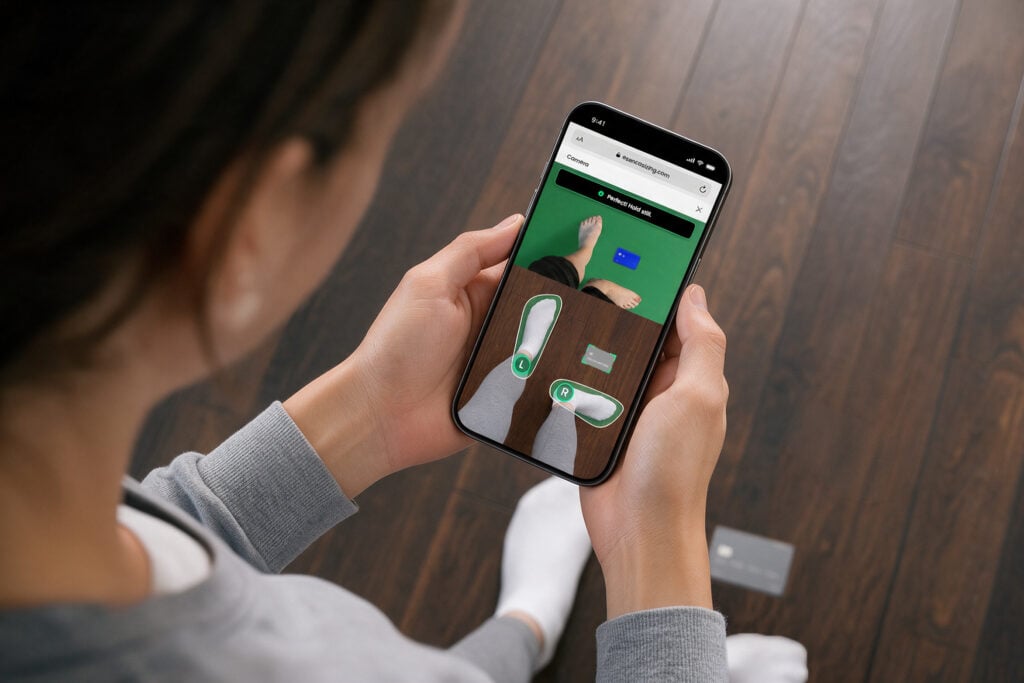
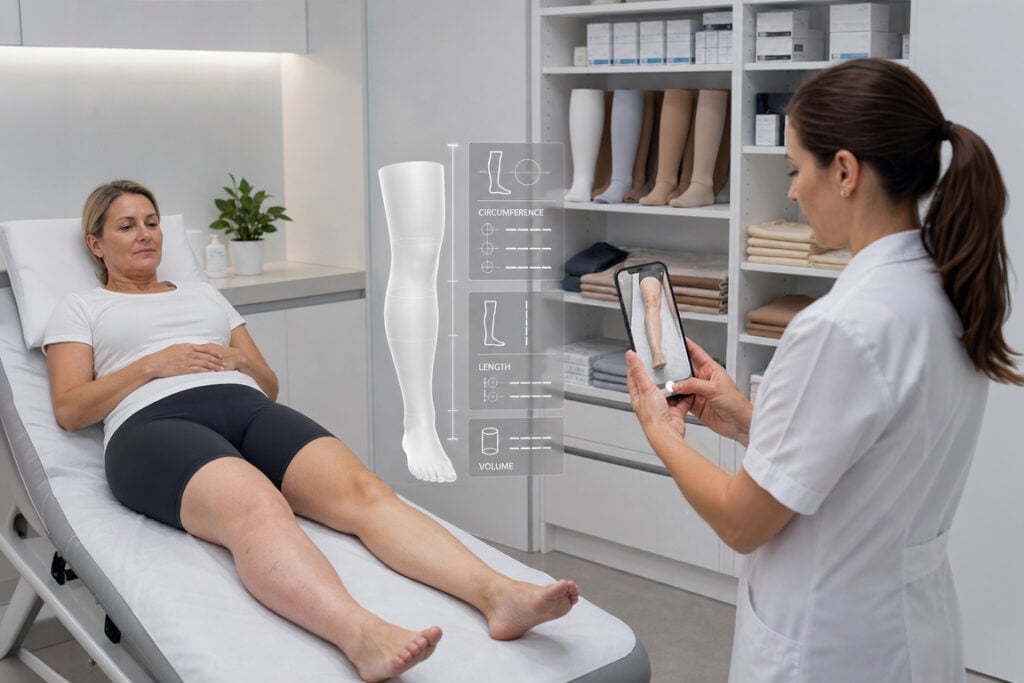
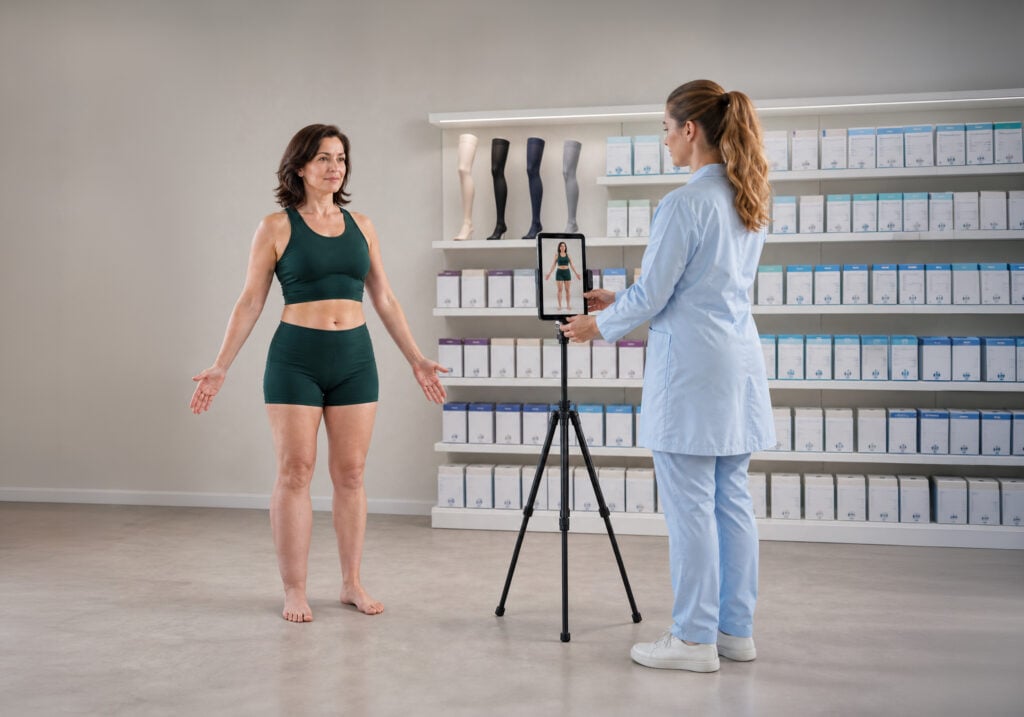
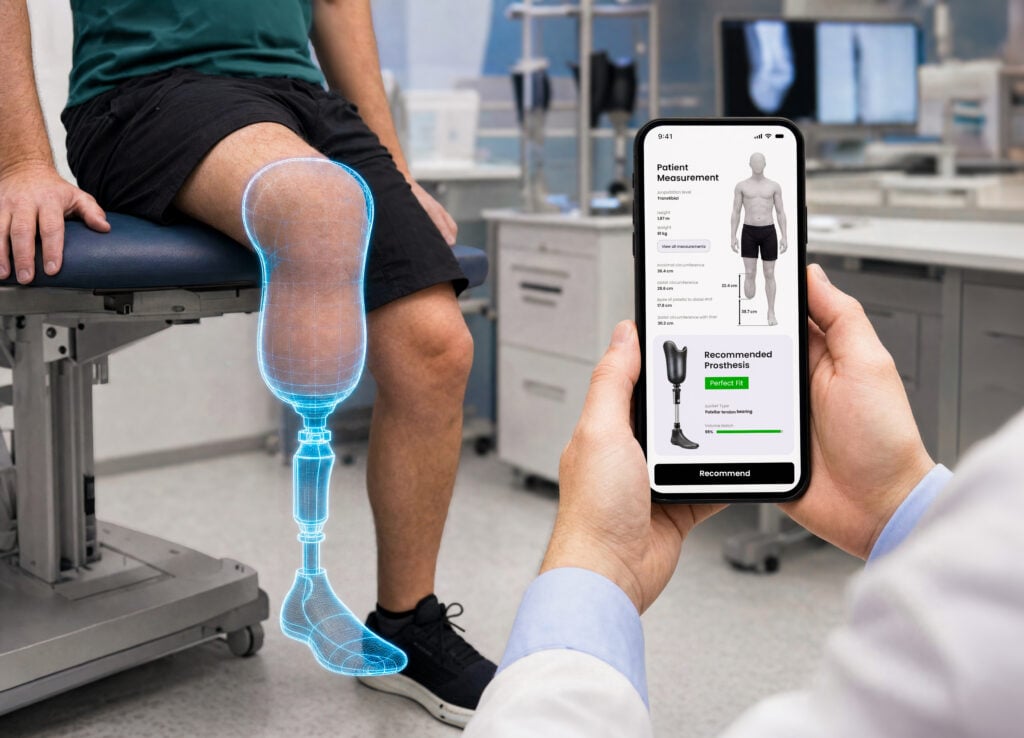
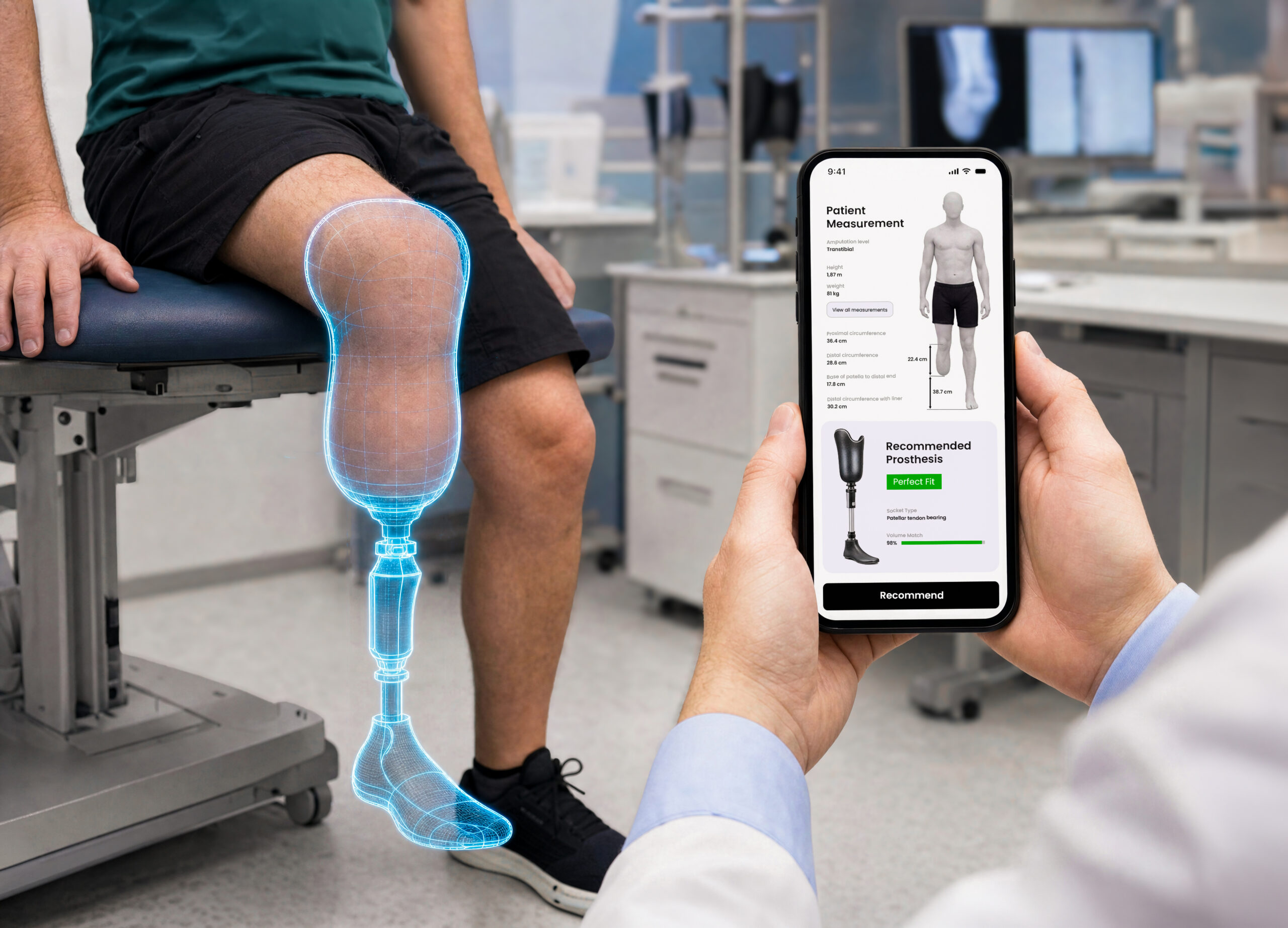
Scanning takes a full surface in one capture, so the clinic gets shape and volume together, though the bigger practical gain is how often you can repeat it. A capture method that runs on a smartphone can be repeated at every visit, or between visits, without booking chair time for it.
Repeatability: Same Practitioner, Same Patient, Different Day
Scanner repeatability is well documented on models. Seminati and colleagues (2017, PLOS ONE) reported intra-rater reliability of 0.5% and inter-rater reliability of 0.7% of volume for a structured-light scanner on ten limb models. On live limbs, Walters and colleagues (2024, PLOS ONE) tested smartphone photogrammetry against a reference structured-light scanner on ten limbs across five amputation levels, and the two apps that passed their clinical criteria showed coefficients of variation of 1.1% and 1.4%. A third app failed, so the specific capture method needs its own validation.
Catching Bilateral Asymmetry That Calipers Miss
A full-surface scan can be compared against the previous scan of the same limb, or against the contralateral side, region by region. Where volume change is uneven, concentrated distally or on one side of the tibia, a few girth readings at fixed heights will record it only if the change happens to fall at those heights. The same applies to bilateral amputees, whose two limbs can change at different rates and need tracking separately.
From Measurement to Socket: CAD/CAM Workflow Implications
Feeding Digital Measurements Into CAD/CAM Fabrication
In CAD/CAM prosthetics, the shape file is the starting point for rectification and carving or printing. A scan enters that workflow directly. A plaster cast has to be digitized first, and tape readings have to be turned into a shape by the software or the technician. Each conversion step is a place where error is added.
Remake Rate and Cost: What the Evidence Shows
The published evidence here is thin. A 2022 CADTH rapid review on multiple prosthetic sockets for lower limb amputation found no recommendations on the optimal number of sockets during preparatory and definitive phases, and called for higher-quality evidence. We have not found a well-sourced remake-rate or cost-per-remake figure for a general O&P population, so this article does not quote one. Seminati and colleagues describe socket adjustments and replacements after fitting problems as expensive and time-consuming. That is a qualitative description, not a measured rate.
If a vendor quotes a remake-reduction percentage, ask for the baseline, the period and what counted as a remake.
Digital Measurement vs. Traditional Methods
| Criteria | Digital / 3D scan | Plaster casting | Tape and caliper |
|---|---|---|---|
| What it captures | Full surface shape and volume | Full shape as a physical negative mould | Girths and lengths at chosen levels |
| Published repeatability | 0.5–0.7% of volume on models; CV 1.1–1.4% on live limbs for validated smartphone methods | Depends on casting technique; no comparable figure cited here | 1.5–2.3 mm SD for circumference on foam models; 2.4–5.7% error for volume change from girths |
| Output for CAD/CAM | Direct digital file | Needs digitizing | Needs a shape reconstructed from readings |
| Repeat between visits | Practical, including smartphone capture | A new cast each time | Possible, but only at the measured levels |
| Main limitation | Accuracy varies by capture method; validate the specific one | Messy, consumes materials, no record of change over time | Soft tissue compresses under tension; volume is an estimate |
Glove size conversion is simpler than footwear or apparel conversion for one reason: the US, UK and EU numeric columns hold the same values, because all three express hand circumference in inches. A size 9 is a size 9 in London, Chicago and Frankfurt.
The differences are in the columns besides the numbers. The alpha letter attached to a given circumference shifts between men’s and women’s ranges, and the centimeter marking some continental makers use looks like a different scale entirely. Convert through the millimeter figure and both resolve.
vs. Plaster Casting
Casting remains the reference many prosthetists trust, because it captures the limb under the practitioner’s hands and lets them load tissue deliberately. Scanning captures the unloaded surface. That difference matters for rectification. For tracking volume over time, a cast is a poor tool, since each one is a single physical object and comparing two of them means digitizing both.
vs. Tape/Caliper Measurement
Tape is fast and, on rigid models, consistent between trained practitioners. Its limits are coverage and inference. It measures where you place it, and the volume it implies carries an error comparable to the change you are trying to catch.
What to Ask a Vendor Before Adopting Digital Measurement
- Measurement protocol: How often can a capture be repeated, by whom, and does it fit your existing visit schedule?
- Validation evidence: Accuracy and repeatability on live limbs, with the reference method, sample size and amputation levels stated. Model-only results are a starting point.
- Error in volume terms: Results stated as a percentage of volume, so you can compare them against the 3–5% range that affects donning.
- CAD/CAM integration: Which file formats, and does it import into the software you already use for rectification?
- Clinical records: Where scans are stored, who can access them, how long they are retained, and how they link to the patient record.
- Remake claims: The baseline, period and definition behind any remake-reduction figure.
For a fuller treatment of what separates real validation from a headline number, see our guide to clinical validation versus marketing claims.
Frequently Asked Questions
How much can residual limb volume change in a day?
In published measurements of mature transtibial limbs, daily fluctuation ranged from about −1.5% to +2.0%. Readings taken in the first minutes after removing the socket can differ much more, so timing matters.
How often should residual limb volume be measured?
There is no published consensus interval. Measurement should be most frequent during the first 12–18 months, when volume is still stabilizing, and whenever a patient starts changing sock ply or reports fit problems.
Can digital measurement reduce socket remakes?
It can reduce the error and the gaps that lead to remakes, but no well-sourced remake-reduction figure currently exists for a general O&P population. Treat vendor percentages as claims to verify.
Does digital measurement integrate with existing CAD/CAM systems?
Scans produce a digital surface file that most CAD/CAM rectification software can import. Confirm the specific file format and import path with both the vendor and your CAD/CAM supplier before a pilot.
About Esenca Sizing
Esenca Sizing builds smartphone-based limb measurement, with validated work to date on legs for compression garments. See how Esenca Sizing captures limb measurement or book a demo to discuss a clinical pilot with your own reference method. For the rest of the evidence-first series, read Clinical Validation vs. Marketing Claims and Digital Measurement vs. Manual Tape in Compression Therapy.