


A medium from one manufacturer and a medium from another can sit a full size apart on the same hand. There is a standard behind protective glove sizing, EN ISO 21420:2020, and it publishes a reference table of hand dimensions by size. It also permits manufacturers to use a different sizing system of their own, provided they explain it in the standard’s terms. The number or letter printed on the cuff describes how one maker grades its patterns.
Below is the glove size chart to work from, the two measurements you need to use it, and the specific places where labels stop agreeing with each other: men’s and women’s ranges, numeric against alpha systems, and disposable gloves graded on palm width.
How to Measure Your Hand for Glove Sizing
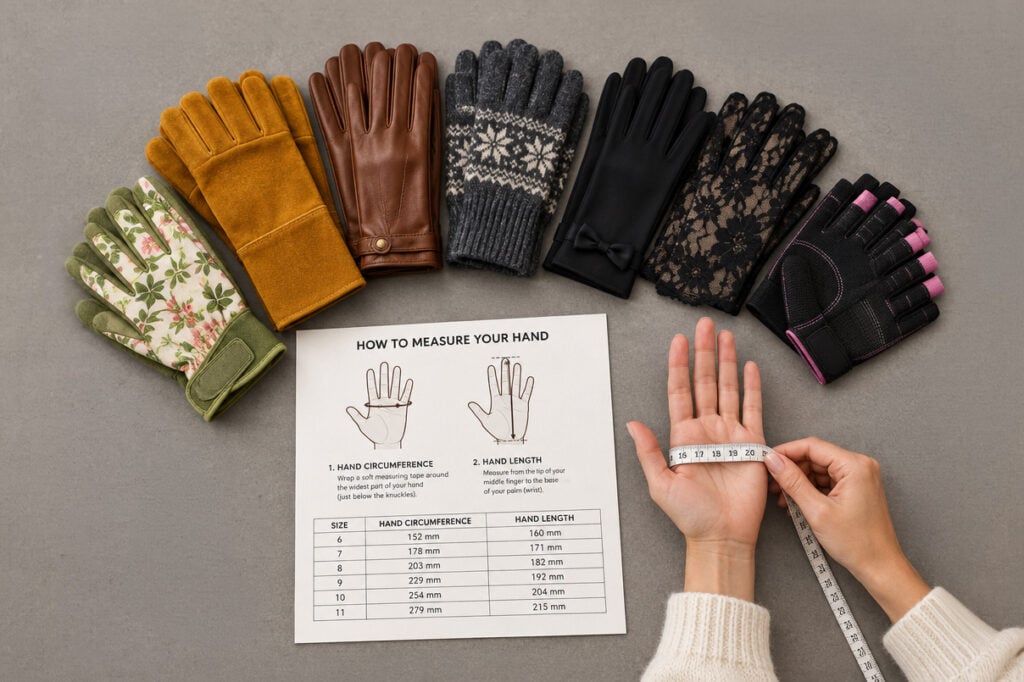
What to Measure: Hand Circumference and Hand Length
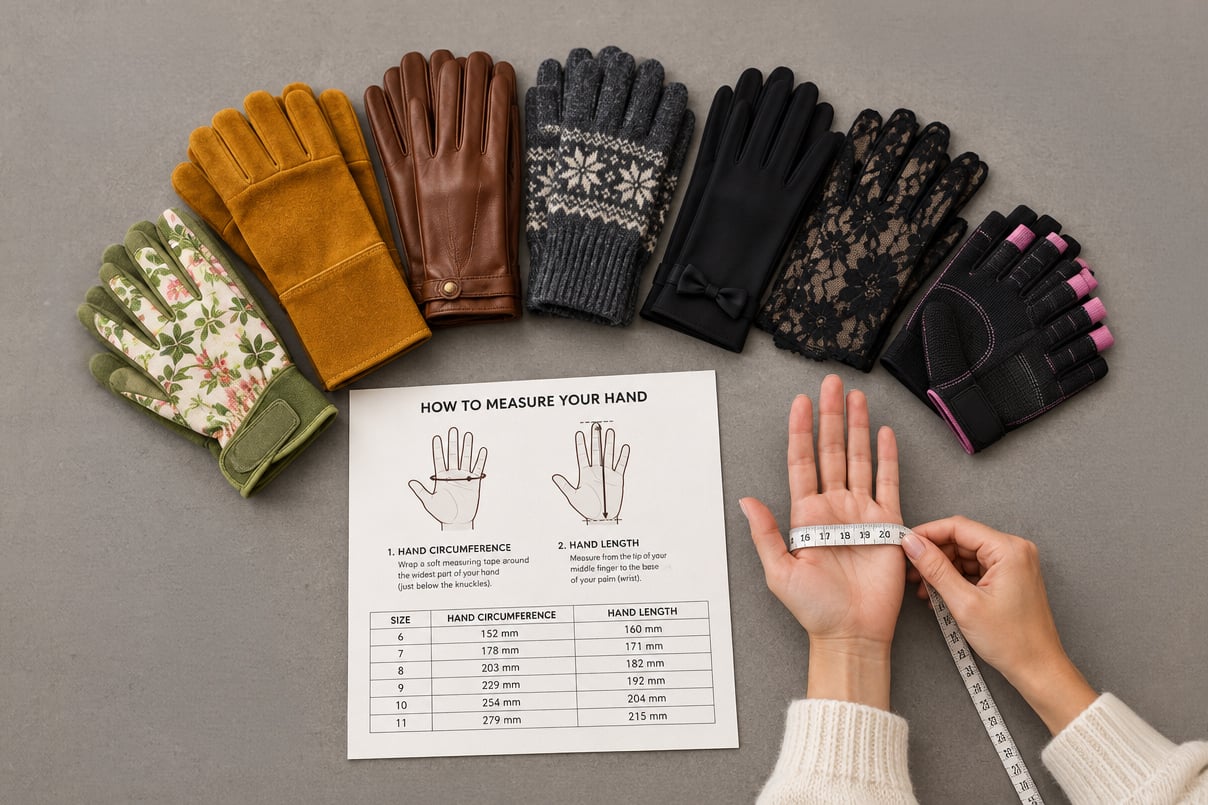
Glove sizing runs on two numbers. Hand circumference is the distance around the widest part of the palm, across the knuckles, with the thumb excluded. Hand length is the distance from the tip of the middle finger to the crease at the base of the palm. EN ISO 21420 defines each size against both figures, though most published charts show only circumference.
Circumference drives the size. Hand length tells you whether the fingers will be right at that size, which is where long, narrow hands run into trouble.
Step-by-Step Measurement Instructions
- Use your dominant hand. It is usually the larger of the two, and a glove that fits it will fit the other.
- Open the hand flat and relax it. Flexing the palm adds several millimeters.
- Wrap a soft tape around the knuckles, excluding the thumb, and note the reading in centimetres and inches.
- Measure from the middle fingertip to the base of the palm for hand length.
- Between two sizes on circumference, check hand length against the chart before deciding. Long fingers point up, short fingers point down.
That is how to measure glove size in full: two readings and a soft tape. For how repeatable those readings are between one person and the next, see our piece on hand circumference measurement accuracy
Standard Glove Size Chart
The table below is the EN ISO 21420:2020 reference scale, which replaced EN 420:2003+A1:2009 for protective gloves in Europe. Note that each row is a single nominal value, not a range. Brands turn these points into ranges themselves, and they do it differently.
| Size | Alpha | Circumference (mm) | Circumference (in) | Hand length (mm) | Hand length (in) |
|---|---|---|---|---|---|
| 6 | XS | 152 | 6.0 | 160 | 6.3 |
| 7 | S | 178 | 7.0 | 171 | 6.7 |
| 8 | M | 203 | 8.0 | 182 | 7.2 |
| 9 | L | 229 | 9.0 | 192 | 7.6 |
| 10 | XL | 254 | 10.0 | 204 | 8.0 |
| 11 | XXL | 279 | 11.0 | 215 | 8.5 |
The scale runs wider than this. Sizes 4 (101 mm) and 5 (127 mm) cover small hands, sizes 12 (304 mm) and 13 (329 mm) cover large ones. Most industrial catalogues stock 6 through 11 and order the rest in.
Men’s vs. Women’s Glove Sizing
The standard scale is one table with no gender split. A 203 mm hand is a size 8 whoever it belongs to. Consumer and workwear ranges split anyway, and the split moves the label rather than the hand.
A hand measuring 19 cm around the knuckles is labelled small in a typical men’s glove size chart and medium in a women’s glove size chart. Same hand, two letters. Many makers also cut women’s patterns with a narrower palm and shorter fingers at a given circumference, so the two ranges are not interchangeable even where the numbers appear to line up. If you are sourcing for a mixed workforce, ask suppliers for the millimeter values behind each label and compare those.
Numeric (European) vs. Alpha (US) Sizing Systems
The numeric system is the more precise of the two because the number is the measurement. A size 8 glove is built for an 8-inch, 203 mm hand circumference. Half sizes exist in dress and some sports ranges.
Alpha sizes are buckets. A common US chart puts XS at 6–7 inches, S at 7–8, M at 8–9, L at 9–10, XL at 10–11 and XXL above 11. Each letter absorbs a full inch of circumference, which is the entire gap between two adjacent numeric sizes. Someone at 8.1 inches and someone at 8.9 inches both buy a medium.
There is a third labelling habit to watch for. Some continental makers print the centimeter value directly, so a glove marked 20 is the glove another maker calls an 8, since 8 inches is 20.3 cm.
Why Glove Sizing Isn’t Standardized Across Brands
No Universal Manufacturing Standard
EN ISO 21420:2020 defines sizes 4 to 13 against hand circumference and hand length, then states that different sizing systems may be used if they are explained in the terms of the standard. A brand can grade its own way and remain compliant by documenting the mapping in its user information, which makes the scale a reference with an opt-out.
The 2020 revision also removed the minimum glove length requirement that EN 420 had carried. Under the old standard, total glove length was specified by size, from 220 mm at a size 6 up to 270 mm at a size 11. Minimum length now applies only where a particular application calls for it, such as welding or firefighting gloves. A size 9 certified in 2026 can be shorter in the cuff than a size 9 certified in 2019 with both fully compliant.
And the standard covers protective gloves. Dress gloves, fashion gloves and most sports gloves sit outside their scope entirely, on sizing conventions their own trades settled long ago.And the standard covers protective gloves. Dress gloves, fashion gloves and most sports gloves sit outside their scope entirely, on sizing conventions their own trades settled long ago.
Material and Cut Differences That Shift Fit at the Same Labeled Size
Two gloves built to identical internal dimensions still fit differently once material is involved.
Leather relaxes and takes the shape of the hand, so a leather glove that feels correct in the first week is looser by the fourth. Knitted gloves stretch on the hand, which is why one knit size often covers two or three numeric sizes and why knit ranges sell in three sizes where a leather range needs six. Coated gloves add a dipped layer over a liner, and that thickness sits inside the finger where you feel it. Thermal linings consume internal volume, which is why insulated winter work gloves are frequently ordered a size up from the same worker’s summer glove.
Pattern cut matters too. Where a maker sets the thumb, how much material crosses the palm, and how the fourchettes between the fingers are shaped all change how a nominally correct size feels during a grip. None of that appears on the label.
Size Charts by Glove Category
Work and Safety Glove Sizing
Industrial ranges usually follow the numeric 6–11 scale, often with an alpha letter printed alongside it on the cuff. A work glove size chart from a supplier should state hand circumference in millimeters for each size, and if it only gives letters, ask for the millimeter values.
Coated and lined models fit tighter than their uncoated equivalents at the same size, so a size range validated on one model does not transfer to another. And manufacturers themselves recommend confirming fit with samples from an authorized distributor before committing, which is worth doing on every new model in a programme.
Nitrile and Disposable Medical Glove Sizing
The labels diverge most on disposable, because the measurement underneath them changes. Plenty of manufacturers grade nitrile gloves on flat palm width instead of circumference. One published nitrile glove size chart lists XS at 70 mm palm width, S at 80 mm, M at 95 mm, L at 110 mm and XL at 120 mm, with its numeric range running 6.0 to 10.0 on that same palm-width basis. A “size 7.0” there means a 94 mm flat palm width. A size 7 under EN ISO 21420 means a 178 mm circumference.
Other disposable ranges publish hand circumference in inches, using the familiar 6–7, 7–8, 8–9 brackets. Two boxes of medium nitrile gloves can therefore have been graded from two different measurements of the same hand. Flat palm width roughly doubles to give circumference, which is enough to compare them before ordering.
Fit tolerance is narrower here. A disposable glove has no meaningful stretch reserve, and a size too small tears at the fingertips or rolls at the cuff during donning.
Dress and Fashion Glove Sizing
Dress gloves use the inch-based numeric scale with half sizes, and they carry a second specification the other categories do not: length, counted in buttons. One button is slightly over one inch, measured from the bottom of the thumb seam to the top of the glove, and the finished length runs roughly six to seven inches above the button count. A 4-button glove is 10–11 inches and covers the wrist plus a little forearm. An 8-button is the 14–15 inch three-quarter length. A 12-button reaches just over the elbow at 18–19 inches, and the 16-button opera glove is 22–23 inches, ending around mid-bicep.
Width and length are ordered separately here, so a size 7 exists in every button length.
International Glove Size Conversion
The table below shows one hand expressed in each of the systems you will meet on a supplier’s chart.
| Circumference (in) | Circumference (mm) | US / UK numeric | EU (EN ISO 21420) | Continental cm marking | Alpha |
|---|---|---|---|---|---|
| 6.0 | 152 | 6 | 6 | 15 | XS |
| 7.0 | 178 | 7 | 7 | 18 | S |
| 8.0 | 203 | 8 | 8 | 20 | M |
| 9.0 | 229 | 9 | 9 | 23 | L |
| 10.0 | 254 | 10 | 10 | 25 | XL |
| 11.0 | 279 | 11 | 11 | 28 | XXL |
Glove size conversion is simpler than footwear or apparel conversion for one reason: the US, UK and EU numeric columns hold the same values, because all three express hand circumference in inches. A size 9 is a size 9 in London, Chicago and Frankfurt.
The differences are in the columns besides the numbers. The alpha letter attached to a given circumference shifts between men’s and women’s ranges, and the centimeter marking some continental makers use looks like a different scale entirely. Convert through the millimeter figure and both resolve.
When a Size Chart Isn’t Enough
A chart maps one or two hand measurements onto a label. It works when the measurements are taken correctly and when the label matches the chart. Both conditions fail often.
Tape measurement varies between people and between attempts by the same person. Tape tension, thumb position and whether the hand was flexed all move the reading, and a few millimeters at the boundary between a size 8 and a size 9 decide the order. The label is the second gap. A chart cannot tell you how a manufacturer graded a particular model, whether it was cut on palm width or circumference, or how much a coating eats into the finger.
For one person buying one pair, an exchange fixes it. For a programme issuing gloves to a few thousand people, the same failure shows up as exchange volume, freight, administrative time and PPE that workers stop wearing because it snags or slips.
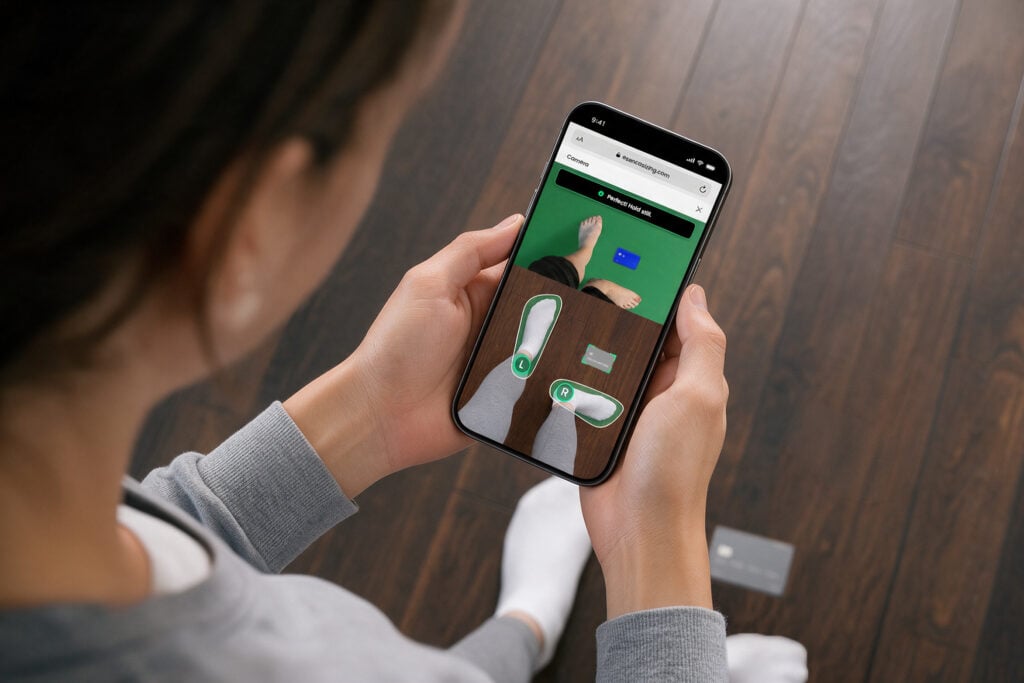
Closing that gap means measuring hands consistently and mapping the result to a specific manufacturer’s grading for a specific model. Esenca Sizing captures hand measurements from smartphone photos and maps them against the size chart of the glove being issued, so the recommendation is tied to the model in front of the worker.
Frequently Asked Questions
How do I know my glove size without a chart?
Measure the circumference of your palm around the knuckles, excluding the thumb, in inches. That figure is your numeric glove size for most brands: an 8-inch hand is a size 8. You still need the brand’s own chart to translate that into their alpha label.
Does glove size vary by brand?
Yes. EN ISO 21420:2020 publishes a reference size table but allows manufacturers to use a different sizing system if they document it, and the standard does not cover dress, fashion or most sports gloves at all. Alpha sizes vary the most, since each letter covers roughly a full inch of hand circumference.
What’s the difference between numeric and letter glove sizes?
A numeric size is a measurement: size 8 means a 203 mm hand circumference. A letter size is a bracket, typically one inch wide, so medium covers hands from about 8 to 9 inches. Numeric sizing is more precise, which is why industrial and medical ranges rely on it.
How do I convert EU glove sizes to US?
For protective gloves there is nothing to convert. Both use hand circumference in inches, so an EU 9 is a US 9. If a glove is marked 20 or 23, that is a centimeter measurement used by some continental makers, and it corresponds to a size 8 and a size 9 respectively.
See how Esenca Sizing’s hand measurement works, or book a demo.
About Esenca Sizing
Esenca Sizing is a machine learning-powered body, hand, and foot measurement platform used by manufacturers and distributors in medical garments, workwear, and footwear. The platform is browser-based, requires no hardware or dedicated app, and is ISO 8559 certified and GDPR audited. With over 500,000 measurements processed across 21 supported languages, Esenca Sizing provides consistent, body measurement data for production and fit optimisation workflows.