


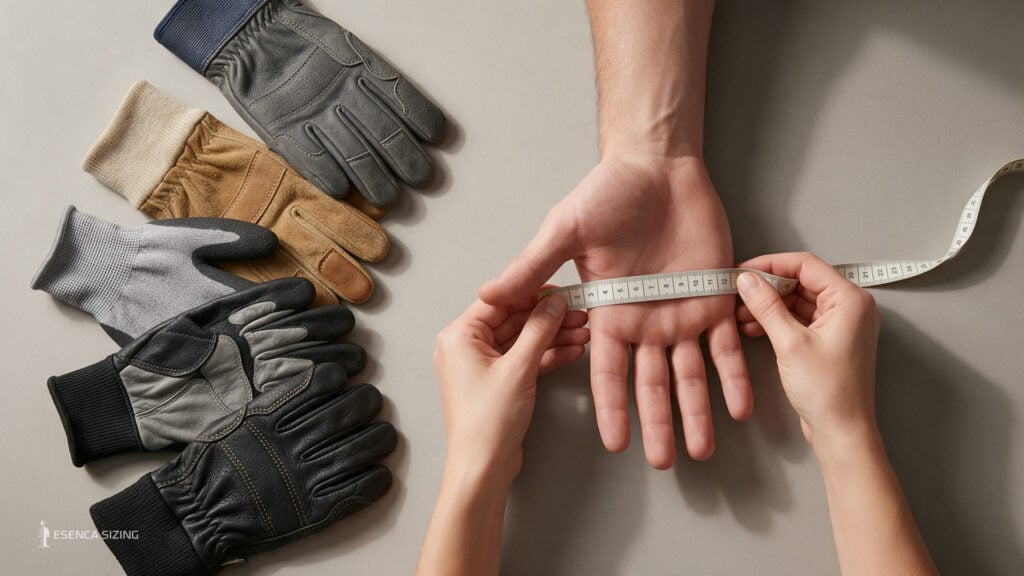
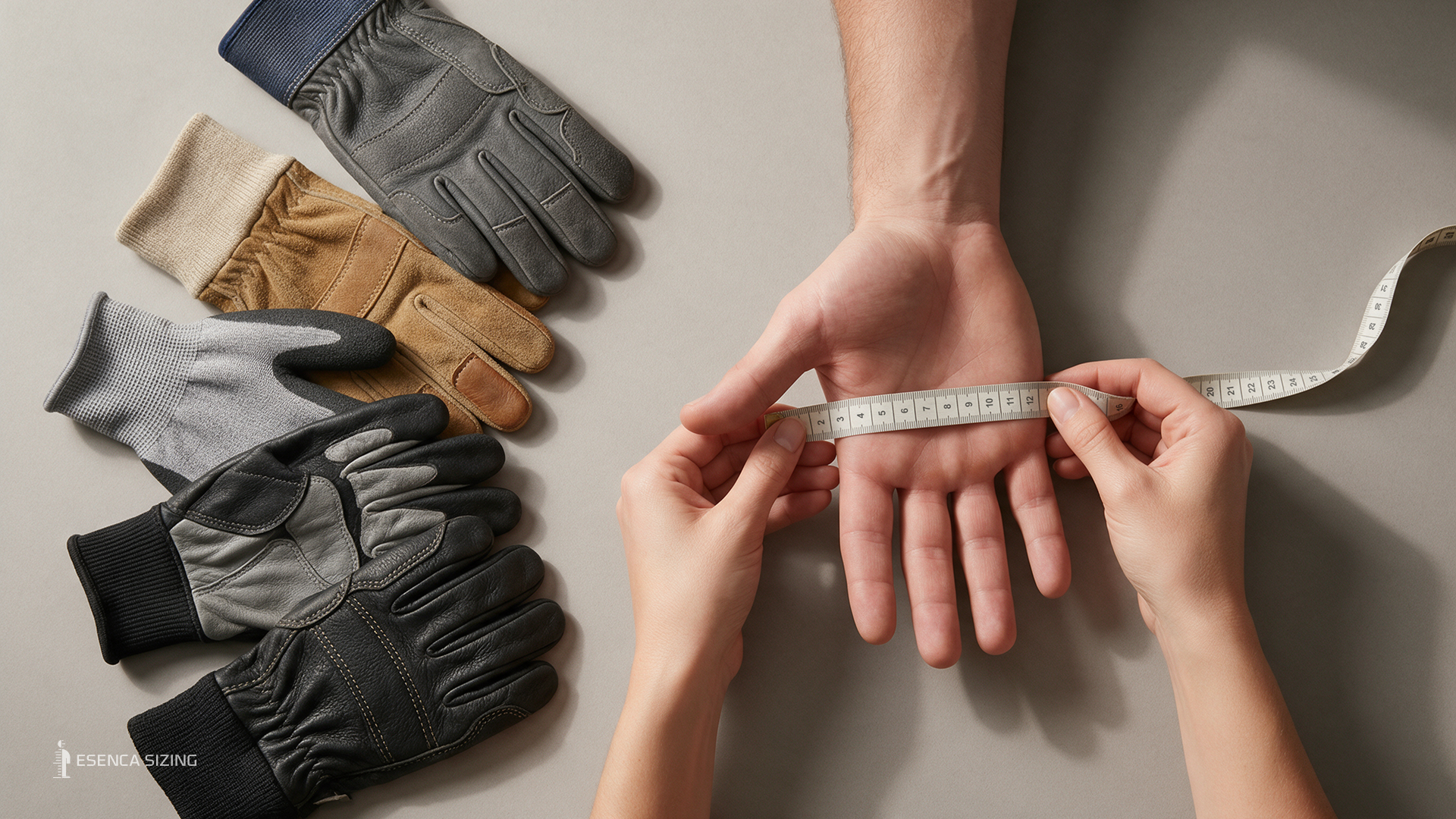
A tape around the knuckles is the standard way to size a glove, and it is more repeatable than most people assume. Trained measurers using a tape on a hand reach intraclass correlations of 0.94 to 0.97, which is good agreement by any clinical standard.
The number still moves. It shifts with tape tension, with where the measurer sits the tape, with what the hand has been doing for the last ten minutes, and with whether the person measuring is also the person being measured. This page covers how much it moves, how that compares to the size steps a glove range uses, and when the difference changes which glove you order. For the chart and the step-by-step method, see our glove size chart.
What Hand Circumference Actually Measures
Hand circumference is the distance around the widest part of the palm, across the knuckles, with the thumb excluded. It is the primary glove-sizing dimension because a glove has to pass over the knuckles to go on at all, and because the palm is where a glove carries load during a grip.
Palm Circumference vs. Hand Length vs. Palm Width
Three dimensions describe a hand for sizing, and they do different jobs. Palm circumference sets the size. Hand length, measured from the middle fingertip to the base of the palm, decides whether the fingers of that size will be right. The flat measurement across the knuckles is what several disposable-glove makers grade on, which is why a size label from one maker does not transfer to another.
Circumference captures thickness as well as width, so it describes more of the hand than a flat measurement does. One number still does not describe a hand. In a study of 943 US firefighters, Hsiao and colleagues measured fourteen hand dimensions and concluded that structural glove fit is multidimensional, recommending a sizing scheme built on overall hand size and on the contrast between breadth and length.
Where to Measure
Around the knuckles at the widest point, thumb excluded, hand open and relaxed. Measure the dominant hand, usually the larger of the two. Repeat measurements only mean something if the landmark is the same every time.
Where Tape Measurement Goes Wrong
Tension and Landmark Inconsistency Between Measurers
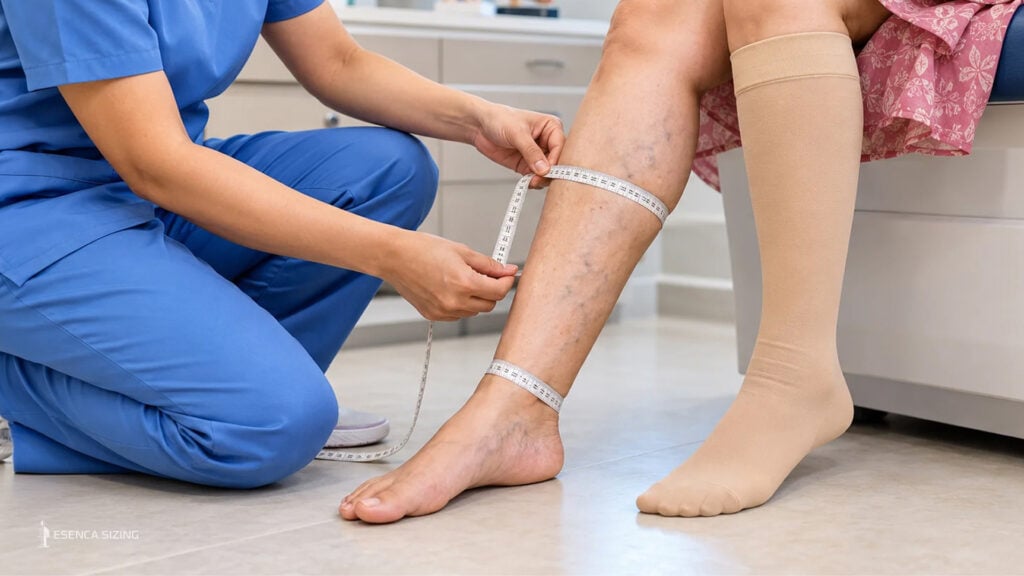
The best-characterised tape measurement of a hand is the figure-of-eight method used in hand therapy, where a tape follows a fixed path around the hand and wrist. Dewey and colleagues tested it in 2007 on 33 oedematous hands in 20 burn patients. Two testers each took three blinded readings: intra-rater agreement came out at ICC 0.96 and 0.97, inter-rater agreement at 0.94, and the correlation with water volumetry at r = 0.83 and 0.89.
Read that carefully. The method is reliable in trained hands, and two testers still agree measurably less well than one tester agrees with themselves. Tape tension is the main reason. A tape pulled snug compresses soft tissue, a tape laid on compresses none, and nothing on the tape tells you which one you did.
Self-Measurement Error
Measuring your own hand introduces problems the studies above never tested. You cannot keep the measured hand relaxed while the other hand pulls a tape around it, so it tends to tense, and a flexed palm reads several millimetres larger. Reading the scale means rotating the hand, which moves the tape. Most people take one reading.
No published study quantifies self-measurement error for this measurement. The honest position is that it is larger than the trained-rater figures above by an amount nobody has measured. For a single pair of gloves that is fine. For a workforce, the error is both unmeasured and uncontrolled.
Swelling, Time of Day, and Activity
The hand changes size during the day. Yamauchi and Hargens measured hand and wrist volume in nine healthy adults before and after gripping exercise at 20% of maximum effort, six sets of 30 seconds each. Volume rose by 2.2 ± 0.7% after dynamic gripping and 1.4 ± 0.8% after static gripping. Heat, salt and long periods with the arms down push the same way.
So a hand measured at 7 a.m. and the same hand at 3 p.m. are not the same hand. Gloves issued from a morning fitting session are worn by a hand that spends most of its working day slightly larger.
How Much Measurement Error Actually Affects Glove Fit
The useful comparison is error against size step. Under EN ISO 21420, consecutive numeric glove sizes are one inch of palm circumference apart, so a size is a 25.4 mm band and a half size is about 12.7 mm. A few millimetres of tape tension is a small fraction of a full size. It is a large fraction of a half size, and it decides the order for anyone sitting near a boundary.
Fit Tolerance by Glove Category
Tolerance depends on what the glove is made of. Knitted gloves stretch, so one knit size often covers two or three numeric sizes and a few millimetres of error disappears into the stretch. Leather and coated gloves have far less give, and a coating sits inside the finger where the wearer feels it. Disposable gloves have almost no stretch reserve, so a size too small tears at the fingertips during donning. Medical and compression gloves have the tightest tolerance of all, because the fit is the therapeutic mechanism.
When a Half-Size Error Matters
For a casual or fashion glove, a half size out is a comfort preference. For PPE, it is a performance and compliance question. A safety glove a half size too large slips during a grip and snags. A half size too small restricts circulation and gets taken off, and a glove nobody wears protects nobody.
The firefighter study has a harder finding. Its published size ranges covered 72% of the men measured, and choosing the size that matched those ranges showed no association with whether the wearer reported a good fit (χ² = 0.18, p = .67). Measuring correctly and matching the chart is necessary. On that evidence it is not sufficient, and a vendor claiming measurement alone guarantees fit is overselling.
Tape vs. Digital Measurement Compared
| Tape measure | Camera-based digital measurement | |
|---|---|---|
| Published reliability | ICC 0.94 between trained raters, 0.96–0.97 within one rater (figure-of-eight method) | 2.4 mm average spread across repeated measurements, vendor-tested |
| Dimensions captured | One per pass of the tape | Twenty or more per capture |
| Main error source | Tape tension and landmark placement | Capture conditions: reference object placement, camera angle, hand pose |
| Equipment | A soft tape | A smartphone and a sheet of standard-size paper |
| Self-service | Possible, with unquantified added error | Designed for it, with on-screen guidance during capture |
| Record produced | A number someone writes down | A stored measurement set per person, reusable across styles |
What This Means for Bulk and PPE Procurement
For one person, a tape and a careful reading is enough. Across a workforce the problem changes shape. The error is no longer one person’s few millimetres but an unknown distribution across hundreds of self-measurements, taken at different times of day by people never trained to take them, and afterwards nobody can tell which sizes were wrong or why. Capturing the underlying dimensions and keeping them per person is what makes the next ordering round cheaper than the last.
Frequently Asked Questions
How accurate is hand circumference measurement with a tape measure?
In trained hands it is reliable: published figures for tape measurement of the hand show intraclass correlations of 0.94 between raters and 0.96 to 0.97 within a rater. Tape tension and landmark placement are the main sources of disagreement, and self-measurement adds error that has not been quantified in published work.
Does hand size change throughout the day?
Yes. Hand and wrist volume rose by about 2.2% after dynamic gripping exercise and 1.4% after static gripping in one controlled study. Heat, salt and long periods with the arms down have similar effects, so a hand measured before a shift is smaller than the same hand after one.
What’s the difference between palm width and hand circumference?
One is the flat distance across the knuckles. The other is the distance all the way around the palm at the same place, excluding the thumb, so it captures thickness as well as width. Some disposable-glove makers size on width and others on circumference, which is one reason the same label fits differently between brands.
Can you accurately measure your own hand for glove sizing?
Well enough for a single pair, if you keep the hand open and relaxed, take three readings and use the middle one. It is harder than it looks, because the hand being measured tends to tense while the other hand works the tape.
About Esenca Sizing
Esenca Sizing captures hand measurements from a smartphone photo and maps them to the size chart of the specific glove being issued. See how it works or talk to us about a programme.
For the chart and the measuring method, see our glove size chart, which covers how to measure your hand step by step and why a hand size chart from one manufacturer does not transfer to another.