


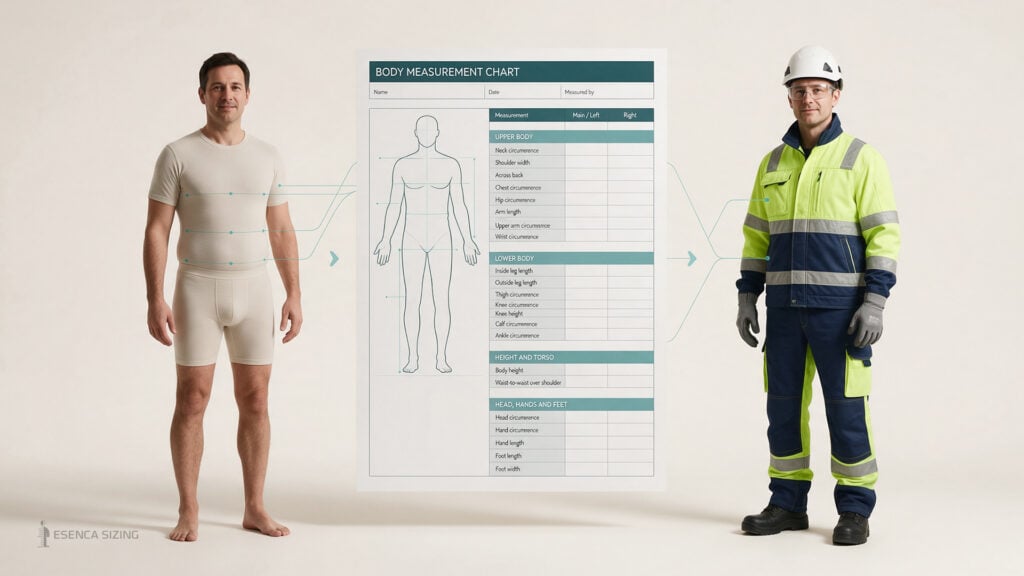
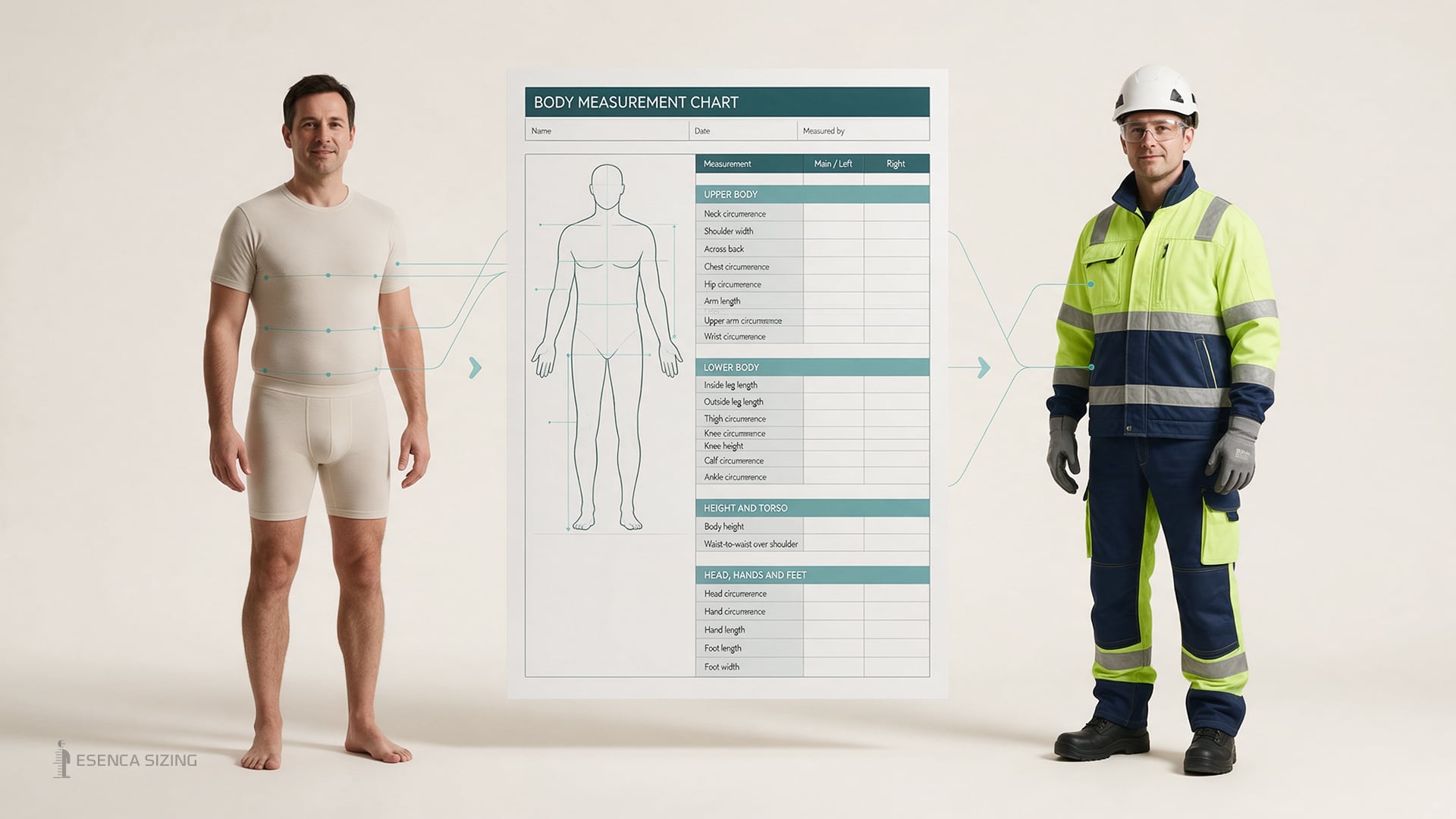
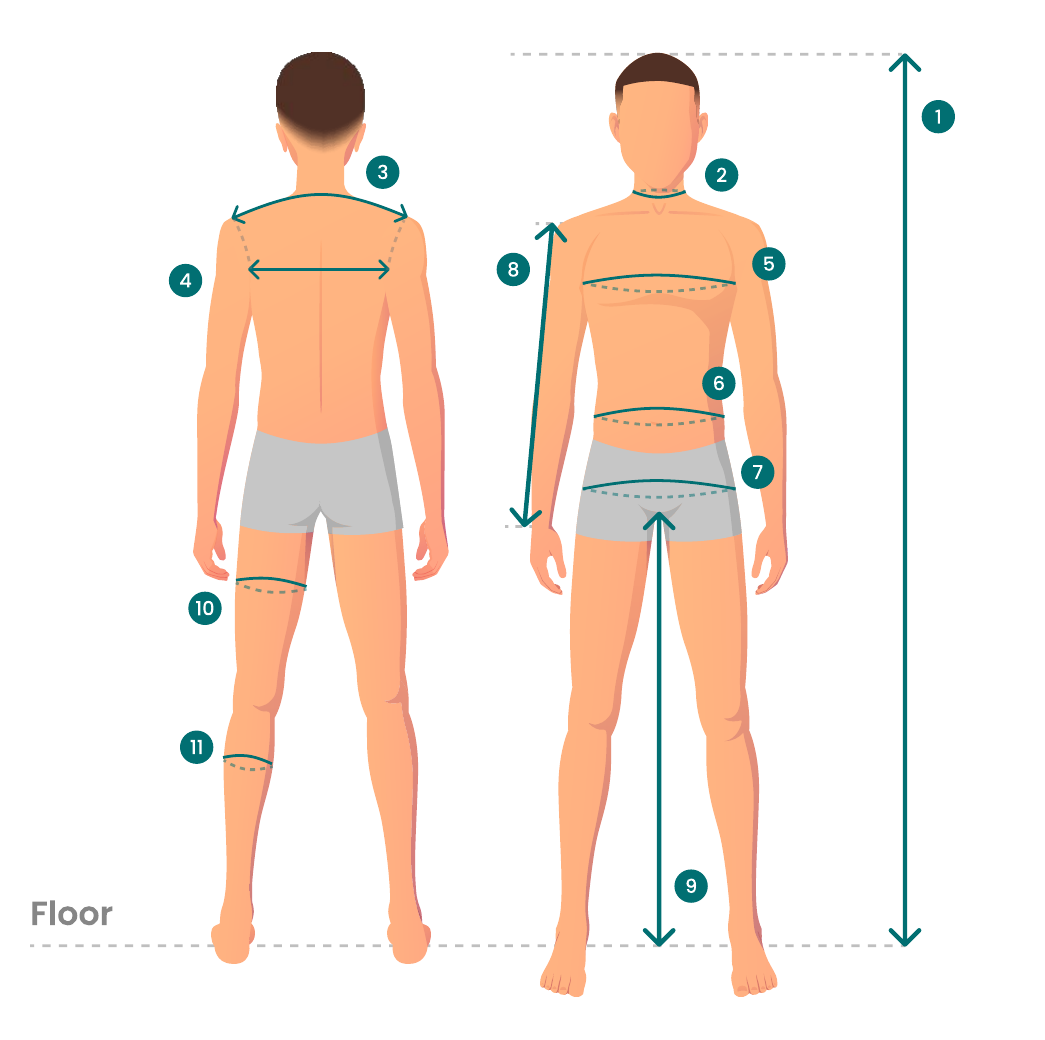
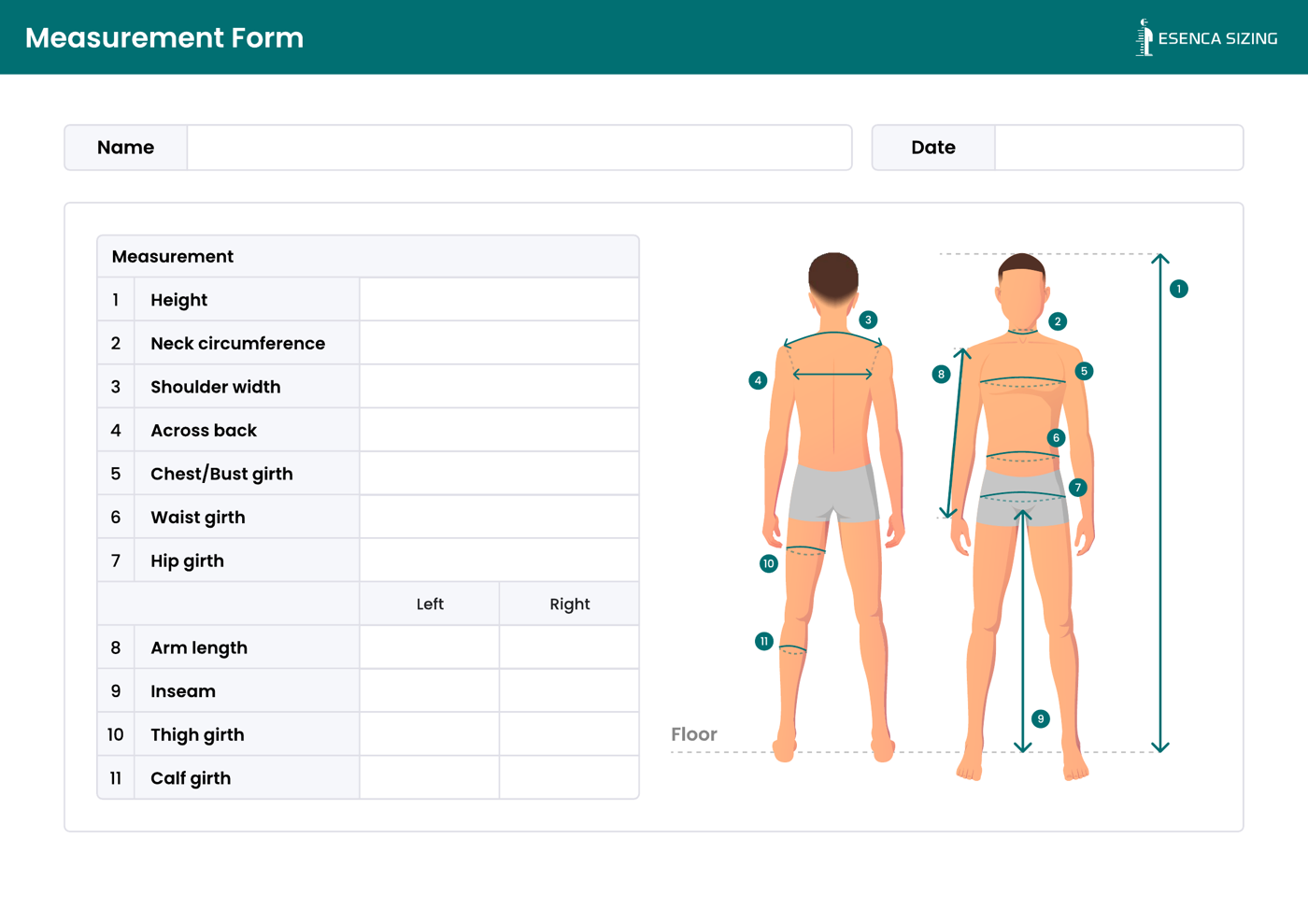
Each body measurement matters for some garments and not others. Chest girth sets a jacket size but tells you nothing about trousers. The table below is the working body measurement chart: twenty-one dimensions, where each one is taken, and which garments depend on it.
Most consumer size charts publish four or five of these. A body measurement chart for clothing in a workwear or PPE catalogue uses most of them, because a coverall, a glove and a boot each fail in a different place.
Body measurement chart: the core dimensions at a glance
| Dimension | Where it is measured | Garments it drives |
|---|---|---|
| Height | Floor to top of head, standing, without shoes | Everything with a vertical dimension: coveralls, trousers, jackets, one-piece suits |
| Neck circumference | Around the base of the neck, at the collar line | Shirts, collars, high-visibility vests, flame-resistant hoods |
| Shoulder width | Point to point across the back, shoulder tip to shoulder tip | Jackets, coveralls, scrubs, tailored outerwear |
| Across back | Between the rear armhole creases, at mid-armhole height | Jackets, coveralls, anything with a set-in sleeve |
| Chest or bust girth | Around the fullest part of the chest, under the arms | Shirts, jackets, coveralls, body armor, most upper-body PPE |
| Under bust girth | Directly under the bust, above the ribcage edge | Women's fitted garments, medical and compression tops |
| Waist girth | At the natural waist, the narrowest point of the torso | Trousers, skirts, aprons, harness-compatible garments |
| Hip or seat girth | Around the fullest part of the seat | Trousers, skirts, coveralls, bib-and-brace |
| Arm length | Shoulder tip to wrist bone, arm slightly bent | Sleeves on shirts, jackets, flame-resistant clothing |
| Bicep girth | Around the fullest part of the upper arm | Fitted sleeves, arm protection, flame-resistant clothing |
| Wrist girth | Around the wrist bone | Cuffs, glove gauntlets, sleeve closures |
| Inseam | Crotch to floor, along the inside of the leg | Trouser length, coverall leg length |
| Outseam | Waist to floor, along the outside of the leg | Trouser length, especially where rise varies |
| Rise | Waist to crotch, measured seated or from the inseam and outseam | Trouser comfort, squatting and climbing range, harness fit |
| Thigh girth | Around the fullest part of the thigh | Trousers, kneepad-compatible legs, compression garments |
| Knee girth and height | Around the knee, and floor to the middle of the kneecap | Kneepad pocket position in work trousers |
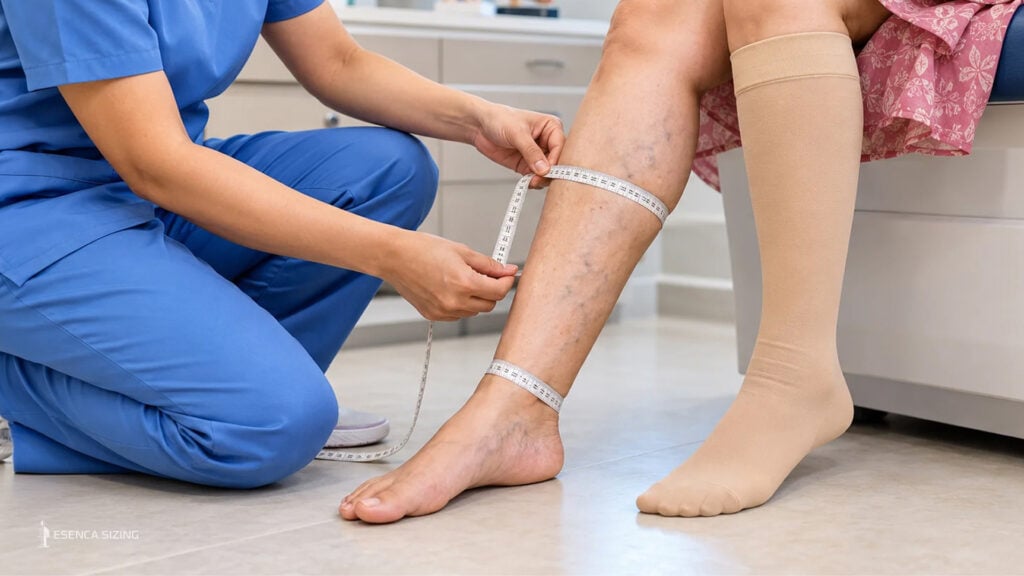
| Calf girth | Around the widest part of the calf | Boot shafts, compression stockings, waders |
| Ankle girth | Around the narrowest point above the ankle bone | Compression stockings, boot cuffs, trouser hems |
| Head circumference | Around the head above the brow ridge, at the largest circumference | Helmets, hard hats, caps, hoods |
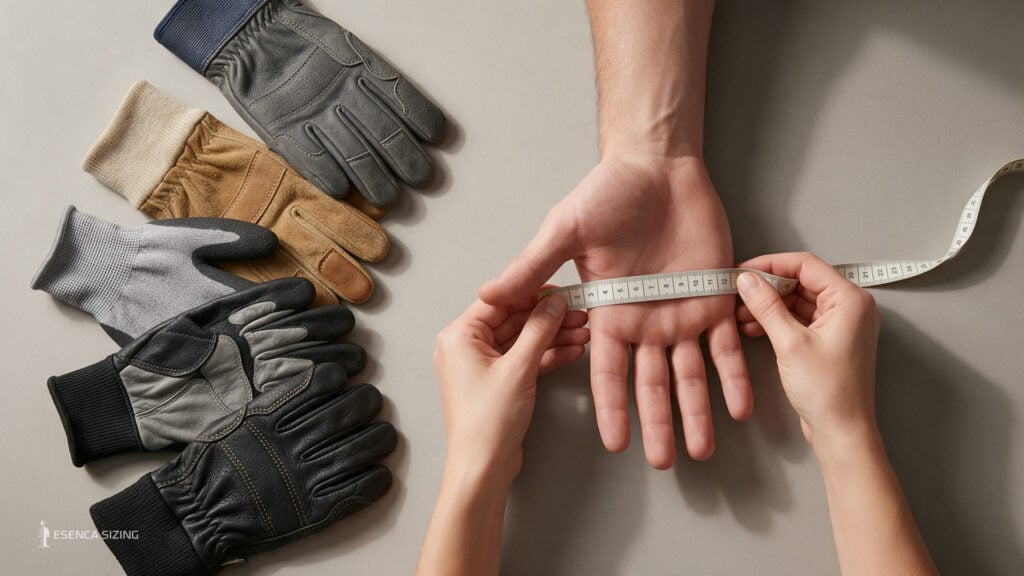
| Hand circumference | Around the palm at the knuckles, thumb excluded | Gloves of every category |
| Foot length and width | Heel to longest toe, and across the ball of the foot | Safety footwear, boots, insoles |
Primary vs secondary measurements: how sizing systems work
Control dimensions: why chest, waist, hip and height decide the size
Sizing systems run on a small number of control dimensions. Everything else adjusts the pattern once the size is chosen.
ISO 13688, the general requirements standard for protective clothing, puts it in writing. Clause 6 requires that protective clothing “shall be marked with its size based on body dimensions measured in centimeters”, and that the value “shall correspond to the actual value in centimeters of the user’s body dimensions”. Table 1 of the standard then names the control dimensions per garment type:
- Jacket, coat or vest: chest or bust girth and height
- Trousers: waist girth and height
- Coverall: chest or bust girth and height
- Aprons: chest or bust girth, waist girth and height
For most garments, then, the size label needs only two dimensions.
The same clause allows the manufacturer to “also designate additional measurements, e.g. the arm length, the inside leg length or the hip girth for women’s garments”. Because these extra measurements are optional, companies handle them differently.
Secondary dimensions: why they decide whether the size fits
The control dimensions get a wearer into a size. The secondary dimensions decide whether that size is wearable for a shift.
A coverall sized on chest girth and height can still be wrong in the rise, which is what stops someone squatting. A work trouser sized on waist and height can put the kneepad pocket above or below the kneecap, which makes the pad useless and the trouser uncomfortable. A jacket that fits across the chest can bind across the back, because across back and chest girth vary independently between people with the same chest.
The size label reveals none of these problems; they tend to show up later as complaints, returns or garments left unworn.
Why the same body falls into different sizes across companies
A labelled size describes one manufacturer’s grading, not a fixed body dimension. ISO 13688 fixes the units and the control dimensions and leaves the intervals open: the standard’s own note says the interval figures in its Annex D “should not be standardized”.
So, two catalogues can both comply and still put the same chest girth into different sizes. We documented the same mechanism in detail for gloves in our glove size chart article, where EN ISO 21420 publishes a reference size table and then permits manufacturers to use a different sizing system of their own if they explain it.
Upper body measurements
Neck circumference: shirts, collars, high-visibility vests
Taken around the base of the neck where a collar sits, with one finger of ease. Neck girth sizes dress shirts directly in many markets, and it drives collar closure on flame-resistant hoods and the neckline on high-visibility garments. It correlates loosely with chest girth, which is why shirts sized on chest alone produce collar complaints.
Shoulder width and across back: jackets, coveralls, scrubs
Shoulder width runs point to point across the back between the shoulder tips. Across back is taken lower, between the rear armhole creases. The two are different numbers and they fail differently: shoulder width that is too narrow drags the sleeve head inward, while across back that is too narrow restricts reaching forward. Both matter more in a coverall than in a shirt, because a coverall cannot ride up to compensate.
Chest, bust and under bust: tops, outerwear, medical garments
Chest or bust girth is the single most used control dimension in the chart, and it is also one of the harder ones to take consistently, because the tape must stay level around the back while sitting at the fullest point in front. Under bust is a separate measurement taken directly below the bust, and it is what distinguishes a garment graded for a range of bust shapes from one graded on bust girth alone. Medical and compression tops use both.
Arm length and bicep: sleeves, flame-resistant clothing, cuffs
Arm length is taken from the shoulder tip to the wrist bone with the arm slightly bent, because a straight-arm measurement comes up short once the wearer moves. Bicep girth sizes the sleeve, and it is the dimension that makes flame-resistant and arc-rated clothing fail: those fabrics do not stretch, so a sleeve that is tight at the bicep reduces the air gap the garment relies on.
Wrist girth sets the cuff size and matters where a glove gauntlet must overlap the cuff.
Lower body measurements
Waist and hip or seat: trousers, skirts, harness fit
The natural waist is the narrowest point of the torso. The trouser waist is wherever the garment sits, which for many wearers is lower. Charts differ on which one they mean, and the difference is easily several centimeters, so confirm which the chart is asking for before you record anything.
Hip or seat girth is taken around the fullest part of the seat. For anyone wearing a harness, the waist and hip readings also decide whether the harness sits on the pelvis or rides up onto the soft tissue above it.
Inseam, outseam and rise: trouser length and kneepad position
Inseam is crotch to floor on the inside of the leg. Outseam is waist to floor on the outside. Publishing both is useful because the difference between them is the rise, and the rise is what decides whether the wearer can squat, climb a ladder or kneel.
Kneepad position is a measurement problem that catalogues rarely address. A work trouser with kneepad pockets places the pocket by size, so two wearers at the same waist and inseam with different knee heights get pads in different places relative to the kneecap.
Thigh, calf and ankle: compression garments, boot shafts
These three are where ready-to-wear sizing breaks down fastest, because they vary independently of each other and of the waist. A wide calf with a slim ankle fits no standard band cleanly. Compression garments size on the ankle and calf circumferences directly, which is why the measurement method matters so much there. Our article on how to measure for compression stockings covers where the tape work goes wrong in that application.
Calf girth also determines whether a safety boot’s shaft closes. When it doesn’t, the boot usually gets the blame, even though the missing piece is the wearer’s calf girth.
Vertical and full-body measurements
Height and torso length: coveralls, bib-and-brace, one-piece suits
Height is a control dimension in ISO 13688 for jackets, trousers and coveralls alike. For one-piece garments the more useful number is torso length, taken over the shoulder from waist front to waist back, which the standard lists as “waist to waist over the shoulder length” for certain protective equipment.
Why coveralls fail on vertical fit before girth fit
A coverall is one garment spanning shoulder to ankle, so vertical error accumulates. Size up for a large chest and the crotch drops. Size down for a short torso and the shoulders bind. A two-piece suit absorbs that mismatch at the waist, where the jacket and trousers meet independently. A coverall has nowhere to put it, which is why a coverall programme that sizes on chest girth alone generates complaints about reaching and squatting, not about tightness.
Extremity measurements: hands, feet and head
Hand circumference and length: gloves
Hand circumference around the knuckles, thumb excluded, is the primary glove dimension. Hand length, from the middle fingertip to the base of the palm, decides whether the fingers of that size are right. Under EN ISO 21420 the numeric glove sizes step by one inch of circumference, about 25 mm, so a few millimeters of measurement error is a large fraction of a half size. Our post on hand circumference measurement accuracy covers how large that error tends to be.
Foot length, width and girth: safety footwear
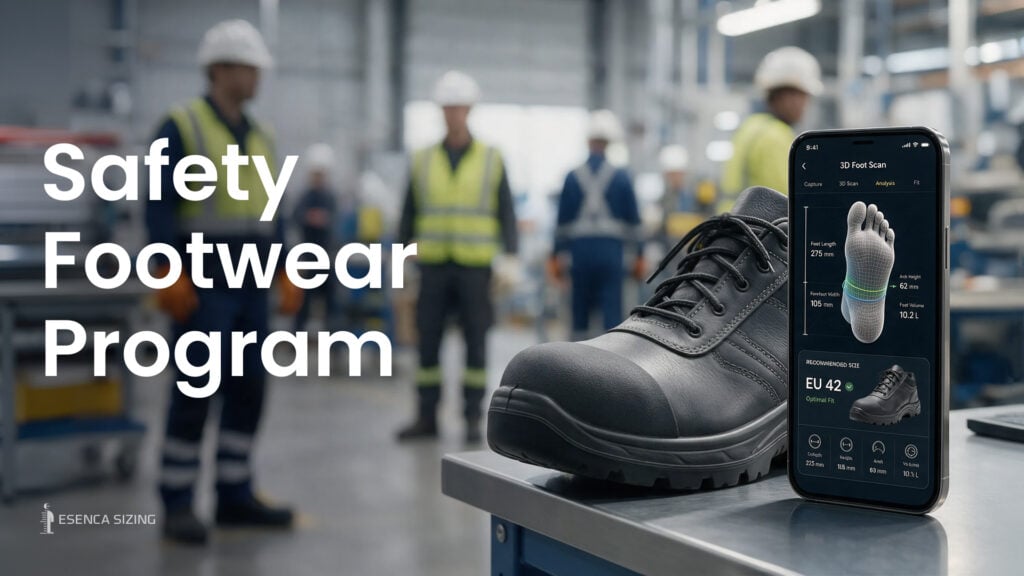
ISO 9407 defines the Mondopoint system, which designates footwear by foot length in millimeters and, where required, foot width in millimeters, written without the unit. A 280/110 marking means a 280 mm foot length and a 110 mm width. The same system uses a 7.5 mm length step for protective footwear, against 5 mm for casual shoes.
Length alone is not enough for a safety boot. Width and ball girth determine whether a toe cap sits over the toes or on them, and a steel or composite cap removes the give that a soft shoe has. Our safety footwear procurement guide covers how that plays out across a workforce.
Head circumference: helmets and hard hats
Taken around the head at its largest circumference, above the brow ridge and the ears. EN 397, the industrial safety helmet standard, requires each helmet to be marked with its size or size range in centimeters, on both the shell and the inside of the helmet. The number on that marking is a head circumference, so it is the one body dimension in this chart that is printed on the product in its raw form.
Body measurements for clothing: which measurements each garment needs
| Garment | Control dimensions | Secondary dimensions that decide fit |
|---|---|---|
| Shirt | Chest or bust girth, height | Neck girth, arm length, across back, waist girth |
| Jacket or coat | Chest or bust girth, height | Shoulder width, across back, arm length, bicep, waist girth |
| Trousers | Waist girth, height | Hip or seat girth, inseam, outseam, rise, thigh, knee height |
| Coverall | Chest or bust girth, height | Torso length, hip or seat girth, inseam, rise, arm length |
| High-visibility vest | Chest or bust girth | Neck girth, across back, waist girth |
| Gloves | Hand circumference | Hand length, finger circumferences, wrist girth |
| Safety footwear | Foot length | Foot width, ball girth, instep height, calf girth for shafts |
| Compression garments | Ankle and calf girth, leg length | Thigh girth, knee girth, hip girth for thigh-highs and tights |
| Scrubs | Chest or bust girth, waist girth | Shoulder width, hip girth, inseam, arm length |
| Airline and military uniform | Chest or bust girth, waist girth, height | Neck, shoulder width, arm length, inseam, hip girth, head circumference for caps |
Men's and women's body measurement charts: how they differ
A men’s body measurement chart and a women’s body measurement chart differ in more than scale: some of the landmarks are different. Chest girth is taken at the fullest part of the chest. Bust girth is taken at the fullest part of the bust and usually paired with an under bust reading. The natural waist sits higher on most female bodies than the point where a trouser waistband rests, so one word describes two different heights depending on which chart you are reading.
Hip girth carries more weight in women’s grading, which is why ISO 13688 names it specifically as an additional measurement for women’s garments.
PPE programmes often get this wrong. A women’s range built by scaling a men’s block keeps the men’s proportions and shrinks them, so the garment is tight across the hip and loose at the waist, the shoulder sits wide, and the rise is short. The wearer reports that nothing fits, yet no single measurement explains why, because the problem lies in the ratios between dimensions.
How to take body measurements: tape, booth scanner and smartphone
When taking body measurements by hand, three rules account for most of the accuracy: keep the tape level and perpendicular to the body, keep tension consistent and light enough not to compress soft tissue, and take each reading three times and use the middle one. Measure over underwear or close-fitting clothing, and record which it was.
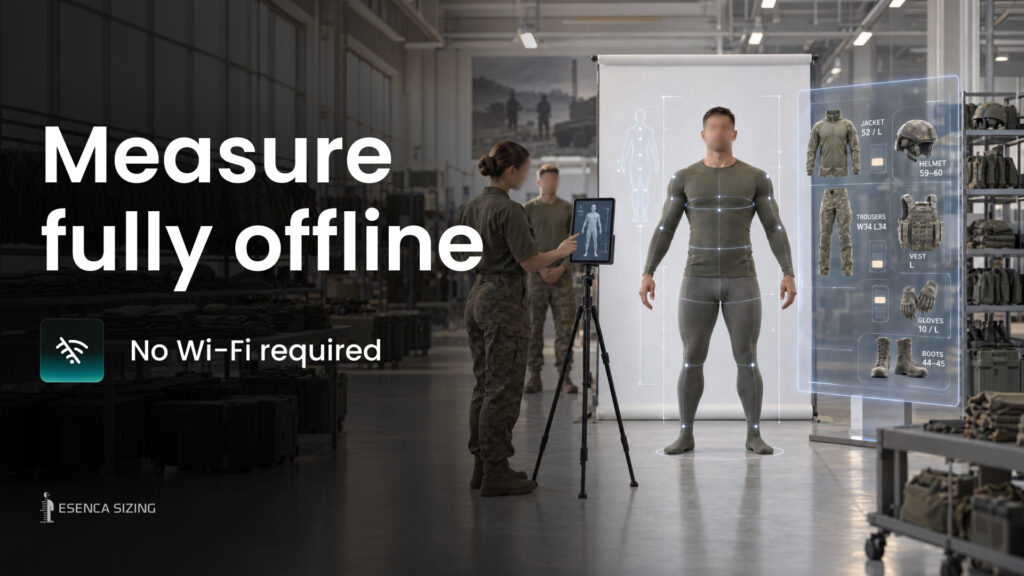
A booth scanner removes operator variability and needs the person to come to it. A smartphone capture keeps the repeatability and travels to the person, which is what makes it workable across sites.
Esenca Sizing ran two validation studies against stationary 3D scanners in October 2026. In the first, 99 general-population subjects were scanned five times each, giving a mean absolute percentage error of 2.23% at the chest, 2.33% at the waist, 1.12% at the hip, 1.10 to 1.17% at the thigh, 0.97 to 1.04% at the calf and 1.06% on the inseam. In the second, run by a client on 147 participants with lymphoedema or lipoedema and seven scans each, the figures were 1.37% at the hip, 1.22 to 1.25% at the thigh, 1.19 to 1.35% at the calf, 1.10% on the inseam and 1.31% on foot length. Repeatability standard deviations across both studies ranged from 0.16 to 0.89 cm.
The spread across dimensions is the important part. Chest and waist, the two control dimensions that ISO 13688 puts on the label, are the least accurate measurements in the set. Hip, thigh, calf and inseam sit around 1%. Any supplier quoting a single accuracy figure for a whole body is averaging over that spread, so ask for a breakdown by dimension, like the one above.
See the Body Pro page on smartphone body measurement for how the capture works or ask us for the full validation report with the reference method and sample composition.
Printable body measurement chart template (free PDF)
A printable body measurement chart template is available as a one-page sheet. It lists every dimension above in measuring order, with space for both sides of the body, the date, the measurer’s name and whether the reading was taken over clothing.
Frequently Asked Questions
What measurements do you need for clothing?
For most upper-body garments you need chest or bust girth and height. For trousers you need waist girth and height. Those are the control dimensions ISO 13688 requires on protective clothing labels. Arm length, inseam, hip girth and neck girth are what decide whether the chosen size fits.
What are the most important body measurements for sizing?
Chest or bust girth, waist girth, hip girth and height. Those four place almost anybody into a size on almost any chart. They do not tell you whether the garment will be comfortable, which is what the secondary dimensions govern.
How many body measurements are there?
There is no fixed number. A consumer size chart publishes four or five, the chart above lists twenty-one, a tailored suit uses around twenty, and a made-to-measure or anthropometric study can run past a hundred. The useful question is which dimensions the specific garment is graded on.
What is the difference between body measurements and garment measurements?
A body measurement is taken on the person. A garment measurement is taken on the finished product laid flat. The gap between them is the ease the designer built in, and it varies by garment, fabric and fit intent. ISO 13688 requires size labelling to use the wearer’s actual body dimensions in centimeters, which is why mixing the two produces consistently wrong sizes.
How often should workforce measurements be updated?
Re-measure on joining, when someone reports a fit change, and on a cycle that matches your issue schedule. Body measurements for clothing drift with weight change and age, and a measurement file three years old produces returns that look like a sizing problem when the data is simply out of date.